Showing posts with label public health. Show all posts

2016-06-03

Notable Quotes #5: On Cycling, from the People's Common Sense Medical Advisor c. 1918


If one were asked what athletic exercise deserves to be brought back into popularity in America today, the answer would of necessity be cycling. The bicycle's hygienic value as a means to healthy exercise cannot be overestimated. In this, as in everything else, immoderation is to be condemned, particularly where persons have not had sufficient training to take long "spins,' or attempt racing. Beginners should ride only 10 or 12 minutes at a time -- resting then to permit the circulation to become equalized. In all cyclists, at all ages, in veteran riders as well as those not practiced in the art, there is, in the beginning of each attempt, a quickened circulation; the pulse is full and bounding, and rarely falls under a hundred pulsations per minute. So long as the exercise is continued, an increase of cardiac motion is observable, and a vigorous circulation is kept up. This accounts for the astounding journeys a fully trained cyclist can accomplish, and also for his endurance without sleep. In spite of the quickened motion of the heart, rarely have riders been known to grow giddy or show symptoms of cardiac embarrassment. A good rider may climb a flight of stairs without breathlessness and palpitation. Bicycle riding as a means for acquiring strength and vigor, improving the circulation and developing the respiratory organs, is excellent. Fast riding, or "scorching," among those not used to physical exertion, and leaning over the handlebars so as to ride in a stooping position, are to be heartily condemned. The latter prevents the lungs from getting their full expansion, and cultivates a tendency to round shoulders. Men or women suffering from diseases of the sexual organs should not ride.

2016-01-07

The Gas / Pop Metaphor

[Bendy tubes.]
"If you like cheap gasoline, this January is the month for you!" says the headline this morning.*

The framing reminds me of the recent Marathon gasoline advertisement, and its unforgettable bluegrass jingle: "With a full tank of freedom, find your own highway, we'll take you wherever you go."

The ad features magic American flag fumes, nostalgic images of gas pumps, and a close-up of a young white woman sipping the straw of a big cup of soda.

[Mmmm. Good ol' pop 'n' gas.]

[Ouch.]
The mistake that we make in framing articles about "people who like cheap gasoline" is to think about gasoline as a consumer choice. Sure there are "types" of gas -- high and low octane, I suppose. And maybe in some earlier era, when gas was young, there were differences between gas companies.

Filling your car with gasoline is like paying your taxes. Everyone hates doing it, everyone must do it.** It's not a choice, it's a curse.

The other side to the metaphor is that both gasoline and soda pop are 20th century mass market productions tied deeply to vast cultural and material infrastructures. Both the gasoline in your tank and the corn syrup that's the #1 ingredient in a big gulp rely on cheap energy, exploiting vast acres of land, shady conglomerates, and heavy government subsidies. And for both, these pernicious supply lines are hidden behind a patriotic, nostalgic, and shiny façade.

[Billions of dollars and lifetimes of work to convince us there's a difference.]

[From the NYC soda pop wars of 2013.]
And both gasoline and soda pop are terribly bad for your individual health. For a long time our culture was willfully naive about the effects of cheap pop, putting machines in schools or making the "super size" option a default choice. But then diabetes began sweeping the nation like a bad dance trend, and a few places began pushing back. There's a long way yet to go.

And apart from cigarettes, the only thing worse for you than soda pop is gasoline. Even if you don't drink gasoline -- and don't drink gasoline -- driving everywhere keeps hundreds of millions of Americans from getting any exercise in their everyday lives.

It would be nice if we stopped talking about "people who like cheap gas." For most people, gasoline isn't a question of taste. It's simply the most visible piece of an environmentally destructive transportation system that desperately needs reform.

Gas isn't pop. Gas isn't fun. It's a boring bad habit.


[Only an idiot has fun at the gas pump.]


* It's another article about gas prices, and articles about gas prices are about as useless they come. Never once do any of them mention tax structure, subsidies, or global oil markets. To simply report the price of gas is like reporting on the blowing of the wind. You might as well be an inanimate sign.

** PROTIP: Once you get rid of your car, you never buy gas any more.

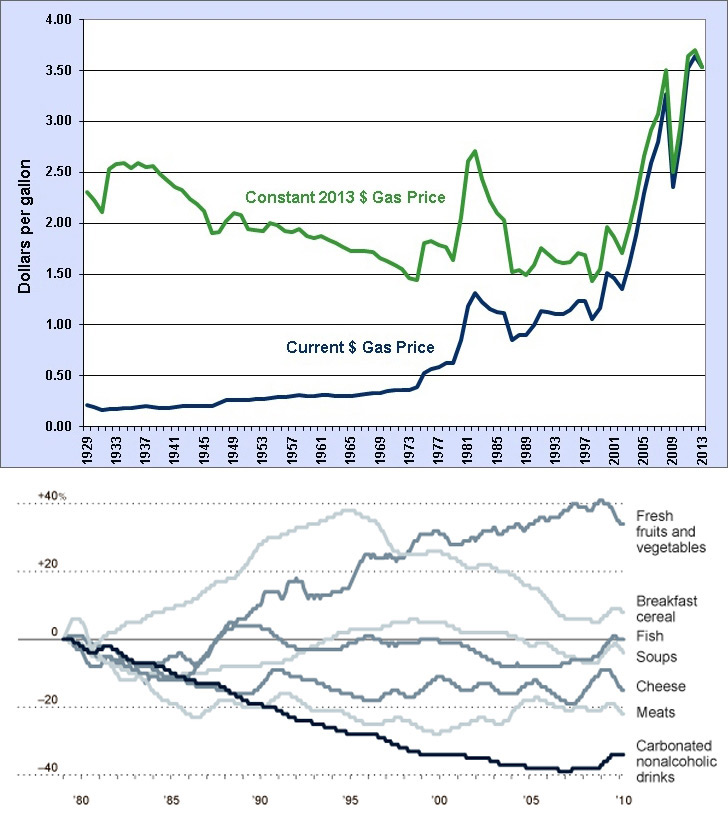
[Pop has gotten cheaper, gas more expensive.]

2015-06-16

In Saint Paul, Bikes Lanes are the New Smoking Ban


[Nice Rides are only as useful as the lanes that connect them.]
There’s a sometimes harshly worded debate going on right now in Saint Paul over the future design of Cleveland Avenue, whether or not it should have bike lanes and/or on-street parking. (The exact design depends on where you’re talking about.)

You can read some of the comments on the discussion, taking place on Open Saint Paul, on streets.mn, on this blog, and in the newspapers, emails, and voicemails of Saint Paul’s elected leaders.

Here are a few representative samples that capture, I think, the heart of the issue, i.e. how moving parking spaces will hurt business versus how creating safer streets will improve access for bicycles.

Try this one, from an article on streets.mn:
The fact that business owners are losing their minds over this is disappointing but not unexpected. Small proprietors operate on shoestring budgets usually, so any change is perceived to be potentially catastrophic. It’s not a rational response, but an understandable one.

[...]  As a dad who carts his kids around sometimes by bike, but sometimes by SUV…I’m just so annoyed by the trite “think of the mom in the van” garbage.

Or this one, from a different article on streets.mn:
The owners of the building/barber shop/other stores clearly CLEARLY perceive the lose of parking as a threat to there business. If the bikes lanes were a boon to their business, they would feel the opposite no?

But the more the argument goes on, and the more histrionic it becomes, the more I’m reminded of the 2006 rhetoric surrounding the city’s smoking ban, which disallowed smoking in bars throughout the city. At the time, many small business owners (primarily bar owners) claimed that the smoking ban would kill their business. Despite the pressure, the City Council (led by CM Thune) insisted that the effects of second-hand smoke outweighed the potential economic impacts on some businesses. It was the right thing to do.

[Richard Jackson, the guy who wrote the book on public health and urban design, speaking in St. Paul a month ago.]


Cars are the New Tobacco

[Not just a metaphor.]

Just like Saint Paul is a healthier city without smoky bars, it will be a healthier city with bike-friendly streets. And what’s more, unlike the Nazi analogy, this comparison isn’t an exaggeration.

Here’s some of what I wrote on the subject back in 2013:
Now that smoking rates have declined, the new #1 public health risk in the US and UK is the automobile. [...]
But let's keep the metaphor going. If cars are the new tobacco, what would be a public health solution for the deadly automobile? What if we treated cars like we did cigarettes? What if we used all our anti-smoking tools and waged a public health campaign against cars? [...]
We would acknowledge the harms of second-hand cars. Just like with smoking, cars don't just harm those who use them. Even people who choose not to use cars, who kick their car-dependency, are forced to deal with 'second-hand cars' as they try to walk or bike around the city. Eventually, our society would recognize these harms, would try to come up with rules for limiting the danger of second-hand cars.

Last month, city leaders gathered to celebrate the idea of using urban design to solve a very real public health crisis that finds America in general, and Saint Paul in particular, suffering from a whole string of health problems. Tobacco use is no longer the #1 public problem we face as a society; lack of physical activity has taken its place as a driver [sic] of long-term health problems.

At the time, the solutions garnered headlines. But as I wrote at the end of in my piece on Minnpost, "talking about a healthy city is certainly nice, but the true test will come when road construction begins this summer."

Well, now’s when the rubber meets the road. And so far, it doesn't look good.

[The circled statement is just plain wrong.]

Seeing the Big Picture

[This guy would really like to light one up.]

I’m sure the smoking ban did hurt some businesses in Saint Paul. The giant cigarette mural on the outside wall of Costello’s Bar (one of the most vocal opponents of the ban) has been replaced by a (socially inferior, in my opinion) quasi-chain burger joint from Edina. And to this day, Mayor Coleman is not allowed inside the Gopher Bar (if he ever was), which clings on for dear life serving the city’s best coney dogs in a changing corner of downtown.

But sometimes moral issues should outweigh unknown economic impacts, and implementing the city-wide bike plan is the clearest way to actually achieve the goals that city leaders set out during their gala dinner last month.

Looking back at the smoking ban issue, it’s hard today to find people who don’t see Saint Paul as a better place now that smoking has been banished to sidewalks, alleys, and occasional patios. If we implement the bike plan, starting with Highland Park’s main street, years from now I’m confident that the vast majority of people in Saint Paul will look back and wonder what the fuss was all about. We’ll be living in a city that made it easier to get active when we’re young, stay active in our old age, and get around without exacerbating our already-stressed roads and parking lots.

I understand the reluctance of business owners to take risks. Our city's small businesses struggle to make a living in a country where the game is rigged in favor of chains and corporations. But it shouldn’t be too much to ask that businesses work to help bring a healthy city to life. And just as our leaders boldly did the right thing back in 2006, they should prioritize the big picture here too.

I'm sure that no Saint Paul City Council Member wants to take the kind of abuse that CM Thune received ten years ago. But I'm also sure that if you asked him today, he'd say that he did the right thing. And he'd make the same decision every time.

The smoking ban didn't kill small business in Saint Paul. On the contrary, bars, restaurants, and nightlife are thriving, and almost everyone is better off. Implementing the bike plan is exactly the same kind of issue, a moral question where putting health and safety first is the right thing to do.

[Three Saint Paul smoking ban protests: from Mike's Bar, Costello's Bar, and the Gopher Bar.]


Update:

Oh, I almost forgot. The public hearing is tomorrow!
As the first proposed projects since the passage of the Bike Plan, it’s important that these projects succeed. For Cleveland and Front specifically, there has been a lot of concern raised about the loss of parking. Even if you don’t live in these neighborhoods, elected officials need to hear from you.

Lexington, Cleveland, Front Public Hearing
Wednesday, June 17 at 5:30 PM 
City Hall: 15 West Kellogg Blvd, 3rd Floor Council Chambers

Learn more!
Lexington: http://stpaul.gov/index.aspx?NID=5691
Cleveland: http://stpaul.gov/index.aspx?NID=5690
Front: http://stpaul.gov/index.aspx?NID=5692


2013-02-12

If Cars are the New Tobacco...

A while back, my attention was arrested by a public health article titled "Are Cars the New Tobacco?" It was in the Journal of Public Health, written by a bunch of researchers from the UK. It basically argued that, now that smoking rates have declined, the new #1 public health risk in the US and UK is the automobile. Here's their main thesis:
This paper argues that private cars share many characteristics with tobacco and could be regarded as the archetypal ecological risk. Like tobacco, cars harm the health of users and others. Moreover, cars damage global sustainability. Like tobacco, car use is seen as an individual choice and policy responses to limit it are resisted by a powerful industry lobby. But it is over-simplistic to view car use as a simple behavioural choice. This paper will argue that the use of private cars reflects and reinforces the physical and social environment that we have created, and that an ecological approach is needed to understand and address the harms caused by car dependence.

In one sense, this is nothing new. Public health professionals have been warning for years about the dangers of automobile-dependent lifestyles. Books like Urban Sprawl and Public Health, or Health and Community Design argue convincingly that the car kills people in many ways, large and small. Cars kill not just by running someone over in a crosswalk, but through their invisible asthmatic particles, and by cultivating a culture of rapid immobility, where nobody walks except to and from the garage. Cars are the new tobacco.

But let's keep the metaphor going. If cars are the new tobacco, what would be a public health solution for the deadly automobile? What if we treated cars like we to cigarettes? What if we used all our anti-smoking tools and waged a public health campaign against cars?   

Here's what I imagine:

Cars would come with warning labels. Right on the trunk perhaps, or on the dashboard. It might say, "Warning: Operating this Vehicle is Hazardous to Your Health. Continued Daily Operation of this Machine will Make you Fat and Lazy, and Create an Instinctive Fear the Outside World. Reliance on this Machine will Increase Chances of Heart Disease, Obesity, Diabetes, and an Early Demise."

We would ban car advertisements on television. Direct marketing of this deadly product to consumers, particularly the young, would be seen as immoral and made illegal. There would be no more car commercials, tempting people into BMWs and SUVs that promise impossible freedoms. 

We would condemn auto industry lobbyists. Anyone who took one of these jobs, representing a car company in DC or the state capitol, would be treated like the proverbial leper. It would be right up there with the gun lobby or the nuclear weapons industry: about as low as you can go.

We'd start to institute car taxes, special levies on cars designed to make people using cars pay the whole cost of their health impacts. We might even call these "health impact fees." Eventually, filling your tank with gas would be tinged with guilt and failure, with the feeling of knowing that you were doing something bad for your body and for your city. People driving cars would slowly become defensive and bitter, making everyone a tiny bit sadder.

We would acknowledge the harms of second-hand cars. Just like with smoking, cars don't just harm those who use them. Even people who choose not to use cars, who kick their car-dependency, are forced to deal with 'second-hand cars' as they try to walk or bike around the city. Eventually, our society would recognize these harms, would try to come up with rules for limiting the danger of second-hand cars. Which would lead to...

Cities having separate car and non-car sections. Just like how restaurants used to have smoking and non-smoking sections, cities would be separated into car and non-car areas. For car-users, they would have their clogged and dirty streets, but for the rest of the non-car citizens, the dangers of second-hand cars would be eliminated. They'd be allowed to stroll their streets in peace, free from the health effects of the automobile. 

Eventually, as people got used to the healthy car-free city, we'd kick our car habit for good. Cities, then entire countries, would institute bans on cars in public places. As we looked back on the earlier era of car commercials and car-inducing regulations, it will seem as ridiculous as old 50s cigarette advertisements, the ones with the doctors in the white coats declaring Winston's to be the healthy choice. Eventually, the car-dependent era will be seen as an aberration, an odd moment in history before people came to their senses.

If cars are the new tobacco, why not?


2012-02-10

Talk Today -- Julian Marshall, 3:30 U of MN, West Bank

If you're around the University of Minnesota campus this afternoon, the Geography Department is hosting a good talk as part of its weekly coffee hour series. The speaker is Julian Marshall of the Department of Civil Engineering.

Here are the details: 

Urban Sustainability:
Design of Clean, Healthy Cities

Prof. Julian Marshall, Dept of Civil Engineering, UMN

The physical design of neighborhoods and cities can impact human health and the environment, including via pollution exposures, exercise levels, and daily travel patterns. This talk will explore the impact of urban design on air pollution emissions and exposures, physical activity, and public health. It will also discuss approaches for understanding and improving environmental justice. Results focus on quantitative analysis of national and international data, as well as case studies locations (Minneapolis; Los Angeles; Vancouver, Canada).

Time: 3:30 PM–4:30 PM, Friday, 10 February 2012.
Location: John S. Adams Community Room (Blegen 445), Department of Geography

Coffee and snacks starting at 3:15 PM. Sponsored by the UMN Geography Department.

If you decide to attend, say hello! I'll be the dorky looking person with black glasses and a grey cardigan.

[Collage!]

2011-09-22

Goldy's Frequently Asked Questions about Riding your Bike at the University of Minnesota


Hey Kids! Dismount and push your NiceRide and you'll get big strong arm muscles like me!


[Oops! Looks like you broke the law! That'll be $115.]
FAQ: Hey! I just got a $115 ticket for riding my bicycle on campus! What the hell?

Goldy Sez: Hi there student! I’m Goldy Gopher, your Official Parking and Bicycle Ambassador. Welcome to the University of Minnesota, one of the top three public research universities in the Western Half of the Big 10. We’re glad you’re here!

FAQ: No seriously, what the hell? This sucks!

Goldy Sez: The University of Minnesota loves bicycles! We just want to make sure you’re safe. Bicycles are very dangerous! You can fall off them really easily. They don’t even have seat belts or airbags. One time a rogue student on a bicycle dangerously brushed the shoulder of the Vice-President of Parking and University Relations. He was so upset he almost forgot to raise your student fees! One time I saw a bicycle rider who didn't come to a complete stop at a stop sign on campus. Seriously! I saw it with my own eyes, swear to Dog.

FAQ: How can I get a $115 ticket for biking to class?

Goldy Sez: Oops! Looks like you were in the new “Bicycle Dismount” area, a new Golden Gopher program that keeps everyone safe and secure so that all of us can learn valuable research knowledge in safety and security. My friends at the Department of Parking and Sign Placement Services have clearly marked the areas where bicycles are not allowed by placing tiny gold signs at random places around the school.

["Hello Officer Friendly!"]
So I asked my friends at the Office of Parking and Policing Services to hand out “incentives” for rogue students who are breaking the law. Looks like you were breaking the law! You’re a dangerous criminal!


FAQ: I was going 3 miles per hour! There weren’t any signs at all.

Goldy Sez: My friends at the Department of Parking and Tiny Signage Services have clearly marked the areas where bicycles are not allowed by placing tiny gold signs at random places around the school. Here’s a helpful map of the Bicycle Dismount zones on campus. See, its easy! Go-pher-it!


FAQ: WTF is that? How am I supposed to get to class?

Goldy Sez: We love bicycles at the University of Minnesota! We recently received a Silvery ranking from the League of American Bicyclists. We’re bicycle friendly!

Just don’t ride your bicycle anywhere on campus, please. It’s not safe! We don’t want you to fall and hit your Golden Gopher head!

That's why we've initiated a new safety procedure where we're marking the pavement with helpful signs letting you know that "the pavement is hard."

[The UMN's innovative new warning label for pedestrian safety.]
It's like when I went to McDonalds that one time and spilled hot coffee all over myself. I burned my fur! They should really put a warning label on those cups! They're very dangerous.

If you need to get to class, we have many conveniently located parking garages where you can park your car, including a large seven-story ramp right next to the Office of Parking and Transportation Services.


FAQ: Hey Goldy. Go to hell! [Attacks Goldy with textbook.]

Goldy Sez: Eeek! [Runs into “The Gopher Way," the tunnel system hidden underneath the campus,  disappearing into the safe safe darkness.]

[A helpful new sign informing people to walk their bicycle. Note the absence of a $115 fine warning.]

[A criminal breaking the law and endangering innocent pedestrians.]

[If you get one of these NiceRide bikes, be sure not to ride it. You're right next to a "Dismount Zone!"]
FAQ: Hi Goldy. What’s that neon green bike thing that’s parked outside my building? It looks cool.

Goldy Sez: Hello friend! That’s the NiceRide bicycle share program. The University of Minnesota is a proud partner of the NiceRide program. We’re excited to encourage new gophers to ride bikes around the large and sprawling campus of the University of Minnesota. Why not give NiceRide a try! Bicycles are good for you and good for the planet. And they’re fun, too! As my friend Tony the Tiger says, they’re grrrrrrrreat!

Oh, I almost forgot! Please dismount and push your bike when you’re on campus. It’s just not safe.


FAQ: What?!

Goldy Sez: Try our new NiceRide program! Bicycles are great for you, and great for the planet. Exercise boosts your Gopher health, improves your Gopher mood, and helps prevent Gopher heart disease! It’s gopher-tastic!

Don’t forget to dismount and push your bike on campus! 

Just remember One – One – Five! That’s how much money you’ll pay Officer Friendly if he catches you breaking the law and dangerously riding your bike on campus!

FAQ: WTF Goldy? Have you been messing around with the tubes in the Chemistry labs again?

Goldy Sez: No. [Giggles.] Gopher Gold… Coach Kill Coach Kill! Sky – U – Mah! [Giggles again.] Ow! Ow! I’m being run over by a bicycle! Help! [squeals, falls over]


[One of the many great bike lanes on the University of Minnesota campus.]
[A criminal bicycling on the incorrect side of the sidewalk.]


FAQ: Goldy... A friend of mine was killed by a truck at the University of Minnesota this summer while she was in a bike lane, biking to class. But I was over there the other day, and the bike lane is still not fixed. It’s nearly invisible.  Why haven’t you fixed this?

Goldy Sez: Oh no! That’s terrible! I told you bicycles are dangerous. Was she wearing a helmet?


FAQ: [Silence.]

Goldy Sez: Don’t worry, though. We’ve painted some other completely different parts of campus with new green paint. Just don’t ride your bicycle anywhere near the office of the Vice President of Parking and University Administration Services, because that’s a “Dismount Zone.” Oh, and look out for trucks! You might think about walking in our safe tunnel system instead. It’s the “Gopher Way.”

[Officer Friendly parking his car on the pedestrian mall, and making sure that vehicles don't obstruct pedestrian rights of way.]
[One of the many places where its illegal to ride your bike despite the nearby presence of a bike lane or a NiceRide kiosk.]

FAQ: Hey Goldy. It’s me again. I have to get to class on the East Bank. Class starts in 10 minutes. Where can I ride my bike where I won’t get a $115 ticket from the cops?

Goldy Sez: Here at the University of Minnesota we love bicycles! Thanks for riding your bike and doing your part to reduce pollution, and be a healthy gopher!

We’re working on a groundbreaking new bicycle plan. We were recently given a Silver ranking by the League of American Bicyclists. We love bikes!

FAQ: Just tell me where I can ride where I won’t get a ticket.

Goldy Sez: Gophers love bicycles! Soon our new Bicycle Center will be complete. It’s conveniently located in a large parking ramp right next to the I-94 on-ramp. Go Gophers! It has everything you need to ride a bike safely and without killing innocent Gophers with dangerous speeding bikes.

FAQ: Where am I supposed to ride? I can’t pay a ticket! Now I have to go to Hennepin County court and contest this damn thing. I’ve been on hold for 30 minutes with the county court clerk trying to get a hearing so that this stupid ticket will be thrown out. Where can I ride?

Goldy Sez: Have you tried our Campus Connector! Here at the University of Minnesota we have a wonderful system of large diesel buses that can take you quickly and safely to wherever you want to go.  Bicycles are very dangerous speeding out of control. Safety is easy, pavement is hard!

FAQ: Screw you, Goldy. [Takes off on a beatup mountain bike.]

Goldy Sez: [Shouting, voice echoing off of the walls of the Northrup Hall Parking Ramp.] Don’t forget to please remove your hat! According to the University of Minnesota fight song, all Golden Gopher students have to take their “hats off to thee” while they’re on campus. My friends at the Office of Parking and Headwear Services have put new “hats off” signs conveniently around campus, to show you where our new “Hats Off Zone” is going to be. Just remember "One – One – Five!" That’s how much you’ll have to pay if Officer Friendly sees you wearing a dangerous ballcap in a “hats off zone.” You could poke somebody’s eyes out!...


[Before becoming the official University Parking and Bicycle Ambassador, Goldy was the drummer for the house band at Showbiz Pizza until he was kicked out because of substance abuse and missing a few key gigs.]


2011-06-15

Three Great Things about the first ever Open Streets Minneapolis

The first ever Open Streets Minneapolis was this weekend, along Lyndale Avenue from 10:00 until 2:00pm. And despite similarities to art fairs or bike tours or Grand Old Days, it also seems to me something quite new for the Twin Cities.

The idea behind Open Streets comes (rather surprisingly) from Bogota, Colombia, where the mayor created a day for cycling and exercise by removing cars from one street in the city. And as cycling and complete streets movements have spread, cities throughout the US have copied Bogota, from Portland to San Francisco to Tuscon and Missoula.

Finally, this last Sunday, after a lot of hard work and many meetings with city officials, Open Streets came to the Twin Cities. For me, it was like a dream come true. And here are three reasons why I enjoyed those four hours on Lyndale Avenue on Sunday...

#1 Open-ended purpose

The idea behind Open Streets is deceptively simple. It's just the removal of cars from a street. There isn't any “point” to the event. It's not about art or music or food or a festival or a holiday. Nobody is telling you what to do!

Instead, people were allowed to enjoy the car-free street in any way they liked. And so you got a real diversity of folks using Lyndale Avenue on Sunday, from sidewalk lemonade stands to skateboarders to dog walkers to strolling shoppers to sidewalk cafe coffee drinkers. But most of all, you had many many different kinds and ages of folks on bicycles just going up and down the street enjoying a nice day.

There wasn't any requirement or theme or purpose, but just an open space, the simple removal of the normal street clogging traffic. The Open Street was simply an opportunity for something new. And it was up to each person to use the street's space in their own way.

[A walker, two folks with a dog, a skateboarder and a photographer enjoying Lyndale Avenue in a new way.]

[A street musician and some cyclists on the South end of the avenue.]

[Group yoga in the street was one of the more eye-catching events during the day.]

#2 Shows that bikes can be good for business

Anytime you try to add a bike lane or install a road diet, one of the bigger hurdles is often the business community, who have long assumed that the only way to get more business in the door is through increasing traffic on the street and improving access to parking spots. Connecting car traffic and revenues makes sense, after all. It's how our urban economies have been designed and built and have operated for 50 years, so that the top three concerns of most business owners are free parking, more parking, and easy access to parking. It means that any time you start talking about reducing traffic lanes or removing surface lots, you're fighting an uphill battle.

Well, during Open Streets everything is different. Lyndale Avenue was designed for crowded streetcars and strolling pedestrians, not for the auto age. I'm sure that most shops along the street were doing gangbuster business during Sunday, and what the Open Streets proved was that bicycles and traffic calming can be good for business too.*

[A small entrepreneurial person operating one of the many lemonade stands up and down Lyndale Avenue on Sunday.]

[A decorated boneshaker.]

[One of the weirder experiences was biking up to a cop at a red light and having them wave you through the intersection with friendly courtesy, while halting a long line of impatient car drivers who had the green light. Completely surreal!]

#3 Changing bodies, not changing minds

As anyone who has gotten involved in politics knows, changing someone's mind is an almost impossible task. You can argue with people for hours, explain to them all kinds of reasons for believing in this or that idea and still get nowhere. And, in a way, its even more difficult to change someone's mind about getting out of the car. Sure, people may “agree” with you about cars being unhealthy or expensive or whatever, but most people still grab their keys and head out to the garage. The car habit is deeply ingrained. You can change people's minds all you want about biking, but its completely different thing to grab a bike and head out onto busy city streets.

What I like about Open Streets was that instead of changing anyone's mind about the benefit and joy of cycling through the city, it focused on changing bodies. Instead of an argument about the environment or exercise, the event provided an experience of cycling through the city, of riding a bicycle not through a park or around a lake or along a river, but through the heart of a city surrounded by people and shops and houses and street life. It's a great pleasure! And for a few hours, anyone who wanted to, people of every age, could experience urban cycling without battling cars for breathing room.

[An accordion player hangs out in front of an old White Castle.]

[The city rather cleverly transformed hydrants into drinking fountains for the event.]

[Cadillac Kolstad brought his traveling boogie band to Lyndale, and meandered up and down the street providing rock to the masses.]

The real legacy of Open Streets is that, at least for me, Lyndale Avenue will never be the same again. When the clock struck 2:00pm and Lyndale Avenue turned back into a pumpkin, I couldn't help but retain this memory of what it had been like to cruise up and down in quiet comfort through the middle of the city. Streets are the most common kind of public space we have in our cities, but they've become almost synonymous with ever-proliferating cars, all fighting for parking spaces and changing lanes and speeding to get to the freeway onramp a few seconds faster, constantly, every day.

Open Streets began to prove that cars and streets are not synonymous, that there exist many different ways of using the streets that we share. Events like this Sunday, and hopefully many Sundays to come, prove that another street is possible. It gave us a taste of a different future, another Lyndale Avenue, another possibility for how our city could look and feel and flow. And to me it was mind-openingly beautiful.

[Back to "normal" on Lyndale Avenue, choking on exhaust and riding in the pothole'd gutter.]

* At one point I went over and chatted with the attendant who was “working” in the parking lot across from the French Meadow Cafe. His job was to make sure that people could find and access the large surface parking lot on the corner of Lyndale and 26th, a spot that used to house that large yellow hardware store. Well, in all my years of wandering this earth, I've never found a young man so visibly bored. The parking lot was pretty much empty, but French Meadow was very much full.

2009-11-11

Health is a rhythm

[One of the everyday urban rhythms and patterns from Christopher Alexander's "Timeless Way of Building".]

What is a city rhythm? Is is something we can see? Is is something we can change?

This interesting article came out a little while back about an experiment in Albert Lea, Minnesota, to try and change the rhythms of everyday life.

Everyday life is the quotidian idea that there is something important in all the unimportant things things that happen all around us all the time. It is the way we tie our shoes, brush our teeth, cook our food, walk around, drive around, use the phone, etc. etc. .... All these small acts depend on architectures that we take for granted. All these small things form patterns that play huge roles in our lives, and (in the case of most of America) are causing us to lead very sedentary and isolated lives.

Lately, the public health world has been trying to change this fabric, and to make exercise and movement a part of American everyday life again. But that is a very difficult thing to do, precisely because all these systems of movement, shopping, interacting, and living are everywhere. In most Minnesotan homes, we need cars to do just about anything. Most of the time, you don't have a choice to walk or bike to do an errand.

So, efforts like Albert Lea's Blue Zone project are really tilting at windmills (just like this blog, in fact.) Here's an excerpt:

The fundamental principle behind Albert Lea's makeover is that diets and exercise alone don't work. Changing health requires changing the community -- the normal rhythms and expectations in schools, workplaces, restaurants, government, grocery stores -- even within families and in neighborhoods.

...

The project's impact shows up all over town, from lunchroom conversations over fruit instead of donuts at Lou-Rich Machine to City Council meetings to approve about 9,000 feet of sidewalk construction -- three years' worth -- in a single year.

Of course I found it excellent that the city identified sidewalks as a key factor in reinstalling walking within everyday life. It's just a very difficult thing to actually accomplish, because of the interlinked nature of movement patterns. Even if you have a sidewalk, without a corner store or small library (without a giant parking lot in front of it), the actual concrete slab doesn't do you much good.

It took 50 years to change our cities so that walking and biking are nearly impossible. It's going to take a long time to make them easy and convenient again.

By city rhythms, we mean anything form the regular comigns and goings of people about the city to the vast range of repetitive activities, sounds, and even smells that punctuate life int eh city and which give many of those who life and work there a sense of time and location. This sense has nothing to dow ith any overall orchestration of effort or any mass coordination of routines across a city. Rather it arises out of the teeming mix of city life as people move in and around the city at different times of the day or night, in whaya ppears to be a constant renewal process week in week out, season after season.

--John Allen, Works within cities (fm. Massey "City Worlds")

2009-08-05

Let's Blame the Homeless!

[A disgusting, mockable woman demonstrating one of the uses of sidewalks.]

At first glance, this desperate plea for attention by the CityPages is kind of cute. At second glance, it's completely wrong-headed and destructive, painting a cartoon picture of poverty and homelessness that only further dehumanizes people who need help.

Thankfully, most of the comments are far more thoughtful than the article: For example, this great comment from MarsBars:
This kind of article just makes people more angry and scared of the people walking down the street next to them. It breeds negativity toward our neighbors and insensitivity toward the very real issues these people are facing: racism, discrimination, childhood abuse, mis- or undiagnosed mental illness, substance abuse, unlivable wages, ridiculously high rents, the high cost of healthcare, etc.

I'd be willing to bet that all of the people mentioned in the article have severe mental health problems. Sure, the "personal responsibility" mantra suggests that everyone needs to be blamed for their own actions. There's a big difference between an addict and a murderer. What good is pointing your finger at someone who can barely put his pants on, let alone feed himself? Is desperate poverty a personal or a social problem?

Cities are one way that we deal with social problems. Especially in the US, we closely identify "the city" with crime, poverty, and social ills, and debates about "funding cities" are codewords for taking care of the poor. That's one reason why we have such a starkly segregated and suburbanized landscape, where social problems are increasingly concentrated within the downtown fringes of US cities. Places like the Near North Side or Franklin Avenue in Minneapolis, or the Dorothy Day Center in Saint Paul become the only politically acceptably sites for social services and homeless shelters. Poor neighborhoods like North Minneapolis and Saint Paul's East Side become increasingly isolated. Building affordable housing in suburban areas becomes increasingly difficult, only further concentrating poverty and overloading already stressed social service networks.

Like it or not, living in the city means confronting and taking care of all parts of our society. We have a responsibility to those least able to take care of themselves. Rather than calling names, pointing fingers, and mocking the truly pathetic lives of "King Listerine" and the "Skyway Jerkoff", perhaps we should be interviewing people who deal with homelessness every day and asking them how we can solve this problem in Minneapolis?


[One person's description of actually helping homeless people in Minneapolis.]

P.S. Believe it or not, many years ago I used to actually read CityPages. I remember lots of great moments: hydropower up in Manitoba, Budd Rugg, Dara, calling out city politicians. But I haven't touched that paper in many years. Every since that cover story about Derek Boogaard.


Update: Nice Op-Ed by Barbara Erinreich about the "criminalization of poverty".

2009-06-10

You too can have a car-blocking block party!

I ended up going past my dad's house the other day for his block party. Apparently in Saint Paul you can apply for a permit to block off the ends of your street (provided you get neighbors to approve, or something) and go ahead and have a party in the street.

This one, on Portland Avenue, was in honor of a high school graduation. The Lex-Ham Community Band (a fine organization) played some rousing marches while older folks sat around in chairs listening and drinking cool beverages.

Kids twirled fire in the street, and there were a whole bunch of street games like football throwing, basketball basketing, and the subtle art of standing around and being high school students. Whole families came outside and kids ran around without their parents.


[Kids playing in the street.]


[A high school student extravagantly twirls fire while other high school students look on.]


[The Lex-Ham Community Band playing a rousing tune.]


A nicely-dressed lady came out of her house with a beautiful plate of fresh lemon bars, and I was lucky enough to get offered one. It was straight out of one of those movies that makes fun of the 50s.

To me, it seemed so easy to have a block party. And it seemed like such a good idea. All you'd need is a good excuse (a high school graduation is a good one) and some neighbor connections, and all of a sudden you've got a reason to chat informally with people on the block, in a very low-key way that demands little of the relationship. You can just meet people, or hang out and listen to music together, but its a loose-tie position that's in the valuable middle ground between "I don't know you" and "let's be best friends".

Of course, you also need to have a sufficiently blockable block, one that has sidewalks and front yards and isn't too wide and isn't a crucial through street. I've heard of suburban neighborhoods doing this on culs-de-sac, which seems like a nice idea. Or you can scale it up and do something like Grand Old Day, where you block off a whole street for a few miles.


[Residents of Portland Avenue uncommittingly mingle.]


[All age ranges exploring the material possibilities of the sidewalk.]


[One example of the perils of playing in the street with cars.]

When I was a kid, my brothers and I used to play football in the middle of the street. Every once in a while, we'd end up moving out of the way for a car, but it was totally do-able to play in the street. Still, though, we could have been run over and squashed by a reckless driver. It was possible!

My point is that just closing streets off to cars for a little while can make such a difference to your streets, yards, and the space around your house. It's a surprisingly easy thing to do. It just takes one orange and white barrier, and some precisely parked cars. And then, all of a sudden, you have a playground park in the middle of your street!


[A pair of cars is all it takes to double the amount of parkland in your neighborhood.]