[A Mary Gibney painting from the Are You With Me? show.]
I was privileged to be invited to give a talk at brilliant local painter Mary Gibney's art opening this Sunday. She's a longtime West Bank denizen and gumbo chef who has a great eye for local culture and a paintbrush to match. She graciously invited my Closing Time co-author, Andy Sturdevant, and I to come chat about bar history this weekend at the Rosalux Gallery in South Minneapolis.
We'll likely go from 1:30 - 2:30, come down if you can! I can promise great art and above-average conversation.
It was all behind me now. By the next day, there would be what my mother had called "another kind of world, one with more hope and promising things." She had said," Make a man of yourself up there. Put something into it, and you'll get something out of it." It was her dream for me. When I stepped onto the chilly streets of St. Paul, Minnesota, two days later, I was determined to fulfill that dream...
[My sisters house,] It was a nice house — two-storied, handsomely middle-class, with large comfortable rooms. And that night, lying in bed, I marveled at the hundreds of deer leaping the bushes on the wallpaper around me, and my thoughts were charged with vague imaginings of the future. Yet I felt that whatever security lay ahead would be of my own making. There was no feeling of permanence in the softness of the ornate bed. I sensed that this was to be an uneasy stopover, and that it owed be necessary to move on before long...
I awoke early the next day dressed and went out of the doors, eager for a look at the new surroundings. The morning was already brisk and alive, with sunshine full upon the big porch. The tree-lined avenue seemed clean and beautiful. The leaves, yielding to the first frosts, had taken on the golds and oranges of autumn. Stretching full length upon the steps, I was suddenly thankful to be in this bright new land.
People were now on the street, moving with the quickness that autumn mornings enforce. I thought that I too would have to move much faster here; otherwise I would be left behind. Maggie Lee had made pancakes and sugar for breakfast. We ate quietly, this three of us; then my brother-in-law, a Pullman porter, went away for a week — the only week that I was to know happens in this house.
I enrolled in Mechanic Arts High School, and got an evening job bussing dishes in a diner, where I was paid six dollars a week and given one meal a day. My brother-in-law took two of this for my rent and meals, yet the four dollars left seemed adequate. It was more than I had ever had at one time in my entire life. The new friends I made kidded me about my country mannerisms and dress, my shyness with the girls and my “Kansas talk.” But when basketball season came, my status grew.
Real winter came one Friday just before Christmas. A hungry north wind knifed down like a hawk. By seven o’clock that night, the temperature had dipped to ten degrees below zero.
….
After the pool hall closed, I rode trolley cars back and forth to the ends of the line between St. Paul and Minneapolis, sleeping most of the time, using my suitcase for a pillow, waking now and then to the sound of snow and sleet pelting against the trolley windows. I was aware of people getting on and off at different stops, noting that they had someplace to go, knowing that I was only riding out the night. Once when I awoke, the car was empty and dark, the doors were open and wind and snow swept in from both ends. I sat up, rubbed frost from the window and looked out. Except for the falling snow, there was nothing — no trees, lights or landscape. The car seemed suspended the stormy blackness. Again I rubbed briskly at the window, and then there came a sputtering of bluish-white light. The trolley operator was swinging the contact pole to the power line from where it had slipped. The lights came on, and a railing came into view. We were on a bridge, high above the Mississippi River.
I rode the trolley between the Twin Cities for several weeks. The rent was reasonable, and there was always some heat. My food for those days and nights was the single meal I got at the diner, eked out by hot dogs and root beer.
So, it's a little known fact that for the past calendar year, a group of artists sponsored by the German government have been ensconced in the Minneapolis skyway system creating critical reactions to the space of the Minneapolis second-floor downtown.
Anyway, I'm thrilled to be participating in this effort. I'm contributing an essay on the Minneapolis skyway system as part of a publication that the Goethe team is putting out, and I'm also going to be part of a symposium this Saturday, September 28th.
It's titled Passages. Here's the didactics:
Passages: a symposium including film screenings, performances, panel discussions, and many thought-bending lectures in the iconic Minneapolis Skyway System
–with Jennifer Newsom/Dream the Combine, Elsa Dorlin, Interesting Tactics, Cameron Gainer, Brandon Hundt, Bill Lindeke, Alexandra Midal, Andy Delany/OOIEE, Sarah Petersen, Emilie Pitoiset, DanielShinbaum, Emily Stover, SandraTeitge, Susana Vargas Cervantes, and Ramaya Tegegne.
Europe-based feminist art and culture magazine Petunia is organizing Passages, a weekend symposium of performances, screenings, readings, and discussions at co. (company projects)/The Third Rail and at the Goethe Pop Up Minneapolis Goethe in the Skyways in the city’s iconic skyway system.
Passages, of course, refers to the skyways as physical passageways. It also, in this case, refers to passing the baton in a relay race. This handoff, or passage, is an apt metaphor for several of the contributing spaces, organizers, and magazines who are participating in the symposium and are themselves transitioning to new manifestations, handing over their own legacy. Finally, Passages refers to a book written by Walter Benjamin dedicated to the famous 19th-century urban Parisian arcades, one of the direct forerunners of Minneapolis’s skyways. Benjamin used those urban features as a pretext to discuss other subjects, just as this symposium will use the skyways to think about legacy, traces, private and public spaces, and more.
Coinciding with the conclusion of both Goethe Pop Up Minneapolis Goethe in the Skyways and the relocation of co.(company projects), the aim of the two-day symposium is to invite critical feedback while reflecting on the notions of transition, transmission, commitment to the local, as well as reflecting on this peculiar urban space/architectural environment: the Minneapolis Skyway System.
It's open to anyone. I'll be speaking at 2:30!
@ GOETHE IN THE SKYWAYSCity Center, Skyway Level40 South 7th Street, Suite 208Minneapolis, MN 55402
2 pm Introduction to the day
2.15 pm Experiences from Goethe in the Skyways. Shifting perspectives withSarah Petersen, Sandra Teitge, Daniel Shinbaum.
2.30 pm Lecture by Bill Lindeke. Skyways, an history.
3 pm Podium discussion Perspective on the Skyways with Andy Delany /OOIEE, Jennifer Newsom/Dream the combine, Lisa Middag, Brandon Hundt, Mod. Valerie Chartrain
4.30 pm Lecture by Emily Stover. Tender City: feminist spatial practices in urban commons.
5.00 pm Guided tour by Interesting Tactics. Who are the future Skyways for?
5.30 pm Performance by Emilie Pitoiset. It took the night to believe
7 pm Farewell and conclusion by Valerie Chartrain at Goethe in the Skyways
I hope to see you there. This is the most interesting thing to happen in the Minneapolis skyway system since they shut them down to create a mini golf course.
[Philip Carlton is a plein air painter who has lived, on and off, in Saint Paul, Minnesota. When he's not traveling the west painting landscapes, I've seen him on the sidewalks and breweries of Saint Paul painting, and here's a short chat with Philip.]
Q: How did you get into plein air painting, aka painting stuff outside?
I discovered painting early in college. I had intended to get into computer science and engineering, and then I when I started my undergrad freshman year, I fell in love with studio drawing and figure drawing, especially from live models. And got into art from that. I started painting a year later, and I’ve been doing it ever since.
Q: Why do you paint outside? How did you start doing outdoor work?
So I actually in college, I was taught painting from an indoor perspective. And it was all about using photographs and sitting a studio and not necessarily sitting in front of what you want to paint.
After college, I realized I enjoyed painting from life, whether its a person or a landscape or a still life. I like seeing something and translating it onto a canvas. Also I realized I really liked being outdoors, I like exploring and going and finding something to paint and dealing with all the elements that may or may not constrain that search.
Q: How long have you been at this?
I’ve been painting now for 15 years, and the last year and a half it has been full time, pretty much been my day job so to speak. I spend some time here painting urban stuff in Saint Paul and Minneapolis, but I also travel for various painting events in the western states. I’ve been painting a lot in Wyoming, Montana, Utah, and Arizona.
There’s a cool story behind all of this, Originally when I got into outdoor painting, people were like, “go to the nature center, go find a lake, a forest.” Traditionally pretty things to go paint, and for a while that was an easy thing. I was living south of the Cities, by Prior Lake, and there was a lot of that traditional scenery. But then I ended up moving up to live right off I-94, by 94 and Cretin, and I had an art studio there for year. And started to simply paint in the Creative Enterprise Zone, the industrial area by the train tracks, by my art studio. All these broken down palettes pallets and power lines and industry, and I was like, oh I can go to my backdoor and there’s all this old urban stuff to paint that not too many people are painting. One of my favorite paintings a few years ago was the old Rock-Ten plant, that has a cardboard pile 24 hours a day, with a giant front-end loader. I did a painting of that 2 years ago, and thought this is kind of cool.
It turns out that’s a cool area too, that plant. When it gets cold out the smokestack makes this awesome billowing clouds, and the colder it gets, the prettier it gets.
Q: What conditions do you paint in? How cold are you willing to go?
I have painted in temps as low as like 15 or 10 degrees. It’s not particularly fun, but I’ll paint down to about that. In truth, these days I chase warmer weather in the winter, but you never know. One day I was in the Grand Canyon. It was 5 degrees that morning. Around 15 or 20 is where I feel like I can paint decently a good job
Q: How long does it take you to paint a painting, in general?
It varies a lot. I would say, around 90 minutes or 2 hours is probably the minimum amount of time, I feel like I can do a complete painting then. My sweet spot these days is 3 to 6 hours, sometimes multiple days. I’ve spent up to 16 hours working on them over a couple of days. Q: So I bet you have some stories about running into people while you're working...
I do have interesting encounters. One time that was memorable was over by the McDonalds on University and Vandalia, and this guy came up to me. “Oh, your an artist? he said. “I’m an artist too,” and he started to freestyle rap for 3 minutes. I was floored by it, in the middle of winter, on University. Thee’s some fun stuff for sure. People seem generally amused to see it. I like being out there. I like showing people that, hey painting is a thing. It’s fun and this neighborhood that you think is mundane is really cool.
Another funny story: I was out in Moab , a beautiful place by the side of the road. Some guy came by on a bicycle to tell me it was too close to his property, but he was too drunk and fell over and then disappeared.
Q: Is there anything else people should know about your work?
You might mention, its kind of the style. The idea of painting outside is called plein air. It’s kind of a one of the things that’s coming back into vogue.
It’s something that I used to avoid. I thought it was like the realm of like stuffy old white men, the Monets and the bearded fresh men from 1890. But we can make this accessible and cool and exciting for people of all ages and living in all places, like to do it differently. Like I’ve been having fun lately doing a series of work for Insight Brewing. It’s just cool to realize that these are people that aren’t artists, they’re just stoked to see this cool part of their backyard turned into interesting art.
[Carlton finishing a painting on the Bad Weather patio.]
The ticket price includes admission to the Somali Museum of Minnesota, a worthy endeavor is ever there was...
As always, Patreon patrons get a discounted price, so sign up there if you'd like to get advance notice of tours and events, and discounted price for ticketed tours.
There is limited space available, so get your ticket today if you'd like this private tour of the Somali Museum and two other obscure spots of Minneapolis lore.
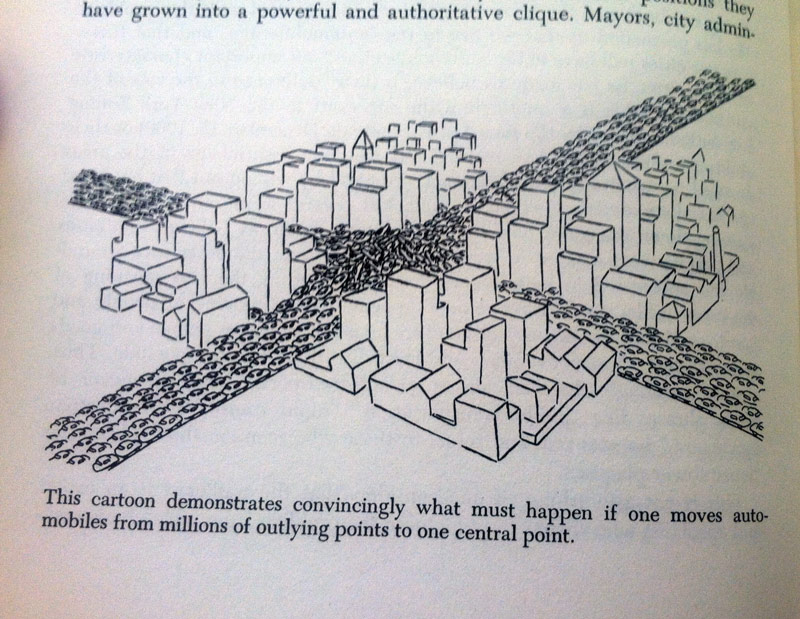
Cartoons, drawings, and illustrations have always been central to architecture and design, both ways of knowing based on observing the urban landscape and reducing it to basic principles. Nothing does that better than a great drawing or illustration.
So here are some of my all-time favorites, along with brief explanations of why I think they're so keen! #1: The "road space" cutaway (by "Todorovic")
I love this drawing because it captures the inequality inherent in our street design priorities. Cars are climate controlled, hermetically sealed bubbles of private space. In general, we give over a huge percentage of our streets to people traveling in relative luxury, while forcing everyone else to share the street's table scraps.
Whenever our cities equivocate between bike lanes, transit, and sidewalks... Whenever we fail to prioritize shared or active mobility, we're propping up privilege. This illustration perfectly shows that fundamental dynamic. #2. The LOS bulldozer (by Andy Singer)
Saint Paul-based cartoonist and my friend, Andy Singer, is one of this world's car cartoon geniuses -- a small group, to be sure -- and there are so many great Singer cartoons to choose from. If I had to choose just one, my favorite is probably this one, because it connects the dots in a very specific and important way.
(DOTs... get it?)
It's not often that cartoons can capture a structural problem so elegantly, including specific nerdy data like average annual daily traffic (AADT) and level of service (LOS) to prove a point.
[The original caption reads: NOT THE CAR BUT THE SUBURBAN HOME IS THE DEADLY WEAPON; DAILY SUBURBAN MORTAR FIRE AGAINST CITY CENTERS.]
Architect, urban philosopher, famous Luxembourgian, and overall design gadfly Leon Krier's books are chock full of excellent illustrations that skewer modernist architecture and planning. This one is my favorite, though, because it elegantly captures the violence of sub-urban car priorities and how damaging they are to older, walkable cities.
In a way, suburbs and cities are literally at war with each other, and speeding cars are the weapons of choice. As long as cars are around, no walkable city is safe.
#4. City streets as cliffs (artist unknown by Karl Jilg)
I don't know who made this amazing drawing of a city street as a giant canyon, but it perfectly captures the *feeling* of walking through a car-dominated city.
In many downtowns, and certainly most other urban places too, the danger of the street is everywhere. Technically the street might be "safe" according to modern engineering standards, but being anywhere near a street with cars going at 40 miles per hour just a few feet away feels terrifying. The streets might as well be cliffs, and your kid tugging on your arm might as well be about to fall into a bottomless pit. Crosswalks feel like the bridge in an Indiana Jones movie, and your dog is always in peril.
I love how this drawing captures that feeling so perfectly. This is probably my favorite sidewalk illustration of all time!
That's it. Those are my top four.
But just for kicks, here are some extras that didn't quite make the cut.
Here's an illustration that I found in my dad's wall-hanging collection, an illustration of downtown Saint Paul from 1989 drawn by an artist named Sheryl Alex Getman. It's fun to look back at what downtown was like 25 years ago.
It's full of some amazing retro stuff like this:
[Some cool stuff from the center of the illustration.]
What's happened to 1989 Saint Paul? What's there, what's gone now?
Here's my best attempt to figure that out. Please post corrections in the comments. You can expand the full image but I've also put in a few close-ups.
This is an interview based on a website I found over five years ago featuring systematic recordings of the "caution car approaching" sounds coming from the parking lots of downtown Minneapolis. Intrigued by the project, I reached out to its creator and found Dan Ibarra, a well-known graphic designer, artist, and musician.
This interview was recorded over three years ago, was lost on my
computer hard drive, but recently resurfaced. Apologies for the delay.
As a result, the website with the recordings is no longer up on the internet. I have tried to recreate some of them with my own recordings of parking lots. The sounds have not changed much in the last five years.
[Transcript begins.]
Dan Ibarra (DB): My name is Dan Ibarra, I'm the principal designer at Aesthetic Apparatus. We're a commercial art and printmaking studio. We are mostly graphic designers, but also do illustration and printmaking, sometimes even audio.
For me most of what inspires me and what partially inspired this audio recording project was that I enjoy the culturally ephemeral, the small moments that we don’t see as anything important, but actually become the daily places that we walk through and experience.
So much of my work is literally constructed from print ephemera. I’ve also published a book that’s photo documentation of misplaced groceries in a grocery store. And I feel like this is kind of along those same lines. This is a thing that you wouldn't t really give any thought to, but once you start paying attention to sounds to downtown Minneapolis you start noticing those “Caution, car approaching" sounds everywhere.
Twin City Sidewalks (TCS): I can't wait to hear about it. But first, tell me about the posters. What kind of posters?
DI: We still do posters on weekly, daily, monthly, or annual basis. We’ve done a lot of art shows. Printmaking has really become much more of a prominent discipline, for example Artcrank. You see one hundred bike posters, you’d think well that’s just all the possible bike posters there could be. But no, it’s not. There are one hundred the next year, and one hundred more the year after that.
I’ve never been one for the fetish of the bike, it’s always been about the experience of biking. Last year our art crank composition was a poster of trash collected from the Greenway, then put into a collage composition and reprinted.
TCS: So some detritus!
DI: Yeah. On one hand, we were cleaning up the Greenway, then collecting a cultural core sample of the Greenway. For example, there’s always Swisher Sweets and flaming hot Cheetos. We have so many different iterations of the flaming hot Cheetos bags. It’s a good measure of who’s on the Greenway and why.
TCS: So let's talk about this project in downtown Minneapolis. Tell me where this project came from.
DI: The project began when our studio used to be Downtown at Nate’s clothing company.
TCS: Hey, I bought my only suit at Nate's! [Note: I've since bought another suit.] DI: I think all men of our generation bought their only suit at Nate’s Clothing Company. It was a great building, great location. … It was one of the last of those buildings where it was really hands off. Scott Seekins was in there, too, another person who had lived there for 30 years.
So I was working downtown, driving downtown, walking downtown, and this perception I have of my world, about what’s ephemeral and what's the trash, what’s the leftover of the things we think are important. Well I kept taking note of these car warning. I found it was interesting that a lot of them in a literal sense shared the same voice. Some times it was a worn out recording.
[Parking lot klaxon from Portland Avenue and 6th Street.]
[A car approaching sign, klaxon embedded.]
Yes, that’s the original caution car approaching,
[Note: Since I have inserted my own recordings, they will not be the original ones and will not match perfectly with the transcript.]
I began recording as many of these as I could. I got obsessed with it, and I wanted to find out the background.
I did discover that Minneapolis is the only city that has this. I assumed there was some guy in the Northeast that did all this, and there may be other approaches to this idea, but this "caution car approaching" voice is the sound of downtown Minneapolis alone.
So I reached out to the Minneapolis "ramps and lots manager" Tim Belezing [Note: spelling is unclear.] and he informed me that it as an ADA issue. They wanted to make something that gave warning to people that couldn't t see that there was a car coming.
For a long time they had buzzers and bells which I imagine are universal to any downtown city. But they wanted something that had a bit more of a direct input as to what was happening if you were walking down the street and if you were blind. A buzzer could be a fearful sound to hear. They wanted something that was calm, but let you know what was happening around you.
For a while they were working with a recording that simply said “car coming.” When he said that I couldn't help but think of Wayne's World where they just yell “car!”… That’s what it seemed like to me. Just yell “car coming!”
DI: So through a process of elimination, they came to this idea that it would say "caution car approaching", and that seemed to meet the needs of ADA requirements as well as being something that was social enough, something that’s... To me it means it's not yelling at you, but it’s a gentle warning. “Car coming” to me seems like there’s not a kindness to it
[Parking lot klaxon at 3rd Street and S 3rd Avenue.]
TCS: Then what happened?
DI: There was an even mix of some people who really like how casual it was, very simple and succinct. Other people felt like the warning was backwards, and they wanted the cars to get the warning that a person was coming.
I liked that idea and I liked the shift in perception. This warning is also about us making way for the car, as opposed to the car making way for the pedestrian. At some point it had to have been a decision of someone one that they thought about, as opposed to the cars, that the people are here.
TCS: So to me the tone, and the way that the language is used reminds me of Robocop. That scene where Robocop is interrogating a criminal, or that scene with the giant other Robocop, where he says "WARNING you have five seconds to comply." That's what this sounds like for me walking down the street. It's almost threatening to me sometimes.
DI: Yes, it's the idea that there's this disembodied voice commanding you. Tim Belezing said they brought in a Japanese engineer to come in and study the technology of the ticket machine, the one that that says “please take the ticket.” They were working on that technology. And they had a Japanese engineer some in and say, "well where do you want the voice to come out?"
"Well maybe just this box, a speaker." They didn’t understand the question. In Japan it’s offensive to have a disembodied voice. You put a person there, or some sort of animatronic being,
DI: Just something so that there is a thing, a person, an animal talking to you. Although we don’t have the kind of cultural offense there, we still have this weird relationship to technology talking to us in a human voice. Who is talking? This building? Who is telling us to approach with caution? Is it the door or the car itself that we’re supposed to hear? TCS: It’s the system. It's the skyway system with the retail activity and all its interior spaces. If you're actually walking down the street, you’re faced with a lot of blank walls and giant grey slabs. And its very inhuman. And on top of that, there's this sound, this voice you hear that will give you a verbal assault. It produces an affect of melancholy that's almost militaristic … Sometimes it gives me the jeebees.
DI: I know what you’re saying, the sense when you’re walking down the street you don’t interact with those buildings at all except when you’re warned about them shooting cars at you. That’s your only interaction with public space in any sense.
TCS: Then there's parking ramps that extend extend out over the sidewalk, and you’re forced to walk in these dark tunnels. Walking around can be unpleasant to say the least... So how many of these parking ramps did you go to?
DI: I think I got about 20. That was a week’s worth of taking an afternoon and biking around and recording, and it was this logistic nightmare. I had to go during rush hour, because that was my best chance to get a car coming out.
You can go at any any time of day, but then you sit and wait. I spent a good amount of time biking around at rush hour, waiting until a car came, and recording. And sometimes recording again it it wasn’t right.
[Parking lot klaxon at the IDS center, Marquette Avenue.]
TCS: It's like going fishing or hunting! DI: Yes! I was fishing for cars. I started in a geographic location at what I considered was the most northern portion of downtown, the parking ramps like the 2nd Avenue ramps. And then I slowly worked my way back block by block.
It's interesting when you start looking for the ramps how many you come across, and ramps you didn’t even notice were there. They all have their own audio signature.
And I think its also beautiful in a sense. I find beauty in really a lot of ugly things. What i think is beautiful is typically what the normal person thinks is ugly, and so those audio recordings, the awkwardness, the blemishes and bad recordings... Those are beautiful in their own weird sense of music. It's all we've got for sounds downtown now that there's no horrible opera music coming out of Block E an more…
TCS: The sonic landscape, mostly it's the sound of cars, and an almost space like vacuum of air rushing through.
DI: Yeah the wind of Nicollet. TCS: So convince me these are beautiful sounds. Is there one you think of that is particularly beautiful?
DI: Let me see if i can find one. There’s one that’s awkward. "Caution vehicle exiting." It sounds like maybe an intern did it or something. They’re a little bit…
DI: There’s... You’re almost convinced. What I like about that one is that for some reason someone felt that "caution car approaching" was not appropriate for their needs, or ended up trying to do it a little bit different. Maybe they wanted a signature style for their caution announcement.
There’s an institutional thing to it. This it the US Bank parking ramp. You can tell he’s a little bit nervous about having to do it. There’s something human, flawed about this awkward voice being the voice of this institutional parking ramp.
It gets to the idea of trying to humanize a parking ramp in some way. I collected them not for their consistencies but for their inconsistencies. I think that those more interesting, to think about the hows and the whys of what’s happening, what they say and how they say it.
TCS: The sonic architecture of a parking ramp, it's all hard spaces. There's a lot of space and it's all so echo-y, rigid, sharp. You get this cathedral-like murkily lost-ness, and inside there's this tiny attempt to convey a message, but it's getting swallowed up by the vastness of parking ramp space. It almost makes me feel bad for the person.
DI: I intentionally didn't try and sweeten the audio. You want to get the noise of the city, the background white noise. Hearing that echo, that white noise, you can tell it's city. It’s not …
TCS: It's a vacuum sucking sound.
DI: I equate it to the white noise of an ocean, but it has its own little signature to it, in a sense. It's that great sound where you would never really listen to it, and if you’re in a recording, you think "oh, that’s the sound of a city, the buildings, the air of a city." I don’t know what that is, the echoes the near cars and the distant cars and the white hiss of whatever is going on.
[Parking lot klaxon at 3rd Street and N 2nd Avenue.]
TCS: That’s what your project is generally. Most people walking around downtown will filter all that out, filter out the white noise, the honking of a horn. Filter out the sound of the parking ramp. Our perceptions are filtered through our habits and our routines, so that if we walk the same six blocks from the parking lot every day, we go on autopilot and don’t notice them. I like your project in that way because you're revealing these things again to us for the first time.
DI: Well said. That’s kind of a creative meaning for anything that I do, taking these things we gloss over and forget about, but are around us on a daily basis. Trying to see them again, hear them again, smell them again, to experience those small moments of our life.
I want these recordings to be kind of funny too. When you start getting them again and again... I'm laughing to myself as I'm thinking about this idea, these eccentricities. They get funnier in the context of the other parking ramps, like they’re all talking together.
TCS: They’re having a conversation, but it’s a really boring conversation.
DI: It's a horrible conversation. Yeah. But it’s like bird calls or something. We don’t really know what they’re saying to each other. Maybe they’re just warning each other that there’s a car approaching.
[The Brooklyn Heights promenade.]
TCS: I used to live in New York City. Have you ever been to the Brooklyn Heights promenade? It's part of Brooklyn just south of downtown. There’s this beautiful walkway pedestrian overhang, over a freeway, right on the river, with a great view of the lower Manhattan / Wall Street area. It's directly across the river from Wall Street, and a lot of people like to go there and look at the city.
I was there at night walking along this promenade. Then all of a sudden one of the office buildings, all the lights in the building started going on and off at random. This is like a 40-story building On an off at random for a good 30 seconds. Then it went back to the way it was before.
I thought it was trying to send a message to me. This is a building trying to tell me something, that there’s this secret code in there that means something, and I’m never going to understand it. But that there was a message.
So sometimes I feel that way about cities in general. You’re walking down the sidewalk, and there’s a piece of paper there, and then you just make your bus by a split second, and on that bus you meet somebody that you hadn’t remembered them from years ago, and you have this interesting conversation, and it feels like the city is trying to tell you something.
I don’t know if you try to decode these messagesin that way.
[Termite mound architecture.]
DI: I don’t decode it, but I try to see the city as just as much an organic existence as a forest. In that we have these variations in a single downtown of climate and culture and smell and people. I was thinking a lot about where we draw the line between nature and industry and how we would never really think about a downtown as nature. Or as environment in the most political sense of the word something environmental.
A city is not environmental really, but in a sense it's not that different than an ant colony. An ant colony in a sense, an ant colony, is very much a natural occurrence, and a city is a much larger scale example of that. But because we are human we have our own abilities and the constraints of our own nature, of course We make cities that go way beyond what I would consider a standard human existence, but the city is still made by humans and controlled by humans in some way.
TCS: And it reflects our social nature, our emergent social understanding in some way. We don’t understand it individually, but together..
DI: And we, our humanity comes out in strange spaces and in strange ways. And these parking ramp recordings are a way that humanity finds a way, in something as large as a downtown in the city space.
TCS: Is there another one you want to play for us
DI: Let’s see? What other ones. Its tough just having them transcribed.
TCS: Let’s listen to one of these beeps. That’s a municipal parking ramp.
DI: Yup. That’s it. That really is... it sound almost like you’ve just come back from a concert. It’s that level of beep.
Let’s play another one here. There’s different beeps as well. [sound plays]
TCS: It does sound like a bird doesn't it?
DI: I like that one a lot. I never really figured out if that was the intention of that sound, or if it was some kind of technological malfunction in that. it was really kind of an interesting sound.
TCS: It's like it’s a tape trying to play.
DI: Or its lopsided or something. But I feel obviously those beeping and chirping, it isn’t as human as a voice. But I do still enjoy those because, at some point someone had to decide on that balance, about what’s warning enough and what’s too much warning, and what is the audio equiavelnt of that.
I was thinking just yesterday about the FCC warning test sound.
TCS: The EAS the emergency alert system...
DI:The emergency alert system sound. The grating... you can’t even... We all hear it in our head but it's an amazing grating sound. I hope someone got paid a lot of money for that sound, because it is the perfect, most horrible sound that you can possible imagine. And i love that someone somewhere got paid to figure out what is the most atrocious sound you can make for us, and how they came up with that.
TCS: Another one that jumps to mind is the tornado warning siren, which is actually kind of pleasant one a month. In a way
[Tornado siren.]
DI: Yep. And here...
TCS: It’s exciting like there’s fireworks going off all over the city.
DI: I guess it's not a city, Its anywhere that the culture of the industry that provides for us, where we become so large that there's not a person any more to tell us, there’s a machine to tell us now, and how we anthropomorphize that machine or don’t... I feel like the emergency broadcast system could have chosen a human voice, but for some reason they do not. And they also chose the most grating sound possible.
But the huge spectrum between the most horrible sound in existence and the most beautiful song, the most beautiful singing voice, and everything in between... It's interesting how we react to those sounds and how they move things in us.
TCS: There's a way in which the city... When I moved to New York and I didn't know at the time that the apartment I was getting into was a block away form the New York City trash truck washing facility.
DI: [laughing] Now you know why you got such a good price.
TCS: Well, it wasn't that good a price... But so what this meant was that we had all our windows open because it was hot in the summertime, and each night between midnight and 4:30 in the morning there were these big trucks idling outside our window. And for the first week or two it really annoyed me, but then I just got used to it. You sort of filter it out. Don’t even hear it any more
DI: Yep and when you start really looking at something seeing, re-seeing it, re-hearing it...
I always say that I can feel a physical shift in my brain between the point where I’m trying to impose my direction on how something should be versus listening to something or being open to something. And for me in terms of art making, that’s a huge shift, for me to think about "ok oh i’m not going to really pursue an idea, I’m going to keep myself open to what comes to me, what ideas come to me and make themselves known."
And I feel like living in a city can be a lot of that. You can thrust yourself into a city, or you can let the city come into you, and be part of that city. And it’s a very different dynamic of how you walk down the street. If you are open to the city and what’s happening in the city, you can find those beauties in the small moments of things, the institutional, or things that aren’t meant to be.
TCS: You discover a new place. DI: But if you just pursue your life with a single-minded agenda, you don't ever get to really let those things come in that you wouldn't have anticipated happening. That’s something that's important to me to experience on a daily basis, opening myself to those experiences those ideas, those sounds, those objects, those people. Whatever...
TCS: There's one more I wanted to play, a really fast one.
[Parking lot klaxon from the lot across from the new Guthrie Theater.]
[The lot by the Guthrie, on 2nd Street.]
DI: I like that one a lot, because its almost stuck on "car." He’s barking it, but he’s also singing it. Like "caution ca-ar approaching." There’s almost two beats. TCS: It almost sounds like a vendor at a Twins game.
DI: Right. And I always wonder if its intentional. How many takes they did with that? The more you listen to it, the more you hear those little things that happen in it. Especially once it repeats itself again and again. That one is just, again it's just... What I’m left with is a lot of questions about why it sounds that way. TCS: That’s the city again. Maybe its someone you see on the bus, and you come up with a fantasy of who they are and why they’re there. You live with the uncertainty. DI: Yeah and I think that when we think about cities, and these huge institutions, we think about certainty, and we think about rules and organization and the amount of energy that’s put forth to keep a city moving forward. We never think that someone just kind of did something unintentionally.
But the truth of it is with these downtown recordings, they really were done with this "we’ll just do this" attitude. There were not done with any thorough analysis about how to say it or what it sounds like.
That's Something that Belezing said. He kept saying, "Well, what can I say, I just park cars." That’s how he saw his job. He just parks cars, and this was not really an important thing for him. This was a thing that just happened. I like that it was so unintentional I like that they let the thing just seed.
At the end of the month, on Saturday April 30th, I'm taking part of an exciting month-long "walking and art festival" in Northfield all about the intersection of walking and art.
One of the key ideas at stake in the festival is psychogeography, which is a favorite concept of mine that emerged from out of the French Situationist movement of the 1960s.
(For example, check out the various "sidewalk games" that I've put on this blog, many of which come directly from Phil Smith's great book Mythogeography. Smith himself will be at the festival in May as a visiting artist at Carleton.)
On Saturday the 30th, I'll be down in Northfield giving a talk and leading a walk around the city. Both the talk and the walk will focus on something I call the "spatial perception" of sidewalks. Put simply, it's how sidewalks express the relationship between the walking body and the city, between speed and and observation.
In a way, I'll be sharing sort of an "artist talk", where I'll go into a bit of detail about how I try to move through urban spaces. What tricks can you use to help think about walking in the city? What kinds of things are useful to notice or observe? How can we start to see the built environment in different ways?
I'll be sharing my personal "walking practice" as its evolved over the years. This includes noticing and photographing things like signs, dogs, telephone poles, windows, and doorways. But I'll also be sharing how I think people can develop their own walking practices, why it's important, and pointing out some interesting ways to go about it.
Then we'll go on a 2-3 mile walk around Northfield to see waht we can see, and to experience the non-linearity of place, how the city and sidewalks ebb and flow and flux to create different and evolving urban landscapes in Northfield, a wonderful walking Minnesota town.
Urban geographer and an editor ofstreets.mn, Bill Lindeke, will offer an on-foot introduction to the wealth of ways sidewalks invite us to explore. Following a brief talk, Lindeke will lead a guided walk of Northfield sidewalks. Lindeke is a specialist in urban and human geography, specifically how urban space creates habit and shapes desire. His research involves how public space works in US cities to create social possibilities, specifically around the push to increase non-motorized transportation. Twin Cities Sidewalks
It's always delightful to get down to Northfield and I'm excited to participate in such august group of pedestrian thinkers.
Liberté, the pursuit of happiness, the unfettered city air freeing us from the visible and invisible chains of oppression.
These freedoms are not only found within history books, but are all around us. And America’s great unsuffering icon, the colossus of escape and relief lies not just at the center of New York harbor. You can’t pin down an idea.
Even Saint Paul has its statues of liberty, its small freedoms. These ladies liberty stand scattered around the city, beacons of relief and lights of opportunity giving succor and hope to the despondent.
Here are five of them:
What: wooden statue of liberty made from a tree stump Where: Crocus Hill, Fairmount Avenue, up on the bluff
What kind of liberty are we talking about:
The freedom to decorate your yard. The freedom to live in a well-kept wealthy neighborhood of tasteful and remodeled Victorian homes where you can almost always park your car in front of your house. The freedom to be able to walk to a street with delicious restaurants, clothing retailers, and a small liquor store, but to drive there anyway. The freedom to shed convention by making delicate objects with brute tools like chainsaws. The freedom to not only chop down trees, but to turn them into kitsch.
Site-specific poetry:
"Keep, ancient yards, your storied grass!" cries she
With silent lips. "Give me your trees, your stumps,
Your leftover timber yearning to become large animals,
The wretched detritus of your dumpster.
Send these, the homeless, wooden materials to me,
I lift my chainsaw beside the 19th century door!"
What: large liberty in a coffee shop Where: Nina’s Coffee, Western and Selby
What kind of liberty are we talking about:
The freedom to have room for a laptop, a dedicated electric plug, a coffee, and plenty of space to work all day without paying more than $6. The freedom to sit down and share a table with someone if the café is full, even if they’re a stranger. The freedom to gaze out large windows at passers-by on the street. The freedom to pretend like you’re working, even if you’re not. And the timeless liberty of reading a newspaper for which you did not pay.
Site-specific poetry:
"Keep, suburban lands, your Starbucks!" cries she
With silent lips. "Give me your tired, your upper-middle-class,
Your uncaffineated masses yearning to drink coffee,
The nomadic laptops of your creative industries.
Send these, the LSAT takers with low batteries, to me,
I lift my lamp inside the historically preserved brothel!"
What: guy wearing a foam liberty outfit Where: on the bus bench of University Avenue
What kind of liberty are we talking about:
The freedom to not have to do taxes by yourself. The liberty of speedily getting a tiny portion of your tax refund right away, and bequeathing the rest of it to predatory lenders. The freedom to hire people to be objects. And the freedom of feeling superior to others because of their crappy employment, because regardless of how bad your job may be, at least you’re not standing in the rain wearing a “statue of liberty” costume.
Site-specific poetry:
"Keep, ancient lands, your storied accountants!" cries she
With silent lips. "Give me your tired, your poor,
Your huddled masses yearning to get something out of the regressive taxation system,
The wretched returns of your working class.
Send these, the undocumented with empty wallets, to me,
I lift my lamp beside the bus stop!"
What: medium-size statue of liberty on the roof of an office building Where: Lawton Professional Building, West 7th Street
What kind of liberty are we talking about:
The freedom to divorce thy spouse, the freedom to litigate estate disputes, and to have affordable rent while doing so. The freedom to declare bankruptcy, even under the limited protections afforded to people under to new GOP regulations. The freedom to park on the street without paying. And to protest transit projects that threaten such parking no matter the opportunity cost.
Site-specific poetry:
"Keep, ancient firms, your storied pomp!" cries she
With silent lips. "Give me your conveniently located, your hopefully not poor,
Your befuddled masses yearning to resolve disputes,
The no-longer-happily married refuse of your teeming Riverview corridor.
Send these, the underwater homeowners, the financially insolvent to me,
I lift my lamp beside the 60s one-story office building!"
What: medium-size statue of liberty on the roof of an Italian restaurant Where: Yarusso Brothers, Payne Avenue What kind of liberty are we talking about:
The freedom to never change recipes. The freedom to take absolutely anything from a garage sale and put it on the wall. The freedom to force people to work in places that show the first two Godfather films simultaneously all day, every day. And the freedom to eat as much pasta as you can, once having paid the buffet price.
Site-specific poetry:
"Keep, newfangled hipsters, your trendy foodie culture!" cries she
With silent lips. "Give me your traditional, your firmly middle-class,
Your hangry masses yearning to eat meatballs,
The curmudgeons of your teeming railroad island.
Send these, the nostalgic, balding men to me,
I lift my lamp beside the pasta buffet!"