Showing posts with label Climate Change. Show all posts

2019-12-19

My Public Comment on the Saint Paul Climate Action and Resilience Plan

[Russ Stark presenting the plan to the City Council.]
[Yesterday, the Saint Paul City Council held a public hearing and then adopted the Climate Action and Resilience Plan. You can see the plan here,  listen to a podcast on the topic, or read my column on it. Many people gave testimony before the Council. These were my comments.]

I’m grateful that Saint Paul leaders have crafted this ambitious slate of goals for reducing carbon dioxide emissions within the city. I strongly encourage the Council to pass this plan, and to follow up by meeting these goals with concrete action.

Sitting here today in 2019, the list of things we have to do might seem daunting. When you look at these goals from our perspective, they seem ambitious. To take just one example, the transit and vehicle miles targets included here represent huge strides, compared to what we have been doing in Saint Paul.

But unfortunately for all of us, when you look at climate change action from a different perspective -- from that of coming generations, your children or grandchildren -- things change dramatically. It sorrows me when I hear politicians, like the recent comments by leaders of Minnesota Republican Party, scoff at warming the earth by 2ยบ Celsius, which, by the way, is a hopelessly optimistic outcome.

This existential, global problem is is no laughing matter. Warming the earth’s climate by two or more degrees Celsius will be catastrophic for Minnesota and for Saint Paul. We will experience severe flooding, droughts, death from heat exposure, massive storms, collapsing infrastructure, the extinction of countless species and irreparable transformation of the world. There is no end in sight.

This is why these steps are so critical. Again, unfortunately for all of us, I am confident that, when future generations look back at the 2019 Saint Paul Climate Action and Resilience Plan, they will see not a huge radical change, but the very first steps that we made as a city and as a society. The goals laid out in this plan will look like common sense, only the most basic of adjustments. Even if we meet these targets, people will be saying to their elders: Why didn’t you do more?

Here in Saint Paul, it might feel like we are doing something today. But it will be critically important to act on these goals, and not simply put them on the shelf next to the long library of our city’s ambitious but unmet aspirations.

The most disturbing fact I’ve heard in a while is this: “More than half of the carbon exhaled into the atmosphere by the burning of fossil fuels have been emitted in just the past three decades.” This means that climate change was not inherited, but was caused in my lifetime, and by our actions. This is our problem.

When you vote for this plan, and more importantly, when you act on these goals, it will seem like a big change. But this is just a critical beginning. This plan charts out the first steps toward addressing the biggest political challenge of our lives. I urge you here today to support the Saint Paul Climate Action and Resilience Plan, for our children and their children, in Saint Paul and all over the world.

2019-07-26

Mayor Carter's Complete Remarks to the Senate Democrats Climate Change Panel

[The Wabasha street landslide mentioned by Mayor Carter.]
The other day, Mayor Carter was in Washington DC to talk about climate action and the future of Saint Paul. You can read about it here, or watch it yourself, but I transcribed his statement for you below.

Thank you for the opportunity to testify about what is without question one of the most critical issues we face, our climate crisis. My name is Melvin Carter and is serve a s mayor of St. Paul Mn. I stand alongside four other mayors int eh room and over 400 climate mayors who represent over 400M Americans who have pledged to uphold the Paris climate agreement through local action despite the withdrawal of our federal administration. We thank you for our efforts and urge you to carry on your work toward our future. 
In the tragic event that you’ve never visited St. Paul, we are Minnesota’s capitol city found 165 years ago where the Minnesota and Mississippi rivers converge. We boast a nationally recognized network of parks and trails and beautiful white stone cliffs for which our original Dakota inhabitants named the area i'mnizha ska.  
Our most iconic feature is our unmatched 65 miles of Mississippi River frontage which is filled with canoes, houseboats, and barges that move more than 145 million tons of commodities through the area terminals each year. St. Paul’s defining natural features, its northern location, and dependence on our river, make us particularly sensitive to changes in temperature. From the polar vortex of this past winter to the summer heat waves, we have an acute perspective on how the climate crisis plays out at the local level. Three of our ten biggest floods ever recorded have occurred in the past decade, and our stretch of the Mississippi River spent a record 42 consecutive days at major flood stage this year with mitigation costs exceeding 2M.  
Warmer winter temperatures and an increase in snowfall have made it more expensive to maintain public infrastructure and accelerated erosion on our bluffs. Last year that erosion resulted in a major slope failure and landslide that dropped 400,000 pounds of limestone onto a local arterial street. Clearing the debris and stabilizing the bluff above cost our city $1 million, and interrupted the lives of countless businesses and residents. 
But I'll always remember how narrowly we evaded catastrophe. those rocks fell onto the route of our annual Cinco de Mayo parade exactly one week before thousands of people would have flooded the same street for the festivities.  
We have no choice but to adapt to our changing climate while working to mitigate its harmful impacts. Saint Paul's Climate Action and Resilience Plan aims to do just that. Our plan prioritizes efforts to reduce energy and transportation costs and create pathways to opportunity for low-income residents. It proposes local actions to reduce emissions from buildings and transportation, including public and private investments led by a grant from Bloomberg Philanthropies to build charging hubs and the nation’s first electric car share powered completely with renewable energy. Transitioning to LED lighting to reduce energy use in city buildings, a major investment that will have only a 5-year payback period for us. And improving pedestrian and bike infrastructure to make it safer and easier for residents to get around our city. 
We are also pursuing an unique opportunity to develop a sustainable energy efficient demonstration neighborhood on a 122-acre site that once housed a ford production plant. Buildings on this site will generate 80% less emissions than those built to code in 2005 and most homes will be powered heated and coiled with renewable energy. Finally Xcel Energy, our electric utility has committed to providing 100% clean renewable electricity by 2050, a commitment we strongly support.  
We are doing our part on the local level to address our climate crisis, but without significant federal actions our efforts will not be enough. America must rejoin and accelerate the Paris Climate Accords. Our federal government must help us build for the 21st Century with major investments in pedestrian, bicycling, and transit infrastructure, electric buses like those made at New flyer of America in St. Cloud, Minnesota, public charging equipment to help us transition to electric vehicles, and R & D to advance technological solutions.  
Communities across our country are counting on you to continue pushing this vital work forward and we stand as ready teammates int eh work ahead. Thank you again for the opportunity to address you hear today. I look forward to our conversation and any questions you may have.

QUESTION FROM SENATOR ABOUT TOP PRIORITY 
One of the reasons St. Paul’s Climate Action and Resilience Plan centers around transportation and buildings is because the vast majority of our emissions come from transportation and buildings. And so we are taking efforts to revise our building codes to make sure that new buildings are built up to energy standards and support from the federal level is critical from where that is concerned. If there’s one area where we would love to partner with the federal government, if I had to narrow it down to one area that could have far reaching impacts on all the other things we’re talking about, I would certainly appeal for increased funding for transit and high speed rail. As an opportunity, I heard Mayor Bottoms say that this is an equity crisis for us that the impacts of our changing climate are hitting our lower income communities harder than everyone else and I heard moved by mayor Caldwell’s statements about how everyone in their government is responsible for impacting sea rise it’s obvious to understand why Hawaii would see that issue with that urgency and I would encourage us all especially in Washington DC to meet it with that same level.

QUESTION ABOUT ENERGY 
One thing St. Paul is leading is  reducing energy use in buildings. We have a district energy system that powers our downtown, it's the largest combined power and heat system in North America and it uses 50% local wood waste. 
Connecting opportunities to reduce emissions to opportunities to increase sustainability and growth in our cities is a must, and we’ve successfully been able to partner with our private sector including our businesses downtown. We recently launched a :race to reduce", it's essentially the TV show Biggest Lower but for buildings. We’re challenging commercial buildings to benchmark energy production and have over 100 buildings downtown and across our city sign up for that, and we are working to significantly reduce CO2 emissions from buildings in St . Paul.
QUESTION ABOUT CLIMATE RESILIENCE 
As we’ve all mentioned, we are cities from entirely different locations with different geographic features. But we are all sharing with you how our geographic features make us vulnerable to climate crisis. As I mentioned, being on the river, we’ve seen record flooding on our river three of our largest ten floods ever recorded have happened in the last decade. We had a heat advisory, this past weekend and the record breaking snowfall, I tell folks that in a state like Minnesota or Wisconsin it takes a lot of doing to break a snowfall record, and we’ve been doing that. And the record-breaking snowfall we’ve been experiencing creates additional costs, makes it more expensive to maintain public inrasatrucute, creates more wear and tear on our streets as the freeze and thaw cycles wreak havoc on our streets. And that certainly is a major challenge for us. 
As we’re building our new Ford neighborhood along that Ford plant, and as we’re seeing a lot of development opportunities right now one of the things we’ve led on is how to manage storm water. Adapting to our new environment, so when we have those events we have to make our city more able to recover from them and more able to deal with the precipitation and that water. And we are working, just as we are working to have the conversation with business leaders to save them money against their bottom line, we’re working to have that conversation potentially with our taxpayers and our residents that these are necessary investments we have to make. Often they are significant investments and it would be helpful to have partnership from the federal and state government partners to be able to do that. These are investments we are making because they match our values, and they produce a return to our community over time. 
QUESTION FROM SENATOR ABOUT ENGAGING THE BUSINESS COMMUNITY. 
Our administration focuses really heavily on engaging different voices in our communities often voices who coming into the room  assuming they’ll disagree. Our race to reduce strategy with downtown buildings, we're showing business leaders in our community that there are opportunities to reduce emissions while saving money for their businesses while contributing to their bottom line. And they're all in in that and interested in participating in that.  They've been enthusiastic participants with that.
We're learning in our community in St. Paul that as we engage people, whether its residents, low-income residents, or business leaders, their concerns, that are valid in many cases, is that pressures they have against themselves will be not heard or taken into effect. We need to bring those voices to the table, voices of union leaders and those concerns, and make sure that they understand that we are thinking about the challenges they bring to the table and produce solutions for them as well. 
QUESTION SENATOR ON EV INFRASTRUCTURE 
That's a critical question we are working to leverage public and private investments our most ambitious project in partnership with Bloomberg, local utility, state government and local leaders, working to build the state's first electric car share hubs powered completely with renewable energy. Our goal is to have all residents be within a ten-minute walk of four low carbon mobility options like transit, bike share, car share, or a scooter ride, and that's one of the most ambitious things we're doing, in partnership, I should say with the city of Minneapolis, who is our city next door. That's critical for us for a number of reasons you described, and to address the equity issues involved in transit.
SENATOR ASKING WOULD YOU LIKE TAX EXEMPT BONDS 
Yes I would.


2018-11-01

Minneapolis 2040 is what Climate Action Looks Like

This weekend, a pair of articles in Sunday's Star Tribune caught my eye. They were right next to each other on the site, shining a spotlight on the challenge facing our city and our country when it comes to climate change.

[We're still talking about lightbulbs.]
The first one -- the #1 most read article of the day -- is a classic good intentions piece. It tells how individual people in the Twin Cities are concerned about climate change, and trying to change their habits.

Here's the gist:
They tossed out the old gas lawn mower and got an electric one instead. The new car in the garage? It’s electric, too. 
“It’s sort of like, the more stuff that got plugged in, the more excited I got,” she said.
... 
While the science suggests that individual actions by individual households won’t solve the problem alone, hopelessness is wrong, said University of Minnesota economics Prof. Stephen Polasky. It’s not too late, he said, and the fix can be made with tools we already have. 
“We don’t have to come up with some brand-new [technology] that we’ve never thought about,” said Polasky, who studies the intersection of ecology and the economy. It’s just a question of whether or not we act, he said.
...
High school senior Shaza Hussein said she, too, worries about her future, but working with friends and peers has given her hope that her generation can help build a better path forward.
...
Hussein, who said her relatives in Sudan have seen widespread drought decimate their farms, has been speaking at meetings and rallies, urging other young people to take a stand. 
“I tell them to recognize that even as an individual, you have power,” she said.

This piece is weird to me. Nothing against the admirable efforts and intentions of Shaza, Jessica, and the rest, but I have read that article dozens of times. You could find this same story written two years ago, five years ago, ten years ago, and twenty years ago. This was the list in Al Gore's film, and it's not too far off what you'd find in the pioneering environmental tracts of the 1970s.

Every honest person knows climate change is a global problem, and we all know what individual solutions look like. And (as the article subtly infers), people also intuitively understand individual changes are not enough to make a difference. Some things seem timeless.

The second article, further along in the paper's Local section, points to how critics of Minneapolis draft Comprehensive Plan, "Minneapolis 2040", have been trying hard to organize in opposition to the changes.

[Hi Janne!]
Here's a the meat of that piece:
Opponents dominated the first round of public input on Minneapolis’ two-decade vision for its future development. Now city planning commissioners will learn from a public hearing Monday if revisions to the plan will earn more support for increasing housing density and quell the fears of those worried about neighborhood destruction.
... 
Opponents worried that allowing more multiunit buildings would wreck the character of their neighborhoods and give developers a free pass to buy up and tear down single-family homes, many of them small enough that they’re affordable. 
“This plan could destroy the nature of my neighborhood and my reason for living in the city,” wrote a south Minneapolis resident. “We moved here because we like the idea of living in a neighborhood of well-maintained older homes with sunny lots.” 
“NO NO NO ... You are crazy!” wrote another. “I work outside [Minneapolis] but live inside. We don’t need to develop all this land in one of the biggest giveaways to developers.”

As you may have seen, the arguments here took full fledged fight at this week's Planning Commission meeting, where people paraded to the microphone to rant about the dangers of urban density.

[Doubting Thomas, by Mark Tansey.]
Instead of diving into that debate, focus on the disconnect. The two Star Tribune articles offer the perfect distillation of why climate politics are so difficult --  sometimes wonkily called "the value-action gap" --  and this divide is the key problem in 2018 Minneapolis.

On the one hand, people in Minneapolis have the best intentions. We are a liberal bastion, after all, and most everyone believes in climate change. Most everyone agrees that inequality is a problem, that helping the world's most vulnerable is is the right thing to do, that mass extinction of species is something to avoid.

On the other hand, buying "green" products, driving a Nissan Leaf (good car!), riding a bike (good all around!), giving money to the Sierra Club (good organization!), or going out for a meal at the Birchwood (good restaurant!) remain nothing but nice gestures next to the wider systemic and structural changes that really matter.

The gap between good intentions and meaningful action remains huge.

This difference is critical because climate change is at the core of the Minneapolis 2040 Plan. The controversial housing and transportation proposals are focused directly on reducing energy and CO2 use in the city.

In my podcast with Heather Worthington and Paul Mogush, two of the key people working on the Comprehensive Plan, they explain the direct connection between climate and Minneapolis 2040. Here's the relevant quote from Paul, a planner who has worked on the plan for years:
When we started this process two and a half years ago with the public, we threw the doors open and asked big broad questions. ... That's what led to the formulation of the 14 goals that the City Council adopted a few years ago. That's what led to us adopting this plan... We wanted to make this a document that was about the future of the city.  
Among those goals, the ones that really stood out in the public process was, number one, climate change. People see that as the huge threat that it is to our Earth and our city. We as a city have to do something about that. The second is housing. Housing choice and affordability. And the third is racial equity, in general. Those were the three that really emerged as priorities. That's what you see laid out in the goals, and that's what you see laid out in the content. Those are the main lenses that we used.

The gap between intentions and action paints a dark picture of climate politics in Minneapolis.  If our city cannot take meaningful climate actions in 2018, then when and where will change take place? If basic climate action is impossible here, where does that leave the more conservative rest of the country? If Minneapolis environmentalism is limited to the things in the first article -- buying a solar panel, a critical habitat plate, an LED lightbulb -- we are dooming the majority of the Earth's species and hundreds of millions of the vulnerable poor, people just like Shaha Huzzein's family in Sudan.

I'm not being histrionic. The latest report was clear on that last fact. In a recent podcast interview with Adil Najam, one of the lead authors of the IPCC, he bluntly described the unequal stakes.

Here's a quote:
It's not a surprising report. The surprise is how we keep getting surprised about the same thing again and again and again.  
For the poorest people it the world, hundreds of millions of the poorest people in the world, climate change is not something that's happening in the future tense. The problem with this report is that it's not frightening enough. It's trying to frighten us about the future, what it’s really telling us about is the present.  
They [the report’s final authors] want to spur, mostly you and me, people who are affluent, into action. I think that's a good message, but there's another message and that is that climate change is happening now. It's happening in Bangladesh. It’s happening in Haiti. It’s happening in Mauritius. It’s happening in Vanuatu. And it’s happening with gravest consequences in places which had the least to do with causing the problem. Those who had the least to do with making the mess are at the forefront of having to deal with it. That is why I think climate is a justice issue. 
This report, I don't think they have done justice to climate as a justice issue.
(The whole thing is worth a listen.)

In this critical moment, the political choice around climate action is clear. There's a massive gap between our city's stated values and our collective actions.  For now, the only bridge we have is the Minneapolis 2040 Comprehensive plan.

If you want to feel better about yourself personally, install a solar panel on your house, buy organic food, drive around in a Prius. Walk more instead of driving, turn off your LED lights more often, stop eating hamburgers, and compost. Take whatever medication suits you.

But if you want to actually do something, Minneapolis 2040 is what city-scale climate action looks like. If you say you care about climate change, but are not supporting this plan, you are fooling yourself.

[Hurricane Michael.]

2017-06-05

Climate Change is a Local Issue Too

Last week, when Trump announced he was pulling out of the Paris Climate Accord, I was neither surprised nor alarmed. From Day One, the Trump White House has been dedicated to undermining meaningful action on reducing CO2, appointing people like Scott Pruitt, scrapping the Clean Power Plan and CAFE standards, and (still to come?) selling off Federal lands for mining. There was never any chance that anything good for climate change would come from last year's election results

That's why the announcement didn't really bother me. It just made the apocalyptic politics explicit, brought the dynamics over climate change into sharper focus. The speech itself was like a cheese grater to the brain, angry ignorant bluster, equal parts dog whistle and bullshit. Listening to it made me flee to the nearest bluest-collar dive bar to see how working class white folks in the first-ring suburbs were perceiving the speech.  

It turned out that Marty's Bar, just over the West Saint Paul border, was full. I was the youngest person there, and to my surprise, everyone was watching women's softball and ignoring the world-historical moment.

One hardscrabble older lady sipping Diet Coke from a mug offered up, unprompted, "I had to get out of my house; I couldn't keep listening to Trump."

"Same here," I muttered.

Even when compared to other great liberal lost causes such as ending poverty, world peace, or erasing the legacy of racism, the politics of climate change are particularly impossible. Compared to those pies in the sky, the causes and effects of climate change are so temporally and spatially diffuse. Our actions today will have effects not right away, but in a generation. Oil burned in Minnesota becomes borderless. It might cause the butterfly in China to go extinct, a flood in Fargo, or a civil war in Chad. It's all atmospheric, and there's no direct causality to be found, much to the delight of the Oklahoma skeptics.

[Historical analysis of who "caused" climate change in the first place.]

In a way, that's why Trump's politically unnecessary grandstanding in the name of backwards ignorance was helpful. Pulling out of a weak, voluntary agreement did little except to (hopefully) galvanize more people around this diffuse geologic problem. Mayors and governors and corporations alike were able to restate their support of the Paris Accord and reducing CO2.

It's always challenging to draw a connection between global climate change and local politics, but luckily tens of thousands of scientists and policy makers have already spent lifetimes working on this problem. The whole "carbon footprint" and "sustainable action" problem has already been researched. To the best of anyone's ability, we understand of how our local policies translate into greenhouse gases. (Even though a huge part of the problem is embedded within consumer capitalism itself; every time you spend money on a new product, you are creating CO2 emissions somewhere in the globalized world.)

[FYI, there's a bible college near this Alberta town.]
This helpful list of things you can do includes (from two years ago, but this crap is evergreen because nothing has changed) "2. take the bus" and "3. don't buy a second car." In fact, the Times prescription is just like a list I made a while back.

You've heard it all before, the "first order" direct actions that are basically recycled (! yay !) from Al Gore's 2006 movie which was recycled from every other environmental tract leading all the way back to the first Earth Day or Ivan Illich's amazing 70s tract on the revolutionary effects of bicycling.

But as I said in my earlier post, there are second order less-direct actions you can also take. Let's say you, personally, can't take the bus very often. You can still help other people take the bus by supporting Metro Transit, supporting dedicated bus lanes, yielding to buses pulling out in front of your car, little things like that. These add up and still make a difference for people taking their lives into their hands every day by trying to ride a bicycle or walk across the street.

To put it another way, even if you can't stop driving your car, you can "stop stopping" people from driving their car:
Stop stopping people from driving less

Support bike lanes / dedicated transit lanes
Be willing to pay (more) for parking 
Support walkable safety improvements like bumpouts
Support a gas / transit tax
Don't speed; stop for pedestrians

This seems easy but has turned out to be really hard, and illustrates the mammoth hypocrisy hard boiled into first-world environmentalism.

Take one of the more ignominious moments in recent Saint Paul politics: the evening when city held a public meeting on installing a mile of parking meters. It was and is a sound public policy that would minimally price an environmentally harmful externality, help better allocate scarce on-street parking spaces, and also raising money for a cash-strapped city full of poor people. Yet at the packed-and-angry public meeting, the crowd saved its most lusty shouting for when Mayor Coleman brought up the topic of environmentalism. (This happened and I transcribed it for you...)

The howling politically mothballed commercial parking meters in Saint Paul for another ten years, which is a huge shame because it's an ideal public policy tool. Priced parking simultaneously nudges behavior while it raises needed money with a "user fee" instead of a general tax. Parking meters are exactly the kind of precisely targeted policy tool that cities should be emphasizing if they want to be serious about climate change.

It doesn't end there. Other recent great moments in local Trumpism include a garden store named Mother Earth Gardens (!) fighting a bike lane because of a parking spot. Or neighbors on a quiet wealthy street trying to scuttle the city's most sustainable development in generations because of small changes in car traffic. Or Saint Paul spending over $100K to build a few parking spots for a VHS-to-DVD business while desperately needed bike connections (like Kellogg Boulevard) go unfunded.

If the people speaking up in cities like Saint Paul, Minneapolis, or any of our potentially walkable suburbs want to actually do anything about Trump's blatant attack on the future -- as our leaders say they do -- we have to built a movement around some basic sustainability principles. We need to stop complaining about parking, density or the price of gas. Stop talking the talk, and start walking the walk. That's the only worthwhile reaction to Trump's moment in the warming sun. 

2016-06-02

At the Very Least, Stop Stopping Climate Change Solutions

[Sebastian Copeland's polar bear project.]
There’s a great op-ed in today’s Star Tribune about the everyday life politics of climate change.

Here's a passage:
I find it disturbing that many of my “progressive” friends, who claim to be concerned about global climate change, haven’t really changed their lifestyles all that much. Air traffic is at an all-time high, and with the recent downturn in gas prices, SUVs and trucks have been selling like mad.
Certainly, not all of these big carbon consumers are climate-change doubters or libertarians who believe in letting the “magic of the markets” correct all things in due time. Many are progressives who haven’t yet adapted their lifestyles.
Why aren’t more of us walking or biking to work, school, church, the post office or the grocery store?


For me, Daniel Johnson's perspective is right on. Thoughts like these pop into my head whenever I see another news article about the warmest month on record, or hear about flooding in India, or rapidly melting glaciers, or the future of Miami.
Johnson then calls on people to do more in their everyday lives to reduce their personal carbon footprint, and points to bicycling and transit as a solution. That’s something that I also try to do. When my car died ten years ago, I didn’t fix it, and since then I’ve been getting around without a car. That’s just one example of how any of us can personally reduce our CO2 footprints, and assume some measure of obligation to combat a global human problem.

The list is pretty simple, and you know it already:

Drive less — transportation accounts for a third of our social CO2 emissions
Eat less meat — this is the #1 thing any of us can do right now to reduce CO2
Use less energy (heating / air conditioning) — smaller homes, greater tolerance of diverse climates
Fly less — worst CO2 emissions ever
Use recycled / reused goods — stop buying new things

The problem is that, for most people, these changes are difficult. We can’t drive less if we live twenty miles from work, or have to pick up the kids. Hamburgers taste great and are cheap! Target has everything we need in one place. Flying to our sister’s wedding or home for Christmas or because we've always wanted to see Peru… You get the picture.

[When Barb Thoman and Mayor Coleman mentioned climate change at the Grand Avenue parking meter meeting, people openly jeered, booed, and mocked them.]

[A recent pro-parking protest in Minneapolis.]
Stopping Stopping Change

But even if we can’t make these changes personally in our lives right now, the least we can do is stop stopping others from changing their everyday habits. If we care about climate change, and we absolutely should, the least we can do is support life changes for others. The least we can do is to not get in the way of creating a more sustainable social environment.

What would this look like?

Stop stopping people from driving less

Support bike lanes / dedicated transit lanes
Be willing to pay (more) for parking
Support walkable safety improvements like bumpouts
Support a gas / transit tax
Don't speed; stop for pedestrians

Stop stopping people from eating less meat

Make sure good vegetarian options are available at meals you organize
Don’t question or shame people for choosing vegetarian or vegan diets

Stop stopping reduced energy use

Support density: this could be zoning changes, new development, etc.
Ask your employer / store owner / etc. to turn down the heat or A/C

Fly Less

Support passenger rail
Purchase offsets

Recycled / Re-used Goods

Donate to your local thrift store
Buy used stuff


The Power of Guilt

Cars are the new tobacco” is a metaphor I enjoy, and from a public health standpoint this is quite true. Along with guns and drugs, driving is our biggest public health problem, leading to all kinds of direct and indirect social problems.

And on top of that, you have climate change. Each time we get in your SUV to drive to Target, we’re melting a glacier. Each time we buy a car, we’re displacing a farmer in Bangladesh. Each time we complain about parking, we kill a penguin.

It’s not that we need to change right now, though if we could, that would be ideal. But we should at the very least feel guilty about resisting the fight against climate change. When we drive, we should feel as guilty as the smoker who knows that smoking is bad. (And what smoker doesn’t?) We should feel small but steady pangs of guilt for our giant homes, throwaway burgers, and airline ease.

That doesn’t mean that each of us needs to change our lives right away. But it would be nice if, as a whole, we would stop stopping sustainable change, and start making way for a more ethical future.

[The US alone is responsible for over 25% of the cumulative CO2 in the atmosphere.]

2015-09-28

Rest Assured that Car Culture Will Not Go Gently to the Grave


This car commercial caught my eye this weekend. Here’s the transcript:
[Menacing male voice.] We don’t have to worry about predators like our ancestors did.

No saber tooth tigers stalking from the brush. No dire wolves circling the camp.

There are no more monsters to fear... And so we have to build our own.

The commercial is a Dodge, and I mean that in the most dual sense of the word.

Yet the metaphor is apt, as cars are increasingly becoming a simple transportation technology. In today’s congested wired cities, many younger people no longer view cars as an intensely personal thing. Most simply buy cars because “they work” (hello Honda Fit!) and not for nostalgic or Freudian reasons. The affect of the automobile is evacuating.

And this places car companies in a situation where they have to create their own justification, invoke their own monsters. They have to sell people on driving as excess. And for many machines, invoking auto desire is a desperate affair. They can’t peddle the growl.

Cars as Class Performance

[Not GM, but Imperial.]
In a sense, this is nothing new.

Car makers in general, and General Motors most of all, have long understood that the lure of the automobile goes far beyond simple transportation. The appeal of the automobile is affect: the feel of leather, the growl of an engine, the techno glow of the dash, the curves of the fender.

Here’s an article by sociologist David Gartman called "Three Ages of the Automobile: the Cultural Logics of the Car," which describes the relationship between GM and (French sociologist Pierre Bourdieus’ theory of) class distinction:
General Motors head Alfred Sloan sensed the emergence of what he called this ‘mass-class market’ in the mid-1920s, arguing that many buyers were now willing to pay a bit more for a car beyond basic transportation. His corporation began to compete with Ford’s Model T by creating mass-produced cars with the superficial style of the luxury classics. One of the most successful of these was the 1927 La Salle, a smaller, cheaper model of the corporation’s luxury car, Cadillac. Unlike the craft-built Cadillac, the La Salle was mass produced to lower its price. But to borrow the prestige of the nameplate, Sloan wanted the car to have the look of handcrafted luxury. To design this ‘imitation Cadillac’, he hired a Hollywood coachbuilder, Harley Earl, who created custom bodies for the movies and their stars. Earl was so successful in capturing the superficial look of unity and integrity for the mass-produced La Salle that he was hired by Sloan to do the same thing for the entire line of GM cars. In 1927 Earl joined General Motors as the head of the new Art and Color Section, later to be renamed Styling.
[…] The working class also wanted to appear distinctive and superior and, given the chance, imitated the goods of the bourgeoisie to do so. Workers may have initially consumed simple, functional cars because they could afford nothing else, not because they had an ingrained taste for them. The rising incomes of American workers during the 1920s, however, allowed them to abandon these goods and demand cars with style, thus entering the game of distinction for the first time.
A glance at a classic car convention reveals that the “golden age” of the American auto is synonymous with the pioneering GM car/class hierarchy, when the difference between a ’58 and a ’59 Chrysler was both everything and nothing. But today, the brands are mothballed; only four remain. (And really, how much longer can Buick last?) The symbolism and meaning of the American car has been replaced by functionality — and even there, with the on-board wi-fi, the “foot-actuated trunk”, and a wide variety of other gimmicks — car companies seem increasingly desperate to generate distinction.

Face it: cars are elaborate expensive toasters.

Deception and Desperation
 
[Truck Viagra.]
And in this vacuous space, lies have been breeding. The new car smell is toxic, and even something as simple as the roar of an engine turns out to be amplified and recorded, just like the bell of a light rail train. Worst of all is the Volkswagen scandal, where the advance and wonder of German technology is employed not to save humanity, but to deceive it.

The fraud flies in the face of the techno-environmental narrative, where state-led liberal good governance somehow survives the apocalyptic onslaught of Congressional politics. The story suggests a seamless transition out from the auto age: CAFE standards will rise, cars will shrink, corporations will turn over new Nissan Leafs, and slowly but surely we will evolve from the stink of everyday driving.

[CAFE plans.]

But that’s not the reality on the new car lots of the ring road, where automobiles and hucksterism have long been synonymous. Instead of Jerry Lundegaard’s “trucoat”, today’s cars are cloaked in lies, from EPA ratings to gas tax politics.

The most disturbing part of the VW story is that this kind of cheating might be commonplace. The second-largest car company is surely not the only one to flout the letter and intention of the law.

This is from The Guardian:

Max Warburton, an analyst at the financial research group Bernstein, said: “There is no way to put an optimistic spin on this – this is really serious.”

A British expert in low-emission vehicles claimed the manipulation of air pollution data could be “very widespread” and that tests in Europe are “much more open to this sort of abuse”.

Greg Archer, a former government adviser and head of clean vehicles at the respected Transport & Environment thinktank, said: “I am not surprised. There has been a lot of anecdotal evidence about carmakers using these defeat devices. All credit to the EPA for investigating and finding the truth.”

Archer, the former managing director of the UK’s Low Carbon Vehicle Partnership and non-executive director for the government’s Renewable Fuels Agency, said the scandal could spread into petrol cars and CO2 levels. “It is probably not limited to diesel and not limited to emissions,” he added.

Car culture is so central to the economic networks of the mid-20th century, the freeways, suburbs, gasoline, and automobile companies that are no stranger to corruption. How can you reconcile the death of fossil fuels with the life of the automobile?

Cars are their own worst monster, and they will dodge on their last legs like a boxer on the ropes until the very end. No, cars will not go gently into that good night. They will lie, cheat, and growl their way to the grave.

[The emissions Volkswagen and the Back to the Future DeLorean.]

2013-07-15

Six Things Rapidly Becoming Obsolete

Lost in the automobile buzz over robo-cars is the debate over Tesla Motors' attempts to sell cars over the internet. To me, Tesla, which makes high-end electric sports cars, is a harbinger of the electric, elite future of driving. But Perhaps their most interesting angle is that Tesla has found a way to bypass the auto-dealer system, selling their cars directly to customers over the internet.

Here's a good description of the situation from North Carolina:
Dealers say laws passed over the decades to prevent car makers from selling directly to consumers are justified because without them auto makers could use their economic clout to sell vehicles for less than their independent franchisees. Dealers say Tesla's direct sales violate those laws. These franchise laws have insulated car dealers from much of the e-commerce revolution that has hammered other sectors from books to electronics. 

Trying to bypass the car dealership system is maybe the most interesting thing that Tesla is doing! Ever since Denny Hecker was rode out of this town on a rail, all his old car dealerships left to rot in the harsh suburban sunshine, ever since University Avenue's row of mid-century car dealerships went belly up, to be replaced by actual people living and doing things, I've dreamt of cities unringed by huge car dealerships. Clinging to state regulations will only work for so long. Eventually, we'll start selling cars online, it will catch on because people love saving thousands of dollars, and all those large parking lots festooned with American flags occupied by begrimed salesmen addicted to truecoat will begin to fade away.

Picture a world without car dealerships, where people have cars shipped directly to their homes. I'd give car dealerships another 20 years, maybe, but in the 21st century city, huge acres of patriotic parking lots might be as popular as an orthodontist at a Jr. High dance.


What Else Is Becoming Obsolete?

It got me thinking about what else might be becoming obsolete. In a world of high energy prices, constant communications technology, and low wages, what else might go the way of the elevator operator and the TV repairman? Here's a short list, with the ETA on obsolescence:


Taxis: The 'smart taxi' trend is growing faster that I would have thought. Smart phones are threatening to replace taxis with part-time drivers and fairly sophisticated software that can rate different customers and drivers. I've always thought that taxis are too expensive. One or two cities will go 'all in' with the smart cab system, and they'll have very cheap rates. While they'll never likely disappear, the top-down taxi system as we know it is bound for the scrapyard.

Time horizon: 10 years

[Air travel already peaked.]

Airports: Expensive oil means that flying will keep getting more expensive. It's already plateaued, forcing airlines to consolidate and brainstorm diabolical new ways to treat people like chattel. Cities continue to expand their airports, hoping to attract carriers increasingly likely to cut their losses and abandon great swaths of the country to fly-by-night operations. Because its so damn fast, air travel will always be around. But, particularly once the feds stop subsidizing small and mid-size airports, you'll happily take the bus for eight hours to save $1000 on a flight to the coast. All but the largest airports will become obsolete.

Time horizon: 20 years


[Bemidji's poorly placed convention center.]
Convention centers: Convention business is already peaking. As cities all around the country use obscene amounts of money to try and lure the smaller pie convention, lots of places are going to lose out and get stuck with giant architecturally dubious albatrosses in their downtowns and along their lake fronts. Throw in expensive air travel, thin profit margins, and flat wages, and convention centers might soon be as popular as a mime at a blindness convention.

Time horizon: 15 years


Football stadiums: One reason that football's concussion problem is interesting is that it nicely illustrates risk thresholds: the more elaborate the safety equipment, the more risky and extreme the play becomes. Thus, paradoxically, football was safer before they had real helmets.  Today, there have been many predictions of football's demise, as parents begin refusing to let their children play the sport due to inevitable brain damage. Maybe pro football won't disappear, but it might shrink to UFC-level relevance, making giant stadiums obsolete.

Time horizon: 30 years  


[Sandy seems an inappropriate name.]
Beach Homes: You can all see this coming. Climate change + hurricanes = problems securing flood insurance. No more Jersey Shore. One or two more storms, and at some point, beach homes will be only for the extremely wealthy. It's only a matter of time.

Time horizon: 20 years


Ski resorts: Ditto. Climate change sucks. Hard to see this economy continuing, except at the very high end (which it already pretty much is anyway).

Time horizon: 25 years  

2013-03-28

Sidewalk Games #17: Iceshelf Calving

Crack and calve ice shelves that form along edges of snowbanks in early Spring. With each calving incident, a chunk will break off while making a dark hollow crack.

Points are given for size of the ice piece, and for depth of tone.


[An impending calving incident.]

2011-09-12

An Attempt to Capitalize on the Fact that I was Living in Brooklyn 10 Years Ago

[The East Williamsburg Industrial Park.]
I graduated from college in 2001, and when September rolled around I moved from a small town in Massachusetts to a loft apartment in the East Williamsburg Industrial Park on the border of Bushwick, Brooklyn, six stops in on the L train in New York, New York. I was unemployed and looking for work and asleep when 9/11 happened. My roommate woke me up and we watched the tower smoke for a little while, but never figured out that it was a really big deal until much later.

In fact, because we'd just moved in and only had a crappy antenna-less TV, combined with the fact that the top of the WTC was where a lot of TV antennas had been, meant that I wasn't hypnotized by the gruesome slow-motion mezmer of the disaster footage. Instead I listened constantly to Rudy's fairly confusing pressers on 1010WINS (or whatever that station was) and sat around my apartment confusedly, while talking a lot on the phone with friends and family.

The thing that I remember though was going into the city a few days after the disaster, and hanging out in the city around Bryant Park, and how different it felt. The city really shut down for a few days and weeks after 9/11. It really felt different, quieter, slower, more still, as if something had changed. I had many conversations with strangers about different helicopters or motorcades that were traveling the streets. I remember coming out of a movie theater to find everyone gathered onto the sidewalk in long lines as a bunch of speeding SUVs went by, and to hear the man next to me say "there goes the president." At this point an older gay man started yelling, "He's not MY president!" He was the only one at the time to register a voice of protest, but in retrospect, his dissent was brave and precise.

Anyway, its hard to believe 9/11 was 10 years ago. Today, looking back, it doesn't seem like that big a deal. More people die every month in car crashes, and both of those disastrous facts are partially caused by our fossil-fuel automobile lifestyle.

Mostly, it seems like a huge media event, a huge emotional political touchstone. (For example, see this awesome 9/11 media archive of all the footage from a whole bunch of TV stations.) 9/11 illustrates the power of cultural focus. It presents a limit case of our world's ability to be captured by a single moment, the most extreme form of “the event” that we've had in my lifetime. I only wish we could garner the same kind of unity and energy around issues that are more important, like climate change or war or famine.

Anyway, I was living in Brooklyn during 9/11, and it was 10 years ago.

2011-05-26

Sidewalk of the Week: Irving Avenue North

[These days on Irving Avenue, every side of the street is the sunny side.]

We tend to take for granted all the things that make it possible for us to walk down the street every day: the concrete, the earth, the trees that give us shade and oxygen. On a nice spring day when the sun is shining and the leaves are green and the smell of lilacs tickles your nose, it's easy not to notice all the little things that make our lives so easy. It's easy to get mired in some anonymous annoyance, pacing past and thinking on myriad problems, pounding the concrete with your feet assuming that all the buildings and lampposts and telephone poles and cars and trees and pavement and windows and shingles and bricks and earth that surround you each every day are sturdy and unmoving will support you forever and its almost as if they owe you something.

That's why its so bizarre and strange and completely disconcerting when something comes along and shakes up your world completely. Something like a tornado.

The sidewalks of North Minneapolis are very strange these days, after the tornado blew through town and killed one person and completely moved around all kinds of things we take-for-granted every day.

For one thing, you can't really walk down the sidewalk with any sort of consistency, though things are improving every day. There are all sorts of trees and trunks and large branches that bar your way, forming a sidewalk steeplechase, so that lots of people just opt for walking right down the middle of the street and the cars and trucks traveling the city slow down accordingly. (So many trucks! Trucks of all sizes and shapes and with all kinds of various trailers and hydraulic lifts and appendages and devices.)

[These things are normally vertical.]

[This tree is bowed down over a fence.]

[The earth is normally under the sidewalk and now exposed to the sun.]

And you become very aware of just how many trees there are and used to be and how large they in fact were, and how very deep and wide their root system extended. This becomes clear because of the way that the ground is upearthed, that giant swaths of dirt and root and layers of earth like an indelicate cake have been pushed and pulled out of the ground, exposed to your eyes and hands for the first time.

And you become very aware of how many trees and branches there used to be up above your head absorbing the sun, covering you with cool shade, branches that were previously overhead stretching up into the sky but are now mounting higher all about you on every boulevard and edge and patch of grass along sidewalk curbs. They mount up, collecting on the streetcorners like snowbanks and the rich earthy smell of dead and dying treebranches lingers in the concrete, the odd mix of life and death.

[Things that were picked up and moved by the air collect along the streetside.]


[A neat stack of former-tree.]

And you're very aware now of the sudden fragility of rooftops, how easily they seem to strip themselves of their most important qualities, things like water resistance and having no holes.

And you're aware of the ubiquity of powerlines, as they all seem to have come down all around you through the trees and across the yards like some giant spiderweb fallen from the sky. And the men in trucks appear in all the alleys moving slowly and constantly, waltzing to the whine of a thousand chainsaws everywhere cutting through broken wood.

Little bits of shingles are all about underfoot. The sidewalk is four feet in the air. Houses are covered in plastic tarps. People are out on the street walking around and talking and slowly we all get to work.

[The root system must have been extending itself all this time under the concrete.]


[A concrete slab, now angled quite upward, no longer seems to be a sidewalk.]

2010-04-01

Warming Up: The Big Picture

[These little blue flowers bloom in my front yard every spring.]


Here in the Twin Cities we're used to changing weather. Thanks to being in the middle of a large continent, we have some of the largest temperature extremes of any major city in the world.

After so many long winter months, hitting the mid 70's on April Fool's Day is the best feeling in the world. The sunshine hitting the skin on your arm. The warm breeze. No longer feeling like you have to retreat from the out-of-doors. It all adds up to the kind of high usually reserved for sherpas or space tourists.

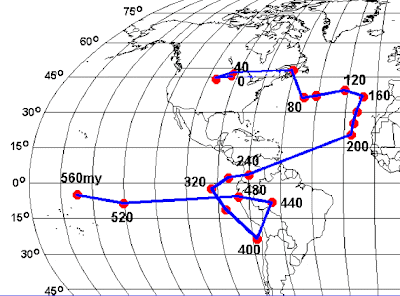
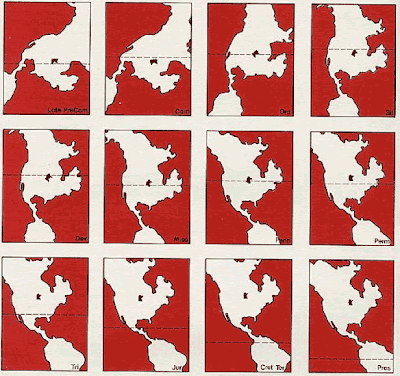
But, just to keep things in perspective, it's worth remembering that Minnesota was not always this way. As a TA for a Bio-geography course at the University of Minnesota, I teach and learn about place tectonics, soil formation, and geology. And if you look at the big picture, 70 degrees in March is nothing to write home about. As recently as 240 Million Years Ago, Minnesota was very close to the equator, and had a hot, humid environment filled with rainforests.


[The location of the Twin Cities has moved during the past half-billion years, from the South Pacific to near the Andes to its present location in the North.]


For example, did you know that Minnesota used to be in the Southern Hemisphere? Don't get too excited about this recent spring warmup. Just wait a few hundred million years, and we'll really have something to talk about in the office elevator.*


[The location of Minnesota in relation to the Equator over the last few hundred million years.]


*... provided climate change does not kill us all.