Showing posts with label seasons. Show all posts

2020-01-16

Twin City Myth #2: The Reign of Malor


These words — whose earlier legacy will be familiar to close readers of this blog —are written from my home office in the dead of winter. I upload them now for you to view online, in the hopes that someday we may better comprehend the strands of horror and madness that lurk on the surface streets of the strange Minnesota city that now serves as my home. In the few next paragraphs I will share with you all I have learned over these past days, the span of which have torn through my mind like an SUV on Kellogg Boulevard, barely a blur, recalling only the ancient carousel ride in Como Park, where the grim visages of the wooden horses that there reside are locked in an eternal rictus of pain and astonishment, their equine anguish forever drowned in the infernal jolly tune braying outward and unceasingly by the calliope at the center of that revolving contraption.

Some weeks ago, I was struck by a disturbing vision that I can barely describe. This image was quite sudden — though later I realized that I had been having premonitions, brief chaotic glimmering thoughts that formed a precedence for my indelible impression — and for the rest of the day my head ached with a singular feeling that something terrible was occurring. 

My cat, Djuna Barnes, felt this also. As she twitched her tail and curled at once into a ball, shunting the world itself away from her eyes, I realized that she, too, was struck with the angst that can only come from glimpsing a black sea of infinity. She placed her tail before her eyes and I could only wish that I myself had a prehensile appendage I might use to block the wintry landscape from my horizon.

As soon as my fragile legs permitted, I left my Frogtown home to trudge the streets of Saint Paul in search of a salve for my new fragility. Given the gruesome climate, this was a daunting task, and the streets and sidewalks were covered in the two-inch-thick layer of  ice, snow, and dirt that collided and mixed in chaotic and unpredictable fashion. With each falling step, the kaleidoscopic insanity of the city's surface tormented my passage, and yet I trudged onward, seeking respite from the anguish that had befallen my consciousness, the spectral and nameless horror that gripped my imagination. 

I wandered through the maze of hybrid squalor along University Avenue, passed over the dirty highway where a river of decaying automobile carcasses continued to lurch in both directions, belching toxic menace into the foul air that choked the very oxygen from my lungs. I do not know how long I walked or in what path I travelled that evening -- I remember nothing else from the voyage -- only that eventually I realized again where and when I was. 

Somehow, I had found myself pacing through that bleak crepuscular dusk that is the Ayd Mill trench, clutching my stained coat about myself and walking along a set of railroad tracks that ran through that parched and terrible valley under the moon. To my left, paralleling my forlorn steel path, was a concrete highway of such frightening state. Its very surface was pocked and cratered like the face of Steve Bannon himself, The Black One, The Filler of Space, who absorbs his victims within his featureless malevolence.

There below my grey sneakers lay the railroad, and afar I saw a stone monument protruding uncannily above the edges of the valley, as parts of an abandoned Chrysler may protrude from an ill-made Wisconsin junkyard. What this stone surface meant I did not know and could not fathom, but I found myself walking towards it nonetheless, as if pulled toward the bottom of a cold black lake to drown.  

As I approached the stone wall I examined its surface, which was intricate and ancient in form. The stones were of a pale almond hue, and had been set into a massive pillar that stood there for no apparent purpose. Each stone was joined to the next with a chalky substance whose origins I could not determine, and as I touched the old rock with a well-worn glove, I discovered a dark aperture near me, a singular rectangular stone marked with an ancient scrawl. In the waning moonlight I could make out only the symbols -- #KSPB -- though its significance I could not fathom.

This stone had clearly once served as monumental artifice, and without much thought, I cleared the snow and ice away the crevasse with my trusty beer opener keychain shaped like a pedestrian warning sign, a tool without which I am never to be found. With my iPhone flashlight, I peered inside the dark cavity to reveal what mysteries it might hold.

Inside was a tattered book of ponderous, archaic, and vaguely repellent aspect, thick with old paper and bound by some sort of rubbery substance. I removed it from its stony tomb, clutched it in my fingers, and nestled it underneath my coat. The touch of this book seemed to restore my balance, for instantly I felt the wind gusting through that cursed valley, and looked around me for a path of retreat.

Finding a break in the thick branches that stretched like a wheel-bender bike rack around the wasted margins of the foresaken slope, I climbed up the side of the bramble, following a barely discernible path through the dim wintry foliage. In time I had returned to the streets of my lifeless city, which crawling with the toxic steel carcasses of the death machines that launch themselves day and night through the spaces between buildings. Around me, avenues of limitless night radiated in every direction, and I was sure that somewhere here lay the root of a contagion destined to sicken and swallow the city itself.

After an hour of walking along the dreadful passages that the ice allowed, I had returned to my home and only then did I begin to make sense of what I had discovered in the dark mouth of that asphalt waste.

Seeking the safety and comfort of my study, I carried the book through my house, and it was at that moment that my cat, Djuna Barnes, edged herself between my feet and tripped me, as if a feline foreboding had struck both her and myself with its urgent word. The resulting intermingling of limbs overturned both my body and, at the same time, the weather-beaten tome I clutched. 

It fell to the floor and opened to a page, seemingly at random.

Startled, I found myself shifting at once to a sitting posture and gazing back along the hallway, as if into a tunnel to the outer world. My sensations were much like those which had made me shun Saint Paul at night, and were as inexplicable as they were poignant.

I looked upon the page that had opened upon the floor and gave witness to the following words:

COVER IT ALL

What this meant I did not yet fathom, though something about the cadence of the wretched syntax deflated my stomach like a flat tire. I immediately recovered my erstwhile sense of purpose, and retreated that night to my chambers, leaving the black book alone on the desk, for I dared not touch it.

Some days later, yet plagued by a grim unease, I resigned myself once more to tackling this unknown catalog. What I found will not come easy to those who value their security, and if you wish to retain your sense of calm about traversing this grim city, onto which nearly endless winter has once more befallen, I beg you to read no further.

With a trepid hand I opened the book, and began to make sense of its unkempt scrawl.

It was titled “Collected Records and Journals of Saint Paul Bike Scum”, which I can only imagine was reference to some hopeless population that once dwelled in the dank margins of the strange capital where I make my home. 

The notes were largely unintelligible to my eye, recordings of dates and names, crude cartoons made in thick marker, diagrams of cross-sections of streets, and many cursings of specifically named powers. Most of it was rendered a meaningless Babel to my eyes, but haunted by the words that had appeared to me in my moment of cat-addled gravity, I persisted.

On the eleventh page, I found it: a mention of Malor.  


“Who is Malor? What does it want?”

This was all that was written on the weathered paper, under the date November 19th, 1992. A great blank emptiness lay around it on the page, followed, oddly, whether by some ill intention or accidental befoulment, with subsequent pages which were rent and torn from the very book itself.

Malor… Malor… Malor...

The word repeated in my mind like the bells of St. Agnes toll from that grim tower, which even now glows green and alien over the shuttered homes of the odd city where I live. I fell to babbling over and over that unpronouncable name. But as always in my strange and roving existence, wonder soon drove out fear; and I pressed on to glean what I could from this malevolent abyss.

At this point, the crusty tome seemed to change in character. As as I read the journal, I found it less and less about street names and dates and the dark ways of city hall, and increasingly focusing its text around on that one singular name: Malor. 

The entry for January 9th, 2005, begrimed upon the page with the same scrawling hand:


Malor came into physical being a short time ago but has always been present in the universe. Born of deep cold in the hearts of the drivers, and the tears of children, Malor willed itself into physical being in order to torment the citizens and public works department of Saint Paul.

What did it mean? The name seemed familiar, like the instinctive desire to stop at a bar. I pressed on and, as the pages turned, spring and summer all but vanished from the entries of the text. Only the winter months remained.

Under December 28th, 2008, the manuscript mentioned Malor again:


No one is sure what Malor’s objective is - other than to cover it all. 

COVER IT ALL

As I turned the pages, comprehension spread like salt brine through my imagination. This Malor, the black, icy horror, was a creature of impenetrable coverage, oddly widespread and persistent, and covered the very streets of Saint Paul where I had tread but a few nights prior. Malor existed at this very moment, right outside our door. But where did it come from, and what did it want? 

Could Malor be connected to the Winter Carnival, the ancient cult of Vulcans and so-called royalty, the most visible and long-surviving of the secret societies that thrive in this fecund metropolis? Or was that merely a cheerful facade, beneath which the ancient and malevolent truth of Malor lurked like so many shards of glass in a bike lane?

February 4th, 2011:


The power and fortitude of the belly plow is our only hope for breaking the bond of Malor

This appeared to be one of the many times that this intrepid but doomed cult, which must be one and the same as the Bike Scum, had attempted in vain to end the reign of Malor, to vanquish the ungraspable being that had lay waste to the city streets. 

I later learned that they believed that Malor had always existed and always would exist, hidden under the snow and car tires of all streets of that worn city, and emanated somehow from a dark house in the Hamline-Midway neighborhood where poisonous discourse and terrible ideas were generated like a blizzard descending from the Canadian prairie.

From January 2012:


Only when Malor is at its weakest will a girthed steed save you. At its strongest - there are none that can remain upright against Malor’s slick - only the studded have a chance.

It is here that I noticed around the edge of the musty pages, text scrawled haphazardly in a hand so small that I could barely make it out.

The first marks read:


I am Malor’s Chosen. I venerate his name!

And again it continued on the next page:


Malor honors me with a sure foot upon his icy visage!

And thrice the pen marked:


His frosty rime is ornate upon my form!

At that point the marginal statements ceased, leaving only the dread conclusion that icy madness had seized the mind of a grim occultist. I realized then, as I do now, that when faced with the malevolent abyss of the ice sheet, one’s grip on sanity slips as much as one’s grip on the ground. I know this all too well in my ventures, and it is only by clinging to my cat, Djuna Barnes, that I retain even a slim thread of sanity under Malor’s reign.

On September 28th, 2015, an ominous prediction:


Once more, Malor will rise and bring the streets of Saint Paul again beneath his icy sway. Some day he would call, when the stars were ready, and the secret cult of trash people would always be waiting to liberate him.


The entry from 2017:


Cry havoc and let's slip on the gloss of Malor.

And the last entry in the book, undated:

Malor. Only Malor. Forever. Cover it all. Cover it all.

What it means I cannot fathom and, to be truthful, my will to continue is weak. To convey any idea of this monstrosity is impossible as primal myth and modern delusion have joined in my mind in the assumption that we humans are only one — and perhaps the least — of the highly evolved and dominant creatures of this city’s long and largely unknown lifespan, that on the surface of the streets lurk things of inconceivable shape, 

For the book itself, I shall give it to my cat, Djuna Barnes, to sit on. She is the only member of my family who stuck by my side after my queer amnesia, and remains organism best informed on the inner facts of my case. Of all living beings, she is least likely to ridicule what I uncovered on that fateful night.

As for Saint Paul, it is always the same. Malor has come and perhaps some bright day, if we are lucky Malor will go away, as a terror gathers and fades. But the evil spirit of darkness and squalor yet broods amongst the hopeless that persist in the old wood houses, and prowling bands of scum on bicycles still glide past my stoop on unknown errands, where windows of dim lights and twisted faces unaccountably appear and disappear.

2018-03-19

Introducing Sprinter (spring + winter), the Season You’ve Been Waiting For

[Sunshine + snowpack.]
People in Minnesota always say that "spring is so short here."

They also always say, with a resigned air, "Oh woe is me! We have six months of winter."

Many people wear these seasonal affectations like paper bags on their heads. In the grips of the seemingly endless winter, they wilt and feign helplessness. They insist they cannot do anything like ride bicycles, sit on patios, play football out of doors, or leave the banal containment of the downtown skyway system from November through May.

Of course that’s not true, but one of the problems I think we face as a northern (albeit rapidly warming) society is that we assume that because it *might/probably-will* snow at some point in April or November, that therefore winter lasts that long also. This kind of attitude subsumes all seasonal variation within a six-month period into once overarching and oppressive seasonal concept — “winter" — that to the untrained eye looks homogeneous and bleak and therefore sends otherwise reasonable people into a cycle of place-based self-loathing that leads invariably to seasonal affective disorders, anti-social architectural escapism, and misguided flights to Florida.

It's sad. But it doesn't have to be this way...

Listen friend, have I got a concept for you! It’s a brand new season that has already existed your whole life,  but you didn’t have a name for it yet.

It’s called Sprinter!

[Sprinter is when all these lines get tangled up at once.]
Sprinter is spring + winter, and it's the season that begins with the first 50ยบ day and lasts until the final bit of snow or sleet-type precipitation.

Like an actual fast-moving runner, sprinter comes at you fast and can be fleeting. But it’s a meaningful, distinct season that exists in Minnesota and helps us understand the fine-grained stuff happening in between actual winter (defined as mostly below-freezing temps) and actual spring (defined as when leaves and flowers appear out of the trees and ground).

Here are some hallmarks of sprinter season.
  • Mud! Lots of mud. In some communities, sprinter is also known as “mud season.” The earthy sickly-sweet smell of mud surrounds you in sprintertime, and you grow to love it in the way that a farmer loves the smell of manure or an old man loves the smell of his farts. It’s a sign that things are alive and working properly.
  • Heavy snow. I mean this literally, in the quality vs. quantity sense, where any snow that falls has a lot of moisture content and is heavy. Thundersnow might also be a thing that happens here.
  • Melting snow. The drips and drops of snow are all around you, forming into sidewalk ice flows and piles of snirt (snow + dirt). The constant dripping and evaporation fills the air with a crisp kind of cold humidity that’s sort of exciting, especially in contrast with…
  • Warm sunshine. Unlike in actual winter, the sprintertime sun warms your skin and you can legit get a sunburn in sprinter like I did at the Minnesota United home opener this weekend. The contrast between the still-existing snow and the warm sun is the hallmark of sprinter weather. 
  • Uneven landscapes. The “warm side” of streets that get all the south-facing sun are dry but the “cold side” of streets that face northward are full of ice. It’s weird!
  • Teens wearing shorts. Oh those teens!
  • Other things? Feel free to leave them in the comments.

Sprinter is what we need. They have more than four seasons in other places (e.g. Japan’s “rainy season” and India’s “monsoon season” and the Shire’s “second breakfast”). Why not here?

Sprinter is spring + winter and it’s a season for those who feel trapped in the eternal slog of wintertime and calendars and whatnot. Embrace sprinter, for it has already embraced you. Get out and ride your bike, bask in the warmth of the midday sun, and go on walks on the sunny sides of streets.

Sprinter moves fast, so enjoy it while it lasts!

[This kid gets it!]

2017-12-25

A Christmas Prayer for Streets and Sidewalks

God bless our sidewalks, and the spaces that bring us closer to each other every day.
Instill in us the strength to listen, and give our cities, parks, and streets the grace of rich connections.
Bless us with the patience to treat each other with kindness, toleration, and love, even when our world makes this a difficult task, even in the thousand rushed hours of our daily routines.
Let anger and frustration fall from our thoughts and roll off our backs like raindrops from the awning of a corner store.
Let us travel with the relaxing poise of a drifting cloud.

God give us the strength to love our neighbors as ourselves, to shovel the ice and snow from our sidewalks, to trim our hedges and share the benches in our parks.
Give us the wisdom to be stewards of our inheritance, the parks, buildings, trees, and countless nonhuman lives that form the cities where we make our homes.
Give us the vision to see and know the people that dwell in public places, not just those that speak our language or share our taste in music, but even the strangers to our eyes.
Give us the grace to share our space, our thoughts, and our streets in new ways, to reward ourselves with the compassion, care, and camaraderie that come from lives of rich connection.

God grant us the beauty of long walks.
Let us understand ourselves as we understand our streets.
Let our perambulations be like pilgrimages along our sidewalks and through our alleys.
Give us the patience for a pedestrian pace.
Allow us to breathe freely as we go on our way, and grant us the space for serendipity.
Let us discover new and precious things even in our own back yards.
Let us hear the sounds of birds, bells, laughter, and the rustling of leaves as we wind our way through the coming new year.

God thank you for this life we live together and grant us the grace to receive it with curious eyes, open hearts, and springs in our steps.

Amen. 

[Delivered during the 2017 Christmas Eve service of the Judson Memorial Baptist Church in South Minneapolis.]


2017-12-20

Close Horizons of the Winter City


One crucial trick to living in Minnesota is appreciating winter.

For many, long months of colder weather, ice and snow, shut windows and thick jackets, offer nothing. We wallow in a mentality where winter strips our theoretical freedom to be Californian, to drive with open windows or bask in the sun. We freely wield the moralistic assumption that warmth is good and cold is bad, that melting snow should be greeted with sighs of relief, that winter is a thing to overcome or ignore or engineer out of existence with tanning beds or heated garages or skyways or flights to Florida.

It's all too easy to fall into these canyons of climactic resentment, as the small talk builds up and weather reports plot daily escape. It's far harder to appreciate winter, to see seasons not as limits but opportunity.

This winter I've found myself marveling anew at its expanse and openness. I love the way that leafless trees expose the surrounding city, and seem to draw it closer like a hug. This year, I'm embracing the sight lines of the winter.

It helps that I live near a bluff, just south of downtown Saint Paul, and just downstream of where the Minnesota and Mississippi rivers come together. Here the valley opens up and expands into a wide bend.

In the summertime, the views of the valley seem suffocated, as the trees and sumac and various vines explode to swallow up the landscape. In summer, it seems as if the ground beneath the streets is alive and trying to buckle. The edges of the valley around seem distant and unclear, far removed from the rich world unfurling around me.

In the winter, it's the opposite. The valley telescopes in strange new ways. The leaves disappear. Trees quiet. Horizons appear closer.
From my back porch in winter, I see the crisp ridge of Saint Paul's East Side over the rooftops. It appears as perfect as an origami fold edging the city. There is Mounds Park, the pulsing lights of the airport tower, the purple glow of the Metro State building (a former hospital), the red cross of the old Lutheran church on the edge of Swede Hollow, and there is the row of yellow streetlights cresting the bluff top. It's all plain as day during long winter nights. These places seem closer in the cold, offering new arrangements. Looking at the silent horizon, I feel I could reach out and brush the bluffs with a bit of snow, like Bob Ross adding a highlight.

Walking in winter, the bluffs newly manifest. Rocks arrive. Foundations expose themselves. The limestone cliffs, normally hidden beneath a thick quilt of green, are now frosted with thin white snow.

The bluffs are thick, ancient, and impassable, the basis of the city below your feet, and walking down Wasbasha, in wintertime I can look up and see the house that sits on the end of Delos Street, its windows poking up aglow. It levitates over the streets below like a magic carpet.

Driving along Highway 13, that narrow road that curves over the river below, the West 7th neighborhoods stretch out. The lights of the buildings and streets read like a braille sequence, and the Schmidt Brewery sign sits atop the story like cake decor. The edges of city are visible in new ways, and everything from the downtown Minneapolis skyline, poking above Highland, to the alabaster Capitol dome is right there for your eyes to encompass.

This is to say that Saint Paul shrinks in winter, its geography contracting like an iris. Sweep the horizon with your glance. Notice the fresh connections. Winter offers such subtle surprises, cold vistas to appreciate, and even the dark embraces.


2017-12-04

The Last Ice Palace of Saint Paul

[Plans for an ice palace that will never be built.]
The forecast high temperature today, on December 4th in Saint Paul, Minnesota, is 58 degrees. That might seem unusual, but it shouldn’t.

The warm air reminds me of a little-noted event that happened a few weeks ago. It was the announcement, made by a group of civic boosters, that despite the upcoming Super Bowl, there would be no ice palace in Saint Paul this year.

Here’s what one report said:
Even if they’d gotten the money, however, organizers also faced the challenge of having a place to harvest the ice. In the past, it could be chopped out of area lakes but too often lately the lakes don’t freeze early enough.

The planners envisioned an ice palace reaching 170 feet at its apex, which would break a current world record of 166 feet set in Minnesota in 1992 — also during a Super Bowl.
Though no fan of the Super Bowl, the story stuck with me because the plain truth is right there. There will never be another Ice Palace in Saint Paul.

Never.

That’s a crazy and absolute word, but it’s true. Saint Paul’s lakes will never freeze thickly and quickly again. People will never harvest blocks of ice, never again build a fantastic palace of frozen water. A tradition that's as old as anything in this city is dead forever.


[The 1887 Ice Palace in Central Park, built from 30,000 blocks if local lake ice.]
The first Saint Paul ice palaces were built in a park that no longer exists, Central Park by the State Capitol complex. The park was partly funded by a distant relative of mine, a wealthy merchant who built a mansion on its northeast corner in 1880. A few years later, in defiance of the long cold relentless winters, they began the Winter Carnival, an annual celebration of the city's most infamous season.

A few decades later, F. Scott Fitzgerald grew up in Saint Paul, and wrote an early story based on the Saint Paul ice palaces. It tells the tale of a southern girl named Sally Carrol who moves north for love, and quickly becomes alienated by the winter’s cold. The tale centers on the ice palace:
After another ten minutes they turned a corner and came in sight of their destination. On a tall hill outlined in vivid glaring green against the wintry sky stood the ice palace. It was three stories in the air, with battlements and embrasures and narrow icicled windows, and the innumerable electric lights inside made a gorgeous transparency of the great central hall. Sally Carrol clutched Harry's hand under the fur robe.

"It's beautiful!" he cried excitedly. "My golly, it's beautiful, isn’t it! They haven't had one here since eighty-five!"

Somehow the notion of there not having been one since eighty-five oppressed her. Ice was a ghost, and this mansion of it was surely peopled by those shades of the eighties, with pale faces and blurred snow-filled hair.
The story does not end well.

[The 1896 Ice Palace, built the year Fitzgerald was born.]

In the 1940s, they again built ice palaces in Saint Paul, designed by a man named Cap Wigington, the city’s African-American civic architect. Compared to the utilitarian buildings he was normally tasked with, the mercurial ice palace designs became elaborate dreams. The palaces were a chance for him to create the incredible, to capture the hopes of the city in ephemeral blocks, frozen for but a moment in time. Wigington made six ice palaces, and each of them melted crazily in the springtime.


[Wigington's 1937 Saint Paul Ice Palace.]
Growing up, I remember going to the Ice Palace as a kid. It was in 1986, when I was seven years old, and I  recall the cold smell of the crowd that lingered in the air, the dry scrape on my feet from the corners of the walls. The thick blocks, the lights shining in pastel colors, the monumental towers and the sheer impossibility of the building stick in my mind like a barely remembered dream. To me, that palace was the most fantastic.

A few years later, for another Super Bowl, they built another one, with cleaner modernist lines.


[The world record 1992 Ice Palace, that bankrupted the Winter Carnival. The record might never be broken.]

[The 2011 ice wall, a shrine to the lost past.]
In the remaining years, whatever was left of any Winter Carnival ice had shrunk to the size of a simple wall erected in a downtown park. A candle seemed to flicker alongside the ice as people strolled past, the light glowing like a shrine.

That was the end of the Saint Paul ice palaces. I saw them, and they are gone forever.

Climate change is typically viewed as an event horizon. By 2100, so they say, the seas will rise and Miami will flood. But in fact, climate change has already taken place. A major piece of culture that I personally remember has gone extinct, and Minnesota winter itself rapidly follows suit.

As I write this, the annual ice fishing show has just wrapped up at the downtown arena, but it’s hard to envision much future in that endeavor.  So too with cross country skiing, outdoor hockey, dogsledding, and snow forts, all things that will disappear on my watch, reduced to nothing by our collective climactic failure.

Years from now, when I am old, I will tell children about Saint Paul's ice palaces and they won’t believe me.

“When I was your age, we walked on lakes in the wintertime,” I will tell them. “We even drove trucks across them! People would build houses on the lakes and stay out there for weeks on end. And the snow covered the ground for months and months without melting.”

“We don’t believe you,” they will say. “That’s not possible!”

“When I was young, there was a blizzard on Halloween,” I will tell them. “Snow plied up to the windows, and everyone stayed home from school. In January, when I was your age, it got so cold that your nose hairs froze, each tiny little hair, frozen like a popsicle! When I was little, the air got to be twenty below zero! Once I took a pot of boiling water outside, tossed it the air, and it froze immediately. It disappeared and never hit the ground.” 

"You're lying to us!" they shriek.

“No I am not," I insist with a smile.

"When I was little, there were huge castles made of ice, right here in Saint Paul in the wintertime,” I will say. “I saw them with my own eyes. I went in one! When I was your age, I walked in a ice palace that was over a hundred feet tall. It had towers and lights and stairs of frozen water.”

They will say, “Are you telling the truth?”

2017-07-20

Six Hot Tips for Biking in the Unending Damnable Summertime Heat

[Makes you want to bike right into the river.]
Biking in the heat kind of sucks. No matter where you go, there you are sweating on the asphalt, the sun beating down on your puny body, your poor skin pinking and your hair stuck to your eyebrows. Then you arrive at your destination looking like a homeless muskrat and it takes a full fifteen minutes before you can recompose into something resembling a normal drives-in-the-air-conditioned-car human being like everyone else seems to be. Biking in the summer:it’s not the heat, its the humility.

That said, there are a few things you can do to make it better. When it gets really hot out and stays that way, I find myself riding in a slightly different manner. So here are my hot-take pro tips for biking through the summertime heat.


1. Take it easy and chill out

The first thing is that I tend to slow down a bit in the summer. (Unless you’re on a workout ride, in which case go ahead and sweat as much as you want.) Actually biking to get somewhere, I find myself coasting more and being a bit lazier.

Basically, you want to be going fast enough to keep a breeze going — about 10 miles per hour. The reason people sweat is because condensation is a cooling process. Maintaining a consistent steady pace in the summer heat, and avoiding stopping at stoplights, is a great way to keep just a bit cooler.

2. Find the shade

[Stark shade lines.]
If you do have to stop at a stoplight, though, see if you can find a patch of shade. I find myself doing that on some streets, stopping a bit short to stay behind a building or under a leafy canopy. Or sometimes I might take a more shady side street instead of the more exposed main drag. Shade makes a huge difference when the sun is beating down on you, and if you look for it, you can find some.

See also this post about street trees and finding the shade.


3. Panniers are your friend

Nothing’s worse than riding in the heat with a bag on your back, then peeling it off like an unshelled turtle to reveal the soggy swamp that is your shirt underneath.

So ride a bike with a rack, if you have one, and put all your stuff in a pannier.

4. A/C stops are easy!

If you’re going a longer distance, take a break in the middle at a library or cafรฉ. Nothing makes you appreciate air conditioning as much as a hot summer bike ride!

5. Water is good

Keep drinking it. Put it in a bottle and drink it form the bottle. Drink it when you arrive, before you leave, just whenever. Bonus points if you find one of those old-fashioned Minneapolis water pump fountains and just put your head in there.

6. Bring extra clothes

Always have another shirt on hand in case you need it. You’ll probably need it. Soon it will be sweaty too, but at least you'll feel better about yourself.

That’s it! Good luck to you. When winter comes, you’ll look back on these hot days with envy and regret that you didn’t ride your bike more. There should be a long German word for that… maybe Fahrradsommerbedauern?

[It's only going to get worse.]

2016-05-05

Bike and Smell the Flowers

[Canopy of lilacs.]
Spring in Minnesota is not subtle. It hits the landscape like a bowling ball, trees exploding with leaves, and all at once the sun feels legitimately hot on your skin. It stuns, a tingling numbness that makes springtime walking and bicycling a semi-euphoric Vitamin D contact high.

But there's an extra dimension to bicycling that is the cherry on the springtime Sunday, something that makes me feel actually sorry for all the people stuck speeding their cars around town. For the last two weeks, riding a bicycle around the Twin Cities has felt like having your face stuffed into a pillow of flowers.

The apple trees, the pink trees, the white trees, the other red trees, the lilacs, purple and white, stuff I don't even about or notice. Everywhere you go, gliding along city streets, flourishing flowers send amazing scents up your nose. Especially after months of being cooped up inside, it's a magnificent everyday drug.

[This is me right now.]
Scent is one of the dimensions of our cities that we lose behind the windshield. Cocooned in metal shells, we smell little more than our insulated world: fossil fuel, fast food, the old coffee in the cup holder, the detritus of domesticity. But outside on a bike, the air is alive with secret springtime signals tickling your nose, like the slight hint of rain or the tint of pungent mud. On a bike you can imagine what a dog must be thinking as it wanders up the block, led by its nose, looking for other dog butts or forgotten glorious dirt. And for humans, during two or three weeks each year the urban smellscape fills the air like a firework of invisible color.

You don't even have to stop and smell the flowers. They will surround you with their magic. Biking around the city, I feel like the 1960s cartoon of rascal cat led by the scent of the pie cooling on the windowsill. The flowers beckon me around the corner, lure me with sweet aroma, conjure my energy, suffocate my senses with a blanket of fresh life.

What ephemeral glory! Olfactory inertia. Get out there.

[Purple and red ones.]

2013-09-20

Name That Sidewalk #7 MYSTERY REVEALED!

[The mystery sidewalk, with a lovely askew desire path.]
Well, there were a lot of incorrect guesses about the latest mystery sidewalk. My theory is that, by late August, Minnesotans develop a perception filter that forces our brains to not be able to comprehend a sidewalk covered in snow. As we live here, experiencing the bi-polar climate, whether we like it or not, our brains banish any memories of the opposing season, fostering collective states of willed bi-annual amnesia. Call it "midcontinentitis."A wintery landscape in late August seems like another planet, and cannot be comprehended by a Minnesotan.

That said, this sidewalk wasn't completely difficult, certainly not as challenging as Mystery Sidewalk #6. Guesses included:
"50th and France"
"East River Road"
 and "Lake Calhoun"

Could it be? Note the lengthy topographic slant, certainly rarity in the Twin Cities. Note also the lights in the distance, betokening some sort of dense node. What is it? A mall? Note also that I live nowhere near Minneapolis, and am a profoundly lazy person.

Yes, those are the distant lights of downtown Saint Paul. Dutiful reader and long-time Saint Paul West Ender Adam Yust was the first to correctly ID the spot, sending me an email that simply said:
Wabasha St, west side

Correct! Not only is this spot less than a mile from my apartment, it's less than a 1/4 mile from Name That Sidewalk #4, the spot at the top of the no-longer-extant "green stairs."

Better luck next time!

[Studies show that most sidewalk bloggers will only walk 1/2 mile to take photos of mystery sidewalks.]


2011-12-23

Merry Sidewalk Christmas; Twin Cities Shop Windows #2


[Santa spotted through a shopwindow. Marshall Avenue, St Paul.]

2011-12-21

A Rough Guide to Christmas Lights in the City

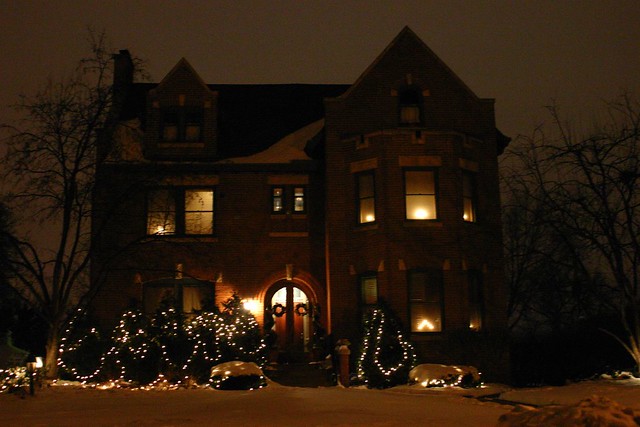
High rise lights – These are often the simplest, smallest, hardest to spot, and usuallly the most boring. It involves draping a string of lights on your balcony because that’s the only place visible to the outside world, who has to squint up from a vantage point 100 feet below. These lights are purely symbolic. They say, “Look, I’m trying!” Other than that, they have no real aesthetic value.

[If you look closely, you can see a string of lights in the center of the picture.]

Working class urban lights – These are my favorite. These are the little decorations and lighting efforts that exist in the close-knit sidewalk proximate neighborhoods in older parts of the city. These homes, sitting as they do at a nice balance point between density and private property, allow for the most intimate encounter with the lights themselves. Often it is fences or tiny yards that are filled with lights awkwardly strung up, or dim faded plastic Nutcrackers. Other features of these kinds of lights are great variety and idiosyncratic placement.

[Classic old school lights from St Paul's North End.]
[Another North End example. You can reach out and touch these candy canes from the sidewalk.]

Upper class urban lights – These are also the most boring, in nicer ritzier neighborhoods of the city. Often what you’ll get here is a single huge pine tree festooned with perfect lights equally interspersed at 4.6 foot conic intervals, fake candles placed tastefully in windows, or a single evergreen wreath on a door with white lights embedded inside. These lights look like they came out of a Home and Garden catalog, lack personality, and serve primarily to increase property values.

[St Paul's Summit Avenue: very fancy!]

Inner ring suburb lights – This is where you find the truly manic light decorations, Christmas light extravaganzas of mind-blowing ridiculousness. Something about these smaller suburban homes in aging neighborhoods combined with boomer consumerism at the right time to create the classic Clark Griswold / Homer Simpson scenario: roofs entirely covered, blinking plastic sleighs, music blaring out over a neon-lit fake snowy landscape. Here you have the ideal yard / sidewalk / income ratio, and it leads to terrible greatness.

[This example I found on the internet from South St Paul.]


Second ring suburb lights – This is similar to the above only the yards have grown, the sidewalks have disappeared, and the plastic crap is a bit less crappy, all of which are changes for the worse. You basically have to drive around in your car for long distances to hoping to come across someone who bought the Lowe’s #2 dรฉcor package. People, some of whom are in high school, rent limos expressly for this purpose. (Or else you get crazy stuff like this. Who cares which city this is located?)


[Oy vey.]


Exurban lights – Can you even see them from here? Why bother.

[Lights in a church steeple in Minneapolis' Marcy-Holmes.]

2011-11-21

10 Great Things about Sidewalks in the Wintertime

One of the more depressing things about our car-culture society is that it forces us to view wintertime with apprehensive dread. When snow falls, driving sucks. Ice and snow might double or triple your daily commute. Thus winter, for most people, is a slow torture, stuck in traffic,  wait for a car to warm up.  Winter is like being trapped on a remote island, eternally scraping ice off your windshield like an Eskimo Sisyphus.

Well, winter doesn't have to be that way. If you're walking and taking the bus as your main mode of transportation, winter can be delightful. There's nothing as wonderful as walking through a snowy evening along a well-shoveled sidewalk after the first snow. So, try and forget about your commute for a second, and stop and enjoy...

#1: Transparency

Because leaves have fallen are off all those pesky trees, you can see new things in the wintertime. You can see from the tops of hills. You can spot the birds in the bush. You can see the river from the top of the bluff, or the downtown skyline from your back door.

#2: You can see which of your Neighbors are Assholes (or Missing)
 
All of a sudden, you can see which of your neighbors don't shovel their sidewalks. Nothing says "asshole" like 9 houses with nicely shoveled paths, and 1 house with a 3-layer cake of ice.

Plus, you can find out which homes are foreclosed, for sale or vacant. Or if you're a mensch, you can shovel the walk for the old lady next door who never leaves her house any more.

#3: Snow Makes Things Look Pretty

Snow is what makes Bob Ross' trees so happy. Snow makes nice visual highlights on trees, railings, and eaves like so many little frosting hats.

#4: Sidewalk Snow Canyons

Once you get enough snow, you begin to develop snow canyons on each side of the sidewalk. As these banks mount ever higher, your street starts to feel snug. You begin to feel like one of the marbles in the Sesame Street 1-2-3-4-5 video. Alternately, you can pretend you're hauling a stagecoach full of gold through a bandit-laden Wild West canyon. Embrace the excitement!

#5: Footsteps

Snow on the street means that every passerby leaves little footsteps behind them. There are little cat prints, There are people shoes, dog paws, or the marks of unidentifiable critters. All of a sudden, your neighborhood doesn't seem so lonely.


#6: Shuffling Your Feet

Ice, if it's predictable, can be fun. You can slide your feet along and pretend you're skiing or skating. You can glide and shuffle and pick up some momentum and slide into the nearest fence. Wheeee!

#7: The Underfoot Crunch  

I love when you walk on snow and you get that slight crunch underfoot, that tiny squeak of snow compacting ever so slightly when your weight comes down.

#8 Glittery Reflection

Snow sparkles and shines in the sunshine. Frankly, this is amazing!

#9: Long Wintertime Shadows

Because the sun is low in the Southern sky, wintertime shadows are long indeed. They stretch out over the white topography like great grey fingers, reaching across yards and fields and streets, searching for something mysterious.

10: It's Oh So Quiet

And I think my favorite thing of all about sidewalks in the wintertime is how the city becomes so very quiet.

We tend not to notice all the constant city sounds all around us all the time. The sounds of cars and airplanes and exhaust fans are so ubitquitious, we almost never hear them any more, the whirrs and hums of engines fading into an invisible background.

Snow changes all this. For the first time in months, the soft blanket deadens the sound waves, and a blanket of silent peace falls on the city. The sounds of car tires is replaced by the gentle wisp of your own breathing, and the whole world seems to get a lot smaller. 

So, embrace the winter. Watch your step, be sure to shovel, and enjoy the snowy sidewalks.

[Even Mary Tyler Moore loves sidewalks in the wintertime.]

2011-10-31

Halloween is the Sidewalk Holiday

Every holiday has its geography. Thanksgiving and Christmas are domestic. People hole up in houses, locked in living rooms, huddle with fires and TVs and set themselves against the long winter dark. Summer holidays, like Memorial and Labor days, are outside under skies and in yards or parks with picnics and barbeques. The 4th of July is fireworks, the way they burst high above the city, creating horizons of light embracing entire cities.

Halloween is different. Halloween flies in the face of everything about our modern era of paranoid parents, media hysterics, over-protected children, and privatized communities. Somehow, through the magic of Halloween, parents actually want their kids to wander the city, approach random homes, and take candy from strangers. People are encouraged to dress in creepy ways and be weird. Instead of holing up in your house and gathering possessions onto a dinner table, at Halloween you pace behind your door and wait for the doorbell to ring. You hang out on your porch and watch your neighbors pass by. You wander the streets in the evening, kicking leaves into the gutter and looking for pumpkins. Halloween is the sidewalk holiday.

Somehow, Halloween reconfigures the social orientation of US cities, taking people that are normally homebodies and dragging them off the couch, taking kids out from their electronic bedrooms and fenced-in yards and, using the surefire lure of sugar, demands that they aimlessly wander the streets. Younger kids walk clutching parents' hands, while older kids form elite trick or treating teams, action squads of exploration that map out yards and streets of whatever part of the city seems to hold the most lucrative blends of corn syrup and Pennsylvania chocolate.

Halloween gives kids trotting twixt front doors a gift that will haunt them for years, lingering twilight giggles of city memory that lay a foundation for urban mystery. Early memories of walking winding streets past dark homes and wondering, “who lives inside?” and “why aren’t they giving me candy?”... these are precious city seeds. The first discovery of a new street, a little trail that connecting the park to the back road, sticks with you like a cockleburr... these are the first steps of a lifelong road of alleys and lanes, of possibilities and potential people you might become.

Every holiday makes its own city. The Thanksgiving city is nothing but living rooms, dinner tables, and doors sealed to the outside, homes linked only by telephones and TVs. The Christmas city is a forest of chimneys, churches, and shopping malls. But the Halloween city is wide open and linked by endless strolls. It is a city made from porches and doorbells and strangers and shrieks of laughter. Halloween is the holiday of sidewalks.

2011-09-05

Signs of the Times #35

Top Level
Is Closed

[Roof. Como/Snelling, St Paul.]


36 EACH CAT # 19986
Round Kritter Keeper Small No Label

[Cardboard box. Como/Snelling, St Paul.]

This ash tree was treated
for emerald ash borer.

[Ash tree. Como/Snelling, St Paul.]


Have
You Met
Ryan?

[Youth. Como/Snelling, St Paul.]


Our power is
out. Stop back
in a bit.

[Wooden board. Como/Snelling, St Paul.]

911TRUTH.ORG

[Trash Can. Como/Snelling, St Paul.]


Yes! We have DIET ROOT BEER

 [Building. Como/Snelling, St Paul.]


Please!!
No Photos!
...With Hats!

Thank You!

[Como/Snelling, St Paul.]


Pop Only
This Side
No Donuts

[Como/Snelling, St Paul.]


Free
Photos
Here

[Sandwich board. Como/Snelling, St Paul.]

 Alive!


[Wall. Como/Snelling, St Paul.]

 Memories Start Here

[Wall. Como/Snelling, St Paul.]