Showing posts with label democracy. Show all posts

2022-06-24

Obscure Local History #8: St. Paul Voters Overturn Gay Rights Protections in 1978

[Tribune headline the day after the vote.]

I was reading the 50th Anniversary Pride edition of Lavender the other day, a short summary of the history of Twin Cities' pride written by Ashley Berning, and came across a fact I hadn't seen before. St. Paul passed protections for LGBYQ workers, a "nondiscrimination ordinance" in the 1970s. But then conservatives, led apparently by the Catholic Church, organized a referendum to overturn those protections. It passed in 1978. 

Here's the passage:

By the end of the decade, however, cultural backlash had begun. Conservatives developed strange unjustified concerns that queer men and women were attempting to recruit children into the LGBTQ community thorughteh public school system, and began mcapiangs to protect the children from such abuse. (If this sounds familiar, it's because its the same rhetoric being used currently in Florida, Texas, Ohio, and elsewhere.)  St. Paul Minnesota nd Miami-Dade County, Florida both reversed their antidiscrimnation ordinances in response, leaving gay teachers no protection from termination or slander. Twin Cities Pride 1978 was held in Mears Park, St. Paul in retaliation, and that year attendees danced int eh rain.

It's an interesting and reactionary moment in St. Paul history, and a reminder (as if we need such a reminder these days) that the path toward human rights is not straightforward. 

Sadly, I can't find any photos online of the '78 Mears Park pride, but I did track down a few other sources about the St. Paul campaign and the anti-gay referendum. It sounds horrible!

[MPR article on the "gay marriage debate" that includes a section on the 1978 referendum.]

[TC Daily Planet column covering the history of the 1978 vote.]

[Sad story from the Star about anti-gay violence in 1970s Twin Cities.]


2016-03-15

MPR Decoder #9: Janette Sadik-Kahn on Urban Design Leadership

MPR's late-afternoon curiosity catalyst Tom Weber had urban planning rock star Janette Sadik-Kahn on his program last week as part of the tour for her new book, and their conversation was great.

In the middle of the interview, Weber began to ask JSK (as she is known) about the politics of urban change, and how leaders have to operate in an environment where the often-inelegant status quo often has small numbers of vocal and entrenched defenders.

Here's a rough transcript of what they said:

[Transcript begins.]

JSK: You know change is difficult, and I really get that. And all transportation is local, and people have a lot invested in the status quo. But what we found is that people, if given the choice, will choose better streets. Yeah, there was definitely tussles with the bike lanes when we put them down — we striped over 400 miles of bike lanes — but when we left after the end of Bloomberg’s term, there was overwhelming support for the changes with the bike lanes and plazas. If it had been an election, it would have been a landslide in favor of these new approaches to our streets. And again, it’s just really about looking at our streets differently, and trying things out. When people see the world of the possible, they like what they see, and they choose streets that work better. [The only problem I have with JSK's language here is her over-simplistic use of the term "better." You always have to ask "better" for who? I prefer saying "more walkable" for example. Though in this case, the changed intersection design was literally also better for traffic flow, so maybe "better" is defensible here.]
 

TW: I have to say as I read this book of yours, I sensed a tone and I picked up on a tone — and maybe it wasn’t even a tone, maybe you were trying to hit me over the head with a hammer — but I got a sense that leaders like yourself should sometimes, and I might be putting words into your mouth [just ask the question Tom. Say it!], should sometimes you should “just do them.” You shouldn’t necessarily wait for consensus, shouldn’t necessarily go through 170 public meetings to make sure the community supports it, you should just do it. What do you mean by that?

JSK: Well, I think that a lot of cities are leery of trying new things, and they’re afraid they might not work. But there’s a lot you can do with a little imagination and some paint and a few signs. And NYC, like many cities, had been stuck in this planning paralysis, we’d been stuck doing the renderings and the modelings and the rest. And it led to where we were on our fourth ground breaking of the 2nd Avenue subway, and New Yorkers had almost given up on the idea that change could happen on their streets. There was no expectation that things could change, so moving quickly to show how you can transform a place, so that they can see it and feel it and touch it in real time, that made a huge difference. [This is similar to Minneapolis Open Streets.] And so piloting things, trying things, being imaginative with the real estate that you have, can go a long way to building a new consensus to building a new status quo on your city streets

TW: So when you closed Times Square, for example, you did it as a pilot project that you would review in 6 months. And lo and behold, 6 months later everyone liked it, so it stayed. Does that in any way, are you ever worried it was going around some of these democratic ideas of gathering all that input?

JSK: Some people say we just sort of forced engineered this onto the streets of New York, and nothing could be further from the truth. These projects were requested and approved by the 59 Community Boards of New York City, and we have 130 elected officials and 8.4M very opinionated New Yorkers. [Holy crap, that's some politics right there.] And so we held over 2,000 meetings in person, all over the city every single year, whether it was a bridge project, a bus project, a road project, we met very much with everybody there. It was very important point, you have to take a hands on approach to get things done.

[The Broadway beach chairs.]
But we did close Broadway very very quickly, and we didn’t know whether it was going to work or not. We thought it was going to work, had confidence that it was going to work… But I remember that night, when we closed it off and we were standing there looking at it and i thought, “fingers crossed…” And one of the things that we realized at that moment was that we’d created 2.5 acres of public space in the heart of Midtown, but hadn’t put anything there. So we realized, “we have to do something.” Thanks to some quick thinking, we got some very inexpensive beach chairs from a local hardware store, and put the beach chairs into the street. Once we opened it to people, they zoomed into the space and jumped into the beach chairs, and the media reported only on the beach chairs. Did people like the color of the beach chairs? The size of the beach chairs? And really nobody focused on the fact that we had closed Broadway to cars.

TW: The bigger point you made was that, yesterday this part of the street was open to cars, and then you painted it over night, and the quickness and swiftness that people gobbled up those chairs to sit down, in a place that used to have cars on it. That’s what amazed you.

JSK: It totally amazed me. I felt like it was watching a Star Trek episode [Kaaaaahn!], where you don’t see anyone in the street, and then woosh! Millions of people were suddenly there.


I used to work in West Midtown 14 years ago and would sometimes go to Times Square for my lunch break, just to experience the automotive and audio-visual chaos of the place. There was this little concrete planter on exact apex of the corner between Broadway and 7th, and I'd take my sandwich or coffee or whatever and sit right on it, and try to take in all the commotion, traffic, and density for as long as I could stand it.

Today of course, the place is still a zoo, completely with predatory American flag breasts, but at least it's a human zoo. (Back when I was there, it was a car-and-taxicab zoo.)

The exchange also brings up an ongoing Twin Cities conversation (especially in Saint Paul) about how changes to streets should interact with public engagement processes. For example, when Gil Peñalosa was here a few years ago, he said something very similar to what Sadik-Kahn say here, that consensus isn’t always possible or even desirable, that sometimes insisting on consensus means that change is watered down to irrelevancy.

There seem to be two spectra here: What kind of community outreach do you do? (E.g. experiential "trials" vs. community meetings vs. online polling, etc.) And, what is the trade-off between achieving consensus and creating change?

Balancing these needs is not simple, but at least according to these two big-city consultants, cities tend to err too much on the side of preserving the automotive status quo. Maybe it's time to simply try things out, change our streets, and see what happens.


[Times Square before-and-after.]


Bonus: Here's the full Peñalosa quote, from his 2014 talk in downtown Saint Paul:
[16:30] Change is difficult of course, and it doesn’t happen by consensus. When they were thinking about whether to make this [street in Copenhagen] pedestrian, they said that cars don’t park in front of my restaurant, they’re going to go broke. You have to listen to everybody and, at the end of the day, what matters is the general interest. Change will never happen by consensus. If you want change to be unanimous, you have to water down change so much, that its not going to be change any longer. So listen honestly, and make a decision. So its about changing mindsets.

2013-04-12

Why You Should Show Up at Tuesday's Minneapolis Precinct Caucses

A while back I wrote about working on the Saint Paul Planning Commission, and how rare "public comments" become influential in the city planning process. Sending in a brief comment is an example of how to actually create change in city policies. A rare case of effective and easy politics. People can spend hours complaining, meeting, or arguing about land use, development, or transportation, but it will can little difference. On the other hand, sometimes small gestures have large effects. Sometimes a few people sending letters to the city can change an outcome.

The same exact principle holds for the notoriously catty Minneapolis DFL endorsement process, which starts next week. I was talking to a Minneapolis City Council candidate the other day, and he made the following sales pitch for attending the city caucses:
Be one of the few hundred people that will decide the election for the 11,000 people who live in your Ward.

That about sums it up. Precinct caucuses and the DFL nomination can have a large impact on the outcome of a race. For better or worse, DFL endorsements sway fundraising, tilting the scales for local elections with microscopic turnouts. Most of the time, a DFL endorsement decides the race. And only the people who show up to all the painstaking, petty, and tedious caucus rigamarole get to vote for the endorsement. In short, this is a rare times when your lonely voice will be heard.

At least that was my experience during the last Saint Paul city election. In my ward (between Como Park and Rice Street), there was a contested race between an untested challenger, Amy Brendmoen, and an incumbent, Lee Helgen. During the campaign, I ended up liking what Brendmoen was saying and I went to my precinct caucus. My old neighborhood in the North End is working class, and only two or three people ever show up to these kinds of things. So I easily became a delegate, and ended up at the Ward Convention, organizing a few folks to support Brendmoen.

As the evening went on through a few rounds of balloting, the tension mounted in the room. The vote was exceedingly close. Helgen was just a few votes shy of the 60% nomination threshold. There was a bit of contention about the voting process, how exactly you should write the names on the slips of paper. The acoustics in the room were terrible, and hardly anyone could hear the speakers. It seemed like nobody knew what was going on, and the evening quickly became a bit petty. It reminded me of high school, which wasn't helped the fact that it was in a high school cafeteria.

But in the end, democracy was served. Neither candidate achieved the 60% nomination threshold, and Brendmoen went on to narrowly win the election. She's now the City Councilmember in Ward 5, and making decisions for the city. If the DFL nomination had gone the other way, it might have made the difference. At the very least, it would have made defeating an incumbent much more difficult.

The point is that every vote counts in these races. Unless your name is Chad and you're hanging from a Florida ballot, the City Council caucuses are one of the only opportunities where your vote will really count. So few people participate! If you like or hate your City Councilmember, if you support a one of the many great candidates, show it. Go to your caucus next week, and be one of the few voices that will change Minneapolis.

[Click for info...]

2012-11-05

Nine Ways the US Democratic System Screws its Cities

No, I'm not talking about the usual anti-urban Federal subsidies. I'm not mentioning pro-sprawl policies like the US interstate highway system, FHA redlining, the mortgage interest deduction, the low gas tax, or the uneven geography of military spending. Those are all political outcomes, things that happen (mostly) fair and square through our system of representational democracy.

What I'm talking about here are political inputs. These are ways that the traditional (as of the mid-20th century) one-person one-vote system of democracy is skewed against cities, in favor of rural and suburban (largely white) America. The game is rigged against urban life, against the very places where the most people live.  Jeffersonian agoraphobia lies at the very heart of our constitutions and procedures.

Here they are, in order of least to most egregious:


Map Projections:
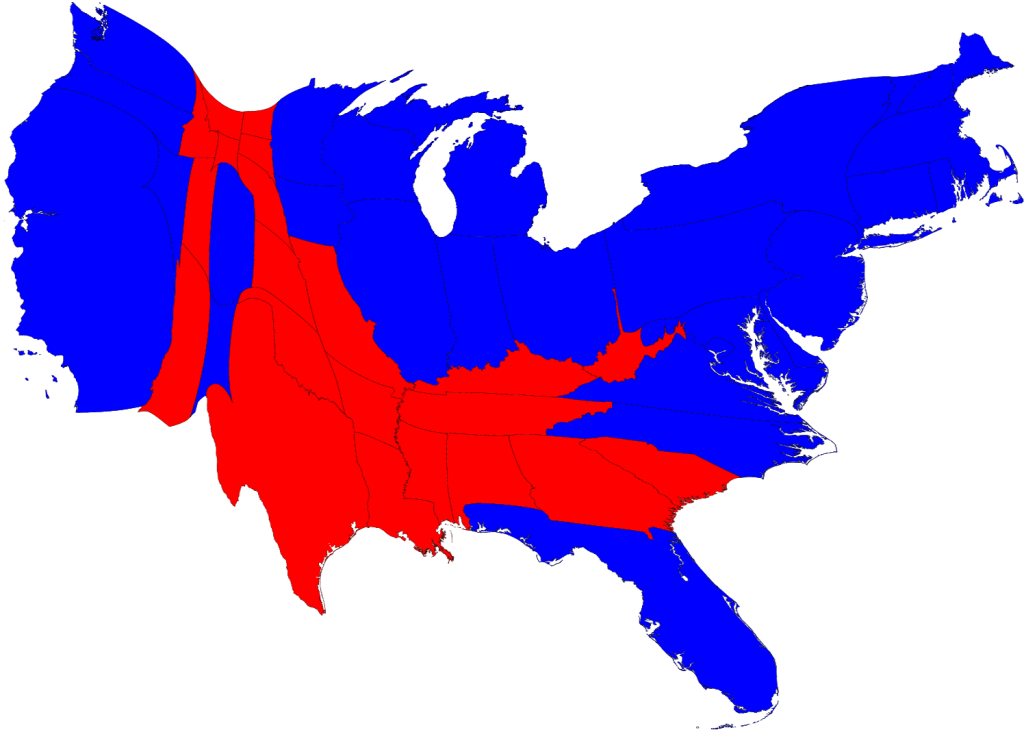
This may seem like small potatoes, but its sets the table for the meal of undemocracy you’re about to enjoy. When you glance at a US electoral map on the television, you see an ocean of red surrounding tiny islands of blue. It makes it seem like a vast conservative majority is somehow outweighed by little blue measles. In reality, it's the other way around. These maps reflect the basic American imbalance between population and geography that makes it so difficult to have fair representation in our vast and sprawling country.

[A population cartogram that reflects the true weight of the 2008 presidential race.]


Primary Elections: In our presidential primary system, New Hampshire and Iowa are the “first in the nation” to vote. These places get a disproportionate amount of attention from ambitions politicains. They are also places with almost zero cities. (No offense, Davenport!) This system is stupid for lots of reasons, but privileging the rural is one of them.

Locations of State Capitols: Harrisburg, Springfield, Albany, Sacramento... These are not the largest cities in America. When deciding where to put state capitals, back in the early days of the USA, those in power chose to locate them far away from the major cities. There were some good reasons to do this, because cities were extremely corrupt. But one goal was also to minimize the potential for grassroots democracy. It’s a lot harder to protest when you’re three hundred miles away. The kinds of direct action tactics that occurred in Madison, Wisconsin two years ago would never have happened if the state capitol was in Marinette, up on the Michigan border.

[Albany, New York: located far from the maddening crowd.]
 

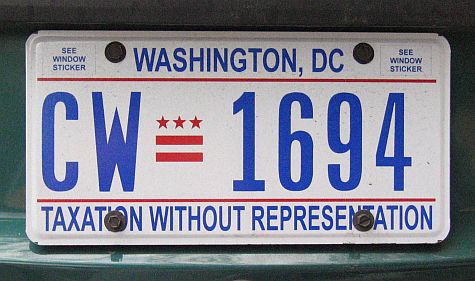
District of Columbia: Our nation’s capital is also one of nation's largest travesties of democracy. It has no official representation in congress. By complete coincidence, DC is terribly poor and disproportionately home to people of color. It’s basically a microcosm of how the American political system screws its cities and black people. If DC were an official state, it would have two senators, but it still wouldn’t be the least populous. That honor would still belong to Wyoming.

[The best license plate in the country.]


Lack of Competitive Districts: Almost without exception, competitive races are out in the suburbs or in rural areas. It only makes sense that, given this system, parties that are trying to win a majority  will promote federal policies that benefit more competitive districts. Thus, you get a military base or freeway project or some other other white meat out in the swing suburbs. Meanwhile, politicians in urban districts are absolute locks for re-election. They can go ahead and spend more of their time concentrating on building a national majority (which means catering to suburban and rural voters).

Redistricting: When faced with the political clout of many people living in a city, a hostile state government is not without options. One popular choice is redistricting, drawing the boundaries of the districts to minimize and/or ‘pack’ urban areas. Sometimes that means creating the aforementioned highly uncompetitive districts. Sometimes that means drawing districts like the ones in Cincinnati or Austin, dividing up urban areas like slices of a delicious undemocratic pie. 
[I don't understand this, and neither do you, but it screws Cincinnati.]


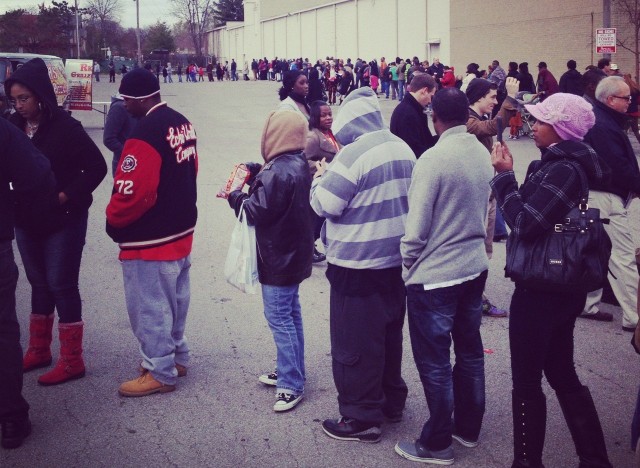
Polling Places: In the US, local jurisdictions are responsible for running polling places. Often this means that voting is more difficult and time consuming in urban areas. For the last few decades, Ohio and Florida have been particularly unequal. Having to wait in line for 10 hours to cast your ballot, while people in rural and exurban neighborhoods vote smoothly, is one outcome of our election system. Intentional or not, it does no favors to our cities.


[A line for early voting in Miami-Dade county from yesterday.]


Electoral College: It’s a little known fact that someone voting for president in Montana gets three votes, while someone voting for president in California only gets one. OK, that’s not technically true, but it may as well be. Our fossilized electoral college system allocates votes unfairly, and disproportionately to states with low population. In Wyoming and North Dakota, there is one electoral vote for every 140K people. In Florida and New York, these is one electoral vote for every half million people. Where do you think the cities are?

[Your presidential vote is weighted according to your misanthropy.]

The US Senate: Congress has two bodies. One of them is extremely unfair. Wyoming gets two senators, each representing a population of 568,000. California also gets two senators, each representing a population of 37,691,000. On top of this travesty, Senators are very powerful. They have long terms and are given the power to wield the the anti-democratic (increasingly abused) filibuster. As Hendrick Hertzberg explains, 10% of the population (the senators from the most rural states) can effectively block the will of the vast majority of the people. This means that passing a (pro-urban) bill through the Senate can technically require a ‘supermajority’ of 90% of the people. The undemocratic Senate holds our cities hostage to the demands of farmers and industry from our most remote places.

[Mr. Smith goes to Washington, screws the people.]


There you have it. Have fun voting tomorrow. Try not to live in a city, though, because your vote won’t be as important. If you really want to affect your nation's democratic system, call your old aunt Agnes in Beach, North Dakota. Her vote is worth double.

2012-09-03

Can Charles Avenue Climb the Ladder of Citizen Participation?

[Everyone looking bored at a strategy meeting on Pakistan.]
Let’s be honest. Most neighborhood meetings are pretty terrible. 90% of them are so boring that half the people are asleep, secretly texting, or staring fixedly at a crack in the paint on the wall. Anyone paying close attention is likely a wonky nerd (guilty!) able to display the love of detail typically reserved for scale model railroad aficionados or life-long accountants. (Not guilty!)

The other 10% of public meetings are so filled with rancor that the very oxygen gets pushed from the room and leaves everyone inside gasping for breath. When they’re over, rushing for the doorways is like fleeing from a burning Tea Party, everyone desperate to reach some sort of oxygen or common sense.

Public hearings are likely worse. They consist of, on the one hand, bored officials tapping pens on blank notebooks nodding while pretending to listen. On the other hand, you'll find dozens of angry people just starting to vent their spleens before being cut off repeatedly by someone with an aggressive stopwatch. This process can proceed for many hours, and because everyone knows that everyone else's opinions were decided far in advance, the process can become a dumb show where empty testimony is dutifully recorded into a public record, filed away, and forgotten. It's like a Harlem Globetrotters game, only if you replaced entertaining circus basketball with correcting spelling errors in old telephone books.

This problem is nothing new. Citizen participation has plagued city governments and planners for a long time. Back in the olden days, people didn’t even pretend to go through the motions. As anyone who’s ever read Caro's biography of Robert Moses knows, city governments used to do whatever they wanted regardless of public opinion. (Moses was famous for beginning projects with his teams of bulldozers before he’d even received official permission, because once you started an infrastructure project, say, by knocking down a garage or a tree. Once you did that, the project quickly became inevitable.)

Beginning in the 60s, people like Jane Jacobs started organizing urban neighborhoods to oppose and re-think planning assumptions.  Effective organizing techniques, compounded by disastrous urban policies, meant that urban planning had a real ‘come to Jesus’ moment when cities finally hit bottom in the 70s and 80s. Planners began sincerely attempting things like “citizen participation” and “public engagement.”

But just because you attempt something, doesn’t mean you accomplish it. Much citizen participation and public engagement does little other than inflame an already annoyed populace. There’s a famous 1969 essay by Sherry Arnstein, a social work theorist, that pretty well captures this sentiment. Arnstein’s essay outlines what she calls the “ladder of citizen participation,” and is a staple of most Planning 101 syllabuses.

Each of the ladder's “rungs” represents a different degree of citizen power. The bottom rungs – "manipulation" and "therapy" – are mostly attempts to pacify publics without even listening to their opinions. The middle rungs (where I’d argue many public processes exist) are only slight improvements. These levels – "informing", "consultation", and "placation" – are what Arnstein calls different forms of “tokenism.” People are heard, but “lack the power to insure that their views will be heeded by the powerful.” Finally at the top, Arstein outlines “real citizen power” where people participating with governments don’t just have voices, but have the ability to act and decide in accordance with those voices.

[Huh?]
Charles Avenue Friendly Streets

Moving up the ladder past tokenism and into the terrain of real citizen power is a real challenge for cities. Often, cities attempt this through delegating the job of public engagement to groups and institutions. That’s basically what Minneapolis did a few years ago with the Neighborhood Revitalization Program (NRP), where TIF funds were given to neighborhoods with few strings attached. One one hand, citizens really had power to make decisions. On the other hand, I feel the project was limited by the fact that neighborhood groups don’t represent their neighborhoods all that well. These groups are heavily weighted toward wealthier homeowners with lots of free time. Often, these kinds of conversations end up revolving around the preservation of property values at the expense of things that might serve less well-heeled citizens. (That could be one reason why Minneapolis didn't renew NRP for another round of funding, opting instead to keep the purse strings tied up in City Hall.)

So cities have to try other things. For the past year or so, one of those experiments has been taking place in St Paul’s Frogtown and Hamline-Midway neighborhood, just north of the ongoing light rail construction project along University Avenue. This project, called the Charles Avenue Friendly Streets Initiative, has a few noteworthy features. First, like many successful grassroots efforts, it wasn’t spearheaded or organized by the city. Instead, local urban design advocates wanted to get out ahead of the city’s official public process along a street designated for a “bike boulevard” traffic calming treatment.

Second, the organizers didn’t rely on public meetings or media campaigns. Instead, they held a series of block parties along the corridor. They got permission from homeowners to close off the street for a few hours on a Friday, put out food donated from a local restaurant, and set up a bunch of activities based on the themes of public art, public space, and urban design.

As I understand it, the decision to use block parties as organizing tools was crucial because it overcame some significant spatial and temporal barriers to citizen participation. Instead of asking people to give up their free time, leave their homes, and go to a strange location for some unknown “meeting,” people could simply follow their noses out their front doors. Kids played in the street while parents looked at different alternatives for street design, asked questions, and discussed the city’s intentions and potential plans. The end result was a successful grant application for street designed around traffic calming, bicycling, and safe pedestrian access.


[Some shots of block parties put on by the Charles Avenue Friendly Streets project.]

The success or failure of the project is still unclear. The first hurdle is that the plan has re-entered the official city process. It made the rounds in the newspaper, and raised the ire of a few business owners near Snelling Avenue, as well as voices in the media. The public comment period is still technically open, I think, at least if you email the planner in charge.

The city council is going to have an official public hearing on the project on Wednesday evening (tomorrow!), where they'll officially listen to people who come down to city hall and/or know how to use the internet and/or postal system. In a way, this project tests two public engagement processes against each other. The official plan comes out of the grassroots block parties, while the dissenting versions of the design express more traditional public engagement strategies. We’ll have to wait and see which form of citizen participation is better able to influence decisions.

In the meantime, the Charles Avenue project gives me hope that it’s possible for cities to do actual democratic engagement, to better reflect the desires of more people. This approach isn't perfect. It is really time consuming, and who knows whether it will bear fruit. But perhaps, on occasion, it suggests that we can leave tokenism behind and enter the realm of real citizen power. I hear the streets are friendlier there.

[From the street level, citizen participation looks a lot like hopscotch.]