Showing posts with label feedback. Show all posts

2017-10-10

Sidewalk Mailbox #7: Counting Cyclists on Cleveland

Here's a letter I received a little while ago, a response to a recent streets.mn post about new bike count data on Cleveland Avenue. For reference, the data showed big increases in bike traffic on the street:

Bill –
I was in midst of my own personal study on Cleveland which was showing similar numbers but I do need to differ with you on ‘interpretation’. You got to be kidding me with ‘build it they will come’ – hell you got about 20 – 30 extra bikes using the road PLEASE!!!

What needs to happen is to set benchmarks just like they do for roads based on use to determine whether a road should be converted to a bike lane? Sorry, but 30 folks don’t justify the loss of parking. What I also observed over about 3 morns & afternoons is that it is a wickedly busy & unsafe road for bikers. I never saw any kids which is good & truthfully I saw more joggers than bikers.

Can I take a shot here at ‘bloggers’ with a mission & use alternate facts!!! I hope that one stung & time for beers.

My buddy is a statistician & don’t know whether he would agree with my interpretation.

My friend lives in the ‘hood’ & we sat a watched a few days together.

I’ll gladly work with you on developing ‘real criteria’ for conversions.
Look forward to a correction/modification of your position in next addition!!!
Ciao,

Counter Conventional


Dear Counter:

Buono Giorno! First off, thanks for reaching out. I always appreciate feedback.

Also, thanks for staring at a Saint Paul street for hours! It’s one of my favorite pastimes and I can’t recommend it enough.

That said, people see what they want to see. After staring at Cleveland Avenue for a few hours, I am pretty sure that you and I would have different takeaways. (More on that in a second.)

But still, the exercise itself is almost always rewarding / infuriating / existential… which is why I recommend it in the first place.

Anyway, this is to say that I think you’re cherry-picking your statistics. Here are a few numerical caveats.

IMO, the larger before-and-after numbers for Cleveland south of Marshall are the more important measure. That's where most of the local destinations are located, where the new lanes create a connection from the colleges down to the heart of the Highland neighborhood.

When I was on the Cleveland Avenue task force, I said it would quickly be one of the most used bike lanes in the city. And I was right! Cleveland is in the top half of streets in the Saint Paul bike count. South of Marshall, there was an increase from 20 to just over 50 bicyclists in a two-hour stretch on one weekday rush hour afternoon.

"Only an extra 20 cyclists", you say?

Well that's only two hours. If you wanted to extrapolate to a full day, you’d at least be tripling that number.

(Sidenote: it's an interesting question about the relationship between commuting rush hour car patterns and all-day bicycling patterns. Especially in a college / mixed-use urban area like this, bike traffic is generally more steady throughout the day.)

Let’s say, conservatively, that we’re talking about 100 brand-new people bicycling on Cleveland per day during decent weather. That's on top of the already existing 50-60 people using the street, who will be better off bicycling in the lane.

So are the new lanes worth it?

It depends on who you ask, I am sure. Before I get to the heart of the question, let me throw a bit more data your way.

When the city was studying the lanes, and coming up "real criteria" for bike lanes (as you say), public works' staff did a "parking occupancy count." They literally counted how many vehicles were parked on Cleveland, at multiple times of the day on multiple days. All the data is here. Spoiler alert: it shows that there is a lot of parking in many places, and parking is tight in others.

The trade-off here is that we’re making parking a bit more difficult. Someone parking their car in one of the tight areas will likely have to walk a bit farther, I'm guessing a half-block on average. (Maybe more?  ¯\_(ツ)_/¯ ) Meanwhile, over a hundred people trying to get around will be safer.

Is that worth it?

To me, that’s an easy choice. I guess you disagree...

I wrote a while back about how frustrating I found it that someone's parked car made it more dangerous for me to get around on a bicycle. To me, the safety of a living human being should be the first priority of our streets, and convenient storage for an expensive private vehicle when you're not using it should be a distant second.

By the way, I strongly disagree with your assertion that the bike lanes are unsafe. I suggest you talk to more people who ride bicycles around the Twin Cities. While there's never unanimity about these things, the vast majority will tell you that lanes are safer. (Consider for example the case of Evan Steeves.) In fact, because they lack a "door zone" problem, the Cleveland lanes are probably some of the safest in the city!

(Granted, that's not saying much... Saint Paul has a long way to go if it wants to catch up to Minneapolis' safety standards.)

Here's a bit more food for thought. One of the more counter-intuitive rules of street safety is called the “safety in numbers” effect. The paradox is that crashes do not increase linearly with the number of bicyclists, as you might expect. If you get more bicyclists on the street, the average per-capita crashes go down, not up. This has happened in city after city.

The point is that the safest thing you can do for bicycling is to get more people bicycling. Drivers learn to expect to see bicyclists, and they slow down and pay more attention. The street becomes safer for everyone.

To sum up, this last year was just the first year of having bike lanes on Cleveland Avenue. I think it's going very well. While two older businesses have closed, two new businesses opened up in their places almost immediately. The gloom-and-doom scenarios have not come to pass,  and I do not think they will.

On the contrary, I believe that each year we will see more people bicycling on Cleveland, especially if we continue to grow Saint Paul's fledgling bicycle network. If you keep watching the street, you might see this for yourself.

Yrs,
Bill

2015-08-03

Sidewalk Mailbox #6: High-speed One-ways are like Watering Your Garden with a Firehose

Here's a very lovely letter I just received:

Hi Bill,

I'm hoping you wouldn't mind helping me understand some City of Minneapolis street layouts/designs. The questions I have are regarding the bike lanes on 26th and 28th streets in Minneapolis. More info is here:
http://www.ci.minneapolis.mn.us/bicycles/projects/WCMS1P-133460

First and foremost, I want to say I support bike lanes. However, I think they're a tricky subject because most bikers do as they please on the roads and give a bad rap to all bikers. That being said, unfortunately, it only takes a few bad apples to ruin for everyone and create a stigma that bikers are a huge PITA. I fully support bike lanes but I'm fairly confident they can be implemented a lot better and make things more efficient for both bikers and vehicles.
I frequently use 26th and 28th streets because they're one ways and quick to get across town for my work - I work for a charitable gambling organization in Minneapolis whose main revenue source is pulltab sales at different bars so going from bar to bar is a big part of my time.

A few days ago, I was on one of the streets mentioned above and noticed that it is now 2 lanes instead of 3 - one full lane of traffic being devoted to a bike lane. This was during rush hour and traffic was backed up and it was backed up for at least a half mile (Hiawatha to ~Chicago). I noticed that once the road went back to 3 lanes (the original configuration), traffic suddenly flowed at a greater pace.

I'm having a hard time understanding why the city/planners/public works department takes a lane of automobile traffic away and dedicates it to bikes only. I was under the impression that streets were intended for cars. The amount of cars on a road vastly outnumbers bikes, so why are bikes taking lanes away from cars?

Consider this analogy: You have a container of water that holds 100 liters. It drains at a rate of 10 liters/minute but filling with water at a rate of 15 liters/minute. What's going to happen to in 20 minutes? The water will overflow. This is what's happening on those streets. You have streets that were meant to handle so much traffic and now there's even less room for that traffic so it backs up. Why would anyone consider this something viable?

We know the planet is warming because of CO2. Does anyone pay attention to that fact? It certainly doesn't seem that way to me. Why do bikes need to travel on 26th and 28th streets when 1 block North or South will accomplish the same thing? Are bike lanes put on busy streets so bikers don't have to stop for stop signs or cross busy streets as frequently? The amount of energy required to move a vehicle is much greater than a bike.

Adding bike lanes is complicated, but it seems that planners just put them wherever without considering all factors. Another good example is Portland and Park Avenues running from Minnehaha Creek to Downtown. Portland used to be 3 or 4 lanes and now it's only 2. And the speed limit was reduced from 35 to 30! A double whammy there!
I'm hoping you can provide a little insight into why bike lanes are added to somewhat busy streets. I really do not understand why bikes need to be on the same roads as vehicles. When bikes and vehicles collide, there's usually damage to the bike and sometimes the rider. If bike lanes were on less busy streets, would that eliminate a majority of accidents? Granted, you can't force bikers to ride on certain streets but vehicles will almost always follow the quickest route (I.E. using 26th or 28th instead of 27th or 29th).

Sincerely,
Impressionable Pulltab


Dear Impressionable,

Thanks for your thoughtful letter, particularly since it contains an analogy which I like a great deal. And first off, let me say that I'm a big fan of the actual physical pulltab industry, the ones where you pull a tab with your thumb and then stack the expired tabs into strange configurations. (It's these electronic pulltabs which are giving bars a bad name, and don't get me started on the gas station lottery.)

[My well-watered garden plot on the West Side.]
And fluid dynamics are interesting indeed! I was biking home last night with a friend and she wanted to stop by her community garden, which was on the way. At one point she asked me, "Can you go over to the hose and turn the water on?"

It took me a while to find it in the dark, but I did. and (lefty-loosey) uncranked the spigot.

"Woah, can you turn it down a bit?" She shouted back to me. So I turned the knob a bit to the right. She was holding the other end of the hose, and trying to water her flowers and beans.

"A bit more," she shouted, and I dialed it back just a bit.

"Is that OK?" I asked?

"Perfect," she said, and for the next five minutes she watered her three raised garden beds. She loves gardening, and later she said, "I feel so much better when I can come water the plants. They've perked up. Now they're all set for some great growing tomorrow."

[Stills from Arteries of New York City, 1941.]
You are certainly right about your "container of water" metaphor, as far as it goes. If our big goal as a city was to keep the most water flowing, then designing streets to maximize volume would be the obvious solution.

And in fact, that's how traffic engineers have traditionally thought of traffic, as cars circulating like blood through corporeal arteries. Just like cholesterol clogging arteries, congestion was seen as inherent vice. A lot of money, public space, and social resources were spent on unclogging our streets to maximizing the "flow" of cars.

But the problem is that cities aren't the hoses, they're the gardens. Just like you don't want to water your tomatoes with a firehose, you don't want to maximize traffic flow in a neighborhood. We need to stop focusing on the water, and start focusing on the plants. How much water do they need to grow? At what rate? Are we flooding them?

In the analogy, the garden is the city. Neighborhoods, sidewalks, streets, and even dive bars with pulltabs require more than just a stream of cars passing by their doorstep. The require public spaces for socializing. They require people to be able to easily stop, park, and cross the street. They require access to ways of getting around that aren't cars, so that after a you win at pulltabs and blow all your money on rounds of drinks for the house, you don't have to drive home drunk because you can catch the bus. And cities thrive when the flowing traffic is at a safe level, both for people in cars and for those on foot.

As I've written before, 26th and 28th have long been some of the most dangerous streets in Minneapolis. Their design dates back to the pre-freeway era, and worked well for the problem they were trying to solve. But the speedy convenience for South Minneapolis drivers comes at a high cost. For example, after a bicyclist named Jessica Hanson was killed on 28th Street, I pointed out how it was the #1 most dangerous street for bike crashes in the city. This isn't to mention the fact that the current high-speed one-way configuration is also dangerous for car drivers. (Here's a 2009 video showing the aftermath of one such accident.)

[From the 2013 Minneapolis Bike Crash Report.]
A while back, I dated a woman who lived in a first-floor apartment whose windows looked out directly onto 26th Street. Even when we were in her apartment, you could still hear (and feel) the traffic rushing by at 40 miles per hour. 26th and 28th are unpleasant places to spend time, and the feeling of danger permeates the neighborhoods on both sides of these roads.

In the big picture, the protected bike lanes are a dramatic positive change for both 26th and 28th, for people in and out of cars. In exchange for a decrease in speeds and a bit longer stacking times (noticeable mostly at rush hour), there is a much safer street with fewer accidents. As a bonus, the new design also creates a good bike route on Minneapolis' most dangerous street for bicyclists. And as one-way streets, they remain the best east-west routes through South Minneapolis, regardless of how many lanes there are.

The simple fact is that high-speed roads destroy walkable cities. It's like watering your garden with a firehose. Fixing these streets is long overdue, and I'm confident that South Minneapolis will flower.

Sincerely,
Bill

PS. I'm interested in how the pulltab business works. Maybe we can chat about that sometime!

[Today's 26th Street: a much safer design for cars and people, slightly diminished capacity.]

2012-12-06

Sidewalk Mailbox #5: Turing Test

I've been stockpiling some letters received for a rainy day. Today is sunny, but whatever. See if you can tell which of them were written by actual humans!


Dear Bill (if I may),

Thank you for your important blog post about design issues and pedestrian accidents. I am a daughter of the two pedestrians killed early this month in Ramsey and the media coverage has been maddening to say the least. (And as a former journalist, I agree that they are overworked and underpaid but in this case the mention of alcohol use was entirely inaccurate and just lazy reporting.)

If there are any initiatives to build the long-discussed footbridge and/or move the highway that you know of, please let me know as I would happy to participate. I hope you keep writing about these issues.

Kind regards,
In Mourning

Dear IM (you may),

This is the most touching letter I have ever received. I am sorry for your loss, and hate to think that Twin Cities transportation system is responsible for so much sadness.

Yours truly,
Bill


Hey Bill, 

I really enjoy reading your blog and check in about once a week.  Even though your Villager rap up is more entertaining and would prevent me from banging my head against the dining room table, I'm still hooked into the agonizing paper version for some reason.  While out walking the dog the other day, I re-found these steps (attached).  Wondered if I could stump you on their whereabouts?

Thanks,
Hooked on Highland

Dear Hooked,

I am sorry to hear about your Villager addition. The good news is that you're not alone. There are an estimated 2500 people addicted to the Highland Villager in St Paul alone, but very few of them will receive treatment. That means that the vast majority of Villager readers are out there struggling with addiction alone. It's a lonely, terrifying existence for anyone that has ever experienced it. I know how it feels because I’ve walked in the same shoes.

There are several reasons why people in need of anti-NIMBY treatment don’t receive it.

    ▪    Money – as of 2011, the average cost of a 28-day stay at a residential rehab clinic was more than $27,000. Unfortunately, mental health insurance companies no longer cover NIMBY addiction, and most addicts simply cannot afford to pay for treatment on their own.

    ▪    Stigma of addiction – despite constant efforts to spread public awareness of NIMBY addiction as a disease, not a character flaw, many still look down on those suffering from addiction, which often causes addicts to remain silent and isolated.

    ▪    Attending neighborhood group meetings – many people find that neighborhood group meetings perpetuate their problem. A large number of addicts are introverts and began reading the Highland Villager early in life to overcome shyness, self-consciousness, and inhibitions. Take away the Villager and those personality traits soon re-appear. Try to drag them from a neighborhood group meeting, and many of them will tiptoe right back into the front door faster than you can say “keep coming back”.

    ▪    Geographical location – millions of people struggling with addiction live in "The Village", where there are few, if any, treatment facilities or support groups available.

Please take care, and find a non-misanthropic friend who can help you through this difficult process.

With love,
Bill


I just finished reading a post of yours from a bit ago and really enjoyed it!

Do you do advertising? I'm marketing out a site and can pay you via PayPal for adding a few text links to an old post of yours. These links would go to resources on education and topics related to the theme of your post.

Let me know if we can work something out! :)    

Thanks
Smiley

Dear Smiley,

My financial institution has issued me a notice to provide the you with consent to present you as a financial partner, so that the proceeds of this account can be paid to you for our mutual benefit. On
receipt of your positive response, we shall then discuss the modalities for transfer.

I have all necessary information and legal documents shall be processed to back you up for the claim. All I require from you is your honest co-operation to enable us see this transaction through. I
guarantee that this transaction will be executed under legitimate arrangements that will protect you from any breach of the law.

Please send your bank account number so that we may pursue this matter further.

Excitedly,
Bill


Hello, sir!  I'm a volunteer for the Bandwidth 2012 Music Festival on April 22.  This nonprofit event is free to the public and we are looking for ways to get the word out-- do you post this sort of thing on your blog?

Thank you for your time,
Tooting My Own Horn

Dear Tooting,

Yes, I do post this sort of thing. The only catch is that I only post it months after the events have taken place.

Belatedly yours,
Bill


Hi there,

My name is Najie C. and I work with the Sweet Elephant Music Group street team. We are a local hip hop organization that promotes local hip hop artists through bringing in big name indie hip hop artists to allow our artists to showcase for their fans. What we do as a street team is gorilla type marketing. We are very diligent in reach each and every community when promoting our events. We were very interested to see a group that was interested in giving a voice to Twin Cities Residents. That is a great asset to companies like ours.

We are interested in seeing if you could provide us with a list of the locations to all of the bulletin boards you came in contact with, or companies allowing bulletins to be posted in the store fronts? Thank you so much for your time and keep up the good work.

2 Pach-yderm

Dear 2-Pachyderm,

I've always wanted to see elephants doing gorilla marketing. Perhaps the Como Zoo might be an ideal location?

Good luck,
Bill


Hi Bill,

I'm a writer for an online resource looking at the intersections between psychology theory and management and I'm interested in contributing an article to your blog. I came across your blog http://tcsidewalks.blogspot.com/2008/07/jane-jacobs-development-v-destruction.html while I was conducting research about industrial organization and found your content to be very engaging.

So far South Carolina's Lieutenant Governor's Office of Aging and the Queensland Government's Health information services have listed the project as a resource for others.

I'd like to write an article relating to industrial organizational psychology, perhaps on positive psychology or prospect theory. Please let me know if you'd be interested. Thanks, and I hope to hear from you soon.

Best,
Quack

Dear Quack,

As you suggest, my blog peaked in 2008. Today it's a shadow of its former self. I doubt very much if you'd want to be affiliated with it.

Best,
Bill


Gosh, there is really much useful information above!
I totally match with anything you have written.
Pretty helpful data, lots of thanks for your post.
Thanks for your article, pretty useful piece of writing.
Wow, there is so much effective info above!

Hello there, I found your website by way of Google while searching for
a related topic, your website came up, it appears great.
I have bookmarked it in my google bookmarks.
Hello there, just became alert to your blog thru Google, and found
that it's truly informative. I'm gonna watch out
for brussels. I'll appreciate if you happen to proceed this in future. A lot of folks can be benefited from your writing. Cheers!

Dear Gosh,

What is this "Google"? I wish there was some way of looking it up.

Thanks for the warning about brussels, though. I just opened my fridge and this is what I found in the crisper:


You probably saved my life.

Best,
Bill

2012-01-24

Sidewalk Mailbox #4: If You Shovel It, They Will Come?

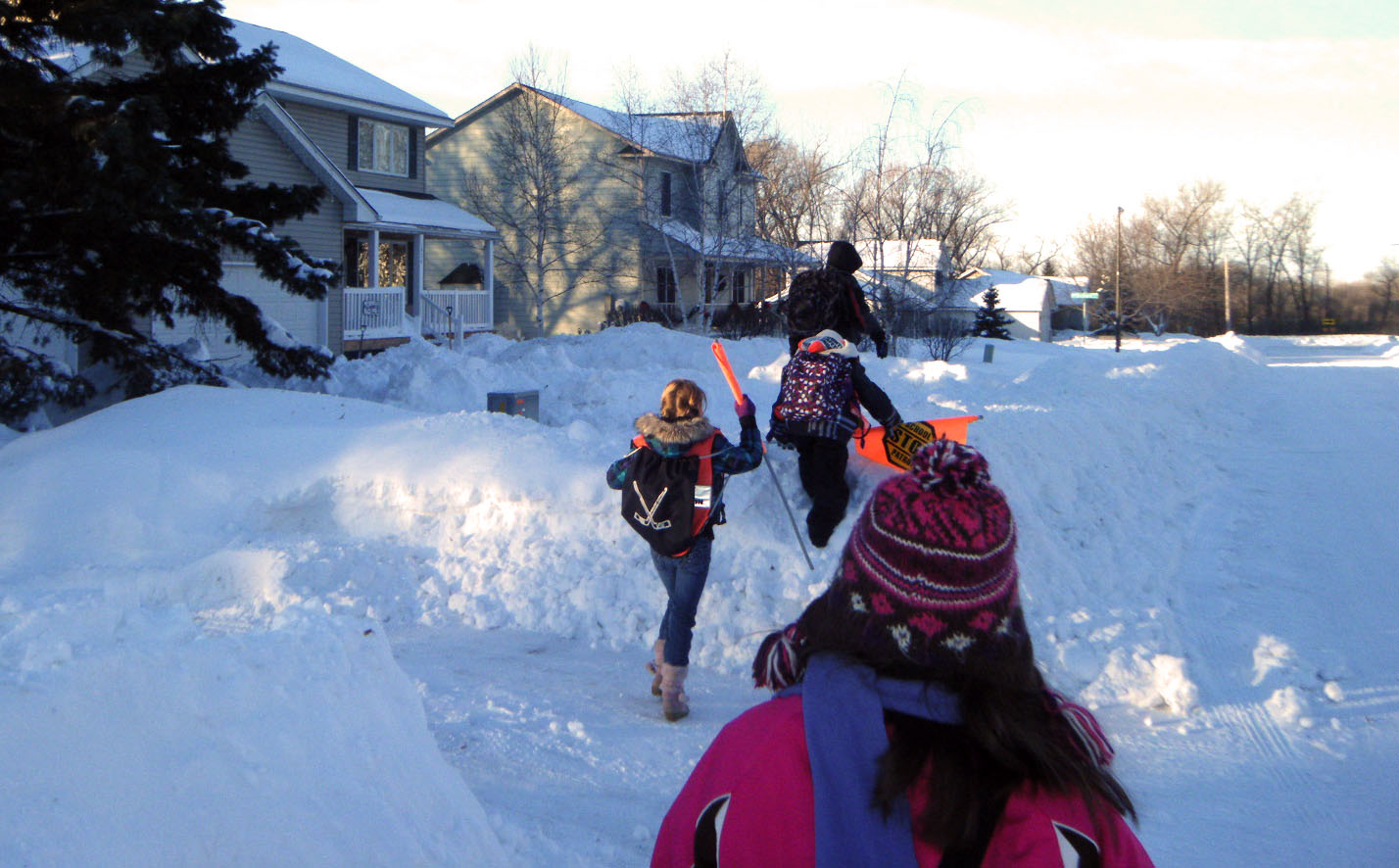
[Walking to school on the "sidewalk", or mountain climbing?]
All too occasionally on this insignificant sidewalk blog, I receive letters from  readers with questions about important matters of the day, issues that range the entire gamut all the way from sidewalk history, to sidewalk graffiti, to types of sidewalk materials!

Needless to say, I find these queries tremendously exciting. Feedback of any kind always makes me giddy.

At the same time, I’m inevitably disappointed with my responses to these kinds of questions, for the simple reason that, to tell the truth, I don’t know very much about sidewalks! Sure, I can blather on about the joys of walking or random curiosities, and thanks to my very expensive education, I can use words with many syllables. But I know next to nothing about actual sidewalks. You might say, I lack concrete knowledge.

That said, I got a letter the other day from a frustrated citizen of a second-ring Twin Cities’ suburb [Hint: it’s in Ramsey County] who expressed frustration about the lack of shoveled sidewalks in his neighborhood.

Here’s a version what the reader wrote to his local civic code enforcer, with all nouns removed to protect the innocent: [Extra fun game: insert your local nouns and create a Madlibs sidewalk complaint!]

I am very concerned about the lack of snow removal on the part of property owners along [street name], specifically between [street name] and [name of local elementary school]. [Name of city] removes "significant snowfall" along this corridor which we greatly appreciate. It's the nuisance snow which property owners neglect to clear in a timely manner. This snow becomes compacted and glazed over with ice becoming extremely treacherous. In my opinion they are in violation of [number of city code].
My wife has walked our kids to school over the past few days and there are sections of glare ice where they had to walk like "penguins" for lack of a better description. This section is heavily used by the [name of elementary school] walk line as well.

I'm not one to nit-pick, but when this happens time and again it's ridiculous. A majority of home owners do their part which we're very grateful for, but it's the following owners which create problems time and again.

In response, the code enforcer wrote that “citizens are not required to remove snow from the sidewalk” and that “we recommend it, but its not required.” Needless to say, this didn’t please my correspondent!

Even on the best of Twin Cities’ sidewalks, winter maintenance is no easy task. For people with mobility issues – especially the young, the elderly, and the disabled – getting around in the wintertime can be a huge challenge!

[A person in a wheelchair choosing to go the wrong way on the street instead of onto the sidewalk in Minneapolis' SE Como neighborhood.]


But the issue is compounded many times over in the suburbs, which often lack sidewalks altogether. Or if they do have them, they’re almost completely pointless because they lack accessible, nearby destinations. We have an almost impossible task ahead of us lot of work to do if we want to make our suburban neighborhoods walkable, but it would seem to me that requiring snow shoveling could be some “low hanging fruit.” (As added benefits, people would get much needed exercise, boost the snow shovel supplying parts our economy, and maybe even meet their neighbors over a good round of kvetching.)

All this is to say that I turn to you, brave readers. What, if any, are the rules for shoveling sidewalks in the suburbs? Does anyone enforce them? Would it matter if they did? Is there any hope for the wintry suburban pedestrian?

Maybe the only solutions are to either learn to enjoy walking like a penguin, or else to move to Minneapolis, where they only recently enacted a new sidewalk snow shoveling law with teeth.

2011-09-08

Sidewalk Mailbox #3


Hi Sidewalk Guy/Gal-

Do you have any history or observations (remembrances) of Stendahl’s, 1001  Nicollet Avenue? (shoes on first floor, bridal on second!?) What happened with that  business after a 1972 fire?


I believe it was part of the “bridal corner” of 10th and Nicollet, or was that  10th/Marquette.


Thank you,
Something Old


Dear Something Old:

Having never been a bride in the 70s, I'd never heard of this. I did a Google search and nothing came up. I looked it up on the Minnesota Historical Society database too. Nothing. 

I did, however, buy my only suit at Nate's Clothing which used to be on 1st Avenue and while I was there shopping all the old guys were watching the Cubs play a day game on a TV above the cash register, and I found that really charming for some reason, particularly as I was being measured by gent with a measuring tape. Nate's was also across from the Army Surplus store (somehow still there) and so one might have called that the “Groom's Corner”, as it contained all you needed to both get married and to flee, escaping into the wilderness to survive off foraging and small game. Alas, Nate's is no more.

Yours,
TC Sidewalks


Dear Sidewalks:


Glad I came across your post.  As someone working on a project in alternative transportation funding with a particular focus on its politics, I was pleased to see you making points I try to make.  Recently I gave a presentation at the Transportation Research Board/University of Florida Workshop on Innovative Transportation Pricing. 

I especially liked your point about how standing at the gas pump is “the most visible, visceral economic relationship we have to our vehicles”.  That very point was at the inception of our project (Efficient Vehicle Assessor (EVA)).  EVA has grown to address other urgent needs but at its root is this notion:

Of all the tools government has to incent or encourage behavior, the tax is arguably the most effective (excluding passing a law mandating or outlawing something) tool policy-makers have.  
When the gas tax was conceived (at least in the iteration under Eisenhower), transportation funding was its only goal, the only thing we needed it to do.  There were no worries about carbon emissions, petro-terrorism, etc.

So while the current gas tax approach made sense then, it doesn’t now.  In fact, as currently structured, it pits our funding needs in direct opposition to our environmental and energy needs (both of which are urgent).    It is a single, blunt tool that is so crudely designed as to be almost useless as a policy tool.

EVA is based on the notion that the most effective place to effect consumer behavior is at the gas pump, where everyone is, as you point out, hyper-sensitive to the price.  And so the concept of EVA was born:  A variable-agnostic platform for transportation pricing.  Any number of factors can go into the calculation of the tax – vehicle characteristics, socio-economic factors (the current flat structure is quite regressive), as well as many others.  In short, whatever policy-makers agree are the factors needed (and that will surely differ from state to state).

I won’t go on further here.  I’ll just point you to our project website www.evasmartpump.com and compliment you again on your post (for which I’ve posted a link on our news link page).

Best,
Eva


Dear Eva:

I like this, I suppose. Much like everyone on Earth, I hate standing at the gas pump. (This is why the states of New Jersey and Oregon have made it illegal to stand at your own gas pump.) And really the only thing that could make standing at the gas pump bearable is looking over at the next sucker standing at the next gas pump and seeing that he's driving a mid-90s Chevrolet Suburban Extend-o-thon which gets 11 mpgs, and so the delicious feeling of schadenfreude sweeps over you like a wave.

And really the only thing that could make that schadenfreude any better would be knowing that the gas pump was programmed somehow to charge him MORE for living out in Rodgers, MN, or for owning four cars, or for being in the top income bracket (in this case the schadenfreude target in question would be more likely driving a Porsche Cayenne Turbo). Then the schadenfreude might reach serotonin highs normally only achievable with chemicals or bodily passion, neither of which typically occur anywhere near a gasoline pump, which would somehow form this subliminal neuron connection in my habit memory associating pumping gas with ecstatic pleasure, leading me to think of little else besides gasoline schadenfreude during my everyday humdrum life, leading me to seek out more and more frequent ways to “fill my tank”, at which point I too would buy a mid-90s Suburban and drive to and from Elko just to pick up a shrink-wrapped Deli Express ham sandwich for lunch (and of course to “get my gas on”) at which point both my wallet and my soul would be emptier then the town square of downtown Mandan on a cold Saturday evening in February.

So, yeah, I don't think your idea is very likely to happen. All of our politicians are still sniffing gas fumes like there's no tomorrow.

Yours,
TC Sidewalks


Dear TC Sidewalks:


So.... I've got a traffic/planning proposal. Thought it might be interesting to get y'all's take on it. Here's the idea:

 Convert Main St SE to one-way (direction of travel: NW) from 6th Ave to Hennepin.

Here's why:

* Bike traffic is really picking up.
* So is pedestrian traffic.
* Cars trolling main st move too slowly and seem to get lost all the time, not to mention looking for parking is weird and awkward.
* Bike/pedestrian traffic has REALLY picked up in the summer time this year.

So... what if Main St was 1-way? We could reduce the road's width, and widen/install real bike lanes. The would make pedestrians & bikers a lot happier. I think even cars would be happier, because it would be a bit easier to drive down the street and figure out where you're going. Plus, 2nd street is really underutilized relative to its size, so it could handle the spillover traffic from a reduced-size main st.

What do you think? Is it a good/bad idea? Could I convince the city to do it? Or at least study it?

Thanks,
Juan Weigh


Dear Juan:


I hate one way streets. I like two way streets, but only if they're sized the same as a one -way street so that if two cars enter the street from opposite ends of the block, they have to confront each other and one of them has to eventually give up and put their car into reverse, only to discover that there are two or three more cars heading their direction coming from behind them and so the driver of the potentially backing up car has to get out and attempt to explain and convince the other drivers heading his direction that it's an impossible impasse and their best way forward is to go back, only its difficult to do this, and none of the other drivers believe him, perhaps because our driver is so self-sacrificing in the first place and lacks the necessary charisma or rhetorical capability. So then everyone gets out of their cars to go see the impasse first hand with their own eyes and when they do so, all massed in an angry huddle, staring at two rows of cars stuck facing each other with no way out, they realize that maybe they didn't want to be driving that day in the first place and, confronted with the absurdity of the situation, they all decide to walk to their destinations instead, or maybe even skip their destination altogether and go off to the nearest pub to grab a pint together and sing songs in three-part harmony.

That's my dream. Your dream is a one-way street on Main Street SE. Well, I hate one way streets, but I actually like 5th Street SE, which is a mega-traffic-calmed one way street with a contra-flow bike lane, so maybe if they did that it'd be cool.

Though I dare say that the street would be aimed in the opposite direction, so that traffic coming off the Hennepin Avenue bridge could turn down the street and find parking (or whatever it is that cars do).

Also, nobody at the city will make any changes to the street unless they have the complete backing of all the local business owners and the city council person, which in your case is Diane Hofstedte, so you're probably screwed.

Best of luck!

TC Sidewalks

2010-04-19

Sidewalk Mailbox #2


Howdy Bill,

So... I found $20 on the sidewalk on friday night downtown. Have you ever written anything about the sidewalks as 'finders keepers" or as some kind of repository, where some people loose things and others find them? Just a thought, similar but different from people who put things to give away on their sidewalks which are free, since that is obviously intentional vs. losing something..

Sincerely,
Finders Keepers


Dear Finders:

Yes, I love to find things on the sidewalk. Well, not always.

Once I found $100 while walking down Lyndale Avenue at night. Five crisp twenties. I picked it up, looked around, and seeing no one, shoved it quickly into my pocket and went home.

Another time I found an older iPod in a pink iPod case on the sidewalk over by Cedar behind Midwest Mountaineering. I posted an ad on Craigslist, with a photo, saying that whoever could name two songs on it could have it for free. Nobody responded, and I gave it to a friend of mine. (I don't think he ever used it.)

And one time I stepped in some dog poo.

Yrs,
Bill


Dear Bill:

Have you done any postings on heated sidewalks? I was going through Saint Paul recently and experienced a heated sidewalk for the first time (or at least the first time I even noticed). Near Market and Kellog, the sidewalk is heated by District Energy and there are some plagues describing the sidewalk. Hurray for heated sidewalks!

Sincerely,
Hotfoot McGillicutty


Dear Hotfoot:

No, I was not aware that there was a heated sidewalk in downtown Saint Paul. I guess I'm impressed at the engineering feat. I wonder, though, how they heat it. Do they heat it like the back window of your car, with little electric strips? Or, is there a subterranean steam tunnel like on University campuses?

Either way it seems like a waste of money! I'm kind of a Luddite.

Shovels and rakes? Yes. Good exercise!
Snowblowers and leafblowers? Loud and lazy! Sure signs of the apocalypse!

What's that you say? You don't like shoveling your sidewalks? You live on a corner lot? Your yard is the size of a small golf course?

Well, my ideal world would solve the unemployment crisis with sidewalk-focused makework projects, kind of like the old New Deal WPA, except everyone would be paid to be doormen, street sweepers, sidewalk shovelers, leaf rakers, gas pump attendants*, elevator operators. And they will all wear symbolic hats.

Yrs,
Bill


* Thank you, New Jersey.

2007-11-30

Feedback Loops: Comment Roundup

One of the great things about the internets is the way it allows for reader-writer feedback ... someone comments on comments about comments on a commentary on an article about commenting on the internet, and all hell breaks loose. Well, I'm for it. I love comments, and for some reason I got a deluge of them this week, coming in from all countries, continents, corners. I thought, in the interests of feedback feedback, I'd comment on the comments and see what happens. Let me start with this doozy:

Anonymous has left a new comment on your post "Other City Sidewalks: Babylon NY":

Wow, you really don't seem to get Babylon Village, do you. I live in town and love it. I moved from Brooklyn after too many years of cramped spaces. To me, the Village has "just enough" of everything for me to offer a very balanced experience between small town and more urban offerings. I think that to measure it in terms of how urban it is misses the point completely about why people live there.

Well, honestly, I agree completely with Anonymous. I don't really seem to get Babylon Village. I mean, I kind of understand why people might want to live there... its like an authentic suburb. You can have your house/yard and eat it too, driving around on the South Shore. In Caro's book on Moses, he describes the historic fishing/working classes along Long Island's South shore, and how different these little villages were from the wealthy Gatsby enclaves on the North side of the island. of course, this is before Moses facilitated Arthur Levitt's potato field alchemy, turning the center of the island into a repeating series of stripmalls, big boxes, outlets, and LIE exits.

My point is that Babylon Village is close enough to the city, conviently on a LIRR stop, to allow for some denser development. Why isn't there a vibrant street life in Babylon? Why aren't there sidewalks? Why aren't there at least a few apartment buildings? Mixed-use developments? According to Caro, people in these little Long Island villages have a long history of trying to keep 'city people' out of their communities, for whatever reason. My proposition is that they're still doing it. The fact of the matter: walking on Babylon sidewalks sucks.

My friend Ann wrote about my New London diary:

My grandparents used to live in New London and used that same library! They didn't know each other when they lived there because he was 5 years old, so hung out in the more adult reading section and grandma was in the children's section. Thanks for reminding me of this part of my family history, Bill. I have New London blood in me.

One of the things I didn't mention about my New London visit was that I got horribly horribly lost. I parked the car somewhere in a 2 hr. surface parking lot, somewhere surrounded old by brick buildings, and started wandering around the city, eventually finding people, corner stores, a coffee shop, train tracks, the Thames River, the old town square, the Patrick Henry schoolhouse (or something), and a few bench bandits. But, at some point I had to re-find my car, and I had this vague notion it was somewhere up one of the hills that surround this river valley town.

I walked up and up and around the hills of the city, passing by this familiar-looking grey church a half-dozen times, looking and looking for the car, wandering down used-car lot streets, past stoplights, abandoned buildings, brambles, and gullys.

I eventually found the New London library, went inside, and asked the librarians to help me (help me please!), saying "I lost my car. It's in a parking lot next to a little red hut. Do you know where that is?" They smiled, and pointed me toward the middle of town, nowhere near where I'd thought it was. When I got there, I found a parking ticket on the windshield. I guess it's easy to enforce parking laws in a town with no people.

Herr Engen has left a new comment on your post "My Way or the Skyway":

The skyways do need to go, but with a lack of money the first thing to do is to close them. Then slowly dismantle the system. To those that say they add to city vitality they must have never been to another city. Separating work and nightlife crowds into 2 sectors cuts the consumer base in half. Walking downtown is, currently, quite boring. The buildings are not inviting, both as a result of their hugeness and...shit, what does this blog matter, no one will read it anyway!

There are so many ways in which we agree, Herr Engen. Yes, this blog is useless. Yes, the buildings have a brutal hugeness that stomps on humanity... In fact, that's the point of a skyscraper. It's meant to inspire and impose as it pokes the clouds. But that doesn't mean the part we use and see the most, the bottom two floors, shouldn't be interesting, have windows, gargoyles, marble, or any number of detailed details. And the more I think about and walk about skyways, the more I hate them. Can't we all just get along? Can't we all just walk along the same damn street?

Minnesotans are so proud of their cold, cold climate! Drop a Minnesotan into a cosmopolitan party, and within 90 seconds they'll be describing the cold, cold weather, puffing their chests and rubbing their hands. And, if there's one we should be proud of, its that really know how to bundle up.

Well, skyways are weak. They're entirely neutered. Either stop bragging about your winters, or get out of the skyways, folks. What do you think those boots are for?

I was talking with a friend of mine last night who used to walk the skyways, once in a while, from the Steven's Square area down to his job at the Graves 601. (He doesn't work there any more.) He told this tale of a group of people, walking these artifical streets at 6:30 in the morning, getting trapped on the Skyway Level of the TCF Building, let in thourgh a door that wouldn't re-open. All the skyway doors were locked, and this group of people wandered around the building for quite some time, searching in vain the rooms of carpeted, blank mall-space for a way out, until finally getting into the one working elevator and taking it down to an exit-able floor.

As Herr Engen says, skyways:
...separate people into upper and lower classes
...split the customer market for any business in half
...make Minnesotan weather-boasting awfully hypocritical
...look dumb, for the most part

Skyways should go the way of the Metrodome, and head to that great Modernist utopia in the sky.

CitySlicker has left a new comment on your post "Sidewalk Semiotics: "Auto Mobility"":

I agree with the authors you read, as most true urbanists do. But you sometimes stop short of committing to what you really want to say, that automobilization is the opposite of urbanization. There are many things I like about your writing, but the biggest is probably how you manage to get your point across without pissing anyone off! Sometimes I find that hard to do after I've been biking through downtown, lulled by the block-long walls surrounding me and almost squashed by F-350s.

I know this girl with some notable punk tendencies, who was biking one night down Hennepin Avenue on a weekend, when some clubbing girls in a white car cut her off, and threw McDonalds litter at her and her bicycle. When the car came to a stopsign, she took her U-lock and smashed in their side window. (I think she spent the night in jail, too!) (This kind of thing was mentioned in this great bike article from MSP Magazine, too.)

Was this wise? Justifiable? Fun?

I don't really hate cars, though one time a grey Jeep mini-SUV totally cut me off on SE Como, turning right in front of me, barely avoiding my front wheel. I flipped them off, which was kind of a first for me.

Don't get me wrong, I hate cars as much as the next guy. I especially hate road rage.... it totally pisses me off! And on snowy days like today, I love seeing people struggle up a hill, clog the intersections, scrape their windsheilds, and spin their tires in the increasingly drifting whitebanks. Snow covers everything, making curbs invisible, erasing the border between sidewalk and street. Everything disappears, lines are no more.

That said, seeing cars in accidents freaks me out, on the freeway or on the avenue, but sometimes I think there's a kind of terrible justice in it. And I really, really love seeing bumper-to-bumper traffic from a freeway bridge.

But mostly, cars make me sad. In the morning I stand on my streetcorner, waiting for the bus, and watching as car after car pull up to the stop sign, and after a microscopic pause, drive off. I have a little second, there, where I can see into their windows and watch their faces. Maybe one out of a thousand will be smiling.

These comments all regarding this post on the great TC divide:

To some extent I would agree. One could say that the different way in which each of the Twin Cities has grown up has endowed St. Paul with more desirable urban neighborhoods. What Minneapolis has, which has had been more of a challenge to foster in St. Paul, are large areas of its old central business district (see the Warehouse District) transformed into new and desirable neighborhoods.

Charlie Quimby said...
St. Paul is more stable, for reasons good and bad.

Another age difference, I'd wager, is that in St. Paul, street cars cemented what was there, while in Minneapolis, they influenced development. (See history of Kings Highway area, etc.)

CitySlicker said...
The author makes good arguments about why the cities are what they are. Does anyone associate Mpls with families and tradition? No. We associate it with partying and skyscrapers. The comment about the streetcars is spot on. That's why it would be so much easier to reintroduce streetcars to St. Paul!

What is the difference between Minneapolis and Saint Paul?

I once took a non-scientific survey of this, asking a ton of random strangers, and the most common answer was that "Saint Paul is neighborhoody," and that it's a "big small town", while Minneapolis was a "small big city". What makes it more stable? Are people just that much less likely to want to try something new? Is that why its hard as hell for a new fancy restaurant to start up in the Capital City?

I'm afraid I don't know the history of the King's Highway area. Anyone care to enlighten me?

Streetcars in Saint Paul should go along Grand Avenue? West 7th? Como Avenue? Robert Street? Rice Street? (That's the order I'd build them.)