2009-09-02

Reading the Highland Villager #5 (August 19 - September 1 Edition)


[[Again, this one is late. -Ed.] Basically, the problem is that the best source of local streets & sidewalks news in Saint Paul is the Highland Villager. This wouldn't be a problem, except that its not available online. I'm reading the Highland Villager so that you don't have to. Until this newspaper goes online, sidewalk information must be set free.]

Total # of articles about sidewalks: 8
Total # of articles about sidewalks written by Jane McClure: 7


Title: Snelling median finally gets hearing
Author: Jane McClure

Short short version: There is a vote today (September 2nd) for the long-debated Snelling Avenue median [A tiny, tiny step toward making Snelling Avenue pedestrian friendly that, despite its tiny size, may fall victim to status quo mongers and sidewalk ignorance on the behalf of StP Councilmember Pat Harris. -Ed.] Article mentions Councilmember Harris' desire to not have one parking lot (Kinko's, Coastal Sea Foods) lose any auto access. [As if this tiny issue, obviously brought by one wealthy constituent, outweighs the need for pedestrian safety for the thousands of people, young and old, that cross this street regularly. -Ed.]


Title: Mayor would raise taxes, cut services in 2010
Author: Jane McClure

Short short version: StP Mayor Coleman, stuck in a budget pickle, is going to raise property taxes and city fees by 6-7 % in order to add police and firefighters, but cutting other city jobs.


Title: Planning Commission frowns on Grand Avenue rezoning
Author: Jane McClure

Short short version: The long-debated issue of a residential/commercial converted house property on Grand Avenue will not be re-zoned for more dense and commercial uses, after a 8-7-1 Planning Comission vote on August 7th.


Title: Central Corridor add-ons could ruel out University Avenue infill station
Author: Jane McClure

Short short version: This article is now completely out of date, but points out some of the high costs of mitigation for the U of MN and MPR (about $30M combined), on either side of the Central Corridor LRT line.


Title: Loans to offset loss of corridor parking
Author: Jane McClure

Short short version: There will be $1.1M for loans to build off-street parking for businesses along University Avenue. The money comes from a half-percent sales tax, and some TIF dollars. Story also mentions that there $350K to pave alleys along University. [This isn't much money, but is a good start. There should also be some sort of program to encourage businesses that already have parking lots to share their lots with their neighbors, and to maximize the use of empty asphalt along the street if possible. -Ed.]


Title: Permit allows coffee to keep flowing at J&S Bean Factory
Author: Jane McClure

Short short version: A neighborhood coffee shop has apparently been in violation of zoning codes b/c it had too many seats, but the Planning Commission gave the shop owner a permit for the added seats. Some neighbors have complained about the smell of roasting coffee beans.


Title: West 7th Federation supports plans for Jefferson Bikeway
Author: Jane McClure

Short short version: West 7th/Ft. Road federation (neighborhood group) voted unamiously to support the Jefferson Ave bikeway [Unlike some of the other NIMBY neighbors in Highland Park. -Ed.]


Title: Building for the future: Economy hasn't kep developer from pursuing his vision of optimal living
Author: Bob Gilbert

Short short version: Profile of a developer who has built all the dense housing along the West End of University Avenue in StP. The dude, who runs Wellington Companies, used to be an urban planner and has been able to sell his condos in the old industrial neighborhoods along the route.

2009-09-01

Death by a Thousand Curb Cuts

They're so common, that you hardly notice them any more. But they're everywhere. Lurking on our sidewalks, between our buildings, and surrounding our fast food restaurants. They prey on our walkable spaces, clinging like barnacles to a rusty waterline. They are curb cuts, and they're all around you. Look out below!

Yes, walking down the sidewalk isn't as simple as it seems. For one thing, there are many different kinds of sidewalks, with different sets of expectations. There's a big difference, for example, between walking down the pedestrian-oriented spaces of Nicollet Mall and the auto-oriented parking garage-laden sidewalks of Marquette or 8th St in Downtown Minneapolis. One of the major differences is that, on auto-centric 8th Street, pedestrians can be attacked at any moment by a curb-cut driveway. One second you're walking peacefully. The next moment, a klaxon blares "Caution! Car approaching!" and a large SUV barrels out of a dark parking ramp into the bright sun of the city sidewalk, striking without warning, feasting on its sidewalk prey.

[This innocent looking bank drive-through curb cut preys on pedestrian experiences along Saint Paul's Grand Avenue, gnawing away at strolling passers-by like a ghostly piranha.]

[Here, an older couple and a shoulder bag'd walker cautiously cross in front of the lurking Toyota...]

[... which menacingly strikes, just missing its desired prey. Curb cuts like to feast on the young and the elderly.]


I was thinking about this the other day when I was going to my bank, watching the interaction between the drive-through window and the well-people'd sidewalks of Grand Avenue. It seems like a very precarious situation: on the one hand, cars crawling three abreast through the pneumatic-tubed drive-in lanes; on the other hand, walkers and elderly people and baby carriages and bicycles and strolling shoppers walking directly in front of these cars, tempting the curb-cut predators with their tender, juicy pedestrian bodies. Even if there are no accidents, its certainly an inconvenience for Grand Avenue street life.

I sat by the bank drive-through window and watched cars go out and drive over the sidewalk for a little while. It was interesting to see how careful different drivers were about watching for pedestrians, and how careful pedestrians were about watching for people. After seeing a dozen or so interactions, it seemed to me that the people proved to be far more cautious. (The laws of physics suggest this is a good approach.) People walk gently into that good bank drive-through curb cut.


[A pickup truck lurks behind a corner curb cut, waiting to pounce on its next pedestrian victim.]


[All at once, it catches sight of its prey: the helmet-less cyclist, the Gazelle of Grand Avenue. Only the speed of this noble animal allows it to escape the curb cuts' strike...]


[A narrow escape!]

[The pickup truck moves on, as another pedestrian warily approaches the curb cut, watching for drive-through cars. The cycle of nature repeats again.]


We take curb cuts for granted. Adding one in on the street doesn't seem to make much of a change, and apparently makes it more profitable or something for a business (like a bank, or a fast food place, or a parking lot for a business) to operate in the middle of the city. At first, one curb cut drive-in seems like a good pedestrian/auto compromise. But then you add one more, and one more, and eventually, you can barely walk down the street without a car pulling into or out of a parking lot or drive-in lane. Not only is the street itself completely dominated by cars, but after enough of these auto-curb cuts, even the sidewalk becomes a space for cars to drive on and park. Eventually, after enough of these drive-in spaces are created and zoned, there is precious little safe, secure, and pedestrian space left in the city.

Most Twin City sidewalks have worked out a precarious compromise, allowing curb cut predators and pedestrians to somewhat anxiously co-exist. I can only hope that our sidewalks can survive the many tiny little bites of curb cuts, as they prey on sidewalks, taking tiny little bites out of the streets for people. Be cautious, Twin Cities! Walk with care!

[Some of the many curb cuts that lurk on our Twin City Sidewalks. (Click to enlarge.)]

2009-08-26

Reading the Highland Villager #4 (August 5 - 18 Edition)

[A bit late, but here's one anyway... -Ed.]

[Basically, the problem is that the best source of local streets & sidewalks news in Saint Paul is the Highland Villager. This wouldn't be a problem, except that its not available online. I'm reading the Highland Villager so that you don't have to. Until this newspaper goes online, sidewalk information must be set free.]

Total number of stories about sidewalks: 5
Total number of stories about sidewalks by Jane McClure: 5


Title: City Hall waylays Walgreens' plan for Highland site
Author: Jane McClure

Short short version: StP Zoning Commission tables oropsal to build a Walgreens on Ford Pkwy b/c of concerns over additional traffic on the corner. The vote came after a very close vote about rejcting the plan, on grounds that there is already a Synder's drug store on the very same corner.


Title: New zoning regulations for Holman Field
Author: Jane McClure

Short short version: StP Zoning Comission are aking the Metro Airports Comission to reconsider recently passed zonining recommendations for the Holman Field (DT StP) airport. The changes would restrict height and new building construction in a very large area around the airport that includes much of DT StP, potentially killing the proposed new StP Saints stadium in Lowertown.


Title: StP may revisit a system of organized trash collection
Author: Jane McClure

Short short version: StP City Council is looking at a system that would consolidate trash hauling. [Currently StP has a fully private system where citizens hire their own trash haulers, which means that almost every day a noisy garbage truck is going down your street early in the morning. --Ed.] A Mpls-like system of public hauling is mentioned. Article also mentions "small businesses" that will be killed, but also points out that 65% of current trash hauling is done by one of three large national corporations. Councilmembers Thune and Stark are behind the push for "organized trash collection."


Title: Committee favors East Mall rezoning, despite SHA objections
Author: Jane McClure

Short short version: StP Zoning Cmttee voted to re-zone the mixed-use bldg on 841 Grand Avenue to favor "more intense" land uses. Article points to a rather obscure battle over B2-C, B2, and BC zoning, which are different levels of mixed-commercial and mixed-residential uses.


Title: BZA grants parking variance for Crossift fitness center inf Merriam Park
Author: Jane McClure

Short short version: New fitness center gets to build its new fitness center w/out building 16 new parking spots in the Merriam Park neighborhood of St Paul. Says it will limit the size of classes and not increase demand for parking in the neighborhood.

2009-08-07

*** Sidewalk Weekend *** #32

Sidewalk Rating: Pacific Northwest

It's like Seattle out there, folks. I'm sure you own an umbrella. Now's the time to take it out.
And, if its going to get hot out tomorrow, you can trade it in for a parasol.

<<<>>>

I'd like to see more of this kinds of 'foots-on' approach to sidewalk advocacy...


<<<>>>


As if I didn't loathe Denny Hecker already, now I get to read about his trial for "reckless driving."

On Dec. 3, Hecker crashed his SUV into a pole near his home in Plymouth. He spent several days in the hospital recovering from his injuries.

We later found out this man's bloodstream was a mobile pharmacy. A state lab reporter a plethora of prescription drugs in his system including three painkillers, a stimulant, an anti-anxiety medication and sleeping pills.


I'm sorry Hecker apologists, but this guy personifies everything that's wrong with America today. Watching him go down in flames is the very personification of schadenfreude.


<<<>>>


National Night Out is an awesome idea, but I'm not sure why all the news reports about it always emphasize crime. It's as if these people are desperate, starving pioneers clinging to each
other for protection in the big, harsh nasty world of the the city, surrounded by thugs, arming themselves like against a mob of bad guys like its the Alamo.

Rather, NNO should be a simple chance to meet your neighbors. This report by the TC Daily Planet got it right, by emphasizing the simple fact that people who live near each other are meeting each other and saying hello. There's no need to turn that experience into a horror movie.


<<<>>>


Very similar to the burgeoning TC Open Streets movement, play street sounds like a great idea, too. (You know, for kids!) It's like the block party suggestion I happened across a little while ago. Can't we make places where you actually interact with people who live around you...


[Kids playing in the street is a sign of a good neighborhood.]


<<<>>>


This is an angle I never thought of before: the idea that the increasing concentration of industry and fincance in 'global cities' and in the Global South (e.g. China), means that many of the second-tier cities end up dominated by 'pro-growth' business interests. So that really the only people left with memberships at the Minneapolis Club are people who make their living building suburban developments, and that local city 'growth machines' end up being intractable interests lobbying for ever-expanding sprawl.

Just a thought...


<<<>>>


I don't know about you, but red light cameras always seemed like a good idea to me. It's awfully hard to take the side of the dude running the red light. That's a hard position to defend, even if you're taking some sort of constitutional stand.*

It reminds me of this post by Cam Gordon, about how cities need to start taking advantage of all their revenue streams if they're going to get increasingly budgetarily reamed by the state.


* (And on that note, why wouldn't the same sort of rights issue apply to the automatic ticketing of people using the MN Pass lanes illegally?)


<<<>>>


A nice op-ed about the twilight of the automobile era (from Canada). I can't really believe that this is happening anytime soon, though, particularly with the CARS bill proving so popular.


<<<>>>


A nice thought about how much more pleasant transit can be than driving in your single-passenger vehicle.


[A dude using a laptop at a bus stop. Img. fm. Roadguy.]

It's hard to use a laptop while your driving. (Though many people do this regularly.)


<<<>>>


Three photos for you:

1) Cedar Avenue Hockney collage. Img. fm WBSC.


2) The Stone Arch Bridge in 1886. Img. via. WeLikeItHere.


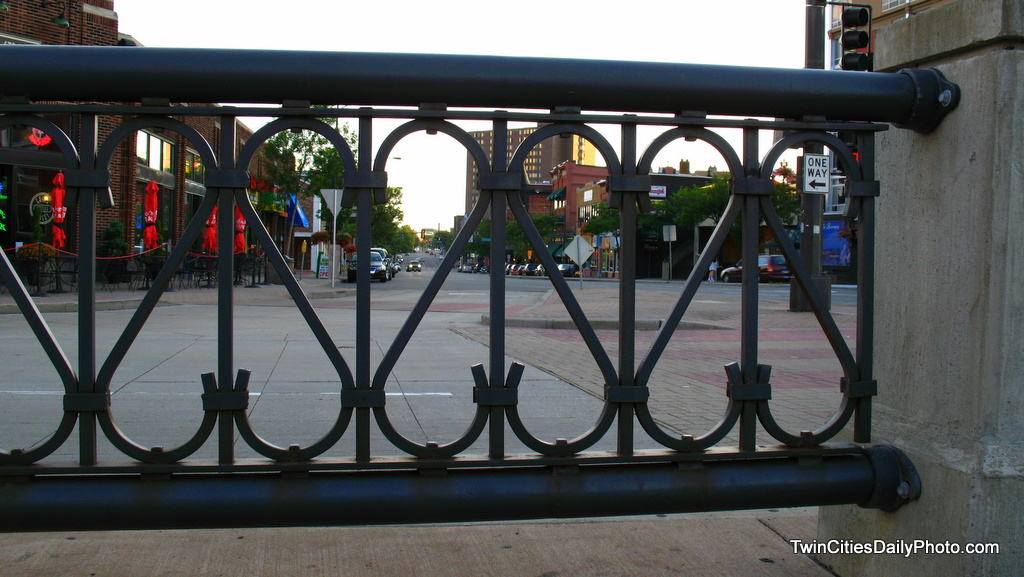
3) A nice CU of the 7th Street sidewalk in St. Paul. Img. fm. TCDailyPhoto.

Other City Sidewalks: Morgan Park, Duluth


[The sidewalks of Morgan Park lead you into the past, the birthplace of suburbia.]


Tucked away along the mouth of the St. Louis River is a part of Duluth you probably haven’t seen, where tourists from the cities rarely go. This is the old industrial section of the city, where the riverfront was lined with factories and worker housing all throughout the first decades of the 20th century. It’s one of the reasons that Duluth was once one of the wealthiest cities in the US, and there’s pretty much nothing left. All the factories are gone, and today the waterfront fills up with forgotten feelings, ghosts of another era. Well, except for a neighborhood called Morgan Park.

Morgan Park is a piece of this history, a “factory town” built all at once by the giant US steel corporation sometime in the 1910s to house workers for one of its big iron ore steel mills. Like Pullman, Illinois, or Lowell, Massachusetts, it’s one of the more famous examples of “welfare capitalism”, a very brief attempt by the big oligopolies to alleviate worker strife by creating small company-centered utopias as part of their industrial infrastructure. Not only was it planned and built by the US Steel corporation, but it was completely owned and run by the company until 1933. (Other examples haven’t aged so well.) At the same time, its a very early example of something like suburban development, but it’s also an interesting look at the values practiced by earlier forms of urban planning. And, at least to my eyes, it’s aged pretty well, barring the odd choice of housing materials.

Today the steel mill is long gone, but the factory town is still there, well-used and seemingly loved by the people who live in it. Finding Morgan Park is difficult, and involves knowing where to turn of Hwy 23. But once you get down into the little nook, you find a little one of the that is a little world unto itself that seems both familiar and strange.


[The sidewalks of Morgan Park, lined with duplexes and single-family homes.]


[All the houses in Morgan Park are made from concrete, each painted slightly differently.]

[One of the larger townhome row-houses in Morgan Park.]


It's familiar because it resembles many suburbs and planned communities you might find today. All the buildings are the same age, and little curving streets are lined almost uniformly with residential homes sitting in a park-like setting. Just like many of the suburban areas you might find in any US city, it has a well-developed brand identity that is blazoned on all the lamp-posts, yard signs, and even the bus stops. Morgan Park could be the name of any one of the new greenfield developments from Eden Prairie to Maple Grove to Woodbury, and in a way, this might be the one of the earliest predecessors of the modern American city.


[The old bus stop bench bears the Morgan Park 'MP' logo.]


At the same time, there is something very different about this place. For one thing, it’s old. You can sense that by looking at the buildings, or the sizes of the trees. For one thing, all the houses were made out of concrete, which is (I think) one of the earlier uses of this material for housing. Compared to brick or wood, it hasn’t aged all that well. It has a vaguely dirty look to it, and certainly would be strange material to walk around on and live inside. But, beyond the simple aesthetics of the place, Morgan Park has a very unusual feeling that you’d never get in a new suburban development.

For one thing, it actually has sidewalks that run down every street. I can’t emphasize enough how much I like sidewalks. The reasons are simple: they give you a place to walk around (a place that isn’t in the middle of the street where cars drive). This is the kind of thing that seems really useful, and to my mind, every home should have one. Morgan Park stems from the era when it would be absolutely insane not to build a city with sidewalks, where people using their feet and legs to move around was a common sense idea about locomotion, before the advent and rise of the cybernetic car-people that can only move around their worlds with their asses strapped into a 2-ton machine, driving through movies and banks and restaurants and grocery stores and pharmacies and coffee shops.

Secondly, Morgan Park has emphasized these sidewalks by placing their garages (for these car-machines) behind their houses. Yes, like much of South Minneapolis, the planned community of Morgan Park, Duluth has an intricate system of alleyways and detached garages that allows the fronts of homes to have porches and windows and gardens, rather than driveways and giant 3-car garages with their bleak and blank doors. Having actual fronts of houses along the street is what gives these homes that “old-fashioned” look, but it also places far more emphasis on the streetscape, on the front yard, on the sidewalk, on the front garden. While most front yards in modern suburbia are strictly ornamental gardens, mere simulations of yards that rarely used by anyone, these front yards seem to have a life to them. People seem to sit on their porch, and perhaps even throw the football in the grass along the street.


[One of the entrances to the ubiquitous alleyways the run behind the homes of Morgan Park.]


[The backyards of Morgan Park, where the homes are set about 20 ft, from each other.]

[Even though it was built at the very dawn of the automobile era, garages sit behind the homes of Morgan Park.]


Third and finally, Morgan Park has a real diversity of housing types. While, like modern suburbia, they were all planned and built by the same exact company, at the same exact time, you’ll find a real mixture of sizes and types of homes in this neighborhood. There are lots of traditional single-family homes, but there are also duplexes and attached row houses (in groups of four) that line the streets. This kind of diversity allows many different choices for many different types of people and families, and especially different income levels. Rather than everyone getting a giant 2,000+ sq. ft. house, there are all sorts of different sizes and arrangements. And, what’s more, they’re all mixed together, so that you likely end up with a more diverse set of neighbors that you might in a modern cookie-cutter development.

The other parts of the planned community, the school, the community center, the park, seem to have aged pretty well, too, with one big exception. Morgan Park still has a ‘main street’, where, presumably, businesses catered to the residents with grocery stores, hardware stores, or whatever other types of retail you had back in the1920s. In today’s era of big box shopping, except for one little hair salon, this commercial stretch is almost entirely abandoned. The row of empty shops sits there, waiting for a time when more localized time that may never arrive.


[A bank along Morgan Park's main commercial street.]

[The strip of commercial shops along Morgan Park's main street sits almost empty.]


But, if you want to see a suburbia baby picture, where the idea of 'a city in the country' first was put into practice, head up to Duluth go off the beaten track, down South along the river, until you find Morgan Park. Walk around and imagine what it might have been like back when US Steel was the largest company in the US, and the place was a wholly owned company town. It's an interesting piece of American planning history, and even today, it seems like a really nice place to live.

[One of the many strange carriage house-esque buildings that sit around in Morgan Park, unused today.]


[The Bob Stoner Memorial Garden at the North entrance to the community of Morgan Park.]