It's August... August, when nothing happens... I'm going to be in remote Ontario for the next 10 days, so if you want Twin City urbanism I urge you to go to the fair.
There's nowhere in Minnesota that more resembles Taipei street life, or Weegee's Coney Island, than Dan Patch Avenue during late August.
Posting will resume after September 4th.
-Bill
2007-08-24

2007-08-16
*** News Flash *** #3
 I'm re-starting a previously recurring feature of Twin City Sidewalks, mostly due to laziness. It's called ***News Flash***, and involves me linking to things with varying degrees of pith.
- First up is a link provided me by reader Caitlin, a radio program called Radiolab out of WNYC in New York that deals with emergence, or the way in which interactions of individuals create a higher order structure cognitively independent of any particular mind. The example most often used to talk about emergence is ant colonies, the way in which the colony forms a larger 'organism' based on interacting behavior of individual ants, independent of any ant 'mastermind'. Like the makers of this program, I'm of the mind that emergence is also a great way to understand cities. For example, this radio show talks about the way in which flowershops congregate together in cities. ("Traffic is everything.") Though its a bit depressing to think of ourselves as tiny ants running around willy nilly...
- My favorite sociologist Robert Putnam (Bowling Alone guy) has a new article talking about 'the downside to diversity.' His argument, as far as I can tell, is that homogenous neighborhoods are more likely to foster social capital then ones with a great deal of diversity, which seems pretty common sense to me. I live in a very diverse neighborhood, and people around here tend to 'turtle' (as Putnam says), and not talk to each other as much as people in more lily white places like St. Anthony Park or wherever. But, what I'm not reading enough is how segregation can also be bad for society as a whole.
- A nice link showing some maps of how the T.C. looked before they put the interstates in during the 60's and 70's.
- The ISLR had a nice op-ed in the Strib on how locally owned energy (ethanol, windmills) is better for local economies.
- On the other side of the river, the PiPress had some coverage of the St Paul Port Authority, and how it's been quietly redeveloping unused industrial land all throughout the city. Despite my reservations about Robert Moses, whose tool of choice was also the port authority, I've been a fan of most of the SPPA's work. For example, the recent Great Northern Railyard developmeny in my neighborhood.
- Urban sprawl is nothing new, according to this article on Angkor Wat.
- Two articles in the Strib on local urban bidness... First, the need for more benches for sitting... Second, are big box stores doing anything (anything substantial?) to fit in better to their neighborhoods? Judging by the Walmart on South Robert Street, I think not... I guess its better than an enema? (T.C. Bonus Question: Once you take away the fireworks and philanthropy, is Target really any better than Walmart? I keep saying 'no.')
- What Google Maps looked like one hundred years ago...
- Duluth rocks, and apparently someone finally noticed.
- This incredibly awesome event is happening today. Get thee to Nicollet Mall. (Guerrilla marketing at work...)
- And a friend of mine is launching a new wiki intended to produce a wiki-what-should-be, called Humane Earth. Feel free to edit it, vendettas and all.
- And finally, this is one of my favorite things to listen to lately: Okeh's Laughing Record. Check it out.
2007-08-15
Other City Sidewalks: Babylon NY
 The only thing I knew about Babylon NY, located about a third out on the South shore of Long Island, was that it had been the home of Robert Moses, scourge of American cities. If you don't know who Robert Moses is, I urge you to put aside a month, sometime in the near future, and read The Power Broker, Robert Caro's 1974 Pulitzer Prize winning biography of Moses. It's a fantastic biography, combining drama and painstaking detail with the rarest of ease, and in it you learn the dangers of concentrated power as Caro tells the saga of Moses's insane forty-year grip on New York infrastructure, building highways through neighborhoods and displacing hundreds of thousands of people, spearheading 'the projects', and singlehandedly yoking U.S. cities to the automobile for what will probably be an eternity. (On the other hand, the bridges he built haven't fallen down yet.)
So, needless to say, when I got to Babylon NY, the town where Moses parked his subsidized yacht, I was most filled with biblical trepidation... trepidation and a desire to somehow unearth the visible scars of Moses's mad genius. Would I find a Moses bust? Would it be the land of gated communities? Or hanging gardens? What I found, though, was a pastoral fishing village surrounded by well-manicured, sidewalk-free, and quite expensive real estate.
 [One of Babylon's old half timber'd shop buildings.]
The other day walking along Raymond Avenue, I'd been struck by the neat way that the parking lot for Noll's Hardware was tucked neatly down an alleyway, behind the st
 reetside storefront.
If these alleys marked University Avenue's industrial/St. Anthony Park seam, they were far more common in Babylon. Every street in the little downtown had a back alley parking lot. There were even whole houses tucked behind stores. (Here's one, pictured at right, for which the only access is this long dumpster-filled alley.) The little downtown is just a five minute walk from the Long Island Railroad commuter train, and features a host of old-school thrift-, paperback book-, antique-, and drapery-stores. It boasted a few grocery stores, and a number of Irish bar/restaurants that must have dated back to the South Shore of Long Island's economic fishing foundations. What struck me most, though, was the drive-through grocery store called The Dairy Barn, which uses a sort of nostalgic aura to entice people to buy milk and bread without leaving their driver's seats.
Babylon, despite its nice sidewalks, transit access, and
 walkable aura... despite its lamppost flower planters (hanging gardens?), its inlaid red brick trim, and the delicate arch of its maple trees that lend it a precious authenticity... despite all that, I didn't' find an urban spirit in Babylon NY. For one thing, the 'downtown' (or village center) is really sparsely populated. There was one building on a main corner that seemed to be undergoing condo-i-fication, but you'd be hard pressed to find an apartment to rent in that town. Similarly, Babylon seemed almost entirely dependent on cars to get aro
 und. The streets date back, I'm sure, a long way, but couldn't they put in some bike lanes or something? (Of course, the same could be said of recent Sidewalk of the Week winner, Carter Avenue, which could serve as a dead ringer for Babylon's village aesthetic.)
I went on a long walk from the downtown to the Babylon harbor, passing along a suburban-seeming sidewalk winding through the lawns of suburban houses. It seemed almost exactly like any of the nicer Twin Cities suburbs (e.g. Edina, Roseville), complete with two-car garages and the proverbial picket fence. most of these houses must have been built after Moses completed his Long Island highways (ever politically astute, he called them 'parkways'). (Indeed, it was Moses's highways which spearheaded the development of suburban Long Island, cultivating Levittowns at an astronomical rate.) I walked on the sidewalks of Babylon, and when the sidewalk disappeared I walked on the edges of roads, through yards, and around poles. I walked but didn't find any sign of public space... The best I could do was the entirely benchless municipal pier, where I sat on the pavement with a book and stared out at the sea.
Would Moses were here, I'd kick him in the balls.

[The view out Babylon Harbor, presumably looking at the Robert Moses causeway connecting Robert Moses State Park with the mainland, and probably Robert Moses's own personal favorite view.]
2007-08-14
Principles of Sidewalkery: Increasing Returns
 Today its time for another POS -- or Principle of Sidewalkery (POS). This time we're going to look at increasing returns, or the idea that 'Sidewalks Aren't a Zero Sum Game'. What is increasing returns?
Well, the first thing to think about is why certain types of businesses cluster together in cities. For example, New York City is famous for having 'districts' in certain parts of the city, where, for example, fifty different industrial lighting shops cluster together along a certain stretch of a street (The Bowery). Why do businesses that compete with each other (ethnic restaurants, antique shops, nightclubs, &c.) often end up in the same kinds of neighborhoods when classical competitive economics dictates that they should create unique identities by locating themselves far from one another?
That's one of the puzzles of increasing returns. At the same time, increasing returns points to the notion that good businesses create good sidewalks, which in turn create good businesses, and so on and so on (and scooby dooby doo) in a catalytic cycle of positive feedback. Increasing returns means that street corners create their own street corner audience, that not only does neighborhood specialization decrease the effect of direct competition, but that vibrant pedestrian traffic can grow itself along contiguous stretches of sidewalk like a grapevine on a fencepost, or like mold on old bread.
Last week's Sidewalk of the Week, Raymond Avenue, is a good example of the idea of increasing returns. While the University Avenue area has many corners boasting one- or two-story mixed-use buildings, for some reason only this particular stretch along the Northwest corner of Raymond has shop after shop after shop with (relatively) thriving pedestrian flow. According to classical economic principles, restaurants might just as well move to some of the empty-ish buildings around the corner, or across University Avenue, capitalizing on their low rent and separate geographic identity. The last thing two restaurants would want to do is bunch together and directly compete with each other for business. But for some reason, the two most successful restaurants in this area are on the same block. Its because instead of competing over the same cafe-going pie, by locating next to each other Key's and Jay's Cafes increase their returns and grow the Saint Paul dining public. This part of town becomes known as the 'Cafe Corner,' and twice as many people show up to eat.
Similarly, on Saint Paul's Selby Avenue the success of Lula Vintage Wear (a vintage clothes store) catalyzed a two new vintage stores (Up Six on Snelling Avenue, and Go Vintage 54
 across the street on Selby) opening up less than one block away, so that now there are three vintage stores forming a vintage clothes district on this little part of town. [image from lulasvintage.com]
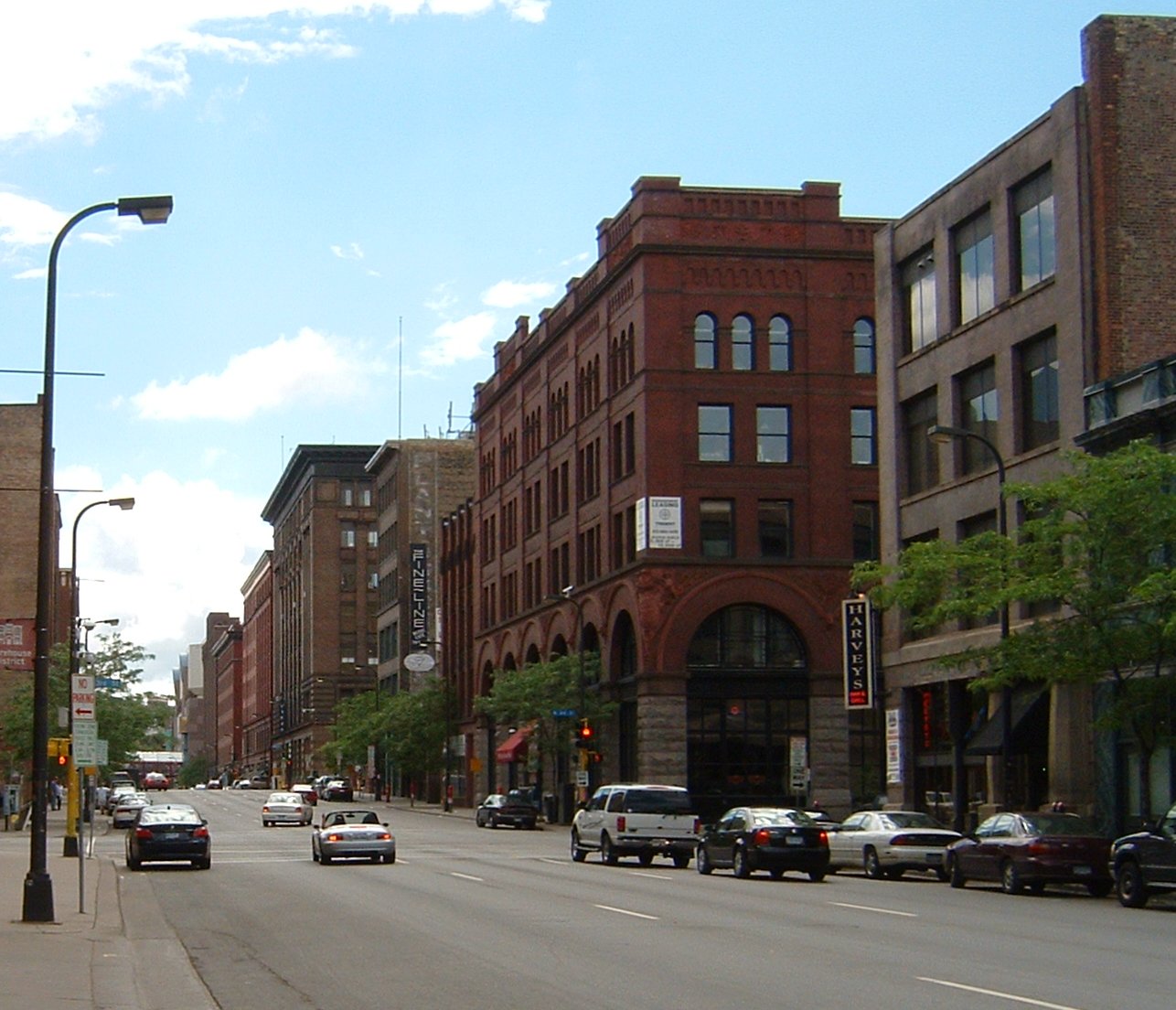
Or to offer another example, one popular nightclub in Minneapolis's warehouse district spawns another across the street, until the entire area becomes known for its nightclubs. So instead of competing for the same pool of club-goers, the neighborhood's identity grows the total number of club-goers, and everyone comes out ahead.
At the same time, increasing returns creates a generalized, overall neighborhood prosperity. In other words, customers to one successful business create pedestrian traffic which can support other unlike businesses in the immediate vicinity. The more people you have walking around a certain area, the more easily a hardware store or a grocery can grab and extra customer or two, so that vibrant walkable sidewalks tend to grow and thrive in tightly contiguous clusters. Sidewalks aren't fighting over a set amount of retail business, but instead can increase their retail return by encouraging neighboring businesses.
So increasing returns to sidewalk vitality works in two ways -- first (1) by allowing for neighborhood specialization to create a unique identity for an entire sidewalk corner, rather than a single business, and second (2) by increasing overall pedestrian flow so that other nearby businesses benefit from added traffic flow. And unlike cars, which are a pain in the tuchas to start, stop, and park, people on foot can amble, stroll, and meander their way along a stretch of sidewalk, whiling away their days gazing in shop windows. Increasing returns is one of the big reasons that sidewalk vitality so often comes in tightly compacted stretches. Good sidewalks make good neighbors, and streets take on lives of their own.
Also:
The increasing returns of sidewalk specialization is certainly nothing new. I'm reading The Continuing City, by urban morphologist and geographer James Vance Jr., and he describes ancient Greek cities thus:
We cannot establish a detailed picture of the commercial geography of Athens or other classical cities, but we can reasonably accept the idea that one did exist. The segregation was horizontal, into the [merchant] quarters already mentioned; it also seems to have been vertical to a small degree. Foundations remain that suggest the existence of upper-story storage of goods, as well as "living over the shop." ... The geographic anchor of all this internal structuring of commercial areas was an agora. Traders first congregated there; from there, they came to occupty more differentiated craft and traders' districts. [p. 55]
2007-08-08
Sidewalk of the Week: Raymond Avenue
 Politically bookended by the dogged, probably all-male Libertarian Party of Minnesota headquarters on one end, and the longstanding (hopefully female) quality newspaper, Minnesota Women's Press, on the other, the sidewalk along Raymond Avenue is this week's Twin Cities' Sidewalk of the Week. Where else can you find such a spectrum? Congratulations!
In a way, stepping down Raymond Avenue is like stepping back in time, w
 ading through a yellow fog of modernity, and standing on tiptoes of timelessness to peer through the knothole of The Now into the hearts of Saint Paul's Hamden Park. (So to speak...) What I mean is, the two block stretch of businesses that runs along the West side of the street boasts of the kind of retail diversity you rarely find any more in the Twin Cities: two restaurants (Key's and Jay's), a host of really small offices including a print shop, a newspaper, a political office, and a karate studio, a hardware store, an antiques shop, and a medium sized grocery store called Herbst Maket which doesn't appear to have changed one iota since the mid 60s -- in other words, canned vegetables abound around the meat counter. This sidewalk's vibrancy really sets a high bar for the University Avenue area, and I think there are only certain parts of the Asian districts of the street can match its pedestrian attraction.
My sense is that this stretch of sidewalk, practically the only retail corner along this largely industrial section of University Avenue, serves as the Main Street for Saint Paul's Hamden Park neighborhood, located just North of this corner along Raymond Avenue. Somehow the folks that live around here have managed to support their grocer and the
 hardware store and keep them afloat for all these years.
One of the things that makes this sidewalk so interesting is the way in which the businesses extend out onto the street, forming a kind of arching tunnel of trees, shop signs, grass & tables through which one is invited to amble. For example, [photo at right] the vintage store, Succotash, puts some of their awesome 60's furniture out on the street, inviting anyone to place their tuchas into an antique chair. Jay's Cafe, too, has under-umbrella sidewalk dining, a rarity in this part of Saint Paul
 Another of Raymond Avenue's nice sidewalk features is the rear-of-the-building parking lots, that presumably date back to the time before cars (a.k.a. B.C.). The sign for
  Noll Hardware [pictured at right] points to the parking in the rear of the building, and cars can drive down the little dirt alleyway to a parking lot that doesn't intrude at all on the sidewalk retail frontage. This alley is perhaps a little narrow for drivers today, but, really, new businesses thinking of ways to incorporate additional parking ought to really consider this kind of parking structure. All it takes is a little bit of fore knowledge on the customer's part, and you have parking lots and sidewalks harmoniously working together. The sidewalk keeps its finely woven fabric, its window'd warp and dog walk'd woof. If only every sidewalk could be so lucky.
Subscribe to:
Posts (Atom)