2017-09-18

Once Upon a Time in Saint Paul #1: Alley 29

It was a leftover space, a sort of light court formed by the backs of surrounding buildings which faces downtown Saint Paul streets of Fifth, Wabasha, Sixth and Cedar, with a sliver of passage space connecting this twenty by forty foot space to Fifth Street. Today the shiny Osborne Building stands there, but before that, this micro area, which nobody apologized for calling ‘quaint’ was know as Alley 29.

In 1961, the owner of the alley’s surrounding buildings, Jim Barwise, conceived of the idea of borrowing the back spaces of the flanking buildings and converting them into small shops and tiny workspaces. George Raffferty of Progressive Design Associates (Now Rafferty, Rafferty, Tollefson, Lindeke Architects) took advantage of the older patina brick three story high walls surrounding the courtyard, added granite paver cobblestones and modest but distinctive signage. That carefully restrained design effort of this small space seemed to be a bit of bohemia, but many downtown people remarked, “This is what Saint Paul is all about.”

The retail spaces consisted of the Twin Cities first Japanese cafe, a bookstore, an art supply store, a tailor, a picture frame shop as well as Progressive Design Associates first offices. Barwise was pleased with his effort that came into place before the boutique retail trend.

But downtown Saint Paul saw progress as their objective. Although a City of Saint Paul 1965 planning document’s techno-utopian language envisioned “intimate environment space,” the latter pages of the document presaged high intensity development on that block, replete with office towers, parking ramps and skyway-accessible retail stores.

That was the kind of progress that made the demise of Alley 29.

Was Alley 29 considered in its time to possess any historical merit? As George Rafferty observed, “It lived during a time when that type of history wasn’t of particular value.”

[From Preservation Matters, November 1986 issue, published by the Preservation Alliance of Minnesota, written by Bob Roscoe.]


[Alley 29 in 1962.]


2017-09-15

Saint Paul Walkability Hell Trek: a DIY Walking Tour

In honor of Saint Paul hosting the National Walking Summit, I have prepared a self-guided walking tour for summit-goers.

By the way, I love Saint Paul! I think there are some great walkable parts of my city. I could easily come up with a tour of the best possible five-mile walk through Saint Paul.

But I also think there are some real design tragedies that keep Saint Paul from being its most walkable, pleasant, and compelling self.

So, here you go! The walk is about 5 miles long, and takes you from the West Side to Rice Park. Give yourself about two hours, though you might go faster than that as you'll often be running from speeding cars.

[Link to step-by-step directions is here.]


Point of Interest #1. You begin your journey on the West Side Flats, on Robert Street, one of the worst streets anywhere in the East Metro.

Back in the early 1960s, this was a working class neighborhood with a tight street grid and small, walkable blocks. Shops and buildings and homes were all around you.

Today it is an industrial park in the shadow of downtown, and the sidewalks of Robert Street are noteworthy for being particularly narrow and horrid. In fact, when this street was first designed great light poles were placed directly in the middle of the sidewalks. At some point, an embarrassed engineer added tiny brick extensions to the sidewalk at each pole.

All around you are parking lots, empty falling apart buildings, and vacant lots. The smell of industry and blood lingers in the air. And you can see downtown!

(Note: biking here is borderline suicidal.)


Point of Interest #2. Proceed towards downtown. You will notice that as you reach the 1920s-era Robert Street bridge, for some reason the street goes from two lanes in each direction to three (!) northbound lanes. It’s the age-old answer to the question: can it get any worse?

(A: yes it can, yes it can.)

Cross the lovely bridge and enjoy the view of the Mississippi. Savor this moment before you reach the dangerous porkchop island-laden intersection of Robert and Kellogg. Back in the early 1930s, Kellogg Boulevard was widened to accommodate more car traffic, and today it’s not very pleasant.

But lo! Ahead of you is downtown Saint Paul, full of historic buildings and walkable sidewalks. It looks great! It is almost seductive.

Don’t worry… we’re not going that way.

Turn down Kellogg Boulevard and proceed along the narrow sidewalk under the tracks of the lovely 1920s-era Union Depot train station.

Enjoy your walk through Lowertown while you can. It’s lovely!
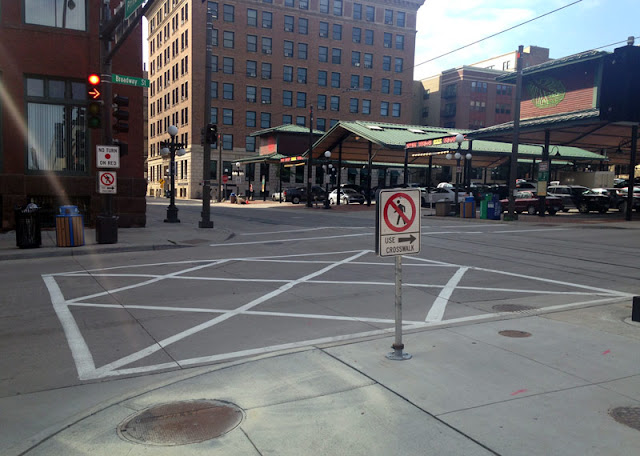

[This sign is epically stupid and nobody pays attention to it.]

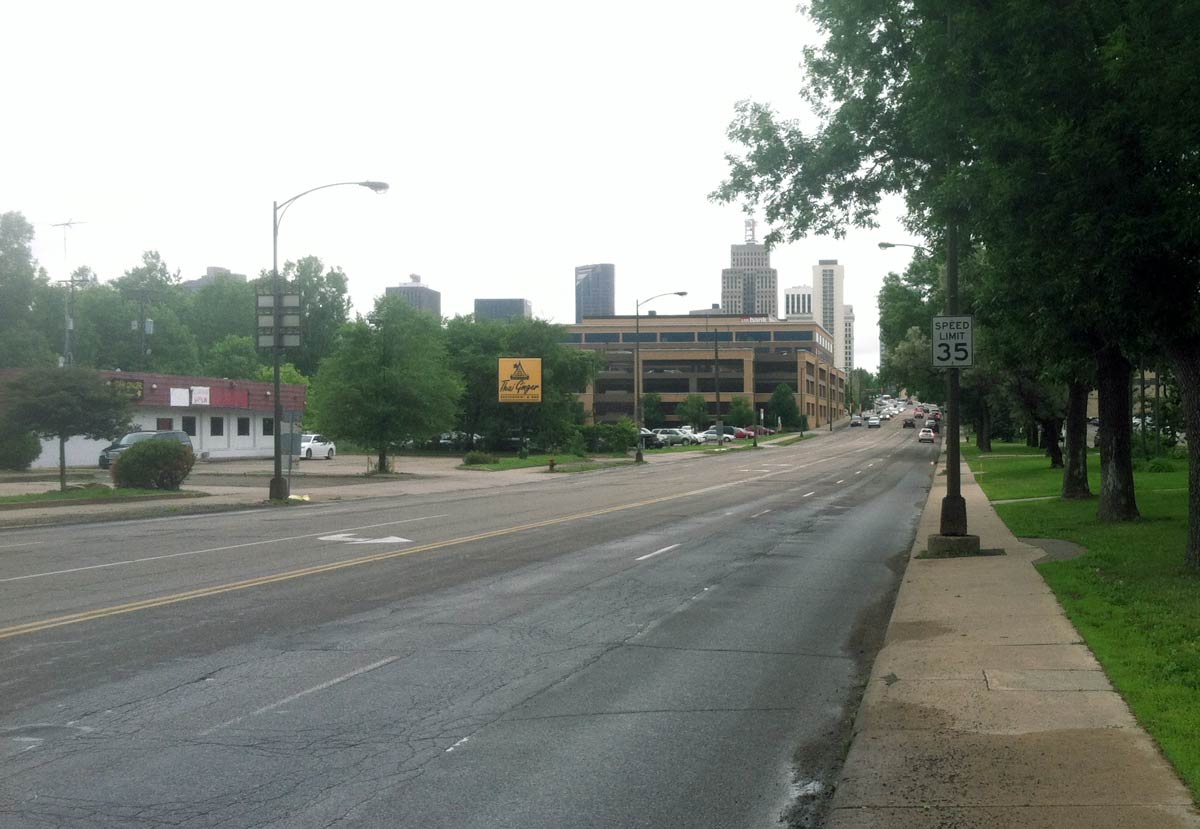
Point of Interest #3. OK You’ve reached the point where Lowertown turns into a freeway on-ramp. Here is where the walkability ends.

(At some point someone even installed a pillar to mark the occasion!)

Tread carefully, for cars speed off of the freeway here and will run you down in a heartbeat.

Approaching East 7th street, which is a US / state highway, note the first ever Super America gas station. How historic!

Also note that this is one off the only streets that connect downtown Saint Paul to the East Side, a huge part of the city that’s full of history, diversity, and no little poverty.

Also note that there’s no sidewalk on one side of the street. How is that even possible? Thanks Minnesota Department of Transportation!

You are now entering the “East Side death mile” portion of the tour.


["Oof da": the Scandinavian phrase meaning, "you can't walk here but will try anyway."]
Here's the challenge. Somehow you have to get from here up to the East Side without being hit by a car. Good luck. You might try running across East 7th during a rare break in speeding traffic. You risk being flatted by cars entering Highway 52, another huge freeway built in this area of Saint Paul during the 1960s.

Honestly, I have no advice for you. I hope you are athletic.


[Desire paths used by the poor.]


Point of Interest #4. OK You’ve reached Payne and East 7th! How'd you do it?

Anyway, good job. Look up the hill along East 7th and imagine trying to get there on foot. How’s it look?

Let’s take a left instead and walk around on Railroad Island, so-called because a century ago it was surrounded on all sides by railroad tracks. Today, it’s also surrounded by high-speed roads!

But there is hope. See the construction here? That’s a legit pedestrian improvement project underway. Thank you City of Saint Paul! They're realigning the previously-horrible intersection of Payne and East 7th to be kinda somewhat OK in the future, hopefully.

Walk along Railroad Island and enjoy the lovely old working class homes. This is a great part of the city!


Point of Interest #5. Welcome to Tedesco Street, one of the very few ways on and off "Railroad Island." Prepare for another horrible experience! This is a low-traffic street with four lanes and a narrow sidewalk on one side only.

Lafayette Road, so named for an old Victorian park that was once here but then demolished for a surface parking lot, is also terribly unwalkable. Plus thousands of government employees work here, surrounded by parking lots and high speed roads. As is the case with many of the government buildings in Saint Paul, there is no economic development anywhere near here, pretty much nowhere to eat lunch or walk to. Kind of sad, really.

Continue along University Avenue. Elsewhere, this is one of the main streets in the Twin Cities, lined with shops and a compelling sidewalks.

Here, it’s an empty windswept industrial unnecessarily-wide street full of speeding cars. Let’s walk to Capitol Heights!

Capitol Heights is another old residential neighborhood that’s been sorely neglected over the last century. Enjoy the neat old buildings and actual topography. There are some good views.


[Sadly, Central Park is not on the tour.]
 

Point of Interest #7. OK You’ve reached Rice Street, an utterly bleak and dangerous county road. This is also the center of the state government and state capitol area. Enjoy your walk along Rice Street, which has four and even five lanes at certain points.

Back in the late 1950s, this was a working class / African-American neighborhood with small blocks and lots of shops. Today this entire area is controlled by the state legislature, and they “improved” it in the 60s by bulldozing just about everything for parking lots and wide roads.

Hey, look to the left. It's the state DOT headquarters! Check out the high-viz crosswalks and heavy-handed signage. It’s almost safe to cross Rice Street here!

(Of course, lots of government workers and others use a “desire path” crossing at mid-block in either direction instead, scampering across the five lanes like well-dressed gazelles.)

[The MnDOT building crosswalk.]


To your right is a classic early 60s modernist Sears building surrounded by a massive typically-empty parking lot. It’s most famous for having a Department of Motor Vehicles office inside. Cool!


[The Sears parking lot.]

[Good view of the Cathedral.]
Point of Interest #8. OK you’ve reached John Ireland Boulevard, named for a famous Catholic bishop. It’s really wide! They widened it back when they tore down most of the old neighborhood here to build massive “green spaces” filled with statues and a whole bunch of freeways. More importantly for our walk, they also built really huge and dangerous roads all through there. John Ireland is the best of them. Check out Marion Street and our old friend Kellogg Boulevard.

Fun fact: Did you know that, just a block to the right, Kellogg has 14’ wide lanes? It’s true! 

OK. Here we are at the Mulberrry Street crosswalk, which connects some major attractions like the History Center behind you and the Cathedral ahead of you. The corner has recently been marginally improved because, just over a year ago, a young woman was killed here while trying help her mother cross the street. It was terrible!

[The deadly crosswalk.]


Point of Interest #10. Continue down Kellogg, trying not to get hit by cars turning onto and off of Interstate 35E.

You’re almost to the really walkable part of Saint Paul!

There are a few remnants of the old city left around you. Cool stuff but you can't get there from here, so just take my word for it.

Turn right at the hockey arena. Keep going!


[You can almost see the walkable parts of downtown from here.]


Rice Park, how lovely. I mean that sincerely. The nicest park in town. A great place for strolling around.


2017-09-14

An Open Letter to Charles Hathaway

[This is in response to a letter to the editor in the most recent Villager, pictured at right.]

Dear Charles:

We've never met, but I read with a mix of interest and anxiety your recent letter in the Highland Villager. In it, you castigate a "small group" of younger people who "jeered" at "what these old people built" during a recent meeting on the Ford site.

As a obsessive student of Saint Paul history, I was initially put off by your condescending tone. As I have done many times during the Ford site debate, I rolled my eyes and looked away.

Yet later I realized we might have something in common. Despite the fact that we disagree on the merit of the city's plans for the Ford Site  -- I have called them "the best thing I've ever seen Saint Paul propose, anywhere" -- I see common ground.

In your letter, you describe the rich social connections that people have built over the years. You list things like PTA meetings, coaching baseball, gardening, attending funerals, and donating used clothing to frame what you see as a lack respect for older folks living in Saint Paul.

I, too, value of these kinds of social connections. When I think of the word "community", it is precisely these sorts of relationships that spring to mind. I love the weak ties of recognition that come from knowing one's neighbor, and I value the strong ties of kinship that come from sharing institutions like schools, churches, libraries, or even the neighborhood bar. (There are too few of these in Highland, by the way, but that's another story!)

However, I think there's something important that you might not yet recognize. I'm guessing you're in my parents' generation, born sometime in the mid-1950s, give or take a few years. That was right in the midst of the post-war baby boom generation when Saint Paul, and indeed all US cities, experienced rapid change.

Memories are a fickle thing, but in my research over the years, I am always amazed when I'm reminded how much denser and more populated Saint Paul used to be. In the 50s and 60s, our city was much more full of people. Streets were narrower. Higher percentages of folks took transit every day. People walked a lot more! And on average, every house in Highland -- and all through the city -- housed more people than they do today. Instead of 1, 2, or 3 people living in a single-family home, when you were born, there might have been 2, 4, or 6 people sharing the same space.

Just like you, I look back on those times (weirdly, before I was born) and think fond thoughts. I like to imagine Cleveland Avenue, Saint Clair Avenue, or a dozen other streets when there were a hundred local shops, foot traffic all day, and a rich world of street life. That seems wonderful to me!

The problem is that, since the 60s, public space in our cities has eroded. Instead of homes and shops, we have parking lots. Instead of big families, we have houses with only one or two people (and their pets, of course). Much of the time, instead of connecting, people watch TV, or stare at their phones. (See? I sound like an old crank!) The point is that the social propinquity that we both value has been changing for a long time.

What do we do?

On this we likely won't agree, but for me, a big culprit of this change is urban design.

I've talked about this before, but when we're swallowed up by private homes or driving around in our private cars, stuck in traffic or speeding past, we become the least common denominator of our social selves. In our cars, we have little way of communicating apart from a honking horn, a revved engine, or a turn signal. In our disconnected homes, with their quiet front yards, we have little way to engage apart from lawn signs. (Witness Highland these days!)

Instead, we spend our time inside private bubbles, driving or holed up in dens. We listen to private soundtracks or (worse) some idiot ranting about "garage logic." Meanwhile, Saint Paul's sidewalks, shops, and public spaces are frayed by vast parking lots, speeding cars, and the march of privatization. Meanwhile, Saint Paul continues to lose the density and social connection that made it a vital place.

If you don't believe me on this last point, I'd urge you to check out the sociologist Robert Putnam's book "Bowling Alone", about the what he calls "the decline of social capital."  Putnam's social capital is precisely the kinds of relationships you describe in your letter. He shows that, since the World War Two generation (your parents), it's been disappearing. And one of the main culprits is our driving habit.

Putnam summarizes the causes for the decline like this [emphasis mine]:
First, pressures of time and money, including the special pressures on two-career families, contributed measurably to the diminution of our social and community involvement... Second, suburbanization, commuting, and sprawl also played a supporting role... Third, the effect of electronic entertainment - above all, television - in privatizing our leisure time has been substantial... Fourth and most important, generational change - the slow steady, and ineluctable replacement of the long civic generation by their less involved children and grandchildren - has been a very powerful factor.
I encourage you to read the whole thing, or at least skim through the charts about picnics and Shriners' clubs. And by the way, it might surprise you to read some of the data on the Millennial generation. They are more interested in civic engagement and social connection than anyone has been in a long time.

The point is that I believe the city's plan for the Ford site matches our future needs and will strengthen the social fabric in Saint Paul. If Putnam is right, we need less "privatized space" and more everyday public space in which people can connect. If we want to keep the kinds of social ties and connections that you and I both value, we need less orientation toward cars and more social forms of transit and transportation. We need opportunities to walk around and encounter the diversity that Saint Paul has to offer. And most importantly, we need better housing accommodation for smaller households. Only then will we welcome the people who will become the next generation of PTO members, community gardeners, soccer coaches, and urban stewards.

In short, Saint Paul needs density. Building a neighborhood for the future can help Highland return to to the rich and dynamic social fabric that it had back when you were growing up.

Given how poisonous the debate has been over the Ford site plans so far -- I had to walk out of the recent church meeting because I could not tolerate the hostility coming from many of the "Say No" people -- I don't expect you to agree. I only hope others might read this with open minds and hearts. I hope Saint Paul might see a possible future for people of all backgrounds. I hope we can value what walkable streets, fewer cars, and more diverse kinds of homes might offer for our community.

I want to see our cities change, but I'm not trying to erase the past. On the contrary, in many ways, I want to return to it. I want those relationships we both value to thrive. I want a city where gardening, volunteerism, civic involvement, and small businesses flourish. I want a city where traditions are both honored and created anew, transformed for a future that includes the full diversity of Saint Paul's children. In the city to come, they will accomplish things greater than either of us can imagine.

Sincerely,

2017-09-13

On Appearing with Sen. Franken in Support of Net Neutrality

Two weeks ago, I got a random request from Senator Franken's office to join him during a press conference about "net neutrality." The Senator needed a "blogger", someone who would represent independent media and the importance of free speech and equal access to the internet. As a almost-always-marginal blogger, I was flattered!

Senator Franken has been a champion of "net neutrality" since he started campaigning, and I knew a bit about the issue. I looked into the state of things today -- tl;dr, the FCC is not good! -- and jotted some notes down of key points.

Here they are:
  • The importance of net neutrality: equal access for everyone no matter who they are or why they are trying to use the internet. Mention important Minnesota bloggers like Aaron Brown, Tony Webster, and Sally Jo Sorenson.
  • Share my story about the Philando situation and writing that interview -- talk about the time you shared information about a major national story from your kitchen, and how the blog journalism reached an audience.
  • Talk about the repression of journalism in Turkey, China, the troubling attacks on the media coming from the White House…how important streaming media in particular is these days for political speech. It is not a given that the internet will be "neutral" and available for anyone, no matter who they are or how much influence they have.
  • Mention that the US built on free speech, American revolution comes directly out of things like the 1765 stamp act, the British attempting to restrict and tax access to paper.
  • Net neutrality should not be a partisan issue, proud of Senator Franken for leading the way on this.
(Note: thankfully I didn't mention the US history stuff. I also didn't mention China and, in retrospect, I am glad I did not start an international incident with Turkey! That said, Erdogan is bad.)

This is to say that, unfortunately for me, I kind of "winged it." Honestly, I didn't really understand the stakes of the situation. There were TV cameras, and I had a US Senator standing beside me while I spoke. The two other speakers both delivered polished statements about the importance of open internet to libraries and entrepreneurs. Meanwhile, I blabbed on... I guess it could have been worse.

Having my mind and daily live enmeshed within the small worlds of local politics, it's easy to forget that there are people who actually have to go out and deal with a Trump White House and (somehow worse!) DC Republicans every day. After the presser, Senator Franken took questions on DACA and a judicial appointment. A week later, he came out in support of single-payer health care. These are hugely important issues, if losing battles at the moment. I wish I'd been better prepared.


[Given what's happened since, can we agree that Al Franken was ahead of his time?]

From a more personal perspective, I've been a big fan of Al Franken's work ever since I first picked up "Rush Limbaugh is a Big Fat Idiot." I used to love political satire (still do, sort of) but Franken's books are legitimately informative and well-written. "Lies and the Lying Liars" has a great chapter on the centrality of top bracket tax rates to US politics in the 20th century. Reading it was the first time I'd really understood the straight-forward greed that lies behind the US right wing. I even listened to Air America once in a while back when Katherine Lampher was co-hosting!

Later, when Franken ran for Senate against the odious Norm Coleman, trying to take back the seat of actual-hero Paul Wellstone, I was cautiously optimistic. I remember during the recount, Franken used to come work out at the University of Minnesota gym. A few times he played squash with my good friend Dudley, and I would see him in the changing room. (Spoiler: as you might imagine, he was a super competitive squash player.)

Luckily, he won, and since then, he's been an extremely hard-working and well-informed Senator. He debates like he plays squash, a dash of playfulness, and a lot of preparation and determination. Unlike me, he does not mess around!

Even though I wasn't that prepared, this time, I'm honored to be able to meet him and (hopefully) help Senator Franken score a few points in DC.

All this is to say that, I felt a bit embarrassed when I asked him to sign my VHS copy of "One More Saturday Night", his early film about being a rock musician in Saint Cloud. (Note: this is the best movie ever made about nightlife in Saint Cloud!) I wish I'd had him sign my Lies and the Lying Liars book instead...

Anyway, thanks Senator Franken for championing the cause of marginal bloggers. Sorry I made you sign your dumb movie! Good luck in DC. God knows you will need it.


2017-09-12

Join me this Saturday, 9/16, for the Cap Wiginton History and Architecture Bike Tour

There's an exciting tour coming up this Saturday. My friend (and occasional tour-taker) Jeremiah Ellis and I have been working together over the last few months to organize a tour in honor of Clarence "Cap" Wigington, one of Saint Paul's most notable historical figures.

I didn't know much about Wigington's story before I began thinking about this tour -- indeed, the ball got rolling because of my interest in watertowers! -- but as it turned out, Wiginton's legacy was all around me. Wigington was Saint Paul's "city architect" from the late 1910s well into the 1940s, which turned out to be an absolutely crucial period in the history of Saint Paul architecture. Most of the city's civic buildings built before that time did not stand the test of time, while many of the buildings built after the war lacked what you might call "monumentality."

To my mind, Wigington's career matched perfectly the growth of Saint Paul into adulthood, the birth of a sense of civic purpose, and the "city beautiful" era of design thinking. This was, in fact, the birth of the time when Saint Paul and most other American cities began emerging from the patronage-based "city machine" style of governance and began attempting to create an independent sense of civic identity, with institutions that might rise above the swamp of quid pro quo politics.

(Some might say these efforts have not been completely successful! But if you think it's bad today, you should have seen it before...)


At any rate, the first City Plans for both Minneapolis (1917) and Saint Paul (1922) date to this era. And I imagine that the birth of a more professional class of bureaucrats seeking to represent and do their best for all citizens (rather than their friends and social networks) might have opened up opportunities in new ways, and finally allowed African-Americans into the professional classes. Wigington's career is a shining example of this, as he was able to use his talents in an amazing variety of ways. His buildings -- many, but not all, done in collaboration with other Saint Paul architects -- display great variety of style. His first Saint Paul building, the Como Park Elementary School (1916) seems to me a dead ringer for contemporaneous neo-classical designs like the city's three Carnegie libraries. But his later work ranges into modernism, art-deco, and a bunch of other architectural styles that are beyond my limited knowledge.

My favorite example is that Wigington was the sole architect of five different ice palaces during Saint Paul's Winter Carnival heyday. What fun it must have been for him -- and for Saint Paul's carnival-goers -- to have free reign, within the structural limits of ephemeral ice, to design anything he could imagine. (His palaces put our modern attempts to shame... though I suppose we can hold out hope for the 2018 ice palace.)

So let's go see it for ourselves! This will be a bike ride beginning at the Highland Water tower (1928) and ending at the Wigington / Harriet Island pavilion (1941). This will be great fun. I'll be speaking about City Beautiful design thinking and what water towers mean to us as monuments and objects that create places. Later we'll be hearing from others. I'll be learning a lot, and I can guarantee you will as well.

[FACT: I have referred to this as the "eye of Mordor"]
Here's the description from the eventbrite page:
On Saturday, September 16, you will hear the unique perspectives of Keon Blasingame of the National Organization of Minority Architects’ MSP Chapter, ice palace historian Bob Olsen, urban geographer Bill Lindeke and documentary producer Daniel Bergin.

During this nine mile (mostly downhill) bike tour, we will be able to visit only five of the nearly thirty Wigington designs which remain today. Our local volunteers will share of their expertise at the Highland Park Water Tower, the Hamline Recreation Center, Saint James A.M.E. Church, the Roy Wilkins Auditorium and the Wigington Pavilion at Harriet Island. Members of Major Taylor Bicycling Club of Minnesota will serve as our ride marshals along the route.
Thanks to Jeremiah Ellis for putting this together, and I'm honored to be a part of this experience.

What: Bike tour to look at buildings designed by, and learn about, Clarence "Cap" Wigington, Saint Paul City architect
Who: You, or anyone who wants to bike six miles; event is free
When: Saturday 9/16 leaving at 1:00 pm (gather beforehand)
Where: Meet at the Highland Water Tower
Why: Because it's there

[Some of the 60 still-existing Wigington landmarks, and a few that don't exist.]


[1937 ice palace.]

[1941 ice palace.]
[Wigington's Roy Wilkins' auditorium, 1932.]
[Harriet Island Pavilion, 1942]

[Como Park Elementary 1918.]

[Hamline Park rec center, 1940.]