2010-08-19

NiceRide with Mom: Testing Minneapolis' new bike sharing program

I've been pleasantly surprised by how many NiceRide bicycles I’ve seen meandering around town. I saw my first one near the Metrodome in downtown Minneapolis. Neon yellow and blue and a bit ungainly, it looked good as some Minneapolis stranger pleasantly pedaled it past. I remember asking him something trite, like “how’s it work?” or “What do you think?” His reply was unmemorable.

Since then, I’ve seen a bunch of these bikes. In particular, while hanging out on the University campus this summer, I’ve been struck by how many folks use them. The kiosks are located all around campus, and if you sit near Nicollet Mall during a lunchtime, you’ll see all sorts of people going by on the yellow green bikes.

And importantly, from my point of view, those people are often older women. It’s no secret that the demographics of the bike community leave a lot to be desired. Cyclists are overwhelming young, male, and white. (I’m pretty much par for the course.) Perhaps in other countries you find women and older folks riding bikes. But here in the Twin Cities, like most of the US, we have a long way to go.

And it’s too bad. One of the big goals for cycling advocates needs to be finding out a way to attract more riders, to make biking comfortable and convenient for people who aren’t daredevils, exercise buffs, or crunchy hipsters. Perhaps NiceRide, with their vaguely ‘Dutch city bike’ feel and low-price convenience, may be beginning to attract more people to urban cycling. Perhaps NiceRide get rid of some of the anxiety and trepidation surrounding people’s vision of cycling in the city. Perhaps NiceRide can be a ‘gateway bike’.*

So, with that in mind, I decided to try out the NiceRide bikes using a non-demographically aligned test subject. My mom, a suburb-dwelling medical professional in her early 60s with a nagging knee injury who hasn’t ridden a bike in something close to ten years, has always showed no small amount of motherly fear and concern whenever I mentioned how I ride a bicycle around the city. To her mind, every time I said I was biking home, it was as if Evil Knievel was going to jump a canyon, her nightmares no doubt filling with an imagistic flurry of near-death experiences, face-shaped fender dents, and broken bones raining down onto windshields of cars. So, I figured she’d be the perfect test case for the NiceRide bikes. If she could enjoy biking through Minneapolis, then almost anyone could.


[My mom's image of "biking in Minneapolis."]

I went to pick her up at her office on the University campus, and we set out on a beautiful Monday afternoon in the Minneapolis summertime. She was "terrified", and told me so repeatedly. She didn’t know if she could "do it", and probably had little inkling of where she was going, or how she would get there.

As it turned out, we visited a good smattering of Minneapolis lefty lady locations, including The Birchwood, the Midtown Global Market, and the Common Roots CafĂ© before winding up at the Open Eye Figure Theater for Kevin Kling’s annual Fringe-adjacent storytelling play. She did great, seemingly enjoyed the experience, and afterwards her “sitter downer” wasn’t even sore the next day.

I quizzed her at the end, and we came up with a list of conclusions about the NiceRide bicycles, and whether or not they will be able to make the Minneapolis bike scene more inclusive.

NiceRide pros:

  • Cheap – $5 a day, or $60 a year is a hell of a steal. You can’t rent bikes for this. Sure, there’s also time charge if you keep for more than a half hour, but most of your trips will surely be shorter than that (especially since there’s no lock on the bikes).
  • Flexible – One of the nice things I discovered about the kiosk system, is that you’re not really tied to any time or place. My mom and I rented bikes and dropped them off four or five times, eventually leaving the bikes we took from the campus over in the Phillips / Central neighborhood. No problem! It’s great not having to ‘return’ your bike to the place you got it.
  • Comfy bikes – While gawky and slow, the bikes are comfy and easy to use. While their slow speed makes them a bit overly-sensitive when steering, the seat is totally tripped out on gelly, and you sit nice and high. Believe it or not, there’s a certain sort of stork-like dignity to sitting so high on a city cruiser.
  • Extra bike features – there’s an adaptable rack on the front of the bikes. The chain is almost totally enclosed. A good quality kickstand, three speeds, and a bell for ringing.
  • Fun in a public way – A dude seated at a coffee shop, shouting out as we bike past, “Nice ride!” I bet this happens a lot.


NiceRide cons:

Hard to find kiosks – The biggest problem we had on the trip was trying to figure out where the kiosks were. For example, you are heading down the Greenway and want to stop at the Midtown Global Market for some Holy Land pita and a fresh tamale. Well, you have to know which exit to get off, find your way down the street and to the front of the old Sears building. It’s a bit confusing, and, an effort to avoid unnecessary ascents, we ended up walking our bikes inside the Freewheel bike shop, down several long hallways and corridors, up an elevator, and awkwardly out a doorway down some steps to find the kiosk.

I had similar frustrating problems locating some of the kiosks at other destinations. They can be a bit hard to see, and the large-scale map doesn’t do you any favors. One of the big advantages of biking, for me, is how easy it is to park. Almost everywhere I travel, I can simply lock my bike up very near the doorway or building at my destination. The NiceRide kiosks don’t have that advantage. Plus you have to memorize your destination kiosk in advance, something I didn’t do when headed to Common Roots at 26th and Lyndale.

I ended up calling the number written on the bicycle, and talking to a semi-helpful phone answerer who informed me that the nearest kiosk was ‘at’ 26th and Lyndale. Finally I spotted it kitty corner, only to find it empty, out of order, and covered with crime scene tape. (It’ll be up and running soon!) In order to have dinner, we ended up having to bike up Lyndale to 22nd and walk back (about ½ mile). My mom thought it might be nice if there was a little map of the kiosks you could take with you, something in the ‘detachable flier’ variety.

Akward kiosk location -- Similar to above complaint, only more specific. Like, why have one next to a huge parking lot, or in the little-trafficked area in the midst of the daunting Moos tower? Shouldn't all the kiosks be very visible on busy street corners?

Hard to find good bike routes – According to my mom, this is the most important thing for attracting new cyclists to the city. For our trip, I served as a capable guide, directing us to all of the good low-traffic and off-street routes through the city. My mom had, for example, never been on the Midtown Greenway, and was rightly amazed by its greatness.

But, for anyone new to the city or new to cycling, for any tourist at a downtown Hotel, it’s not going to be so easy to find the Midtown greenway, the LRT bike path, or the river road. And nobody who doesn’t know what they’re looking for will ever find the second tier of good biking streets, like 22nd or Aldrich in South Minneapolis or SE 5th St near campus. I wonder if there’s a better way to make sure that folks who are new to biking can find the safest routes, the ‘green circle’ runs through the city without accidentally ending up biking down some of the city’s ‘black diamonds’ (like Lyndale Avenue, Franklin between 35W and Chicago, or just about anything downtown that isn’t Nicollet Mall).

Conclusion? They're Grrrrrr-reat!

Anyway, its probably a lot to ask, but until the city gets its network of bicycle boulevards and separated bike lanes built (e.g. a loooooong time from now), finding bike routes that help new riders feel safe and secure is going to the one thing that keeps a lid on the Minneapolis cycling community. But, at least for now, the NiceRide bikes are a good start.


[Fortified with 10 essential vitamins and minerals, NiceRide bikes have no cholesterol, are fat-free, and taste delicious!]


* This would lead to "a vicious cycle."

2010-08-18

August 18th is Developer Dollar Day!

[Traditional DDD rituals include "digging the celebration hole".]


Everybody get out your celebratory party hardhats, close your eyes, and get ready to blow out the acetylene torch. August 18th is now officially Developer Dollar Day, that one day of the year where we take time out to celebrate and recognize the link between real estate development and our different levels of government. A big part of any city government’s job is to figure out ways to get development started, working with the real estate crowd to subsidize, control, entice, manipulate, or be manipulated by developers seeking to make money off of building new buildings.

Each year, on Developer Dollar Day (Triple-D(!)) we look a little closer at how this works.

I’m no expert on this. It’s super-duper complicated, but here’s a simple DDD (Triple-D(!)) glossary:

  • Tax Increment Financing (TIF) – the city gives money to a developer up front to help fund a new construction project. The money is then ‘paid back’ in the added tax revenues from increased property values as a result of the development. The only downside of TIF is that it removes a bunch of land from the property tax rolls, essentially de-funding the city of a bunch of dollars that might otherwise be used for schools, roads, cops, etc., and essentially giving those dollars to the developer. The upside of TIF is that it might ‘kickstart’ a development that “but for the TIF money” would never have happened.
  • Public/Private Partnership (PPP… Triple-P(!)) – Code for the city becoming a ‘real estate developer’, in a way. The city ‘partners’ with a private developer to fund a project. These come in all shapes and sizes. Possible downsides include: public ‘stakeholder’ assumes all the risk while private ‘stakeholder’ makes all the profit. Upsides? Spurs development that may not happen otherwise. May add public goods and/or social benefits to an otherwise private project.
  • Straight-up Bonds – city applies for low-interest and/or tax-free public loans for development.

  • Special bonus: Recovery Zone Facility Bonds (RZ-FBs) – As the Strib explains, “The so-called RZ-FBs are part of a total of $330 million in temporary bonding authority the federal government gave Minnesota as part of the stimulus bill. The bonding authority, which also includes a different flavor of bond called the Recovery Zone Economic Development Bonds [(RZEDB?!)], went to 55 counties and to Minneapolis and St. Paul. But because of a lack of applicants, counties have returned about $50 million to Minnesota Management & Budget, which has been doling it back out.”
  • Other special bonus: Build America Bonds (BABs) – As Finance and Commerce explains, “Build America Bonds are a stimulus-related program meant to lower borrowing costs paid by local government for public works projects. … But the Build America Bonds program requires that projects be publicly owned.”


Saint Paul mayor Chris Coleman pulled out all the stops for his Triple-D(!) celebration, announcing a whole suite of ways to ‘kick-start’ and ‘leverage’ development in Saint Paul. His DDD (Triple-D(!)) list includes:

Not to be left out, the Hennepin County Board got in on the celebration with a big $40M in tax-free bonds for a new luxury hotel, to be grafted onto the current Mall of America (MOA). Apparnetly these were intended to help "economically distressed locations" and are somehow being used to fund the luxury MOA development that Triple-5 (!) Group, the mall's Canadian brother owners, have been trying to get some state money for many many years.

As the Strib describes,

The hotel qualified because in June Bloomington and its Port Authority designated the area south of the airport and around the mall a recovery zone -- by virtue of having a poverty rate of 20 percent or more, or having a median income at or below 80 percent of the state or metro area median income.


[After digging the "celebration hole", tradition states you must cut large ribbons with giant scissors.]

Reading the Highland Villager #22 (August 18th - 31st Edition)

[Basically the problem is that the best source of Saint Paul streets & sidewalks news is the Highland Villager, a very fine and historical newspaper. This wouldn't be a problem, except that its not available online. You basically have to live in or frequent Saint Paul to read it. That's why I'm reading the Highland Villager so that you don't have to. Until this newspaper goes online, sidewalk information must be set free.]


Total # of articles about sidewalks: 12
Total # of articles about sidewalks written by Jane McClure*: 10


Title: Providing artistic direction; Sandra Fjerkenstad-Budel applies the finishing touches to a Paint the Pavement project she designed on Iglehart Avenue and Howell Street
Photographer: Brad Stauffer

Not-so-short version: Photo of an artist painting an intersection to calm traffic and raise awareness of the environment through art. [St Paul has a few of these cool intersection murals, actually on the street, located mostly in the Hamline-Midway area. -Ed.]


Title: Coleman's proposed budget for 2011 holds the line on taxes; Mayor assumes a $10M increase in LGA and that concerns city council
Author: Jane McClure

Not-so-short version: Unlike Rybak, StP mayor Coleman didn't raise property taxes. Will lower library budget by a little bit. Council Members are concerned about mayor's assumption about an increase in state LGA dollars, suggesting that instead of an increase, the city may get its LGA funds cut. [Wouldn't an LGA increase be a first for the 21st century? Hasn't it been something like 10 budget cuts in a row, ever since Gov. Carlson starting doing it in the 90s? -Ed.]


Title: Blueprint for change in Highland; City commissions new study of zoning in Village
Author: Jane McClure

Not-so-short version: The Planning Commission is going to study how to get more density and mixed-use developments in Highland, focusing on Ford Parkway near the river and Cleveland Ave b/w Randolph and Hillcrest Avenues. [Where is Hillcrest? -Ed.] the study comes at the request of the district council, who hope to increase Traditional Neighborhood (TN) zoning in the area. [TN zoning allows for more mixed use, restricts auto-oriented businesses, i.e. no drive-thrus, car repair places, large big-box parking lots. -Ed.] Article suggests study is motivated by concerns over future plans for the soon-to-be-abandoned Ford Ranger plant, and the [well-documented by the Villager] fight over the Walgreens on Ford Pkwy.


Title: Having a university in your backyard; Study sizes up St. Thomas' influence on the surrounding area
Author: Jane McClure

Not-so-short version: Another report on another study-to-be. This one is commissioned by the West Summit Neighborhood Advisory Commmittee (WSNAC) and is about the effect St. Thomas Univ. has on the surrounding neighborhood. Results to include: where is rental housing? are parents purchasing houses for their student children? are there "quality of life" crimes? [public urination? loud music? being young? being a douchebag? or worse: being a group of young douchebags? -Ed.] are there shifts in property values? [Duh. Of course. Property values are always context dependent. but the University has been there for a long, long time, no? Anyway, this is obviously the main concern driving the 'WSNAC-down'. -Ed.] Ends by saying that WSNAC would like the University to require more students to live on campus. [This is hardly an 'objective' study, is it? Not that I like Tommies either... Maybe WSNAC will force the school to build giant 'learning pens' in which to keep the students? Don't worry, there will be airholes. -Ed.]


Title: Commission supports historic designation of Victoria Theater; Advocates hope new status will attract buyer for long-vacant building
Author: Jane McClure

Not-so-short version: St Paul planning commission voted to recommend historic status for the old and abandoned theater on University near Victoria. It was built in 1915, became a "dance hall and Chinese restaurant" in 1924, a speakeasy during prohibition, a lighting store in the 30s, and has been empty for a long time since.


Title: St Paul adopts moratorium, zoning study on hookah bars
Author: Jane McClure

Not-so-short version: City Council is putting a stop to new hookah joints. Apparently people have been complaining about the hookah lounge at University and Raymond.


Title: Speed limit on Jefferson to become a constant 30 mph
Author: Jane McClure

Not-so-short version: [In a move that is sure to irk Soucheray,] the City Council is lowring the speed limit from 40 to 30 all along Jefferson. Cites a new state law from "several years ago" that allows cities to lower speed limits on streets w/ bike routes. [Srsly? Cities couldn't do that until recently? -Ed.]


Title: Merriam Park motorcycle restoration shop expands
Author: Jane McClure

Not-so-short version: Board of Zoning Appeals granted a motorcycle shop on Prior Avenue a variance so it can expand.


Title: City applies for handful of Liveable Communities grants
Author: Jane McClure

Not-so-short version: City Council is gonna try to get a $235K grant for Pride in Living apartments along West 7th street.


Title: Council upholds denial of variante for Lex-Ham triplex
Author: Jane McClure

Not-so-short version: City Council says no to a woman who wants to turn her 6,000 sq ft single-family home into a triplex on Laurel Avenue.


Title: Benefits of sidewalk outweigh loss of a few trees
Author: Russ Stark

Not-so-short version: Editorial by Councilmember [and long-time sidewalk advocate] Stark on how the contested sidewalk on Marshall will actually help people. The project will include better signage for cyclists, informing people that they have right to the full lane going down the steep riverbluff hill and to the Lake/Marshall bridge. Includes a dig at "the loss of a few crabapple trees" [which the golf course lawyers would have you believe are some kind of national park sequoia-esque treasure. -Ed.]


Title: Redevelopment of the shuttered Schmidt Brewery is back on track
Author: Jane McClure

Not-so-short version: [Wildly] optimistic piece that claims that Mayor Coleman will announce plans to use city-sponsored TIF and grant money to help get the old, huge, historic Schmidt brewery developed and turned into something that is used. [Note: Schmidt brewery was not mentioned in any of today's press coverage about the mayor's announcement. -Ed.] The current development plan: 240 live-work housing / arts lofts, new restaurant, mixed commercial & residential developments funded by a bunch of different actors. [Note: I'll believe it when I see it. I.e. I don't believe it. -Ed.]


*Clearly the hardest working woman in Twin Cities' journalism.

2010-08-17

Target Field's Economic Boon (The Sidewalks of Target Field Part 3)


[Fans outside the Loon Cafe on gameday.]

For a long time during the 80s and 90s, sports stadiums were billed as the crucial big ‘megaproject’ that would resurrect downtowns. For planners, politicians, construction companies, the media, and sports team owners (and that’s a large chunk of any city’s local power base), stadiums were shiny silver bullets with silver linings and silver tongues. They could bring people back to downtown, increase economic activity, attract tall buildings in a single bound, etc.

In an argument that will be familiar to anyone whose ever attended a public/private partnership powerpoint presentation, stadium boosters attempted to undermine critics by talking about how stadiums would increase local economic activity, and therefore boost a city's and region's tax revenue. Stadiums would "revitalize neighborhoods", bring in tax dollars, return people and their wallets to the city, lead to an avalanche of new sports apparel shops, sports bars, and local giant-foam-#1-hand factories. Shiny, large, and ribbon-cuttable, plus they practically pay for themselves? They were the ultimate in ‘win-win’ projects.*

Well, as the vacant lots surrounding the Metrodome will testify, it turned out that stadiums were not necessarily supercharged economic magnets. Beginning with Baade and Dye’s influential 1988 article “Sports stadiums and economic development: a critical review” (which suggested stadiums might not have actualy have a positive impact) and then their subsequent 1990 expansion of the argument, (which suggested that stadiums were not only neutral, but had "possibly negative impact" on the surrounding area) the urban economic planning world began to turn on the idea of stadiums as economic development tools. Since the good old days of the 80s, urban economists have systematically debunked the slick claims and magic bullets and of the stadium's snake oil lobbyists. As it turned out, stadiums weren’t that great. Nobody really wanted to be near them. They were uncomfortably large and looming. They caused tremendous amounts of traffic congestion whenever they were in use. Any economic activity that they did generate was probably just shifted from some other place nearby, cannibalizing other retail or entertainment dollars spent in the city.

But, on top of that, there was a basic paradox at the heart of the economics of stadiums. For city planners and local boosters, the goal was to have the stadium’s activity ‘trickle down’ and spread out, having ‘multiplier effects’ that cascaded through the local entertainment and hospitality industries. But, for the owner of the sports team, the goal was to keep as many of those entertainment dollars as possible within the team’s income stream. Stadiums were built with an ever-expanding suite of team-controlled revenue streams. Stadiums were built to include their own bars, restaurants, sporting apparel stores, parking lots, and even hotels. Stadium owners attempted to design places where every last dollar spent on the day’s outing went directly to the team. So, when it came to having local economic impact, teams and cities were very much at odds.

[Wrigley Field is surrounded by a neighborhood filled with buildings not owned and operated by the team owner.]

The economic paradox at the heart of stadium economics means that there is a lot of variability when you look around the country when it comes to how economically friendly each stadium is designed to be. At one pole, you have the classic old stadiums: Fenway Park in Boston, Wrigley Field in Chicago, or (old) Yankee stadium in New York. These were built on small footprints, without a lot of internal amenities and entertainment revenue streams. And, surrounding any of these places, you will find whole neighborhoods of small businesses and bars that have sprung up nearby. On gamedays, these places fill up with fans who hang out somewhere a few blocks away, having pre- or post-game drinks or food, happily spending a portion of their ‘sports dollars’ at someplace out in the city.

[From a local economic development perspective, Dodger Stadium sucks.]

On the other hand, you have the ‘stadium complex’, a la the old Metropolitan stadium, LA’s Dodger stadium (somehow now the 3 oldest stadium in the majors), or (worst of all) the new Dallas Cowboys ‘complex’ (though anything in Arlington TX would qualify). These stadiums aren’t in neighborhoods. Rather, they surrounded by a vast moat of surface parking lots, and the only thing they’re ‘close to’ is a highway exit ramp. Among other consequences, this allows the team to keep something close to 100% of the revenue from the sports fan. There simply isn’t any alternative to spending money with the team’s organization. And, the double-edged result is that the team owner makes off like a bandit, while the ‘local economic impact’ of the stadium is reduced to a minimum of income and business taxes.

There are various iterations of this concept, lots of stadiums that, even when they’re located in downtowns, are still try to keep all the dollars ‘within’ the stadium. Cincinnati is a good example: the stadium is surrounded by a big freeway and a much bigger river, too far from any other ‘neighborhood’ to have a great deal of impact. The Metrodome is another good example, even though its revenue streams were very small. The only businesses that received any benefit from the dome being there were surface parking businesses, Hubert’s, and that crappy “Twins and Vikings museum” that nobody ever went inside.

[The city of Cincinnati has systematically placed its stadia where they will have the least amount of local economic impact.]

Well, for a number of reasons, Target Field seems to be doing really well on this spectrum. It’s small footprint, located in the heart of a neighborhood that is already filled with activity, buildings, bars and restaurants, means that there are many ways that the economic activity of the stadium on game day spills out and trickles into other areas of Minneapolis. In fact, a while back the Strib had a column which is pretty much the best-case scenario for a sports stadium booster:

Not only are 40,000 people showing up night after night during home stands, but they're showing up with smiles on their faces and money in their wallets and a new desire to actually stay a while.

"The crowds are happy; they're not too drunk, and they hang out," Ober confirmed. "It's been great."

Of course, you're going to hear all about Target Field's ripple effect from Twins officials and the mayor and especially the Hennepin County commissioners who put up the tax money for the ballpark. But take it from the people who were on the battle lines, or tap lines: The mania for the Twins' new home has vicariously turned into something of a love affair -- or at least a rekindled likeship -- with downtown Minneapolis.

On top of that, hotel occupancy rates are up, and transit ridership has gotten a boost.

In short, unlike a great many new stadiums built in the US, the location of Target Field seems to be having lots of positive economic consequences for Minneapolis. Because the stadium is right smack dab in the middle of the area’s ‘entertainment’ district, places that usually rely on the weekend party crowd now seem to have a completely different set of customers and traffic from which to draw business. (Even the naked lady industry tried to get in on the action.)

It's impossible to say for sure. Studies of this stuff are notoriously unreliable. But judging from the anecdotal evidence of my own two eyes, its no small thing that the servers at both Pizza LucĂ© and Cuzzy's are now dressed in Twins garb throughout the summer. And, while it probably means that the teams revenue strem isn’t as full as Jerry Jones’ wallet, it’s a good thing for Pizza LucĂ©. And, if you ask me, what's good for Pizza LucĂ© is good for America.

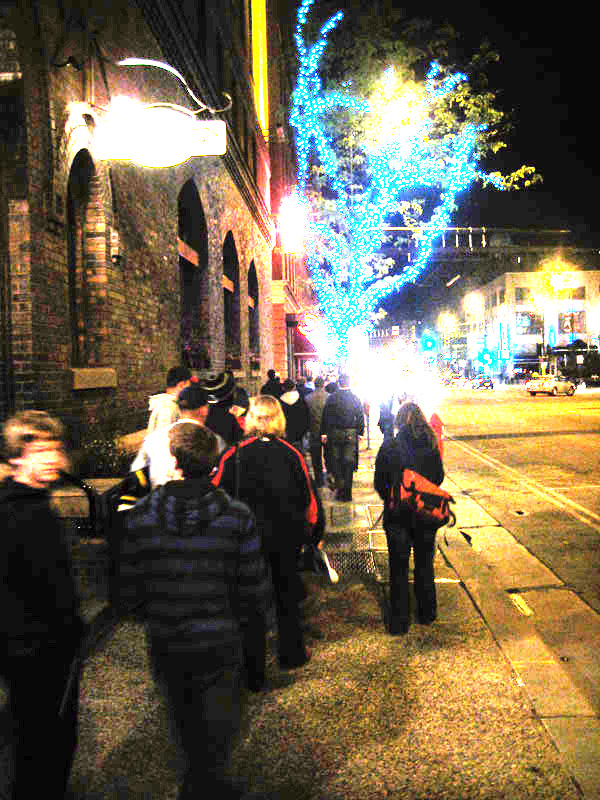
[Even when they lose, there's a party on 1st Avenue after a Twinkie game.]

*Any time you see this phrase, squint your eyes and look suspicious.

2010-08-12

Hypothesized Air Conditioning Feedback Loops

#1. The more we use air conditioning, the more we close all windows.

Result: Breezes are for naught. Sounds of the city are unheard (e.g. ice cream man, church bells).

#2. The more we use air conditioning, the more sidewalks suck.

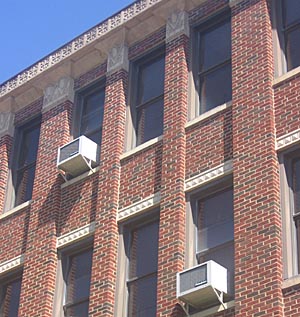
Result: Drips from air conditioners land on your head. Annoying and constant whirr from machine.

#3. The more we use air conditioning, the more people move to hot places.

Result: Huge population shift in the US to the sunbelt, living more and more in places where you can’t possibly survive without air conditioning.

Extra Result: More people use air conditioning. More people vote Republican?

#4. The more we use air conditioning, the less we design buildings that keep cool by themselves.

Result: Windows that do not open. Houses with no cross breezes. Fluorescent lighting. Modernist, shiny, reflective, and boring office towers.

Extra result: More need to use air conditioning. Cities increasingly "climate controlled".

#5. The more we use air conditioning, the more we get used to only one kind of environment.

Result: More separation between inside and outside. Stores that are kept super cold. Less temperature tolerance. Less flexible clothing. Increased whining tendency.

Extra Result: We don’t go outside as often. We don’t even know what its like out there.

#6. The more we use air conditioning, the more we use air conditioning.

Result: On cooler summer days, more likely to say ‘screw it’ and just keep the A/C on.

Extra result: We use more energy and electricity.

Extra extra result: Planet warms.

Extra extra extra result: Use more air conditioning.