Roger O. Thornhill / George Kaplan waits at the bus stop in the middle of nowhere...
... in Alfred Hitchcock's (1959) classic suspense North by Northwest.
2012-10-24

Classic Sidewalks of the Silver Screen #88
Taggart and Rosewood enjoy a late supper, courtesy of Mr. Foley...
... in Martin Brest's (1984) amusing Beverly Hills Cop.
... in Martin Brest's (1984) amusing Beverly Hills Cop.
2012-10-23
Today on Streets.mn: The First Rule of Urban Design is "Show, Don't Tell"
 |
| [Actually, no. A crosswalk is a crosswalk.] |
Here's the main point of my piece:
Real change is concrete change. For example, compare an educational campaign that says “every corner is a crosswalk (even ones without crosswalks)” to actually designing and paint decent crosswalks throughout the city. Compare hiring thousands of policemen to enforcing safe speed limits all through the city, to constructing “sleeping policemen” (what the British call speed bumps) that actually limit how fast people can drive, 24/7. Compare the erection of flashing speed limit signs to traffic calming. Compare a yellow ‘human being’ sign to a road diet, or narrower lanes, or bumpouts,There’s no comparison. Actual concrete viscerally slows down traffic, no matter what the time of day. All of these things, real concrete changes, are effective no matter who is behind the wheel, or what they are thinking about, or what kind of person they are. All of these kinds of changes demand more from drivers, and say “pay attention” not with a sign, but with an demanding road environment.
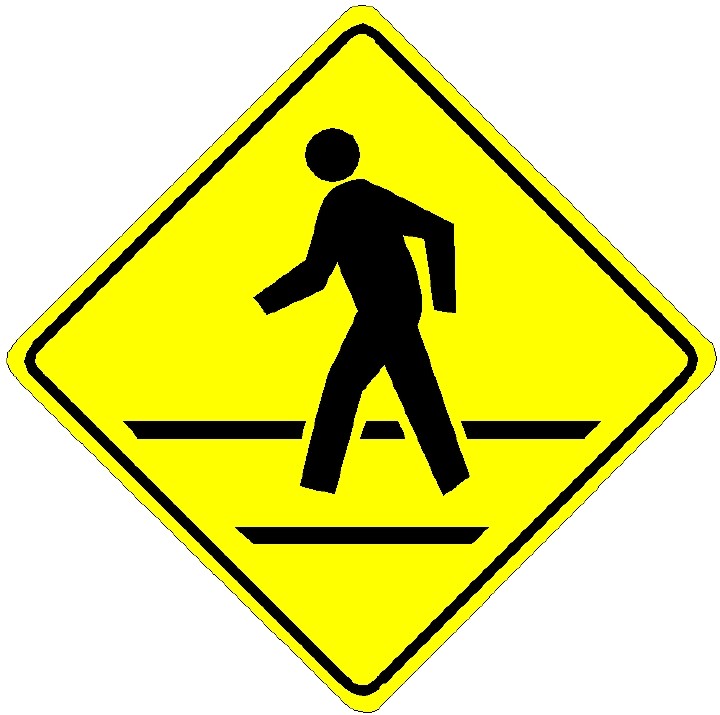
I have this thought each time I see a bike route that relies only on a green sign, or a sharrow painted on the pavement. These kinds of design approaches pale in comparison to traffic calming, where you're actually narrowin the street, putting in a traffic circle, or installing speed bumps.
In writing, one of the oft-repeated rules is "show, don't tell." I think a similar ruel could exist for urban design. Instead of putting up a sign that says "watch for pedestrians" or "Speed Limit 30", you want to design a street that makes it obvious that pedestrians are all around, and that makes it highly uncomfortable to drive fast. You don't want to tell people to drive slowly and carefully, you want to make spaces where that is the obvious way to behave.
While there are some examples of useful educational campaigns, I fear that, for the most part, these are simply ways to keep graphic designers employed. Good street design should be self-evident.
2012-10-22
Real World Urban Design Experiment #1: Franklin Avenue Road Diet

That’s why urban planning relies on models, hypothetical theory, and inductive reasoning. Pretty much the only thing that planners and civic engineers can reliably study are the movement of cars and the taxable value of real estate. (Data for anything else, such as people moving on foot, crime, or behavior change, is almost impossibly tricky.) That’s one of the reasons that car volumes and real estate values become the main emphases for city policy.
But have no fear. All that can change now, thanks to these easy to follow Real Life Planning Experiments. There are a few places in the Twin Cities where you can experience two sets of scenarios right here, on these very streets. These are places where you have a “control group” (Test Case #A) and an “experimental group” (Urban Street Subject 5.2-C5). These are places where the conditions are similar enough that you can come to some preliminary conclusions about different urban designs, different treatments, different planning approaches.
Following these easy steps, you can conduct your own Real World Analysis. Walk, bike, and drive through the city. Find out for yourself whether urban design really makes a difference. The world is your laboratory.
Experiment #1: Franklin Avenue Traffic Calming

Research Background: Franklin Avenue between Hiawatha (Highway 55) on the East and Interstate 35W on the west is one of the most diverse, long-struggling parts of South Minneapolis. Pushed up against three different freeways, it’s right in the old zone of density that used to surround the downtown. This part of the city was filled with old run-down apartments and single room occupancy hotels that were bulldozed during the 60s. Today, Franklin Avenue is one of the most diverse and interesting parts of Minneapolis. In some places, the street has been struggling to attract and retain businesses. Meanwhile, there are also many thriving restaurants and retail establishments all up and down this part of central Franklin Avenue.
 |
| [The control group sidewalks.] |
Control Group: The West side of Franklin Avenue (between 35W and Chicago Avenue) has four 12’ car lanes with narrow sidewalks (between 3' 6" and 5' wide).
Experimental Group: The East side of Franklin Avenue (between Chicago and Hiawatha Avenue) has two lanes plus a turn lane, with large sidewalk bumpouts.
Methodology: Take a walk down Franklin Avenue, from South 4th Street to Bloomington Avenue. What do you notice? How does the street change as you go from the West half to the Eastern half? What kind of differences do you notice? What kinds of changes in traffic behavior do you see? How does the street sound? How does the street feel as you walk? What kinds of businesses are nearby on each half of the street?
Repeat the process using an automobile. Repeat using a bicycle (at your own risk).
Preliminary Findings: Please post these in the comments below.
 |
| [The control group is on the left; the experimental subject is on the right.] |
2012-10-19
*** Sidewalk Weekend ***

Sidewalk Rating: Semi-Quenching
If you stood in the middle of the street you would hear the unreal, thrumming silence of dusk in a dead-end place and you'd smell the rain that would creep in after darkness fell. If you stood still and listened hard you could probably hear the surf of truck traffic on the highway at the edge of town. And if you stood there long enough you might eventually see a child aboard a bicycle glide silently like a dream fragment through the intersection at the end of the block.
You might.
But you might not. There weren't a lot of children around anymore.
[Brad Zellar, fm your man for fun...]

[The view of the game from under the bleachers of St Paul's Dunning Field complex.]
*** CLICK ON IMAGES FOR LINKS ***

*** ***

*** ***

*** ***

*** ***

*** ***

*** ***

*** ***

*** ***

*** ***

*** ***

*** ***

*** ***

*** ***

*** ***
*** ***

*** ***
*** ***

*** ***

*** ***
*** ***
*** ***
*** ***
*** ***

*** ***

*** ***

*** ***

*** ***
*** ***

*** ***

*** ***

*** ***

*** ***

*** ***
*** ***

*** ***
*** ***
*** ***

*** ***

*** ***

Subscribe to:
Posts (Atom)