2011-05-23

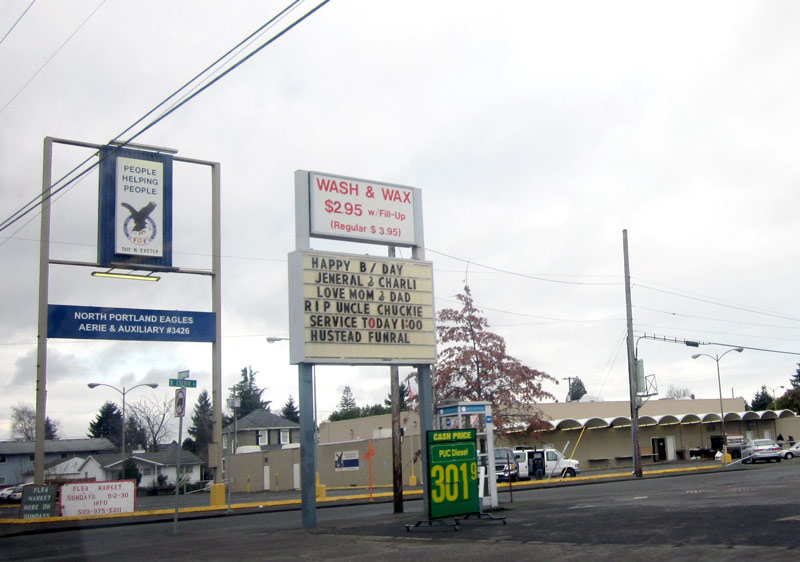
Signs of the Times #29

Free Pile

[Porch. Portland OR.]

AREA 41
"The Place that is never open."

[SE Portland OR.]


Happy B-DAy
Jeneral & Charli
Love Mom & Dad
RIP Uncle Chuckie
Service today 1:00
Hustead Funeral

[Sign. North Portland.]


It you don't
Like the Price
To Bad

[Fence. NE Portland.]


Tabor Hill Cafe
Classic American food without surprises, panache, or strong flavors. The traditional Monte Cristo ($5) -- layers of ham, turkey and Swiss cheese on white bread, dipped in egg batter and fried -- provides a comforting warmth that leaves you slightly sleepy and feeling full. Breakfast is served all day so opt for an order of French toast ($3.95) as an alternative to the usual nighttime fare. Sprinkled with cinnamon instead of powdered sugar this early-morning treat is perfect on a cold evening -- especially when accompanied by a glass of freshly-squeezed orange juice ($2.95).

[Window. Hawthorne Avenue, Portland OR.]


Come in
...
PUSH

[Door. Hawthorne Avenue, Portland.]


We do tent repair

[Window. Clinton Street, Portland OR.]


you are
beautiful

[Door. Belmont Street, Portland OR.]


LOST
In your neighborhood (possibly on 12/05)
White and grey stuffed cat

Our child is inconsolable
Any information on the lost cat ... or best ... on the
found cat will be highly appreciated.

[Telephone pole. SE Portland OR.]

Good Food Here!
is all about great food
in a family friendly
atmosphere.

Please respect that
smoking and alcohol
are not allowed
on this site.

[Patch of grass. SE Portland OR.]

2011-05-13

*** Sidewalk Weekend! *** #55

Sidewalk Rating: Boding well

The screech and mechanical uproar of the big city turns the citified heads, fills citifed ears -- as the song of birds, wind in the trees, animal cries, or as the voices and songs of his loved ones once filled his heart. He is sidewalk happy.

-Frank Lloyd Wright, 1958.*


[A yarnbombed bike rack on the West Bank campus at the U of MN.]


*** Click on Images for Links! ***


*** ***


*** ***


*** ***


*** ***


*** ***


*** ***


*** ***


*** ***


*** ***


*** ***


*** ***


*** ***


*** ***


*** ***


*** ***


*** ***


*** ***


*** ***

2011-05-10

Reading the Highland Villager #34 (April ? - 24th Edition)

[Basically the problem is that the best source of Saint Paul streets & sidewalks news is the Highland Villager, a very fine and historical newspaper. This wouldn't be a problem, except that its not available online. You basically have to live in or frequent Saint Paul to read it. That's why I'm reading the Highland Villager so that you don't have to. Until this newspaper goes online, sidewalk information must be set free.]

Total # of articles about sidewalks: 11
Total # of articles about sidewalks written by Jane McClure: 9

[Editorial note: My apologies for the delay on these last few RtHVs. As it turns out, I greatly underestimated the effect the Central Corridor construction would have on my ability to tolerate looking at The Highland Villager. Is this really going to go on for two more years?]


Headline: Multitudes turn out for the last days of Porky's; University drive-in closes in a hail of burgers, shakes and burning rubber [Note the absence of the Oxford comma.]

Reporter: Bill Stieger
Short short version: Some history of the closing. [Article waits until second paragraph to] Make mention of Central Corridor construction along University Avenue. Lots of nice quotes from people eating at Porky's, including a “vintage-car nut,” and a woman who “won't reveal her age.” Some discussion of historic preservation issues. Profile of Nora Truelson, owner of Porky's, who “just wanted out [of owning the business]” according to one informed observer.


Headline: Popular protest puts brakes on light-rail rezoning; local residents push for more controls on the development that the new train could bring [Note: headline is accurate if by “more controls,” one means “less controls”]

Reporter: Jane McClure
Short short version: Coverage of the April City Council decision about rezoning away from auto-oriented businesses. Article makes no distinctions between gentrification, retention of industrial land use, zoning for auto-oriented land uses such as drive-thrus, and the use of TN or “traditional neighborhood” zoning. Includes quote from Preserve and Benefit Historic Rondo member about gentrification concerns and need for affordable housing.


Headline: Neighbors steamed about light-rail project; Narrowed and blocked streets back up traffic both north and south of University Avenue

Reporter: Jane McClure
Short short version: Report on LRT construction, including “blocked streets, traffic backups, poor signage and gas leaks.” Includes exasperation quote from “one woman” and speculation about interior mind-states of “some people” and “motorists.”


Headline: Reuse of Schmidt Brewery site gains momentum; Historic designation, loan hailed as kickoff to long-awaited development
Reporter: Jane McClure

Short short version: Article about the historic designation status and the $1.89M “deferred loan” from the St. Paul Housing and Redevelopment Authority. The project involves a $76M financing effort and is being organized by the Dominium Development company. The “next step” is to repair a leaky roof and remove asbestos from the buildings.


Headline: St. Paul unveils master plan for its 17 miles of riverfront; Improvements eyed for Island Station, Shepard Road and Hidden Falls

Reporter: Jane McClure
Short short version: Shepard Road redesign is part of a larger plan for the St Paul riverfront. One idea is to calm Shepard into a “parkway more like Mississippi River Boulevard.” [That would make it FAR more pleasant to bicycle there.] The connection to Randolph Avenue is mentioned as particularly important.


Headline: Public weighs design options for a major upgrade of Lilydale Park

Reporter: Jane McClure
Short short version: A $13.7M plan was unveiled for Lilydale Park that includes picnic areas and parking lots.


Headline: Dunning boosters plan to add hockey rink, multipurpose field

Reporter: Jane McClure
Short short version: There was a meeting at the Union Park District Council where they decided they wanted to add a hockey rink and a field to Dunning Park for $750K.


Headline: Op-Ed: Another public trail railroaded by a corporation

Reporter: Mike Madden
Short short version: Op-ed on how the CP railway is putting the kibosh on an Ayd Mill greenway extension. [Really stupid and interesting story actually.]


Headline: Stage set for Victoria Theater to obtain historic designation

Reporter: Jane McClure
Short short version: Victoria Theater fans lobbied the City Council for historic designation on April 6th.


Headline: City Council rejects Wild Onion's request to serve liquor on patio

Reporter: Jane McClure
Short short version: [Another seemingly evergreen story] The City Council is saying “no” to a liquor on the back patio for Wild Onion because of “noise, trash and unruly patron behavior.”


Headline: Village rezonings amended at last minute

Reporter: Jane McClure
Short short version: Rezonings for Highland Village received last-minute changes from Pat Harris that nixed the TN (Traditional Neighorhood) zoning in favor of leaving it as it was (business and residential) for a serires of properties along Cleveland Avenue. Includes quote from Harris about how TN zoning on those properties would be “incompatible with residential areas... You can have a tattoo parlor in a TN zone.” [Also, bakery, frame shop, hardware store, , sporting goods store, coffee shop, store designed simply to raise property values, etc. -Ed.]

2011-04-21

Predictable Bicycle Tragedy Points to Need for New Street Priorities at University of Minnesota

[The dead cyclist and her bicycle at the corner of 15th and 4th in Dinkytown. Img. StarTribune.]

Despite their recent accolades as the #9 best campus in the US for bicycling, I'm no fan of the cycling infrastructure at the University of Minnesota.

As you most certainly know by now, the University of Minnesota was the scene of a terrible “accident” this morning as a woman riding her bicycle to class was killed by turning truck as she progressed (quite legally, it seems) through the dangerous corner at 15th and 4th in the heart of Dinkytown.

If history is any guide, the reaction to this fatality will probably not be very helpful. It'll probably make people afraid to ride bikes. The police and University authorities will probably emphasize the need for cyclists to “behave better” and “wear helmets.” For example, see this quote by Minneapolis PD Sergeant William Palmer in today's Star Tribune article on the death:
In response, said Sgt. William Palmer, Minneapolis police are intensifying enforcement of "drivers not yielding to pedestrians, pedestrians jaywalking in congested areas and cyclists not obeying the rules of the road."

Even though the law is on the side of pedestrians, Palmer added, "police are asking pedestrians and cyclists to watch out for themselves."

In my opinion, the we should draw a far different lesson from this tragedy. The conversation should not be about enforcement of jaywalking, but about the much larger crime of having inadequate and unsafe bicycling streets right in the middle of a college campus where tens of thousands of students, mostly from rural and suburban environments, bike and walk constantly every day.

[The incredible disappearing gutter bike lane along 4th Avenue SE, near where the cyclist was killed. This is only one of many places where bike lanes disappear dangerously on or near campus.]

To put it bluntly, much of the the street design at University of Minnesota makes it almost inevitable that pedestrians and cyclists will be killed.

A few months ago I put together a litany of complaints about how the bicycling routes and treatments are badly designed on the Twin Cities' campus. Here's what I wrote about the North side of campus, which is probably the most dangerous place for cyclists in the whole school (especially right near 35W):
The main bike paths East-West through campus (Washington Avenue, University Ave or 4th Street SE) are designed almost exclusively for cars: all have their problems, 3 or 4 lane roads that encourage cars to speed as much as possible. These streets are both terribly uncomfortable and unsafe places for bicycles, and frequently used by bicyclists.

I certainly could have added 15th Ave SE to this list.


[The accident corner is arguably one of the "safer" corners for cyclists on the North edge of campus.]

Though the street layout on 15th Avenue is a little bit safer -- a 2-lane, 2-way street with bike lanes striped on either side -- it's still a terribly unsafe situation for cyclists. Anyone riding their bicycle to class is forced to navigate a series of claustrophobic intersections filled with buses and traffic along a way-too-narrow bike lane without adequate protection from cars or trucks. (Well marked bike boxes and colored bike lanes along 15th would be one obvious and inexpensive way to make 15th Avenue far safer for the many cyclists to bike from the SE Como and Dinkytown area into the main campus entrance at 15th and University.)

The fact is that the University of Minnesota has long prioritized auto transportation over alternative modes of transportation, despite the fact that many many students at the school don't use cars to get to and from class, despite the fact that the University is one of the best-served schools by transit anywhere in the country. (See for example the University's recent light rail lawsuit.)

Bicycle infrastructure everywhere on campus seems like an afterthought. Even the name for the University's office that deals with street design – The Office of Parking and Transportation Services – points to the administration's love of parking garages and large roads, and helps explain why the school seems to neglect and policing cyclists to the point where it often seems like a battle just to get across campus.

(In fact, email me a photo of a mid- to high-level University administrator on a bicycle, and I will personally buy you lunch in Stadium Village. That's a promise! I've never seen this happen, and I'd bet, neither have you.)

[Q: Does this street say to you "drive slowly and carefully and watch out for pedestrians and cyclists?" A: No, it does not.]

Whose bright idea was it to create 3-lane one-way streets where cars are encouraged to drive 40+ miles per hour right through Dinkytown, just feet from fraternity row, right in the middle of the most highly-trafficked pedestrian environment in the whole city where you have thousands of college kids wandering around wearing iPods and flirting and playing frisbee and drinking beer and generally having a nice time going to college? Why would you put these high-speed streets right in the very spot where hundreds of cyclists are riding at all times of the day and night? Why do the bike lanes along University and 4th start and stop without warning?


[A buffered 'cycle track' bike lane at the University of Wisconsin. Img James Baum.]

If the University really cared about encouraging cycling and keeping cyclists safe, it seems to me that the University and 4th corridors would be the perfect spots for a buffered cycle track, like they have over at the University of Wisconsin in Madison. Cycle tracks are the 'gold standard' of bike infrastructure: bike lanes buffered with concrete barriers and traffic lights timed to bicycle speeds that would calm traffic along this busy and pedestrian-heavy stretch of the city. That would do worlds of good for cyclists and pedestrians on campus, and it's just one obvious idea.

This “accident” was highly predictable, and will inevitably happen again until we do more to protect students and to discourage cars and trucks from driving through campus at high speeds. Hopefully this accident doesn't end up discouraging students from riding their bikes. The University needs to do more to make sure that we can all get around the school on a bicycle without being run over and killed by trucks.


[In a very close decision, this junction of University and 35W gets my vote for "University Bike Lane Most Likely to Cause Another Cycling Death in the Future."]

2011-04-14

Comparing the Small Blocks of the Midwest and the Northwest

Curiously, Jane Jacobs devotes a chapter of The Death and Life of Great American Cities to a relatively obscure topic: the “need for small blocks” in cities. Using Manhattan’s Upper West and Upper East sides as examples, Jacobs argues that long blocks make for “self-isolating streets” that restrict pedestrian choice and curtail economic activity throughout urban neighborhoods.

Jacobs’ small block advice crossed my mind on a recent trip to Portland, Oregon. At first glance, my hometown of Minneapolis has a lot of similarities with Portland, particularly in its housing stock, age of development, density and mixed-use characteristics. Yet many older neighborhoods in the Pacific Northwest have smaller block sizes that you will find in the Midwest. For example, the average block size in Southeast Portland or Seattle’s Capital Hill neighborhood is less than 100 meters square, whereas most of the blocks in South Minneapolis or Chicago’s North Side are nearly twice as large. While walking through any of these neighborhoods, block size is not necessarily something you might notice, I think that the size difference has a few subtle effects.

In these cities, block size seems to affect traffic calming and walkability. In other words, the size of city blocks impacts the degree of pedestrian accessibility and choice. Smaller blocks increase the ratio of public street to private developed space, and create a “finer mesh circulation pattern” in urban neighborhoods (Siksna 1997). For example, Seattle’s Capitol Hill area and Portland’s Southeast neighborhoods suggest how small blocks can lead to walkable urban landscapes. On the other hand, the commercial streets of South Minneapolis, seem to be a bit less pedestrian friendly because of their larger size. With fewer intersections, cars can travel a bit faster. Likewise, there are fewer street corners, so that pedestrians have fewer choices about which path to choose.

Jacobs’ concerns about block size were primarily about the generation of diversity, about how to generate new forms of economic activity. She argued that block size had a large impact on the potential pedestrian populations for businesses, and that smaller block sizes made for more integrated circulation patterns. While Jacobs’ ideas are appropriate for a place like Manhattan, with its contiguous mixed-use fabric, in the streetcar neighborhoods of Seattle, Portland or Minneapolis block size is not really about generating economic activity. Instead, it forms an almost atmospheric part of the urban landscape. It is worth stopping and noticing how these differences in layout have fostered some of the most vibrant neighborhoods in US cities. The Northwest should be grateful for its legacy of small, walkable blocks.

[The relative block size patterns of residential neighborhoods in four cities.]


References:

Jacobs, J. (1961). The Death and Life of Great American Cities. New York: Random House

Siksna, A. (1997). “The effects of block size and form in North American and Australian city centres.” Urban Morphology. 1. Pp. 19 – 33.