Alas. It looks like it's going to rain tomorrow, and also be below 40ยบ. That's about my least favorite weather for bicycling, right up there with single-degree or triple-digit temperatures.
So yeah. I am postponing the Noteworthy Parking Lots of Minneapolis bike ride until another date TBD. Maybe this fall may yet present an opportunity. Maybe it won't. Stay tuned to this blog, or Twitter, or Facebook for more info.
Showing posts with label weather. Show all posts
2019-10-11
2019-10-04
Minneapolis Parking Lot Tour Rain Delay to October 12th
Due to persistent rain in the forecast, I am postponing the Noteworthy Parking Lots of Minneapolis Bike Tour by one week. It will be on Saturday, October 12th, at 2pm. Meet at the Lake Street K Mart.
I hope to see you then!
2019-07-15
Notable Quotes #18: David Roshiem describes Summer Heat in 19th Century Minneapolis
In the Nineteenth Century, the summer heat was an unabated horror. Here is how it affected the Minneapolitans in the old city: "Little was done in the way of business except what was actually necessary. Clerks in the stores confined their principal attention to keeping cool -- a task that was as hopeless of fulfillment as it was specious in promises... Those whose duties took them upon the street dragged along the shady side as much as possible and tried to dodge the issue but couldn't... The only business that seemed to profit by the hot wave was the ice and saloon traffic. The ice men were dripping statues of happiness... At the saloons the principle article in demand was lemonade, plain or with variations." It was wretchedly hot in July.
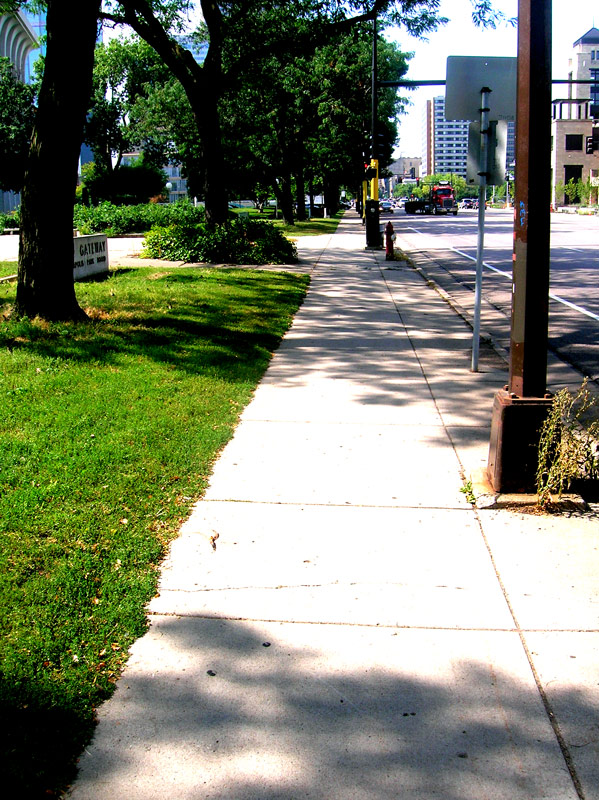
In those un-air-conditioned times, unrelieved heat was thought to cause mental derangement, to wit, the following case of a woman who lived in the Gateway district in 1880.
"Mrs. M. E. Whitney, proprietess of the laundry at 218 South Washington Avenue, yesterday afternoon escaped from her room to which she has been confined for some time with an attack of typhoid fever. Her presence upon the street was noticed by Detective Hoy, who compelled her to return to her rooms. Last evening about 8 o-clock she again escaped and has not since been seen but once. When she left her home she was attired only in her night dress and an alarm was at once given to the police, who instituted a search which after several hours proved of no avail. Wm. Hannigan at a later hour reported that he saw the unfortunate woman in the vicinity of the Falls hotel, and that she was walking rapidly and directly toward the river. The supposition is that she has succeeded in committing suicide which has long been contemplated and once or twice attempted. Mrs. Whitney has been very unfortunate during a number of years past, and the life of a dissipated husband brought dissipation and disgrace to herself..."
Mrs. Whitney responded indignantly, " I write to say that I am not in the river, neither have I been any nearer than I am at present, and if I were very DISSIPATED I could not support myself and family of six persons. I have been sick, or worse than sick, for four weeks, but I can prove by my help that I am not dissipated... You can call at my office and I can get plenty of proof that the whole thing is false excepting that I am sick, M. E. Whitney."
Thus an authentic voice from the old Gateway responding to newspaper smears.
[From The Other Minneapolis, or A History of the Minneapolis Skid Row, by David L. Roshiem.]
![]() |
| [Minneapolis Bridge Square / Gateway, c. 1874.] |
2019-01-31
Pedestrian Vortex Musings
I was driving around during the super cold snap, the "polar vortex" as they call it now, and simply happy to be warm. The car started. The seat heater was working.
Extreme cold weather and wind gives the city an otherworldly gilmmer. Plumes extend to the horizon. Light obscures and refracts. Clouds get weird and hazy themselves, while hard edges crisp. The ground almost vanishes as snow blows itself up into powder, blurring edges like the world is being Photoshopped. Through it all somehow the car still works and runs and speeds the dry buckling streets and loudly blows hot air at my head and gloved hands, and I feel lucky to be adjusting the radio in this hostile world.
And yet the street remains unfair. Even on a day when it's fifteen below zero and the wind is whipping, people are walking the streets of Saint Paul, huddled over their back to the wind noses poking out of thing scarves, standing on the street corner and icy sidewalks of the city. And even today, people are standing there waiting by the stoplight, numbly pressing the WALK button waiting silently waiting for people in warm cars to proceed for thirty seconds, two minutes, standing while the parade of people in warm heated personal vehicles processes by. On a day like this, the streets should stop and people walking should always have priority.
But the hierarchy of the street prevails, even when life is on the line. Cars get their way, constant streams of them, right turns left turns both directions, and anyone sorry enough to be walking along the sidewalks, to and from the bus, is held hostage.
It's like this every day, of course. In the heat or the rain or even on a nice day, where the people in private comfort have their way with the trudgers. But in the polar vortex it seems inhumane to force people outside to wait for you, and it is.
2018-10-10
Coney Quest V: The Downstream Journey Rain Delayed for Two Weeks
2018-09-20
Saint Clair Avenue Factory Tour Moved to Tuesday 10/2
It's raining today all day long, so I'm moving the Saint Clair Avenue Factory Tour to a week from Tuesday.
:(
I've only ever delayed one tour before, the Bowling Alley Bike Ride. That was four years ago, so this is a rare event.
Hope to see you on Tuesday!
2017-12-20
Close Horizons of the Winter City
One crucial trick to living in Minnesota is appreciating winter.
For many, long months of colder weather, ice and snow, shut windows and thick jackets, offer nothing. We wallow in a mentality where winter strips our theoretical freedom to be Californian, to drive with open windows or bask in the sun. We freely wield the moralistic assumption that warmth is good and cold is bad, that melting snow should be greeted with sighs of relief, that winter is a thing to overcome or ignore or engineer out of existence with tanning beds or heated garages or skyways or flights to Florida.
It's all too easy to fall into these canyons of climactic resentment, as the small talk builds up and weather reports plot daily escape. It's far harder to appreciate winter, to see seasons not as limits but opportunity.
This winter I've found myself marveling anew at its expanse and openness. I love the way that leafless trees expose the surrounding city, and seem to draw it closer like a hug. This year, I'm embracing the sight lines of the winter.It helps that I live near a bluff, just south of downtown Saint Paul, and just downstream of where the Minnesota and Mississippi rivers come together. Here the valley opens up and expands into a wide bend.
In the summertime, the views of the valley seem suffocated, as the trees and sumac and various vines explode to swallow up the landscape. In summer, it seems as if the ground beneath the streets is alive and trying to buckle. The edges of the valley around seem distant and unclear, far removed from the rich world unfurling around me.
In the winter, it's the opposite. The valley telescopes in strange new ways. The leaves disappear. Trees quiet. Horizons appear closer.
From my back porch in winter, I see the crisp ridge of Saint Paul's East Side over the rooftops. It appears as perfect as an origami fold edging the city. There is Mounds Park, the pulsing lights of the airport tower, the purple glow of the Metro State building (a former hospital), the red cross of the old Lutheran church on the edge of Swede Hollow, and there is the row of yellow streetlights cresting the bluff top. It's all plain as day during long winter nights. These places seem closer in the cold, offering new arrangements. Looking at the silent horizon, I feel I could reach out and brush the bluffs with a bit of snow, like Bob Ross adding a highlight.
Walking in winter, the bluffs newly manifest. Rocks arrive. Foundations expose themselves. The limestone cliffs, normally hidden beneath a thick quilt of green, are now frosted with thin white snow.The bluffs are thick, ancient, and impassable, the basis of the city below your feet, and walking down Wasbasha, in wintertime I can look up and see the house that sits on the end of Delos Street, its windows poking up aglow. It levitates over the streets below like a magic carpet.
Driving along Highway 13, that narrow road that curves over the river below, the West 7th neighborhoods stretch out. The lights of the buildings and streets read like a braille sequence, and the Schmidt Brewery sign sits atop the story like cake decor. The edges of city are visible in new ways, and everything from the downtown Minneapolis skyline, poking above Highland, to the alabaster Capitol dome is right there for your eyes to encompass.
This is to say that Saint Paul shrinks in winter, its geography contracting like an iris. Sweep the horizon with your glance. Notice the fresh connections. Winter offers such subtle surprises, cold vistas to appreciate, and even the dark embraces.
2017-12-04
The Last Ice Palace of Saint Paul
![]() |
| [Plans for an ice palace that will never be built.] |
The warm air reminds me of a little-noted event that happened a few weeks ago. It was the announcement, made by a group of civic boosters, that despite the upcoming Super Bowl, there would be no ice palace in Saint Paul this year.
Here’s what one report said:
Even if they’d gotten the money, however, organizers also faced the challenge of having a place to harvest the ice. In the past, it could be chopped out of area lakes but too often lately the lakes don’t freeze early enough.Though no fan of the Super Bowl, the story stuck with me because the plain truth is right there. There will never be another Ice Palace in Saint Paul.
The planners envisioned an ice palace reaching 170 feet at its apex, which would break a current world record of 166 feet set in Minnesota in 1992 — also during a Super Bowl.
Never.
That’s a crazy and absolute word, but it’s true. Saint Paul’s lakes will never freeze thickly and quickly again. People will never harvest blocks of ice, never again build a fantastic palace of frozen water. A tradition that's as old as anything in this city is dead forever.
![]() |
| [The 1887 Ice Palace in Central Park, built from 30,000 blocks if local lake ice.] |
A few decades later, F. Scott Fitzgerald grew up in Saint Paul, and wrote an early story based on the Saint Paul ice palaces. It tells the tale of a southern girl named Sally Carrol who moves north for love, and quickly becomes alienated by the winter’s cold. The tale centers on the ice palace:
After another ten minutes they turned a corner and came in sight of their destination. On a tall hill outlined in vivid glaring green against the wintry sky stood the ice palace. It was three stories in the air, with battlements and embrasures and narrow icicled windows, and the innumerable electric lights inside made a gorgeous transparency of the great central hall. Sally Carrol clutched Harry's hand under the fur robe.The story does not end well.
"It's beautiful!" he cried excitedly. "My golly, it's beautiful, isn’t it! They haven't had one here since eighty-five!"
Somehow the notion of there not having been one since eighty-five oppressed her. Ice was a ghost, and this mansion of it was surely peopled by those shades of the eighties, with pale faces and blurred snow-filled hair.
![]() |
| [The 1896 Ice Palace, built the year Fitzgerald was born.] |
In the 1940s, they again built ice palaces in Saint Paul, designed by a man named Cap Wigington, the city’s African-American civic architect. Compared to the utilitarian buildings he was normally tasked with, the mercurial ice palace designs became elaborate dreams. The palaces were a chance for him to create the incredible, to capture the hopes of the city in ephemeral blocks, frozen for but a moment in time. Wigington made six ice palaces, and each of them melted crazily in the springtime.
![]() |
| [Wigington's 1937 Saint Paul Ice Palace.] |
A few years later, for another Super Bowl, they built another one, with cleaner modernist lines.
![]() |
| [The world record 1992 Ice Palace, that bankrupted the Winter Carnival. The record might never be broken.] |
![]() |
| [The 2011 ice wall, a shrine to the lost past.] |
That was the end of the Saint Paul ice palaces. I saw them, and they are gone forever.
Climate change is typically viewed as an event horizon. By 2100, so they say, the seas will rise and Miami will flood. But in fact, climate change has already taken place. A major piece of culture that I personally remember has gone extinct, and Minnesota winter itself rapidly follows suit.
As I write this, the annual ice fishing show has just wrapped up at the downtown arena, but it’s hard to envision much future in that endeavor. So too with cross country skiing, outdoor hockey, dogsledding, and snow forts, all things that will disappear on my watch, reduced to nothing by our collective climactic failure.
Years from now, when I am old, I will tell children about Saint Paul's ice palaces and they won’t believe me.
“When I was your age, we walked on lakes in the wintertime,” I will tell them. “We even drove trucks across them! People would build houses on the lakes and stay out there for weeks on end. And the snow covered the ground for months and months without melting.”
“We don’t believe you,” they will say. “That’s not possible!”
“When I was young, there was a blizzard on Halloween,” I will tell them. “Snow plied up to the windows, and everyone stayed home from school. In January, when I was your age, it got so cold that your nose hairs froze, each tiny little hair, frozen like a popsicle! When I was little, the air got to be twenty below zero! Once I took a pot of boiling water outside, tossed it the air, and it froze immediately. It disappeared and never hit the ground.”
"You're lying to us!" they shriek.
“No I am not," I insist with a smile.
"When I was little, there were huge castles made of ice, right here in Saint Paul in the wintertime,” I will say. “I saw them with my own eyes. I went in one! When I was your age, I walked in a ice palace that was over a hundred feet tall. It had towers and lights and stairs of frozen water.”
They will say, “Are you telling the truth?”
2016-10-04
The New Orleans Metaphor
[Sixth in the highly unpopular "metaphor series" of blogposts. See also: Bicycling/Dancing, Vikings stadium/Star Wars, bikes/guns, gas/pop, and NIMBY/Amtrak.]
There's a way in which all cities, even Denver, are below sea level. All cities are surrounded by a sea of speed, an ocean of cars.
The sea of speed is an oceanic desire, the deep need for velocity. Because of the vast untapped potential of America's 300 million automobiles, each of which can travel 80 miles per hour at the drop of a right foot, there is effectively limitless demand for high-speed travel. This desire represents an ocean of need that surrounds our cities and towns, and explains the "fundamental law of road congestion" where any new road capacity is quickly "used up" by additional high-speed driving.
Meanwhile, speed is anathema to a walkable city. They simply cannot coexist. Even modest speeds -- say 40 miles per hour -- mean death to a human body. To accommodate the need for speed, a city must either build deadly roads or spend fortunes on massive grade-separated infrastructure. Either one of these choices destroys walkability.
So think of a walkable city as a place below-sea level, precarious and surrounded by the ocean. A sidewalk is prone to calamity. A place like New Orleans or Amsterdam, inherently catastrophic.
The key point is that there's no meeting the demand for high-speed driving. For cities, even trying to do so offers a no-win scenario. The more you "let in" the surrounding speeding cars, the more you undermine your city. An urban freeway where cars travel at 50 or 60 miles per hour is like a dangerously engineered canal, an avenue to the ocean that could breach at any time, leaking speeding cars into the city at every on- and off-ramp. A highway through the heart of the city is like the MR-GO or the ill-fated Industrial Canal, crashes waiting to happen, leaks slowly eroding urban neighborhoods.
The only solution for a city below sea level is to keep out the ocean altogether. The only answer is to take great pains, to fortify our borders with care. There's no accommodating the sea. It will win every time.
Instead, cities must be islands of stillness in the sea of speed. Walkable areas must protect themselves from cars on all sides by dikes, streets engineered to firmly keep gas pedals at bay, walls of design decisions demanding slowness and driver caution.
We must not let in the ocean. The alternative is an urban disaster.
![]() |
| [Alec Soth photo.] |
The sea of speed is an oceanic desire, the deep need for velocity. Because of the vast untapped potential of America's 300 million automobiles, each of which can travel 80 miles per hour at the drop of a right foot, there is effectively limitless demand for high-speed travel. This desire represents an ocean of need that surrounds our cities and towns, and explains the "fundamental law of road congestion" where any new road capacity is quickly "used up" by additional high-speed driving.
Meanwhile, speed is anathema to a walkable city. They simply cannot coexist. Even modest speeds -- say 40 miles per hour -- mean death to a human body. To accommodate the need for speed, a city must either build deadly roads or spend fortunes on massive grade-separated infrastructure. Either one of these choices destroys walkability.
So think of a walkable city as a place below-sea level, precarious and surrounded by the ocean. A sidewalk is prone to calamity. A place like New Orleans or Amsterdam, inherently catastrophic.
![]() |
| [Building the Industrial Canal through New Orleans' Ninth Ward in 1918.] |
The only solution for a city below sea level is to keep out the ocean altogether. The only answer is to take great pains, to fortify our borders with care. There's no accommodating the sea. It will win every time.
Instead, cities must be islands of stillness in the sea of speed. Walkable areas must protect themselves from cars on all sides by dikes, streets engineered to firmly keep gas pedals at bay, walls of design decisions demanding slowness and driver caution.
We must not let in the ocean. The alternative is an urban disaster.
2016-04-13
Three Tricks for Overcoming the Dread of Everyday Biking
I want to confess something. Even though I've been biking all year long for years, it still happens a lot. I don't like to talk about it, but there it is...
I still get bike dread.
Bike dread is that sinking feeling when you realize you have to ride your bike but large parts of you don't want to. Not all of you, but large parts of you.
Bike dread can strike at any time, but it usually comes during times of bad weather or rush hour. Bike dread strikes when looking out the window at a tree bending in the blowing wind, silhouetted against a darkening sky. Or it can strike at unceasing sounds of motors on the other side of the door, the honking of a horn, the thin rumble of a revving motorcycle.
When it strikes, bike dread can paralyze. It can leave a bicyclist sitting on their couch staring at the wall, often for hours. Bike dread seems to drain the body of fortitude, leaving its victim unable to get on their bicycle and tackle the city. Bike dread can strike a bicyclist prone, succumbed by thoughts of steep hills or the terror of a car-choked corner. Bike dread renders people with bicycles immobile and stunned by inertia, the dread of the bicycle trip.
For me it happened last Friday. I had a coffee meeting with a friend at a coffee shop across the river. But seeing the snow flurries flit past the window, and the wind whipping my Saint Paul flag around like ocean spray, I kept delaying my plans to leave the house. Maybe I'll take the bus? I thought. If I owned a car, it would have been irresistible.
Instead, I stared at the wall, pet the cat, glazed over social media feeds, and turned the pages of an endless book on my desk. Bike dread had taken hold, and it seemed like nothing other than the passage of time would rescue me from its relentless grip.
But that's not the end of the story. Eventually I cured myself from my stupor and found the will to continue. And it wasn't so bad.
Here a few key tricks to overcoming bike dread. It's possible, and you can do it.
Trick #1: Think about health
As yourself one simple question: "Would I be better off if I got some exercise today?"
Unless you wake up and work out, the answer is almost always "yes." Our American lives are sedentary affairs, where even the act of opening up a car door with your hand has become automated. Bicycling is one chance to get relatively low-impact exercise. Even better, and unlike the gym, it's meaningful work that gets you where you need to be.
(Note: I stole this trick from Mister Money Mustache, and it works wonderfully.)
Trick #2: Don't be in a hurry
Nothing is worse than being filled with bike dread and being late at the same time. Normally contemplative bicycling can transform into a harried battle with the elements, topography, and equally flustered drivers.
I like biking at a pace where you can enjoy where you are, notice the city around you, stop for a second at a shop, for a coffee, or for a chat if you encounter a friend along the way. It makes the bicycling into less of a trip and more of a pastime. But it doesn't work unless you leave extra time for yourself to ride at your own pace.
Of course, some people love riding fast, and that's cool too.
(Note: This tip comes from Lindsey Wallace's excellent bicycling advice. And the rule is also essential for humane urban driving.)
Tip #3: Appreciate the out-of-doors
There are very few weather conditions that are completely unappreciable. As a Minnesotan, I can say this with confidence. Maybe a below-zero wind chill or a cold horizontal rain. Probably a tornado.
But the vast majority of the time, you can appreciate the weather. If you take a moment to look around at the plants, buildings, and surrounding sky, you realize that this moment on the Earth is a precious thing. You realize that, unlike all the people stuck in their cars or homes, you are out there and can hear the sound of the chickadees singing slightly different songs, or the smell of springtime mud or coffee beans roasting or both. You are one of the few people in the city out there noticing the trees just clinging to their leaves or the buds about to pop. Each moment the sky offers something slightly different, and you're there to see it, to feel the wind and its changing seasons.
On the Friday when the bike dread was getting me down, the weather was particularly intense. It kept snowing in Saint Paul, light fast bits of white snow appeared and vanished a few minutes later, only to be replaced by bright springtime sunshine. Back and forth like that for hours in the middle of the day.
The wind was coming out of the Northwest, and for a while it was discouraging, but as I biked down and up the Saint Paul hills, I realized that this was probably the last gasp of the wintertime. I could give myself permission to savor it. Not for many months would something this coldly dramatic take place. And all around me, as I biked down the empty city streets, I began noticing the first flowers.
Here's a final word: it's almost never as bad as you imagine.
Bike dread can almost swallow up you and beat you into a state of submission, where anyone can simply say "are you sure you don't want a ride?" and you immediately cave.
But actually riding your bike is almost never as bad as you think it will be. Almost every time, when I find myself getting onto the seat and heading out down the street, I'm happier with myself. Bike dread is a state of mind, and the physical experience of biking in the Twin Cities is usually far more enriching.
So if you're riding your bike every day in April, or on any day where bike dread strikes, try one of these little tricks.
Like millions of Americans, you're not alone. Your bike has the cure for bike dread.
I still get bike dread.
Bike dread is that sinking feeling when you realize you have to ride your bike but large parts of you don't want to. Not all of you, but large parts of you.
Bike dread can strike at any time, but it usually comes during times of bad weather or rush hour. Bike dread strikes when looking out the window at a tree bending in the blowing wind, silhouetted against a darkening sky. Or it can strike at unceasing sounds of motors on the other side of the door, the honking of a horn, the thin rumble of a revving motorcycle.
When it strikes, bike dread can paralyze. It can leave a bicyclist sitting on their couch staring at the wall, often for hours. Bike dread seems to drain the body of fortitude, leaving its victim unable to get on their bicycle and tackle the city. Bike dread can strike a bicyclist prone, succumbed by thoughts of steep hills or the terror of a car-choked corner. Bike dread renders people with bicycles immobile and stunned by inertia, the dread of the bicycle trip.
For me it happened last Friday. I had a coffee meeting with a friend at a coffee shop across the river. But seeing the snow flurries flit past the window, and the wind whipping my Saint Paul flag around like ocean spray, I kept delaying my plans to leave the house. Maybe I'll take the bus? I thought. If I owned a car, it would have been irresistible.
Instead, I stared at the wall, pet the cat, glazed over social media feeds, and turned the pages of an endless book on my desk. Bike dread had taken hold, and it seemed like nothing other than the passage of time would rescue me from its relentless grip.
But that's not the end of the story. Eventually I cured myself from my stupor and found the will to continue. And it wasn't so bad.
Here a few key tricks to overcoming bike dread. It's possible, and you can do it.
Trick #1: Think about health
As yourself one simple question: "Would I be better off if I got some exercise today?"
Unless you wake up and work out, the answer is almost always "yes." Our American lives are sedentary affairs, where even the act of opening up a car door with your hand has become automated. Bicycling is one chance to get relatively low-impact exercise. Even better, and unlike the gym, it's meaningful work that gets you where you need to be.
(Note: I stole this trick from Mister Money Mustache, and it works wonderfully.)
Trick #2: Don't be in a hurry
![]() |
| [Biking with a sweetheart helps you pace yourself.] |
I like biking at a pace where you can enjoy where you are, notice the city around you, stop for a second at a shop, for a coffee, or for a chat if you encounter a friend along the way. It makes the bicycling into less of a trip and more of a pastime. But it doesn't work unless you leave extra time for yourself to ride at your own pace.
Of course, some people love riding fast, and that's cool too.
(Note: This tip comes from Lindsey Wallace's excellent bicycling advice. And the rule is also essential for humane urban driving.)
Tip #3: Appreciate the out-of-doors
There are very few weather conditions that are completely unappreciable. As a Minnesotan, I can say this with confidence. Maybe a below-zero wind chill or a cold horizontal rain. Probably a tornado.
But the vast majority of the time, you can appreciate the weather. If you take a moment to look around at the plants, buildings, and surrounding sky, you realize that this moment on the Earth is a precious thing. You realize that, unlike all the people stuck in their cars or homes, you are out there and can hear the sound of the chickadees singing slightly different songs, or the smell of springtime mud or coffee beans roasting or both. You are one of the few people in the city out there noticing the trees just clinging to their leaves or the buds about to pop. Each moment the sky offers something slightly different, and you're there to see it, to feel the wind and its changing seasons.
On the Friday when the bike dread was getting me down, the weather was particularly intense. It kept snowing in Saint Paul, light fast bits of white snow appeared and vanished a few minutes later, only to be replaced by bright springtime sunshine. Back and forth like that for hours in the middle of the day.
The wind was coming out of the Northwest, and for a while it was discouraging, but as I biked down and up the Saint Paul hills, I realized that this was probably the last gasp of the wintertime. I could give myself permission to savor it. Not for many months would something this coldly dramatic take place. And all around me, as I biked down the empty city streets, I began noticing the first flowers.
Here's a final word: it's almost never as bad as you imagine.
Bike dread can almost swallow up you and beat you into a state of submission, where anyone can simply say "are you sure you don't want a ride?" and you immediately cave.
But actually riding your bike is almost never as bad as you think it will be. Almost every time, when I find myself getting onto the seat and heading out down the street, I'm happier with myself. Bike dread is a state of mind, and the physical experience of biking in the Twin Cities is usually far more enriching.
So if you're riding your bike every day in April, or on any day where bike dread strikes, try one of these little tricks.
Like millions of Americans, you're not alone. Your bike has the cure for bike dread.
![]() |
| [Some of the winter/spring flowers I noticed after I overcame my bike dread and went on the Friday ride.] |
2015-09-21
Notable Quotes #3: Gil Peรฑalosa Describes Twin Cities Downtown Skyways
![]() |
| [A thriving public space in the Saint Paul skyways.] |
Tom Weber: Tell me your thoughts especially here for the Twin Cities, we have a very unique aspect, the skyways.
We have these second floor walkways so that you can walk between buildings, so that in the winter you don't have to go out in the freezing cold in the snow. There's a lot of debate about the effects on the economy if you don't have those street level businesses there. Where do skyways fit into the 8-80 model?
Gil Peรฑalosa: The skyways are absolutely horrible. They should be ... The best thing that could happen, if God was generous, is to come up with an earthquake that would only affect skyways and nothing else.
The skyways really work like a gigantic vacuum that sucks the life out of the city. The skyways are like commercial shopping malls, elevated, where they don't want the poor people, the don't want the youth, they don't want anybody who's not going there to shop.
And also you don't have enough people to have them on the skyways and and on the street. You see, I have many many photos of the streets here where there are skyways. On the street level they are empty. They are like ghost towns. There are blank walls. And as soon as you enter the skyways, life flourishes. All of a sudden you start having flower shops, coffee shops, and so on.
Of course I know that there is winter in the Twin Cities. But you only really have about 15 horrible days of the year. And in addition to the 15 horrible days, you have another 60 or 70 pretty lousy days. But you have 250 nice days in the Twin Cities! So when we build the city around the 15 horrible days, we mess up the other 350. My advice to the city is let's build the city around the 250 really nice days, and then the 60 pretty bad or 15 horrible days are not going to be as horrible.
![]() |
| [A vibrant streetscape underneath the Minneapolis skyways.] |
[See also William Whyte on Saint Paul's Blank Walls, Jean Baudrillard on "Minneapolis."]
Labels:
MPR Decoder,
notable quotes,
skyways,
weather
2013-12-20
The Last Holidazzle
![]() |
| [Gazing into the Holi-Abyss.] |
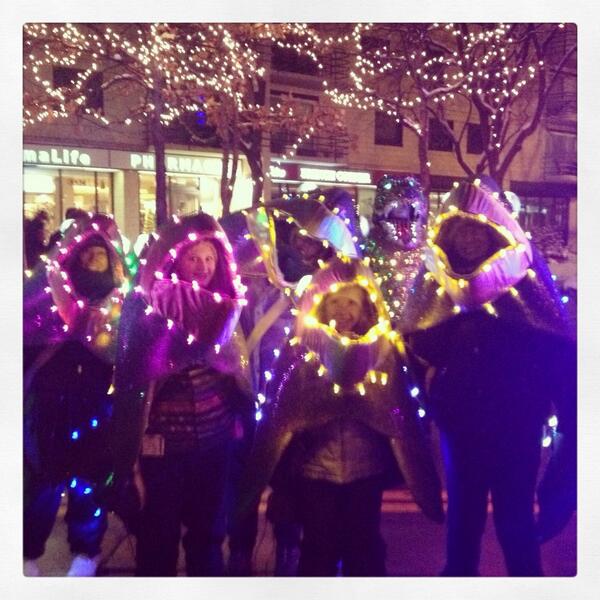
If you ever wanted to see a bunch of volunteers trudge slowly down a cold winter street wearing light-up costumes resembling various childhood tropes, tonight and tomorrow are your last chance. The Holidazzle parade is quietly holi-fizzling away this year with surprisingly little fanfare.
I went with a group of intrepid urbanists last week to see the penultimate Holidazzle weekend. We wandered through the skyways on our way there, and with notable booster R.T. Rybak at the head of the parade, it was not a disappointment.
![]() |
| [Remember these?] |
Meanwhile, the last of the major department stores was still called Dayton's, and they had long trumpeted a rotating holiday-themed display spectacular on their 8th Floor. I remember going there as a kid to see Santa Bears, and various holiday display adventures. Back then, window displays were still a big deal. Downtown retail really invested a lot of time and energy into doing things like this. It was another era...
And that's when Holidazzle was born. I chatted the other day with Michael Murnane, who founded and ran the parade for many years. As he told it, it was during one of these brainstorming hand-wringing sessions that some of the Dayton's 8th Floor designers pitched a new parade for downtown that would draw people to the retail district during the Holiday shopping season. It would be a parade themed around various childhood stories and fantasies, and the main attraction would be that the whole parade would be made out of lights.
At first there was some skepticism, particularly about the high cost of such an endeavor. But after conducting some research down in Disneyworld, Murnane and a childhood electrician friend began re-wiring many many many strings of Christmas lights so that they would run on batteries. Then the fun began. They started building floats and costumes, and launched the first Holidazzle in 1992. It grew for a long while, and evolved into a series of themed floats and costumes sponsored by various downtown interests.
![]() |
| [Last stop for the Twinkle Bus. Last stop...] |
The other takeaway from the Holidazzle experience is that it continues to attract a large crowd! There were lots of people cramming into an otherwise empty-after-six downtown, and it was quite fun to see the city packed on a cold winter's night.
![]() |
| [Please, will somebody please volunteer????] |
![]() |
| [Twirling snowball gets more hits than Drew Butera.] |
![]() |
| [Dunno what these are but whatever! Lights!] |
At the same time, it's difficult to think of downtown civic events that have been as much of a consistent attraction as the Holidazzle parade. Kitschy as it might be, it's at least as good as the Aquatennial whatever-it-is. (Barring, of course, the awesome fireworks display.) Back in 2007, the Holidazzle management got changed, and (so I hear) they started cutting back on some of the expenses and maintenance. The old days of downtown department stores are never coming back, no matter how many bedazzled floats we throw at it. Maybe it was always inevitable that the Holidazzle would twinkle and sparkle and fizzle into that good night.
![]() |
| [After all, no snowman is an island.] |
2013-12-16
A Baker's Dozen Bicyclist Words for Snow
![]() |
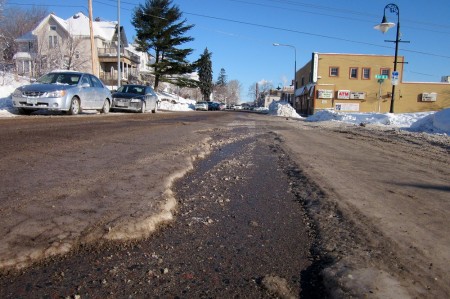
| [Death ruts on 4th Street, Duluth. via PDD.] |
One reason we repeat sayings over and over is that they often make common sense. One reason we repeat sayings over and over is that they often make common sense. In other words, the more time you spend time looking at a thing, the more you see. The longer you dwell with an environment, the deeper your knowledge.
And riding a bike in the wintertime offers you lots of time to contemplate your environment. For safety reasons, you can't ride that fast. Instead, you must continually stare at the street in front of you, attending to its nuance. It's a bit like singletrack mountain biking, or downhill skiing. You immerse yourself in your environment. You start noticing all the varieites of urban ice and snow experience.
Thus, the beginnings of a wintertime bicycling vocabulary:
Powder - Newfallen snow, lacking coherency. Mostly innocuous, pretty fun.
Ice Scabs - Round bits of compressed ice clinging to the street. Dangerous, but avoidable.
Ice shelf - Like "ice scabs" but larger. These tending to the edges of the street, often containing "death ruts." It's very easy to fall on an "ice shelf" if attempting to corner.
Continental shelf - A large seemingly infinite "ice shelf," lacking death ruts.
Death ruts - Bits of exposed pavement between "ice shelves," worn away by cars. It's often safe to ride in a death rut, until it isn't.
Death ridge - The unexpected edge of an "ice shelf." Particularly dangerous.
Brown sugar - A soft mix of snow and salt. It makes a pleasant smooshing sound under one's tire.
Cookie dough - What happens to "brown sugar" in colder temperatures. Kinda chunky.
Iceberg - The accumulated hard mix of ice and snow that mounts on the edge of a curb after a long winter.
Titanic - An immense curbside iceberg, likely to sink even the largest confidence.
Fender boogers / Fender snot - Large brown bits of chunky ice/snow mix expelled from the wheel wells of cars.
Rorschach test - A particularly unpredictable formation of "ice scabs."
Permafrost - A continental ice shelf with a layer of "powder" or "cookie dough" on top. Actually pretty nice to ride on.
Skating rink - A road or trail with a thin, invisible coating of ice. Typically occurs around the freezing point, and almost certain to produce falling for any without studs.
[h/t to David for the help with this list!]
![]() |
| [Midtown Greenway, Minneapolis.] |
2013-09-03
In Praise of Street Trees
Extreme heat brings out a new side to the city. In the heat, you are alive to the dynamics of inside and outside, movement and rest, invisible or irrelevant most of the time. Walks become longer. Clothes become shorter, their lifespans also abbreviated.For some, the city seals up. Our bodies acclimatize to cool interiors, windows seal, shades are drawn. Cars are air bubbles traveling through space.
Mostly we squint at the outside world, peering through venetian blinds at the harsh glare.
But to step out into the hot city and run or walk or ride through the air seems alien. Why would you go out there? Like stepping foot on Mars.
And it is. Walking the hot summer city can be arduous. The variables are relatively simple: most movement produces sweat; a breeze evaporates your skin and cools your body; and most of all, a small patch of shade can make all the difference in the world. Walking the hot city is seeking the right mix, the perfect spot out of the sun and in the right wind.
And that's where trees come in. A well treelined street is a balm on a hot summer day. A treeless street is brutal.
Riding a bicycle along the roadway, I find myself stopping in the small patches of shade. I wait for the light to change while clinging to the tree shadow like a life preserver.
When else do you notice the precise line where shade begins? In the heat, trees are alive in a new way. You feel them soaking up the sun, the shadow on your skin. They are tall green parasols that we all can share.
Let us all praise famous trees.
2013-03-01
Sidewalk Games #16: Mortal Plummet
Pretend you are an old person, who can barely keep their balance. As you walk through your city on the icy winter sidewalks, imagine yourself falling.
1 point for every time you fall.
2 points for every time you acquire an imaginary black and purple bruise that takes three weeks to heal.
5 points for every time you break your hip.
10 points for every time you die from your icy plummet.
1 point for every time you fall.
2 points for every time you acquire an imaginary black and purple bruise that takes three weeks to heal.
5 points for every time you break your hip.
10 points for every time you die from your icy plummet.
[An ice covered sidewalk in St Paul's West Side.]
2013-01-22
Sidewalks: The Cure for Cabin Fever
![]() |
| [A rough sketch of me talking about sidewalks.] |
Pretty much the only topic that will reliably pique people's interest is the Minneapolis skyway system, and why I don't like it. This will almost always generate an expression of shock or surprise, and lead to an argument about the weather, and how wonderful it is that people can walk through downtown without a coat in January.
At this point, a skyway argument has become the "old chestnut" of sidewalk blogging, and I've not made much progress convincing people to adopt my point of view. For example, here's a recent comment from a Streets.mn post about skyways, probably the most thoughtful skyway discussion I've had in some time:
In winter, I would walk to the Convention Center, and hop into the skyway to get to my bus stop. I’d see the some of the same people every day making their last-mile commutes, pouring into the skyways from the parking ramps, or jumping in after a bus ride.
Rather than people keeping their heads down and fighting the cold winds and ice, they were getting coffee and talking to each other. Sure, it’s not like being outside in the summer, but we have six months of winter in this town and skyways are a great alternative to fighting the elements.
I want to focus here on the part at the end. It's a phrase I've heard this over and over again, and not just about skyways. People say this about patios, bike lanes, sidewalks, and ice cream.
"Oh, it makes no sense to build a sidewalk patio there, we have six months of winter, " they say.
"Bicycling isn't practical here in Minnesota, we have six months of winter," they say.
I'm not a doctor, but I know a thing or two, but I'm beginning to think that something is rotten in the state of Minnesota. There are plenty of people who seem to be suffering from a common malady around these parts. Read again the key phrase: "We have six months of winter in this town and skyways are a great alternative to fighting the elements."
That, friends, is a telltale symptom of what's commonly known as cabin fever.
The Cabin Fever Epidemic
![]() |
| [One of the thousands of victims of cabin fever.] |
This ailment has become particularly wide-spread in places like the Twin Cities, where alienation triggered by cabin fever has led many to develop a strain called "Minnesota Modernism," a tendency to build large enclosed structures festooned with the false accoutrements of the outside world. For example, indoor malls designed to look like city streets, massive enclosed domes with fake green grass within which one plays sports (even during summer months), underground tunnels patterned after subterranean rodents, and sealed carpeted tubes with windows looking out over parking ramp exits.
What is to be done? Is there no cure?
Are There Really Six Months of Winter?
![]() |
| [November 2012 temps. Daily highs are in green.] |
I suppose it depends on what you mean by winter. Strictly speaking, according to climatological theory, there are three months of winter. But if you're talking about temperatures that are cold enough to keep you from comfortably going outside, I'd say that you might have (on average) six days of winter.
Yes, that's correct. Six days. 2012 is an extreme example, but let's look at it for a second. One year ago, we had a week in January where the daily highs were 32, 40, 36, 28, 40, and 45. For twelve days in March, the high temp never went below 63 degrees (!). Two months ago, it was 62 degrees on November 21st and 60 degrees on the 22nd.
Of course, I'm cherry-picking the warmest days, and the warmest year. But you could look through 2011, 2010, 2009, or just about any of the past 5-10 years to find scores of lovely wintertime days. In these changing times, every year is the warmest year. These days, for most of the Minnesota wintertime the sun is shining, temps are in the 20s or 30s or 40s, and anyone with a decent coat can enjoy themselves in the outside world. I had two friends email me yesterday to let me know that they went on a walk outside. I'm not sure if they enjoyed it, but at least they got out there and gave it a shot.
The Cure for Cabin Fever
![]() |
| [Take two of these and call me in the morning.] |
"A sidewalk a day keeps the skyway away."
In fact, with the St Paul Winter Carnival coming up, this would be the perfect time to get your cabin fever vaccine. The Winter Carnival is the best example of our rich tradition of going outside in the wintertime. People used to do this all the time: walking around outside, sledding, skating, skiing, snowmen making, walking to buses, walking to stores, walking their dogs, watching their breath billow out while wearing dashing wool coats, knitten hats and warm woolen mittens.
The latest winter carnival treasure hunt clue says it all:
Walk your dog or jog a bit.
Grab your honey, park and sit.
Ride a bike; exercise the kids;
Winter allows what summer forbids.
The next time you're talking to a friend in Florida, traveling through Texas, or lounging in LA, and someone says something like, "Brrr, it's so cold!" when its 60 outside, and you're tempted to puff out your chest and scoff in their faces and say, "What are you talking about? Back where I come from, its -13 below on a warm day..." The next time you do that, remember these words and get outside. Walk the walk, and you just might realize that the unbreachable winter is a scarce commodity, rapidly fading. Remember that (as an ice fishing friend of mine likes to say), there's no such thing as bad weather, only bad clothing. Remember that there aren't six months of winter, that it's 70 degrees in April and 80 in October. Remember that 95% of the time you will enjoy walking outside, and that winter is no excuse for spending all your time in shopping malls or playing baseball indoors. Let's re-claim our proud Twin Cities' tradition of not shunning, but embracing our continental clime.
2013-01-09
On Windchimes
I've never owned a windchime in my life, but then again, I've never felt I had to. Windchimes don't seem to me to be the sorts kind of things that people own. They're not private. Rather, I believe people harbor them, host them, and that they belong properly to the neighborhood of sonic territory.
There are two windchimes in my life right now. I couldn't be happier. Windchimes are an invitation, a crack in the wall to the outside world. Windchimes can linger at the corners of your perception, or strike you all at once like a meditation bell. Windchimes stretch their sounds out like small fingers to beckon through your window, drifting mysterious songs round corners, down alleyways, past porches and houses. Like fog lingering on drains, licking tinkling tongues into the corners of the evening, they chime only sometimes when the wind blows just peculiarly, constantly changing repeating never repeating atonal chords forming invisible bonds of attention. Wind chimes reveal why porches were made.
I still remember my favorite windchime of all time, a moment in time that caught me by surprise. I was walking westward from St Paul to Minneapolis along Como Avenue in St Anthony Park. There is a long hill sloping down from a little neighborhood node, descending toward the border between the two cities. On top of the hill sits a Lutheran seminary, its vast green fields running up toward a reclusive and unapproachable building perched like an owl on the hill. Opposite runs a wide sidewalk lined with tall green hedges and tasteful grand houses with rich views of the urban expanse that opens flatly out to the west. I was noticing all of this on my stroll in the evening, at the moment when the sun starts to slump and shadows stretch out their arms, when a breeze appeared. The most beautiful windchime I've ever ever encountered started singing.
I was arrested. I lingered there for a minute or two listening, feeling the breeze whispering my cheek. Wind itself is an invisible continual force that makes its presence known only in its effects: a ripple on water or a billowing clothesline prisoner. To host a windchime is to try and mark the wind, to trace its contours and give them form, map them musically for benefit of a small world of ears. This chime was harmonically impeccable. Its music spoke to me and beautifully danced slowly on its way across the street.
Where lay its perfection? Was it the chime itself? Perhaps a work of crafstmanship from the finest artisanal chimer in the land? (In that aesthete neighborhood, it would come as no surprise.) Or was it the wind at that moment? Did it blow in just such a way, bouncing round buildings and through certain trees to strike its blow at an exact speed and angle, forming a musical chordal pattern untouched ever again?
There has long been a relationship between bells and neighborhoods. Look at any old sketch of a city, in the era before we scraped the sky away, and what sticks out are the steeples. They point upward, flinging your attention higher than houses and into the clouds of imagination. But steeples were also instruments housing bells. Churches marked out their neighborhoods with song, rang out on the hour or on the week to demarcate celebrations and remembrances. Bells ringing out to remind the halfway pious. Audible guilt, declarations of community. I like to think that in the old days before the ubiquitous personal soundtrack, they marked a territory, they formed a neighborhood. Consider yourself lucky if you live near a ringing steeple. It's the aural mark of urban life.
This last August, I moved to a new neighborhood on a bluff overlooking the river. Yes, there is a church steeple a half block away, visible out my study window. It rings the hours, quietly keeps time. Some evenings it will be lit from within. I'm not a church goer myself, but that hardly seems necessary in order to rest my comfort on the beautiful building.
My apartment also lies in the terrain of two windchimes, like the overlap in a Venn diagram. There is one ringing from the east, and one from the south. The eastern chime must be hanging somewhere in the low houses next door. This chime was the first one that I heard. It's a high chime, that rings quick windward replies. The proper verbs are tingle, tinkle, shimmer, and glisten. Even in the winter, I can hear it chime faintly through my doubly closed window, and it reminds me that there is a world outside waiting for me. It calls me out of bed, out of the doors of my apartment. It invites me into the world, saying hey high hey high glee hi over and again in a random everchanging nonsense music.
I didn't notice the southern chime until quite recently, one night when I was out on my back porch overlooking the back ends of the homes that close round my tall backyard cottonwood tree like a nest. This chime was low and long and lingering, slow repeating clustered tones. It lurked and was mournful. When I hear this chime it seems like ghosts. It somehow channels memories and emotions into my throat, a night time chime making sure I don't forget I'm never alone. It's beautiful in the sad ways of a minor key, and I love it more than anything.
Occasionally the two chimes will ring simultaneously, overlapping off beat, each ringing out toward me like ripples in a pond. I stand there in the middle staring off at the leafless winter trees and letting the sounds bounce off me like raindrops, the music of the city, the sound of time, the map of the invisible wind.
![]() |
| [The small Eastern chime hanging from a pine branch in the winter sun.] |
I still remember my favorite windchime of all time, a moment in time that caught me by surprise. I was walking westward from St Paul to Minneapolis along Como Avenue in St Anthony Park. There is a long hill sloping down from a little neighborhood node, descending toward the border between the two cities. On top of the hill sits a Lutheran seminary, its vast green fields running up toward a reclusive and unapproachable building perched like an owl on the hill. Opposite runs a wide sidewalk lined with tall green hedges and tasteful grand houses with rich views of the urban expanse that opens flatly out to the west. I was noticing all of this on my stroll in the evening, at the moment when the sun starts to slump and shadows stretch out their arms, when a breeze appeared. The most beautiful windchime I've ever ever encountered started singing.
I was arrested. I lingered there for a minute or two listening, feeling the breeze whispering my cheek. Wind itself is an invisible continual force that makes its presence known only in its effects: a ripple on water or a billowing clothesline prisoner. To host a windchime is to try and mark the wind, to trace its contours and give them form, map them musically for benefit of a small world of ears. This chime was harmonically impeccable. Its music spoke to me and beautifully danced slowly on its way across the street.
Where lay its perfection? Was it the chime itself? Perhaps a work of crafstmanship from the finest artisanal chimer in the land? (In that aesthete neighborhood, it would come as no surprise.) Or was it the wind at that moment? Did it blow in just such a way, bouncing round buildings and through certain trees to strike its blow at an exact speed and angle, forming a musical chordal pattern untouched ever again?
There has long been a relationship between bells and neighborhoods. Look at any old sketch of a city, in the era before we scraped the sky away, and what sticks out are the steeples. They point upward, flinging your attention higher than houses and into the clouds of imagination. But steeples were also instruments housing bells. Churches marked out their neighborhoods with song, rang out on the hour or on the week to demarcate celebrations and remembrances. Bells ringing out to remind the halfway pious. Audible guilt, declarations of community. I like to think that in the old days before the ubiquitous personal soundtrack, they marked a territory, they formed a neighborhood. Consider yourself lucky if you live near a ringing steeple. It's the aural mark of urban life.
This last August, I moved to a new neighborhood on a bluff overlooking the river. Yes, there is a church steeple a half block away, visible out my study window. It rings the hours, quietly keeps time. Some evenings it will be lit from within. I'm not a church goer myself, but that hardly seems necessary in order to rest my comfort on the beautiful building.
My apartment also lies in the terrain of two windchimes, like the overlap in a Venn diagram. There is one ringing from the east, and one from the south. The eastern chime must be hanging somewhere in the low houses next door. This chime was the first one that I heard. It's a high chime, that rings quick windward replies. The proper verbs are tingle, tinkle, shimmer, and glisten. Even in the winter, I can hear it chime faintly through my doubly closed window, and it reminds me that there is a world outside waiting for me. It calls me out of bed, out of the doors of my apartment. It invites me into the world, saying hey high hey high glee hi over and again in a random everchanging nonsense music.
I didn't notice the southern chime until quite recently, one night when I was out on my back porch overlooking the back ends of the homes that close round my tall backyard cottonwood tree like a nest. This chime was low and long and lingering, slow repeating clustered tones. It lurked and was mournful. When I hear this chime it seems like ghosts. It somehow channels memories and emotions into my throat, a night time chime making sure I don't forget I'm never alone. It's beautiful in the sad ways of a minor key, and I love it more than anything.
Occasionally the two chimes will ring simultaneously, overlapping off beat, each ringing out toward me like ripples in a pond. I stand there in the middle staring off at the leafless winter trees and letting the sounds bounce off me like raindrops, the music of the city, the sound of time, the map of the invisible wind.
2012-12-17
BURP #8 (Winter Edition) Tomorrow at 5:00 at Northbound
![]() |
| [The sidewalk-friendly windows of Northbound.] |
These are the days of the depths of darkness, when urbanists retreat to their hearths to celebrate the city with camaraderie and beer. On this night, we will make plans for the coming springtime and the flowering of urban form. The seeds of the city are sitting dormant all around us, waiting for a helping hand. Come, raise your wrists. Make new friends and old friends and steel yourself for the helter skelter holidaze in the only way I know how.
BURP with me tomorrow afternoon!
2012-08-08
Hot Cars, Yet Another Hidden Cost of Automobiles
A friend of mine has been emailing folks about the weather and climate for years. He’s very good at it. Most every time a storm of flood or heat wave or cold snap rolls through the upper Midwest, he drafts an engaging, understandable explanation of the underlying climatic forces, compares different weather prediction models, or makes dubious predictions about the near future.Plus, he’s funny. Here’s a recent bit of his work detailing a danger of heat waves:
Hot weather is bad enough, but accidentally killing your or child(ren) or pet(s) would pretty much sap the joy out of the rest of your life. So, do not leave any living creature unattended in cars in the sunshine, even with the windows down. Research has shown (and isn't it incredible that someone had to do research on this?) that cracking the windows 1.5 inches only very slightly delays the temperature increase and does not decrease the final internal temperature. Do not try to outsmart the system by leaving the car running and the AC on; a whole bunch of happy toddlers were killed this way in 2006 when the car overheated, died, and the inside temperature rose to about 160 degrees.
Also, do not be misled into thinking this is a hot-weather phenomenon. The deadly ingredient is sunshine, and not outside temperatures. Even with temperatures in the 70s, a car in bright sunshine can easily get into the 120s.
The following protocol should be followed if you see innocent and/or helpless living things inside hot cars. By the way, Minnesota and Wisconsin have no laws on the books for children, so you are sort of in vigilante mode. But you want to be this kind of vigilante.
1. Call 911 and make a very thorough report, then,
2. break window farthest from child/pet
3. remove child/pet from vehicle; wait for emergency personnel.
4. Break remaining windows for consistency and thoroughness
5. (optional) lift knee and drive heel firmly into groin of vehicle owner
[The scene in Karate Kid where Mister Miyagi and Kreese team up to save two kids from being trapped in hot cars.]
I’d forgotten that it’s not uncommon for people to leave their children (and pets) in cars and kill them in this way. But yes, in America, this happens all the time. According to the intriguingly named nonprofit, Kids and Cars, the US average number of children baked inside automobiles each year is thirty-eight. (They also attempt to raise awareness about kids being run over by cars, backed over by cars, crushed by car windows, or locked in car trunks.)
Wow. It’s another unintended consequence of our automobile society. I’d imagine that most of these incidents occur because people drive everywhere, because the automobile has become such a part of our lives that we almost take them for granted. We forget that they're actually quite dangerous, and not just to the people being run down in the crosswalk. Just like guns, cars can easily harm the people using them.
![]() |
| [Baby on board.] |
Well, let's imagine an alternative. One of the big differences between car culture and an urban street culture concerns private and public space. On sidewalks, streets, and buses you're out in public most of the time. On other hand, when you drive everywhere you're in inaccessible private space. In cars, people are pretty much left alone.
In streets, while you might see some pretty bad parenting, you don’t have people locking their children up and roasting them. It’s literally impossible to confine a creature in a hot space while walking (though those kid leashes do make one think). Nobody would leave their child or dog locked to a bicycle.
As I’ve been documenting for years, people can very easily tie up a dog on a parking meter or railing while they run a quick errand. On the sidewalk, there are plenty of eyes on the street, people that will watch you and make sure you don't accidentally roast your child like an eggplant. On a sidewalk, you’re in public space and a passerby feels somewhat responsible for things that happen there. A car in a parking lot, on the other hand, is a private space and a private situation. Intervening in that case to save the life of a child or dog requires vigilante heroism.
Subscribe to:
Posts (Atom)