
[Cedar-Riverside, Minneapolis.]

[Cedar-Riverside, Minneapolis.]

[Cedar-Riverside, Minneapolis.]

[Cedar-Riverside, Minneapolis. (QR code goes to a travel website.)]

I remember hearing about these "sponsored" benches from Board of Estimate and Taxation Candidate Eric Harris Bernstein. The BET is easily the most obscure elected city government position that I know about, and it's rare that people even take the time and energy to run for it. But I am very impressed with Bernstein's campaign so far, based solely on his typeface designs and sittable signage.
Instead of lawn signs, he's put his resources into hand-made benches for Minneapolis' parks. I saw two of them the other day in Kingfield.

What a great idea! Most campaign spending is the definition of ephemeral. Whether or not Bernstein wins or not, these benches will be providing a civic service for years.
If I lived in Minneapolis, he'd have my vote based solely on this infrastructural brillinace.

I’m endorsing Molly Coleman. If you live in Ward 4, please take the time to vote for her.
I’ve met Molly many times, even before she announced her campaign. She’s smart, humble, experienced, wonky, and has good positions on some of the St. Paul’s thorniest issues like rent stabilization, housing, or economic development. She clearly loves St. Paul, and (for obvious family reasons) has deep knowledge of its neighborhoods and traditions. Most importantly, Molly Coleman seems like a good listener, a rarity in politicians these days. I’ve been impressed with her mix of curiosity and experience, and especially her desire to learn from others even as she brings a lot of St. Paul knowledge to the table. I think this election is an easy choice.
The other candidates:
School Board member Chauntyll Allen is a nice person who’s been involved in local politics for years. I met her during an early discussion of the Rondo Land Bridge, and still remember a lot of what she said about that project. In this case, though, I don’t see her actively putting forward any reasons to vote for her in this situation.
I've never met her, but Carolyn Will is an communications person (and former SARPA president) running on a 'taxes are too high' / 'crime is out of control' message, making her the obvious conservative in the race. More importantly, she helped run the Save Our Street / Summit Avenue anti-safety campaign, which is both wrong about infrastructure and street design and actively wasting your tax dollars.
That's a terrible thing to be ring leading. For a year, I’d go out of my way to not bike on Summit Avenue, just because the signs infuriated me. The endless disinformation campaign is a bleak sign of the future, making it seem like any improvements to St. Paul's urban fabric are going to be slow and painful. There’s a toxic strain in St. Paul toward negativity, where anything “the city” is doing is inherently bad. Carolyn Will seems to personify this pessimistic defeatism.
Cole Hanson is a young organizer who is maddeningly inconsistent, and I cannot suggest supporting him either. For one thing, he is way too online, repeatedly getting into inane fights with people on social media. For another thing, he's both for and against policies that contradict each other; When it comes to rent stabilization or transportation policy, it seems like he’ll say anything. See for example: this weird video. (Sure, Snelling Avenue is dangerous — I've been saying so for 20 years — but random spitballing about something that’s not in the cards, and is out of the city’s control, is a waste of time at best. Why not talk about an issue that's actually in front of us?)
Before launching his campaign for City Council, he'd apparently purloined the District Council mailing list where he'd been working. That's naive at best, and unethical at worst.
The real sign of trouble with Cole Hanson is his parroting the disinformation around the Summit Avenue reconstruction project. The Summit Avenue reconstruction is a great litmus test for one’s susceptibility to bullshit, so that's a deal breaker. Without naming names, the City Council has already been a hot mess this year, rife with inexperience and lack of attention to detail. Cole Hanson would make that problem worse. In a time when St. Paul is in rather desperate straits, he seems like a random policy generator.
We need positive visions and common sense, and only Molly Coleman passes the test. Her stance on the Summit Avenue process and other key dilemmas are great signs of how she’d make decisions at a time when we need thoughtful wisdom in City Hall. Please vote for her on or before August 12th!
[Molly with John Edwards on Wedge Live!]
 |
| [Hard Times Café on Riverside Avenue, open until midnight.] |
Since the dire presidential election, I’ve made a new habit of stopping into the Hard Times Café in the mornings whenever I have time. It’s close to my office on the West Bank and it’s a spot that means a lot to me, one of the few remaining pillars of the West Bank counter-culture.
Of course the crusty punk co-op café has radical politics, which are needed now more than ever, but it’s also the fact that I’ve been going there for twenty years. I remember hanging out there (for example) in 2004 during the Iraq War protest and George W. Bush re-election years. The days after the election, walking into the place, ordering a $1 cup of strong coffee in a brown mug, and singing into the country or metal music is the only real balm I’ve found.
It’s too easy post-COVID to retreat into our domesticity, to focus on our families and turtle up in our homes. With a three-year-old, I find that especially appealing. But we also need to get out and keep our community centers thriving, whatever they might be. Seek out the places in the city that mean a lot to you, and keep them alive.
 |
| [From here.] |
Despite the apparent fury on display at City Hall this week, my take on the debate over rent control amendments is pretty straightforward. Almost all of the changes are minor and there's not that much disagreement at the City Council level. It seems unfortunate to me that affordable housing advocates have been whipped up into a seeming fury over minor policy changes, most (or all?) of which will end up helping the city’s renters.
For example:
There’s unanimous (?) support for a new construction exemption of some length, and for good reason.* I don’t know enough about the inner workings of housing financing to be able to tell you whether 15 or 20 years would be more effective rolling window -- only bankers and developers would know the answer to that -- but I can tell you that difference between a 15- or 20-year window is small potatoes and will not trigger an avalanche of displacement. Given the wide gulf between housing markets in St. Paul and California (where extreme prices make new construction displacement into a problem), I think the concerns of advocates about the new construction exemption are seriously overblown.
The "rent banking" proposed by Council Member Tolbert is even more of a no brainer, and leaves me seriously scratching my head as to why the Housing Justice Center is opposing it. For one thing, this policy is not vacancy decontrol, and should never have been given that moniker. "Vacancy decontrol" implies that when a tenant moves out, rents would go up past a theoretical 3% annual cap. This policy doesn’t allow that to happen; rents would remain capped at a 3% annual increase. (I.e., rent increases could not exceed 9% over a three-year timeframe, etc.)
All this does is remove the “use it or lose it” incentive from the current policy, which is a problem with the rules currently on the books. Right now, both anecdotally and in the rental data, many of the city’s landlords are automatically increasing rents at 3% a year for all their units, no matter the context. That’s likely why, for the first time ever, average St. Paul rents have risen faster than those in neighboring, more wealthy Minneapolis.
Council Member Tolbert's banking provision simply removes that incentive, making it much more likely that landlords will keep rents flat for their existing tenants. If you care about renter stability, that’s a good thing!
Finally, the debate over whether or not to exempt Federally subsidized and regulated apartments seems weird to me. At first glance, it’s doesn't seem legal? We’re talking about rents that are already regulated and controlled by Federal policy. It will surely end in a lawsuit, so that's good for the lawyers, I guess... At second glance, isn’t it possible this decreases subsidized housing production in St. Paul?
But basically, all the proposals I've seen, with the notable exception of Council Member Prince’s vacancy decontrol amendment, are benign tweaks that leave the bulk of the city’s rent control policy in place.
(Personally, I don't think these proposals go far enough, and won’t fix the structural problems with the existing ordinance, but that's a story for another day. I already wrote 4,000 words detailing my prescription for that. I'm glad that Council Member Prince is introducing actual vacancy decontrol, which I believe is the most effective and simplest way to fix the city’s policy.)
In short, having some sort of new construction exemption in the policy is a must. Given the deep need for the city to attract investment in housing, I would prefer to see the City Council erring on the side of caution and going with 20 years. But in general, it’s good that a Council majority is on board with some sort of exemption!
The rest of the changes, with the exception of Council Member Prince’s amendment, seem pretty minor. I guess I’m disappointed that these small tweaks have become so politicized, because the Tolbert amendments are benign changes that should be widely embraced by city leaders.
* The city housing data on display from Department of Safety and Inspections (DSI) at the meeting sure seems fishy, and I’d be willing to bet a good sum of money that it is incorrect. I’m digging into why that table contradicts the numbers from HUD, and will be sure to clarify this when I can. Unless there’s some error in recent reporting from the city, the broad trends in the HUD dataset, which covers every city and county in the country, are likely to be correct, so I’m guessing the problem lies in the city statistics. No offense to the hard-working folks at DSI, but they are not exactly known for their data analysis acumen.
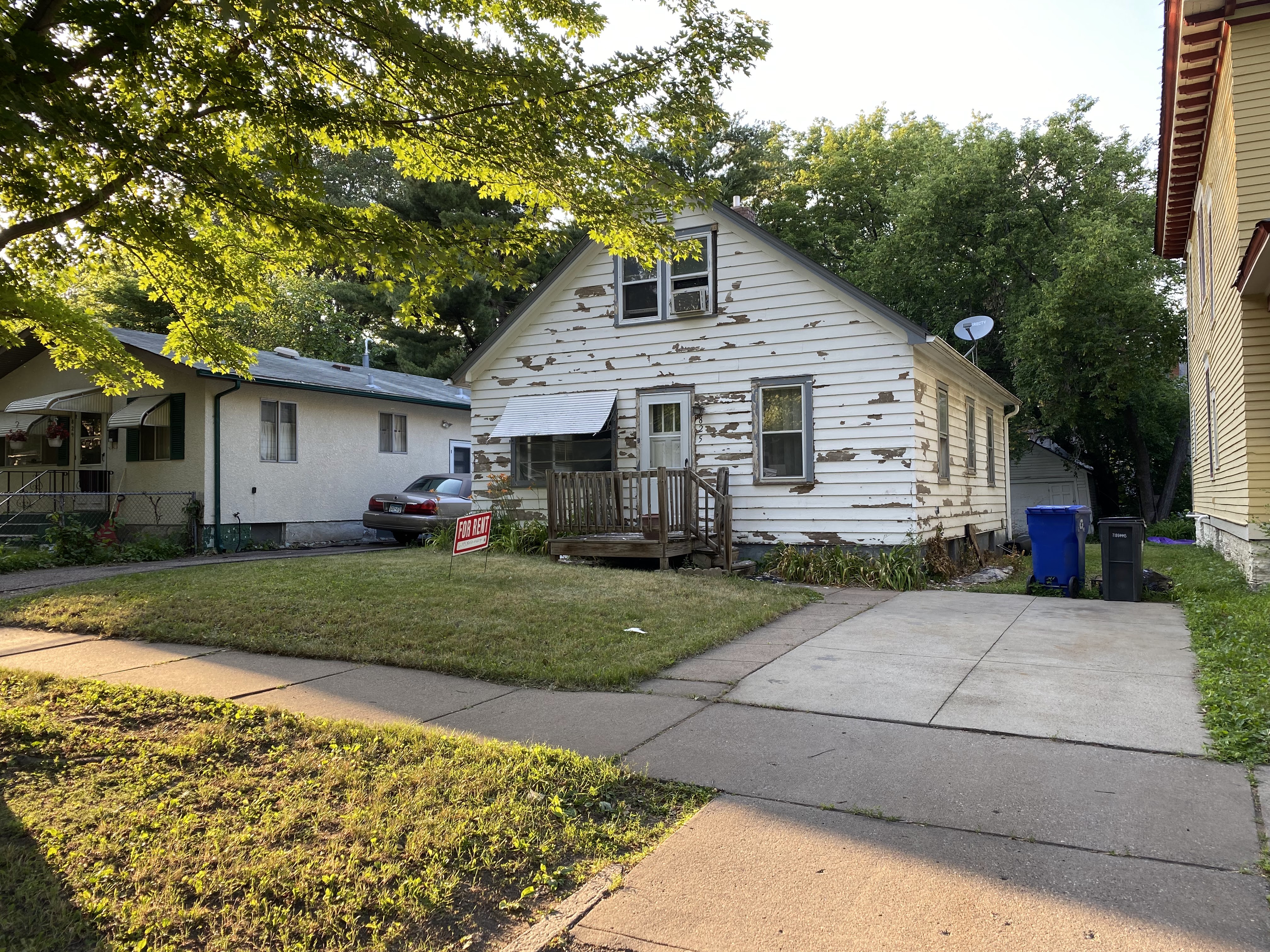 |
| [A house for rent in the Rondo neighborhood.] |
There’s good news and bad news. The bad news is that, in my opinion, the Task Force was not a success. (Note that I refuse to use the term "stakeholder," and will refer to it as a "task force" from now on.) We didn’t craft a good rent stabilization policy, and I doubt that the process created political consensus that will bring anyone together who disagreed about rent control. Those were probably the main goals going into April.
But the good news is that the Task Force was not a failure. It did not completely implode, and there is a set of recommendations that can point Saint Paul leaders in the right direction for amending the policy on the books today.
That’s where we’re at. Despite the bumps along the the way, the Task Force creates a starting point for a conversation, showing broad strokes around which Saint Paul can move forward. With a good discussion, and hopefully input from the Mayor’s office implementing the modified policy, I hope city leaders can work out a good long-term rent stabilization policy.
Looking back on the Task Force experience, I’m going to share what I think that policy should be and why.
Thirteen Weeks of Impasse
 |
| [Watch all the meetings here.] |
The main problem was that not everyone agreed there was a problem. Of the 41 members, maybe one-third were people who had worked on the rent control ballot campaign. Having spent a year trying to put their policy in place, most of those members were ecstatic about the status quo. It’s not hard to see why folks were not thrilled about a group whose stated purpose was to undo their work.
That meant that right from the beginning, and almost unwaveringly throughout the proceedings, a large percentage of the Task Force was not on board with its purpose. And I don’t blame them either; I’d have felt the same way.
It didn’t help matters that, during the weeks of policy discussion, moderators never made a case for why change was necessary. I never sensed that the CURA team leading the eight weeks of policy context viewed the existing ordinance as a problem, and throughout the conversation, there wasn’t any any sense of the stakes to policy choices. It was mostly an overview of policies from around the country — “some cities do it this way, other cities do it this way” — without a sense of what the downsides and tradeoffs might be.
That’s not necessarily the CURA folks’ fault, either. I doubt most of the CURA staff viewed the status quo as a problem, and Director Ed Goetz had been clear throughout the election campaign that he supported St. Paul’s rent stabilization ballot initiative.
This is a long way of saying that most of the Task Force proceedings were, in my view, a waste of time. (I bet most members feel the same way.) Almost nothing from the weeks of preparation for the policy negotiation changed anyone’s mind. The Task Force could have skipped those eight two-hour meetings, spent more time on the small group negotiation, and the outcome would probably have been just as good, if not better. At the very least, doing so would have saved 41 volunteer members, and every staffer at CURA, 20 hours of prime Tuesday afternoons during a wonderful Minnesota spring and summer.
(A side note: I've been researching rent control for a while now, and didn’t personally learn much from the various lectures. In fact, I found the four-part ULI/Minneapolis FED rent stabilization discussion to be more informational than the Task Force lectures, and for housing policy nerds, I recommend those discussions. The only thing that surprised me during the Task Force learnings - mentioned in the talk by Ken Barr - was that the the “reasonable rate of return” provision on the books in Saint Paul is not a simply policy idea, but rather a CYA legal requirement based on existing US case law. In other words, if a city or state passes a rent control policy that does not include a “reasonable rate of return”, it will almost certainly be thrown out in court.)
The point is that there was a gap at the center of the Task Force meetings: What was the issue here? What was the problem we were trying to solve? What were the downsides about the existing policy?
Without common ground — the idea that there was a problem that needed a solution — the Task Force was hobbled from the start.
So today, looking back and looking forward, it begs the question: apart from the new construction exemption provision (which I have written about at great length), what are the problems that the Task Force was convened to solve?
Here are the two biggest that I see.
 |
| [Still-vacant duplex on my block; it was like this for over a year.] |
Problem #1: Disinvestment
My wife and I bought a small house in Frogtown about three years ago, the first time I’ve owned any property. Right away, we learned that the shoddy looking duplex next-door had some problems. For one thing, twice when we were home, some sort of police gang task force rolled up and strode across our lawn with rifles to knock on the door of the downstairs tenants. They eventually moved out, but the duplex remained pretty in said shape, with lots of people coming and going. Probably the nadir was when we watched EMTs pull a dead body out of the basement, a woman who had either overdosed or died of old age.
Anyway, that was not great.
Then one day, I walked out the door and found a guy — let’s call him Dave — who was at that very moment thinking about buying the duplex. I encouraged him, and he did.
For the next year, Dave worked on the duplex, and had contractors there most days going in and out doing things like laying concrete, gutting the interior, remodeling the kitchen, building a new set of exterior stairs, adding a doorway, fixing the falling-down porch, pretty much everything except for the exterior painting and aesthetic stuff.
(Speaking of which: It'd be nice, "Dave", if you could get to that one day.)
I’d chat with him every once in a while, to see how it was going. According to Dave, he’d spent around $100,000 on it (so far), and he’d maybe make his money back in ten years. But he also added that “it was in terrible shape,“ and that if nobody had come in and rehabbed the building, it would have been condemned. Things had gotten that bad.
 |
| [Newly vacant lot across the street from my house.] |
The point is that much of Saint Paul's housing stock is in rough shape. It's not unusual to see vacant buildings and lots in many Saint Paul neighborhoods. On my one block in Frogtown, there’s a vacant lot across the street that had a house on it as recently as 2015. Two doors down, another house has sat empty for three years, though someone comes by to mow or shovel once in a while. Three doors down the other direction sits one of the city’s 400 registered vacant buildings. (The above photo of the doorway is a photo of that duplex.)
Judging by the photos, woodwork, and rooflines, all of these homes were once nice places for people to live, and should still be homes for someone today. My block in Frogtown is one of the nicer in the neighborhood, and if you go to any of the most disinvested parts of Saint Paul you’ll find a similar landscape of homes sitting empty and falling apart.
 |
| [Map from this excellent MPR article on the topic.] |
Saint Paul already has a disinvestment problem and I worry that the rent control ordinance will make it worse. There’s certainly a fine line to walk when crafting policy that places hard caps on landlord revenue while expenses rise steeply. On one hand, cities don’t want policies that make it easy for flippers or investors, triggering the loss of affordable housing through gentrification. But cities should be cautious about passing policy that makes it far less likely — as is the case with Dave — for people to fix up Saint Paul homes in desperate need of investment. There’s a cost to turning the landlords / renters dynamic into a zero-sum game, and then picking only one side.
There’s no way to be precise about how the existing policy will affect disinvestment and the housing stock, and figuring out where to draw the line is going to be a challenge. At the very least, it would have been helpful to hear learn from the many (I thought) open-minded property owners on the Task Force. My take, having talked to a lot of folks who work locally on housing, is that the existing policy is not balanced, and will worsen disinvestment in Saint Paul.
How much worse? I can't say, but I do think city leaders should have a useful conversation about it.
 |
| [One of the many rent stabilization forms.] |
Problem #2: Opaque Bureaucracy
My second big goal was to minimize opaque city bureaucracy. As much as possible, it’s makes good policy to not have city departments handle things that could otherwise be sorted out through well-crafted regulation. (It's kind of like how you should design streets that make it hard to drive fast, instead of lowering the speed limit on a wide road and relying on enforcement to solve the problem.)
For the record, the policy on the books does not work that way. Even though the city is implementing the November ordinance with about as light a touch as they can, the policy is not flexible and, especially in a period of high inflation, creates a lot of extra overhead and paperwork. For example, check out the 19-pages of legal rules, or the 22-page form that every landlord has to keep on hand if they increase rent over 3%. Both are only written in English.
There are open questions about how the audit system or the approval process works, and I don’t know how that will go, but it will likely involve a lot of staff time at City Hall. Then there’s the issue of how rental advocates and their lawyers will challenge rent changes, and how those will be handled. To me, it seems like a lot of overhead just to allow rents to keep pace with inflation.
Another problem with a bureaucratic system is that it’s opaque. My guess is that the existing rent control ordinance will become a classic “Saint Paul situation” where only insiders or big players know how things work. People who know people in City Hall will easily get their way; meanwhile, anyone new to the the city, for whatever reason, is going to be frustrated. Having sat at public hearings behind the curved table in the City Council chambers and listened to zoning complaints, I know this is the kind of thing that drives folks nuts about Saint Paul. The city should try to avoid unpredictable bureaucratic hoops.
The final problem with an opaque, sort-it-out-with-staff-time approach is that Saint Paul city departments are understaffed across the board. I’ve been close enough to city workers over the years to know that, especially with an ongoing labor shortage, most people are doing the jobs that two or three folks should be doing. The situation leads to turnover, creating a downward spiral where experience evaporates and services get worse.
The point here is that, given a choice between an inflexible policy that relies on challenges and audits, or a flexible policy that adapts to changing circumstances, less is more. If Saint Paul can figure out a way to create the same positive outcomes for renters without manufacturing a ton of opaque paperwork, it’s probably a good idea.
My Suggestion Coming out of the Task Force
Anyway, to keep a long post slightly shorter, here’s the policy that I think would make for a good starting point for the City Council:
Here’s a point-by-point case for these policies:
15-20 Year New Construction Exemption
About a year ago, when I first started digging into rent control literature, the lack of a new construction exemption seemed like the biggest problem with the policy proposal on the ballot. Almost no other US city applies rent control to new construction because, so the housing folks tell us, it will reduce investment and construction.
A year after signatures for the ballot measure were first submitted to city hall, and seven months after the election, the impact is clearer. My ballpark guess is that the rent control ballot measure has delayed / prevented something like 3,000 new apartments in St. Paul, with that number likely to grow. Unfortunately, the ballot measure coincided with a housing construction boom across the US and the metro.
 |
| [I made this chart based on HUD data; I know it's not the best chart.] |
This is why, when the Task Force started, Mayor Carter asked us not to deliberate about a new construction exemption. Mayor Carter said that his mind was already made up, and that we’d be wasting our time discussing that provision. (For the record, we talked about it anyway.)
The only open question is how long the rolling exemption window should be, and I certainly don’t know the answer. Something around 15-20 years seems right (what they are doing in Oregon and California), but the real answer is whatever the number is that gets market-rate construction happening in Saint Paul again at a good pace.
Variable Rate / Inflation Adjustment
Another item about which there was early consensus was that a variable rate was preferable to a fixed one. Again, this seems like an obvious change to me. When inflation is over 7%, a 3% rental cap seems like folly.
This is why it’s a strange thing that, during the deliberations, even when inflation was at a 40-year high, the topic of high inflation barely came up. Nobody really talked about the pros and cons of indexing in this kind of environment. Personally, I see lots of reasons why indexing is a good idea, and few reasons for keeping a fixed cap.
(Note that a variable rate is not necessarily more permissive: there are lots of situations where CPI would be lower than 3%.)
Anyway, that should be an easy change for the City Council and Mayor’s Office.
Vacancy Decontrol with Strong Tenant Protections
 |
| [Saint Paul could try again.] |
The argument for vacancy decontrol is that, according to David Garcia of the UC Berkeley Terner Center, it's the most effective way to avoid disinvestment. And because it ties rents to individual tenants, rather than the unit, it’s a straightforward way for landlords to understand the policy. This is especially true when compared to its alternatives, which almost always involve a complex series of write-offs and pass-throughs where small details easily become loopholes.
(This is not to mention an other issue that Matthew Desmond recently mentioned this in his recent Saint Paul talk on housing: dicriminatory screening and “key money” style corruption. According to Desmond, this is an issue in cities like New York and states like California, where there’s a big gap between rent controlled housing and the rest of the housing market.)
With vacancy decontrol, as long as you can solve the harassment/forced removal problem, vacancy decontrol seamlessly combines renter stability with avoiding disinvestment…
… which is why I think a tenant protection provision is the key to the puzzle. If you have legal protection for tenants like just cause evictions, worrying about coastal-city shenanigans becomes less of a problem in Saint Paul.
Amending the rent control ordinance seems like a golden opportunity to revisit the tenant protection push that met an ignominious end in Federal court. Vacancy decontrol would work well if it was tied to tenant protections, and would focus the city policy on the achievable goal of renter stability rather than the unachievable one of keeping city rents below the regional market-rate.
 |
| [From this article on rental trends in Saint Paul and Minneapolis.] |
Other Things and Next Steps
There are some other policy tweaks that could be good ideas, depending on the kind of fine-grained details into which a 41-member group should never delve. There’s a case to be made for an exception for owner-occupied rental properties, e.g. someone who owns and lives in a duplex. Any policy we have should continue to incentivize the creation of ADUs. I think there's a case for different rules for folks who rent rooms to family members.
It’ll be interesting to hear what ideas Council Members have about crafting a long-term ordinance that works for the diverse parts of Saint Paul. I think there are likely to be a bunch of ideas that have pros and cons, tradeoffs between ensuring stability and avoiding disinvestment, between opaque detailed regulation and a more flexible policy.
Wherever Saint Paul moves on this, the sooner the better. Back in the early days of the rent control campaign, CURA head Ed Goetz said in a Sahan Journal interview that “Saint Paul will act as a sort of test for policymakers in Minneapolis.”
The early test results are not great. There’s a huge lack of new housing being built which (because housing projects and lawsuits take a long time from start to finish) is likely to drag on for years, even if the policy changes in November. Meanwhile, for the first time in living memory, Saint Paul rents are now higher than those advertised in neighboring Minneapolis. (See above chart.) It would be ironic if the biggest beneficiaries of the Saint Paul rent control proposal were renters living in Minneapolis, but so far, that’s what’s happened.
The ball is in the City Council’s court. The good news/bad news Rent Stabilization Task Force outcome opens the door to change, but I doubt that the proceedings changed anyone’s mind. It’s likely that, whatever amendments the Mayor and a City Council majority want to make to the existing rent control ordinance, it will be a tooth-and-nail fight.
It’s too bad, because there are good policy solutions that will solve some big problems for Saint Paul while ensuring renter stability and better quality, more abundant housing. I hope Saint Paul leaders can figure it out.

Saint Paul's newly-reelected mayor, Melvin Carter, had a very interesting appearance on a KSTP news show yesterday morning. If you've been following the debate over the rent control proposal, this is quite the revelation.
(Side note: I am amazed that KSTP has a Sunday morning TV news program!)
Anyway, here's the transcript:
KSTP Guy: Good morning, mayor.
Mayor Melvin Carter III: Good morning. How are you today?
KSTP: Doing great. First of all, tell us why this ordinance is a good thing for the city of Saint Paul.
Carter: Absolutely. Thanks for having me. First of all, we’re exited about the strong statement the voters of Saint Paul made last week that endorsed the direction that we’re leading this city in. One of those things was the rent stabilization ordinance. I told the voters of the city about a month ago that I was going to vote "yes", not because I think the policy is flawless, but because we have some real urgent needs where housing growth and housing equity are concerned.
The conversation somehow ended up pitting our growth and equity goals against one another, which I find lamentable. But again, we’re in an urgent moment. We’re in a point of crisis. We lost Saint Paul residents last winter just because they couldn’t find a warm place to sleep. And our teachers in our public schools tell us we have children in our schools who, they switch schools five six times in one school year, because that’s how housing insecure their family is. I voted "yes" because it's a good start, and we have to continue to build on that, rather quickly, frankly.
KSTP: And of course many people are divided on the topic. So what do you say to those people who think negatively about his, who think it may affect landlords and new development. Are you worried that this might scare development away?
Carter: That’s one of the things I’ve said since the beginning of my administration: we’re a city that’s almost at our all time high in population. We’ve already got a significant housing shortage. And we’ve got two decades of projected growth in front of us.
We just can’t afford to do anything that’s going to slow the growth of new housing in our community. I think that is a valid concern. I shared that actually, when I first voiced my support for the ordinance in the first place, about a month ago. And so one of the things that I’m telling them, right now, is that I plan on asking the City Council, very soon, to take action to consider and pass what I think of as a clarifying ordinance, to explicitly allow an exemption for new housing construction.
The ordinance as passed by voters last week is silent on new housing construction, but it does allow a specific exception for a reasonable rate of return. And so, to make sure that our new housing developers can access a reasonable rate of return, our goal is to pass that clarifying amendment, so that people who are interested in building in our city, so that people who are interested in building new housing in our city, can know that they can with confidence.
KSTP: There has been a little bit of confusion, especially with members of City Council, about when this takes effect, or of paying for the ordinance. Can you help clear up some of the timeline? There’s been talk about whether it starts in May, or whether it’s effective immediately. Can you help clear that up for us?
Carter: The City Code and also the state law governing this has been clear that when voters express their will at the ballot box, their will becomes effective immediately. What’s confusing this is that in this case, what becomes effective immediately is a language that the voters approved, that explicitly includes an implementation date of May 1, 2022. So we believe that’s what becomes effective immediately, and that’s what we’re working toward with our team. Implementing that.
We frankly don’t know yet what we expect it to cost, because there are a million variables where that is concerned. There are some folks who want that work to be done faster. The vote passed less than a week ago, and our priority is doing it well.
KSTP: That’s Saint Paul Mayor Melvin Carter. Mayor, thank you so much for waking up early with us on this Sunday morning.
Carter: Thanks for having me on.
Make from this what you will!
I would only flag that the timeline - "very soon" - does not imply waiting until November 2022 to make any changes. I'd predict this happening within a month or two, or as soon as the Mayor and a City Council majority can get on the same page.
I'd say the outcome odds I posted a while ago are looking solid, only that the chances of the ordinance staying "as-is" for two years would drop from 15% to a low number. Unless any of the Council Members have changed their minds about this rent control ordinance, it seems a safe bet that this policy will be changed before it's even implemented.
The other note is that this seems like only the first stage of trying to amend this policy. Both Mayor Carter and his director of Planning and Economic Development have stated that they are hiring a consultant to advise the city on rent control and other housing policies (e.g. inclusionary zoning). They have said they will be convening meetings of "stakeholders" to identify a different city policy than the one that was passed on the ballot last week. I would guess that the timeline for that is more of a year-long situation.
Update: Council President Amy Brendmoen was on MPR today throwing some cold water on the Mayor's plan. Sounds like it might take longer than Mayor Carter was hoping...
Well that’s a good question. We’ve been asking in advance of the referendum being passed by the voters what changes could be made before a year’s time, and we’ve been told we could not make any substantive changes. To me, this sounds like a substantive change, and it’s coming after the voters spoke quite loudly that they support the rent stabilization measures that were put before them. So can we look at something that the Mayor brings to us, sure, but my recommendation would be that he engage the stakeholders who brought the measure forward in the first place, and get their support, so that we can move forward without the risk of legal action.
[Listen here.]
 |
| [Homes for sale in my neighborhood, a part of town seeing 10+% annual increases.] |
Discussing Saint Paul’s rent control proposal over the last few weeks, I've heard one reaction a few times:
"I understand what you’re saying. You’ve got a point, but we have to do something!”
Or, another long-time pro-housing, pro-rent control friend told me:
“It’s not perfect but sometimes you have to throw spaghetti against the wall to see if it sticks.”
Given the urgency of the moment, both around housing, COVID / evictions, homelessness, and demands for racial equity, I completely understand the desire to do something about the housing crisis.
To me, the irony with the rent control proposal on the Saint Paul ballot is that it is literally doing nothing. A 3% rent control cap that applies to new housing is trying very hard to prevent change from happening, to preserve the status quo in amber. Instead, when I think about the need to "do something", it makes me think of another famous mantra: the fundamental Hippocratic principle, “first, do no harm.”
This is where I get frustrated with the HENS rent control proposal. The details of the proposal mean that, quite needlessly in my opinion, the policy will make the overall housing crisis worse.
Here’s the basic housing crisis in one graph:
 |
A = we have a huge backlog of 50,000+ homes that were never built because of the ’07 crash
B = affordable housing funding is a fraction of what we need
If you solve both these problems, you can largely fix the housing crisis.
Notably, rent control does not get us closer to either of these goals. The policy doesn't build more housing, nor does it provide money for housing subsidies. If done well, it can slow the loss of natural occurring affordable housing (NOAH) while we fix these more fundamental problems. But if done poorly, rent control can make both problems A and B even worse.
That’s why the details matter and I continue to be a critical pedant when it comes to differentiating between good and bad forms of rent control.
 |
| [A Saint Paul apartment building.] |
What Should We Do?
The other question people keep asking me: "Bill, if you're so smart, what’s your plan?"
Here are a few ideas:
- actual rent stabilization
I think a pro-housing rent stabilization policy would slow the loss of NOAH and prevent displacement. And I think the details of a rent stabilization policy must be crafted to ensure we grow the housing supply and tax base. That's why the three details I wrote about six weeks ago remain the largest problems with the proposal on the ballot. If I were setting up this policy, I would get rid of all of them.
First, the new construction exemption is a no-brainer. I didn’t concoct the theory that rent control that applies to new construction will reduce the housing supply. It's the dominant, consensus opinion reflected in housing policy literature. I’ve done a lot of research, and talked to dozens of housing experts, on and off the record. If you're still unconvinced by all of that, I don’t know why you’re reading this post in the first place.
The new construction provision is a glaring unforced error by the makers of this policy, causing all kinds of housing problems with little-to-no benefit. We need to get rid of it.
The policy's second problem is the inflation provision. I also don’t see any rational reason for an inflexible cap. I’m can only imagine that, when the folks drafting this ordinance were coming up with the 3% number, they did not envision COVID-19 happening, triggering large rent fluctuations and leading inflation to spike past 5%.
But that’s the point! You need a policy that adapts to changing and unpredictable circumstances. If you tie the rent cap to the consumer price index (CPI), you mitigate much of that risk, which is why every other rent control and rent stabilization policy on the continent uses CPI (or something like it). Saint Paul should do the same.
I would say (depending on the next detail) that you should cap rent increases at the CPI or CPI+3% or something in that range, and it would work OK. It would still piss off the landlords, but it would have many fewer negative consequences than the current inflexible proposal.
Third, the vacancy control question is complicated, involving pros and cons and tradeoffs no matter what you do. It’s certainly a provision worthy of deep discussion.
A lot depends on whether or not you are optimistic you can keep apartments affordable using tools other than rent control. In other words, if you believe that “housing supply” is a lost cause, then rent control becomes your only means of providing affordability, and strict vacancy control makes sense. If you think, as I do, that building lots more housing (see below) will help keep housing affordable, then vacancy control becomes less important and its downsides - disinvestment and discrimination - are magnified.
The way I see it, if you get rid of the vacancy decontrol, you can make the rent stabilization provision stricter, e.g. a CPI rent cap. If you keep hard vacancy control, you have to loosen the rent cap to be something like CPI + 3% or higher. Honestly, I'm still not sure about this very important policy detail, which is why I would like to have an honest conversation about it.
Finally, the other details like "cost pass-throughs" are also important. I think one glaring omission is something that accounts for tax increases. This is the kind of specific detail that makes for bad politics: if you don’t allow people to increase rents to match taxes, at least in some fashion, you’re creating a huge talking point for reactionaries. Plus, a tax levy exception sort of makes sense! At the very least it would prevent thousands of variance requests in a year like 2021, where the property tax levy is going up 11%.
Anyway, that would be where I'd start the conversation around reforming this policy. If it passes, I hope Mayor Carter and the City Council go this direction. Given what the Mayor has already said, I imagine that's likely [see below].
 |
| [New apartments under construction at Raymond and University.] |
- building lots of housing
Almost every housing expert believes we need to build lots of new housing across all levels of income in the Twin Cities. That's especially true in Saint Paul, which has lagged behind Minneapolis for twenty years while seeing a lot of transit investment in the meantime.
I believe Saint Paul needs to build at least 2,000 new homes every year, and like it or not, the vast majority of them are going to be market-rate. I’d love to see a goal larger than that number, between 3,000 and 4,000 new homes per year (i.e. Minneapolis levels). If we built housing at that pace, Saint Paul would make a dent in all kinds of problems, everything from rental housing costs to the owner-occupied real estate market to climate action to pollution to tax base growth to crime prevention. It’s really important.
- inclusionary zoning that works
When I was on the Planning Commission, I repeatedly asked staff to study inclusionary zoning and get a policy in place. Inclusionary zoning has downsides and is not a silver bullet - nothing is! - but it's a policy that, unlike rent control, produces new affordable housing for people at the levels we need.
Unless I am wrong about how housing financing works, having an inflexible rent control policy on the books kills any chance of having a working inclusionary zoning ordinance. On the other hand, if you have an exception for new construction in a rent stabilization proposal, you can implement inclusionary zoning. Doing so will have the extra benefit of setting reasonable affordability expectations during the public engagement process around new housing construction, a problem I have encountered repeatedly.
- tenant protections
Minneapolis has been a national leader on housing policy, and that includes passing tenant protections that have survived court challenges. Just last month, they even adopted (in committee) a new process that will provide court representation for tenants facing evictions.
Meanwhile, the Saint Paul tenant protections (pushed by the same group backing this year's rent control policy) were thrown out in court, leaving Saint Paul tenants with no new rights that help them prevent evictions, screening, and other major problems.
It would be good to follow Minneapolis’ lead, revisit tenant protections and other policies that could help keep the city’s renters secure in their homes.
- affordable housing trust funds
Ramsey County puts $11M in an annual affordable housing trust fund, and spends most of it. Minneapolis budgets around $15M per year. Saint Paul, on the other hand, has been setting aside:
Not great! It's one reason why we need to make sure we continue to grow our city's tax base.
Which brings me to...
- sell off stuff for privileged people to fund affordable housing
One of the best ideas to come out of Mayor Carter’s office in the last few years was when, in 2018, they floated the idea of selling a 1,170-space downtown parking ramp in order to put $10M into the city’s aforementioned affordable housing trust fund.
This was great. The city should not be in the business of owning and operating downtown parking ramps, which run counter to Saint Paul's climate action goals. Subsidizing downtown parking overwhelmingly benefits wealthy folks coming from all over the region; instead this money would have helped provide just the kind of 30% AMI housing that we so desperately need.
So this seemed ideal, not only for affordable housing but also in general for the city budget. Check out this quote from the Pioneer Press story:
Ramsey County property records show an estimated market value of roughly $14 million, though it could sell for more or less than that depending upon the findings of independent appraisers. The ramp pays street maintenance assessments to the city, but no property taxes. In the hands of a private owner, it’s likely that would change, and the ramp could return to the tax rolls.
So what happened? Well, the Children’s Museum cried foul and city leaders balked, citing the need to keep control over the downtown parking revenue.
Since then, especially post-COVID, parking revenue and demand downtown has fallen to less than 10% of its previous 2018 levels, with no end in sight. The city missed a golden opportunity to fund affordable housing, take climate action, and help the tax base, and balked because we lacked the courage to make a tough decision in the name of equity and social justice.
I would like to see Saint Paul sell off marginal assets for affordable housing funding, especially downtown parking ramps. We should also develop at least two the four city-owned golf courses - the most elitist and polluting park land in the city - to fund and build affordable housing. Why does the city own golf courses?
- expand existing landlord programs
The city actually has existing programs aimed at keeping housing affordable with rent caps and tax abatement. Make these more effective and widespread.
- regional or other solutions
The housing crisis is inherently a regional problem, though because of its historic walkable fabric, great transit, and flexible zoning, Saint Paul can play a huge role. Ideally, I would love to see a metro-wide (Met Council?) tax levy set up for affordable housing funding at a regional scale, or a statewide fund.
 |
| [The same homes for sale, from the other angle; IMO rent control will drive Frogtown home prices through the roof.] |
In Conclusion: There are Different Perspectives
The reason I’ve spent so much time writing about this rent control proposal is because it didn't take more than a few minutes of digging into its details until all kinds of red flags began popping up. Since then, I've extensively researched the topic, tried to report what I’ve found, and have shared my own relatively neutral perspective.
How you vote on this upcoming ballot measures involves weighing a lot of different factors.
Q: How many people would be helped by the rent cap and how urgent do you think this is?
(I tried to answer this but really we have no good information other than anecdotes and national news headlines; the average Saint Paul apartment is around $1000 a month, and so the difference between a 3% and 5% rent increases is $20 a month; the difference between 3% and 10% increase, on the other hand is $70 a month, which over a year adds up to a good chunk of change for a family that might need it. You can see the average increases for different neighborhoods in my study and figure out a rough idea of what the short-term benefits would be)
Q: How important do you you think it is to keep building market-rate housing in Saint Paul?
(IMO it's very important, for affordability and other city goals.)
Q: How much do you trust Mayor Carter and the City Attorneys Office to be able to change the ordinance?
For a lot of people, this not an issue of housing policy at all, but one of allyship, race or class solidarity, or something else. Lots of people are simply not interested in making distinctions about different kinds of rent stabilization, and are tossing both cities' proposals into the same boat.
For me, it's a housing issue. I keep coming back to the actual policy on the ballot. It's is not a good housing policy, and I have to vote against it.
If it passes, which I think is likely thanks to Mayor Carter’s support, Saint Paul will be facing intractable legal and/or policy problems. Thanks to the state law, I don't think this policy is easy to change, and I predict it will have a fate similar to the SAFE tenant protections.
Here are my odds of what happens if the HENS proposal is approved by voters:
One perverse thing about most of these outcomes is that rents will be worse than if we had done nothing; I bet most Saint Paul landlords will increase rents significantly before the policy takes hold next May. In the meantime, as I wrote a month ago, it’s unfortunate that this proposal is on the ballot, giving Saint Paul voters a bad set of choices. I don't see this whole thing ending well.
[See also my short column in Minnpost about the Saint Paul ordinance and my long-read with all the research about how this rent control proposal affects housing in Saint Paul, an explainer of why a 3% rent cap blocks new housing construction, short posts on how the policy would affect rents and taxes, interviews with housing policy experts on new construction and rent control, and guesses about Mayor Carter's plan.]
 |
| [Ffwd to about 38:00 for Carter's rent stabilization comments.] |
I have almost two decades of a policy policy, decision-making experience and one of the things that every policy I’ve ever written has in common is that the first draft needed revisions. And I think that is one of the limitations of policy making through referendum, is that we sort of lock in a first draft. This proposal in front of us is absolutely a start, and there are some very clear challenges with regards to the equity of our housing market that must be addressed with urgency. We must address those things.
I am going to be voting 'yes' on the rent stabilization proposal, not because it's perfect, but because it's a start. And our housing and our equity goals simply cannot wait another day. They are just too urgent.
I do believe there are concerns with reference to the impact on potential new housing starts, in a time when population is growing so fast, because our city is that vibrant place that Mr. Frost was talking about, that people want to live in, that recognize that high quality in life that we have here. It’s a must for us to be able to build the new housing that we need to accommodate our rapidly growing population. And I think it’s necessary for all of us, whether this proposal passes or fails on the ballot, it’s going to be necessary for all of us to look at this as a start, and not and end, to the conversation, and all come together in a conversation about how do we want this policy, in the long term for our city, in a way that builds us toward our goals that we have.
I don't see anything in there that contradicts what I took away from the earlier Mayoral tweets...
