Located on the edge of the Torre de San Miguel Homes on Saint Paul's West Side, a 60s-era public housing project run by a non-profit, there's basketball court in a hollow along Wabasha Street. The court and the grassy spaces surrounding are a great example of a quasi-public space. It is not not an official city park, but nor is private space fenced off or reserved for specific property owners. Instead, it’s somewhere in between: open to anyone, not really accountable, vaguely regulated. Like many such spaces that are all around our cities, it serves a crucial function without much formal control. In the underserved, working class West Side, it is a rare place for young people to gather and play games with each other, most especially (but not limited to) the hugely popular sport of basketball.
Yet for over two years, when I used to pass by this court area on my way through the neighborhood, there were never hoops attached to the poles. On either end of the basketball court stood unadorned metal poles. It was a sad symbol of neglect of the poor and neglect of children. I would usually look over at the court on my way past the housing project and sigh.
One afternoon, in the summertime, I was heading down the sidewalk next to the court. I looked over and sighed again.
Then for some reason I paused and watched the six or so kids playing. I realized they were playing basketball.
Despite the fact that the hoops themselves were missing, the kids on the court had a basketball, dribbled it around the pole, and shot it ten feet into the air. They were playing offence and defense with imaginary baskets.
“She shoots, she scores!” I almost heard the young girl thinking, as the ball arced through imaginary hoop hanging in mid-air.
I’m often amazed at the creativity of the young, the ability to make their world fit their dreams. At the same time, the imaginary basketball hoop was a dismaying condemnation of our institutions -- in this case the housing non-profit -- to invest, maintain, and support our children.
[For a little while, someone rigged up a temporary hack, bringing in a store-bought basketball hoop and wedging it under the existing pole.]
Over a year later, real basketball hoops and backboards were finally installed on the court. Today, kids from all over the neighborhood use the court for all year long, stuff from basketball to bicycling to just hanging out.
In many public spaces, especially the informal and unguided ones, kids are always using their imagination to entertain themselves and create new worlds. The power of imagination is inspiring, but there’s no substitute for actual infrastructure, a legitimate place to play or a real basketball hoop.
I was thinking about Mister Rogers the other day, and his striking insistence on using urban frameworks in his show. In Mister Rogers, everyone is a neighbor, and everything revolves around the different levels of neighborhood, from make-believe to the (also fictive) neighborhood in the show. Just like Sesame Street, Mister Rogers’ neighborhood is a lesson about what it means to live in a city. He clearly loved streetcar trolleys, and even had a stoplight in the living room!
It’s tempting to reject the comparison for its explicitly juvenile idealization. We don’t live in a fantastic world full of people singing about their feelings. Your mailman is not actually going to come into your house to watch a videotape he brought over from the library.
But that doesn’t mean there isn’t something basic that Mister Rogers can still teach us. Sometimes, as I sit through meetings where full of people seem driven by distrust, I wish we could rekindle a bit of the Mister Rogers in all of us.
Mister Rogers’ urban language
In a way, Mister Rogers is much more “real” than Sesame Street. He actually visits factories and businesses in Pittsburgh. There’s something deeply urban about the show. (Contrast with Pee Wee’s Playhouse, which seems like like a suburban McMansion by comparison.)
For example, check out the "talk about nighttime” episode, which is about overcoming one of the most fundamental divisions in cities, people who are awake or asleep at night. As he describes it,
I've been thinking about people who work at
night. Because you know some jobs have to get done in the night time. So while
many of us are asleep there are alot of
people who are up working.
He shows police driving through nighttime streets, hospital workers on the late-shift, and even public works employees fixing a water main. (In a way it reminds me of the passage in Jane Jacobs where she's woken up in the middle of the night by a bagpipe.)
Open to New Neighbors
The heart of Mister Rogers’ show is an acceptance of difference, a kindness towards the surrounding urban world and the people that live in it. And in that, Mister Rogers seems like the antitheses of so much of the conversation that happens in actual old-fashioned urban neighborhoods in places like Minneapolis and Saint Paul. If you actually go to a neighborhood meeting, people often seem consumed by knee-jerk negativity. You're more likely to see Mister Rogers-looking cardigan-clad men and women rejecting the idea of having new neighbors.
I like imaging a world where Mister Rogers runs all the community meetings, sits down with drivers upset about bicycles, or neighbors upset about parking, and talks about sharing.
“There are all kinds of people in the neighborhood, and some of them don’t always drive around," he might say. "Sometimes people like walking, and need to get across all these busy lanes of traffic. And they need to feel safe too.”
Or, “Sometimes the neighborhood fills up with so many cars, and where do you put them? You have to share the street. It belongs to all the people who live here, every single one of you.”
It might see naive, but I’d love if more conversations began with a bit of Mister Rogers’s attitude. Compassion instead of suspicion, the joy of appreciating a beautiful day, of trying new things, of being with other people in a neighborhood full of diversity.
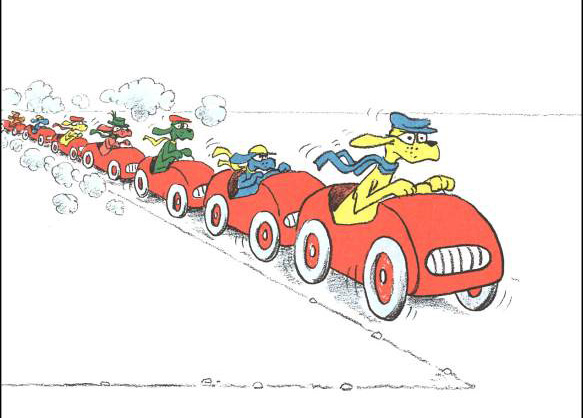
That on-foot-man.
That on-foot-man!
I do not like
that on-foot-man.
Do you like
to stop your car?
I do not like to,
on-foot-man
I do not like
to stop for you.
Would you stop for me
Here or there?
I won’t stop for you
here or there.
I won’t stop driving
anywhere.
I will not brake
and pause my plan.
I do not like to
on-foot-man.
Would you stop
outside my house?
Would you stop driving
for a mouse?
I will not stop
outside your house.
I won’t stop driving
for a mouse.
I won’t stop driving
here or there.
I don’t like stopping
anywhere.
I don’t like slowing my car’s plan.
I don’t like stopping, on-foot-man.
Would you stop for me
in a crosswalk?
Would you stop for me
at mid-block?
Not in crosswalk
Not at mid-block.
Not by your house.
Not for a mouse.
I won’t stop driving
here or there.
I don’t like stopping
anywhere.
I don’t like slowing my car’s plan.
I don’t like stopping, on-foot-man. Would you? Could you?
in a car?
Please wait for me!
It's not that far.
I would not,
could not,
in a car.
You might like stopping.
You will see.
You might like stopping
by this tree.
I would not, could not by a tree.
Not in a car! You let me be.
I don’t like stopping at crosswalk
I don’t like stopping at mid-block
I don’t like stopping by your house
I don’t like stopping for a mouse
I don’t like stopping here or there.
I don’t like stopping anywhere.
I don’t like slowing my car’s plan.
I don’t like stopping, on-foot-man.
A train! A train!
A train! A train!
Could you, would you
for a train?
Not for a train! Not by a tree!
Not in a car! Man! Let me be!
I would not, could not, at crosswalk.
I could not, would not, at mid-block.
I won’t stop driving for a mouse
I won’t stop driving by your house.
I don’t like stopping here or there.
I don’t like stopping anywhere.
I don’t like slowing my car’s plan.
I don’t like stopping, on-foot-man. Say!
In the dark?
Here in the dark!
Would you, could you, in the dark?
I would not, could not,
in the dark.
Would you, could you,
in the rain?
I would not, could not, in the rain.
Not in the dark. Not for a train,
Not in a car, Not by a tree.
I don’t like stopping, Man, you see.
Not by a house. Not at crosswalk.
Not with a mouse. Not at mid-block.
I won’t stop for you here or there.
I won’t stop for you anywhere!
You do not like
to stop your car?
I do not
like to,
it's too far.
Could you for a
parade float?
I would not for a
parade float!
Would you, could you,
for a boat?
I could not, would not, for a boat.
I will not for a parade float.
I won’t stop for you in the rain.
I won’t stop for you on a train.
Not in the dark! Not by a tree!
Not in a car! You let me be!
I don’t like stopping at crosswalk.
I don’t like stopping at mid-block.
I won’t stop for you by your house.
I don’t like stopping for a mouse.
I don’t like stopping here or there.
I won’t stop for you ANYWHERE!
I do not like
to pause my plan!
I won’t stop for you,
on-foot-man.
You don’t like stopping.
SO you say.
But try it! Try it!
And you may.
Try it and you may I say.
Man!
If you will let me be,
I will try it.
You will see.
Say!
I don’t mind to pause my plan!
I don’t mind stopping on-foot-man!
I will stop for you in a boat!
And I will stop for a parade float....
And I’ll stop for you in the rain.
And in the dark. And for a train.
And in a car. And by a tree.
It feels so good, so good you see!
So I’ll stop for you at crosswalk.
And I’ll stop for you at mid-block.
And I will stop before a house.
I’ll even stop for a tiny mouse.
I stop for you here and there.
Say! I’ll stop for you ANYWHERE!
I do so like
to wait for you!
Thank you!
Thank you,
On-foot-man.
I tend to read my “back to the city” trendpieces with a great deal of salt. You know the kind I mean. A magazine or newspaper will pick up on some bit of urban culture, splat a condo or café on the cover, and say something like, “Are cities the new suburbs?” The piece will make various claims about a glowing urban future for the US of America, and say that “kids today” are leaving the suburbs behind and willingly riding the bus.
The problem with these kinds of articles is that they’re not really supported by reality. Sure, New York and San Francisco exist. And sure, there are new condos in most cities, in some important places. And of course, young people who live in cities are cool. (Guilty!)
But I’ve been reading about the return to the city for years, and in all that time, the vast majority of urban growth has continued to happen out in the suburbs. In all that time, the populations of most older US cities has grown (if at all) by only tiny percentages. (See this MPR piece, underwhelmingly titled, "Minneapolis and St Paul populations up slightly.") In a way, 'back to the city' narratives only help young urban professionals (YUPPIES!) feel more self-satisfied, while blinding them to the sprawling reality continually oozing past our beltways. It’s like a parlor trick. "Hey! Wow! Cities are bright and shiny and distracting," these magazines say. Meanwhile, culs-de-sac’d McMansions spread like an incurable infection, orbiting ever newer bigger boxes on the far asteroid belts of America.
"The Cheapest Generation"
I mention this because I recently read one of these trendy tales, and I almost started believing it. As a cheap bastard, The Atlantic Monthly bit with the above title made me smile. It made me proud to be a so-called “millenial,” someone whose most valuable possessions are his laptop and his bicycle.
The piece, which you should read for yourself, attempts to make the case that kids today are more interested in bikes, smart phones, and urban living than in buying cars and houses. The authors include a few illustrative anecdotes, including an wonderful story of Detroit auto executives struggling to sell shiny new cars to young people entirely uninterested in them. As someone who has long loathed car commercials, reading this filled me with the kind of vindictive schadenfreude you can only buy in back alleys in East Berlin.
My hallucinatory high hit me like a flashmob. Visions of Amsterdam on the Mississippi flooded my eyeballs: bikes and cafés and downtowns without stoplights. A housing collective fantasy muffled my brain like an Ikea pillow. Artist lofts were flying threw the air in exactly the way that bricks don’t. I slumped into my chair, and my head hit my stack of architecture books. A dark pool of détournement opened up before me, and I jumped in.
I don’t know how long I was out. My cat woke me when it sneezed all over my face. Rem Koolhaas was covered in drool. As I wiped the feline snot from my cheek, I realized my triumph was but a fantasy. I looked around and saw that I was back in St Paul, and the suburbs were all around me, their immense atomized population and purple political clout stretching past the horizon. I was alone.
My eyes returned to the Atlantic article before me, and I scoured it for any actual statistical data. As it turned out, most of the “trends” in the piece were tied to the current economic recession. The only pre-recession statistic had to do with teen driving: “Even the proportion of teenagers with a license fell, by 28 percent, between 1998 and 2008.” The rest of the article was either a stat about the bad economy, or an anecdote about a realtor, a car commercial, or the growth of Zipcar. With a sigh, I resumed my normal pose, a Quixotic urban defensive posture that vaguely resembles beginner-level epée fencing.
Economy or Society?
Still, maybe there is hope. The post-housing bubble landscape is decidedly different. Gas is expensive. Almost everyone I know has massive loans. Does it really matter if young people aren’t buying cars because they don’t want to, or because they can’t afford it? (Today's front page Star Tribune report, "slow economy puts young lives on hold," is yet another example of this change, except that instead of "lives" it should read, "car and home purchases.")
Maybe it doesn’t matter in the end. There are fundamental changes afoot, and it makes no difference whether they’re driven by a smart phone fetish or a Visa bill. (It’s like asking the proverbial David Brooksian question about whether people buy American-dream large suburban homes because they really like them, or because that’s the only choice.) It's a chicken and an egg, a complex entanglement of individual and society. Our economic landscape largely determines which social trends can emerge. It provides the kinds of potential freedoms that evolve into desire. And we shape our economy by continually re-making the patterns of everyday life. If our 20th century mode of living has become too expensive to continue, then both our culture and our economy need to change.
Barring the emergence of another magical money-printing, subprime-loan-addled housing bubble, we I doubt we'll return to the ‘everyone buy a house’ era anytime soon. And frankly, that's a relief because the new, less auto-centric future bodes well for our core cities. Kids today today want walkable, bikeable, busable, rentable places where they can lead cheap lifestyles. They want apartments in neighborhoods with lots of people around them, places that correspond better to an uncertain economy and a short-term career than a three-car garage with a 30-year mortgage out on the edge of town. And despite the best efforts of new urbanists, the only places where you’re going to find that kind of environment is in our core cities, places like Minneapolis and St Paul proper (and OK, maybe Richfield). You need cities with street grids and sidewalks and working transit and mixed-use neighborhood corners. Sorry Golden Valley.
“Kids Today,” or Why Local Density Battles Matter
There’s only one problem. Our core cities don’t seem to be too excited about kids today. Time after time, St Paul and Minneapolis drag their heels into their young urban future. Examples of local neighborhood groups waging successful battles against density or bikes fill my memory like Easter Island moai. A truncated list includes St Paul bike boulevards, which were the scene of protracted battles resembling The Somme. A very reasonable condo project in Linden Hills bit the dust. Density along the LRT line is met with frowns. The west end of Grand Avenue is on its way to being cryogenically frozen like Walt Disney's corpse. Sidewalk cafés are a scourge. The list goes on and on.
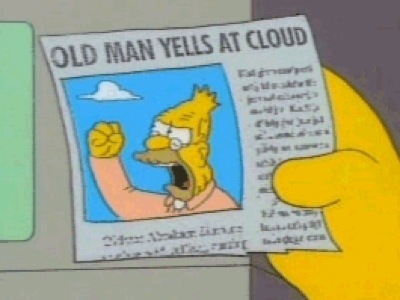
“Hey kid, get off my lawn,” our cities seem to be yelling while clutching a plastic rake and slowly shaking a pale fist.
[Clint Eastwood is a raving loony.]
I don’t want to say that all of these neighbor concerns are wrong. They’re people’s actual opinions, and cities should respect them. Nimbys are people too. Sure, I might try to convince you that you're wrong about density and parking and liquor stores and patios and sidewalks... but I'm not going to take away your right to vote or anything.
Maybe the problem is more about process. There was a Minnpost article recently about the composition of city commissions in Minneapolis. For these groups:
In Minneapolis, about 50 percent of the households are rental, yet nearly 90 percent of those serving on boards and commissions are homeowners.
Another measure of diversity is seen in income levels. The median household income in Minneapolis is $46,508 a year. About 20 percent of current members have household incomes at or below that median, with the remaining 80 percent above the median.
That’s the problem in a nutshell. If everyone involved in planning processes are home owners, but half
the city is renting, what kinds of bias are we dealing with? What kinds
of assumptions are cities making about "quality of life," or the need for
parking, or density?
Young people, and renters in general (e.g. poor people, people of color, people with families, anyone who doesn't speak English) are not part of the process. Their voices aren’t heard at city hall, and for any debate about a new project the voices of homeowners easily drown out anyone else. It means that anytime
there’s a debate about density or sidewalk cafés or better transit,
you’re playing with a loaded deck. One side of the conversation gets a microphone, a PA system, and a professional audio technician; the other side is sick in bed with laryngitis and a slight hangover.
Maybe we need to have spots on city
commissions and neighborhood groups reserved for renters,
affirmative-action style. Maybe we need a YIMBY app. I’d like to see Minneapolis and St Paul reach out more to young people on the internet and on the streets. I’d like to see more ‘block party’ organizing, where we bring city conversations to streets instead of the other way around. We need to enroll public artists in brainstorming, and cities need to value this kind of input just as much as they value irate comments at a community meeting.
That’s why I get excited about things like placemaking, public art, or the upcoming Park(ing) day. (It's tomorrow!) It’s not just because art is cool, or because I like sidewalks. It’s because these kinds of efforts address a huge problem in our public process, in our urban democracy. They allow us to plan and experience cities in a way that isn’t just about maintaining lawn and order. They tap into desire for vital, vibrant urban space filled with people and activity and uncertainty and (yes) free wireless internet. Like it or not, the future will be cheap.
A friend of mine has been emailing folks about the weather and climate for years. He’s very good at it. Most every time a storm of flood or heat wave or cold snap rolls through the upper Midwest, he drafts an engaging, understandable explanation of the underlying climatic forces, compares different weather prediction models, or makes dubious predictions about the near future.
Plus, he’s funny. Here’s a recent bit of his work detailing a danger of heat waves:
Hot weather is bad enough, but accidentally killing your or child(ren) or pet(s) would pretty much sap the joy out of the rest of your life. So, do not leave any living creature unattended in cars in the sunshine, even with the windows down. Research has shown (and isn't it incredible that someone had to do research on this?) that cracking the windows 1.5 inches only very slightly delays the temperature increase and does not decrease the final internal temperature. Do not try to outsmart the system by leaving the car running and the AC on; a whole bunch of happy toddlers were killed this way in 2006 when the car overheated, died, and the inside temperature rose to about 160 degrees.
Also, do not be misled into thinking this is a hot-weather phenomenon. The deadly ingredient is sunshine, and not outside temperatures. Even with temperatures in the 70s, a car in bright sunshine can easily get into the 120s.
The following protocol should be followed if you see innocent and/or helpless living things inside hot cars. By the way, Minnesota and Wisconsin have no laws on the books for children, so you are sort of in vigilante mode. But you want to be this kind of vigilante.
1. Call 911 and make a very thorough report, then,
2. break window farthest from child/pet
3. remove child/pet from vehicle; wait for emergency personnel.
4. Break remaining windows for consistency and thoroughness
5. (optional) lift knee and drive heel firmly into groin of vehicle owner
[The scene in Karate Kid where Mister Miyagi and Kreese team up to save two kids from being trapped in hot cars.]
I’d forgotten that it’s not uncommon for people to leave their children (and pets) in cars and kill them in this way. But yes, in America, this happens all the time. According to the intriguingly named nonprofit, Kids and Cars, the US average number of children baked inside automobiles each year is thirty-eight. (They also attempt to raise awareness about kids being run over by cars, backed over by cars, crushed by car windows, or locked in car trunks.)
Wow. It’s another unintended consequence of our automobile society. I’d imagine that most of these incidents occur because people drive everywhere, because the automobile has become such a part of our lives that we almost take them for granted. We forget that they're actually quite dangerous, and not just to the people being run down in the crosswalk. Just like guns, cars can easily harm the people using them.
[Baby on board.]
How much of this is because of people leading busy, car-dependent lives? How much is a result of attempting to do too much with the automobile? I picture someone looking for a parking spot, getting frustrated, and leaving their car running with a kid inside while they do an errand. I picture an over-worked somebody multitasking while driving, running five errands and accidentally baking their children.
Well, let's imagine an alternative. One of the big differences between car culture and an urban street culture concerns private and public space. On sidewalks, streets, and buses you're out in public most of the time. On other hand, when you drive everywhere you're in inaccessible private space. In cars, people are pretty much left alone.
In streets, while you might see some pretty bad parenting, you don’t have people locking their children up and roasting them. It’s literally impossible to confine a creature in a hot space while walking (though those kid leashes do make one think). Nobody would leave their child or dog locked to a bicycle.
As I’ve been documenting for years, people can very easily tie up a dog on a parking meter or railing while they run a quick errand. On the sidewalk, there are plenty of eyes on the street, people that will watch you and make sure you don't accidentally roast your child like an eggplant. On a sidewalk, you’re in public space and a passerby feels somewhat responsible for things that happen there. A car in a parking lot, on the other hand, is a private space and a private situation. Intervening in that case to save the life of a child or dog requires vigilante heroism.
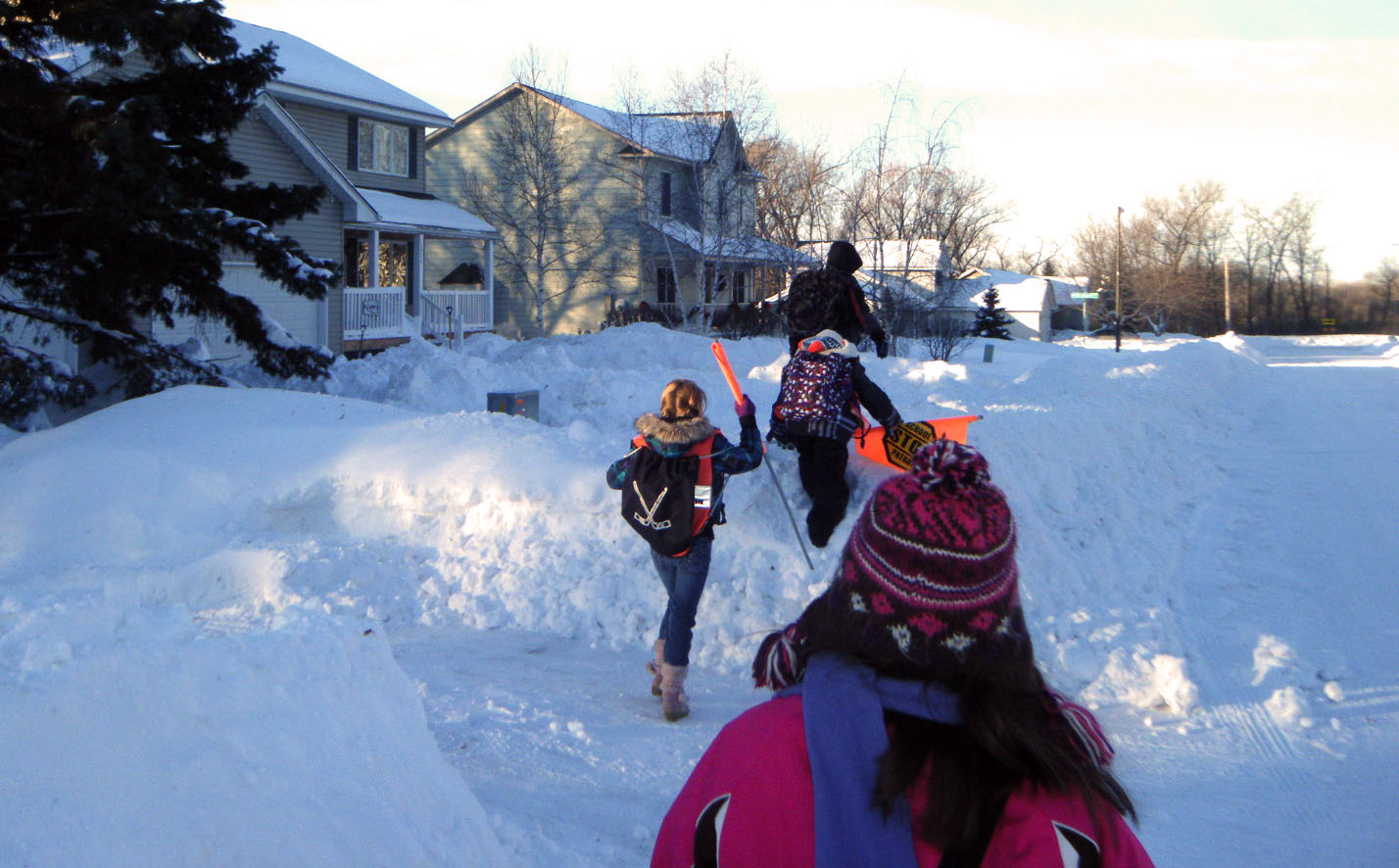
[Walking to school on the "sidewalk", or mountain climbing?]
All too occasionally on this insignificant sidewalk blog, I receive letters from readers with questions about important matters of the day, issues that range the entire gamut all the way from sidewalk history, to sidewalk graffiti, to types of sidewalk materials!
Needless to say, I find these queries tremendously exciting. Feedback of any kind always makes me giddy.
At the same time, I’m inevitably disappointed with my responses to these kinds of questions, for the simple reason that, to tell the truth, I don’t know very much about sidewalks! Sure, I can blather on about the joys of walking or random curiosities, and thanks to my very expensive education, I can use words with many syllables. But I know next to nothing about actual sidewalks. You might say, I lack concrete knowledge.
That said, I got a letter the other day from a frustrated citizen of a second-ring Twin Cities’ suburb [Hint: it’s in Ramsey County] who expressed frustration about the lack of shoveled sidewalks in his neighborhood.
Here’s a version what the reader wrote to his local civic code enforcer, with all nouns removed to protect the innocent: [Extra fun game: insert your local nouns and create a Madlibs sidewalk complaint!]
I am very concerned about the lack of snow removal on the part of property owners along [street name], specifically between [street name] and [name of local elementary school]. [Name of city] removes "significant snowfall" along this corridor which we greatly appreciate. It's the nuisance snow which property owners neglect to clear in a timely manner. This snow becomes compacted and glazed over with ice becoming extremely treacherous. In my opinion they are in violation of [number of city code].
My wife has walked our kids to school over the past few days and there are sections of glare ice where they had to walk like "penguins" for lack of a better description. This section is heavily used by the [name of elementary school] walk line as well.
I'm not one to nit-pick, but when this happens time and again it's ridiculous. A majority of home owners do their part which we're very grateful for, but it's the following owners which create problems time and again.
In response, the code enforcer wrote that “citizens are not required to remove snow from the sidewalk” and that “we recommend it, but its not required.” Needless to say, this didn’t please my correspondent!
Even on the best of Twin Cities’ sidewalks, winter maintenance is no easy task. For people with mobility issues – especially the young, the elderly, and the disabled – getting around in the wintertime can be a huge challenge!
[A person in a wheelchair
choosing to go the wrong way on the street instead of onto the sidewalk
in Minneapolis' SE Como neighborhood.]
But the issue is compounded many times over in the suburbs, which often lack sidewalks altogether. Or if they do have them, they’re almost completely pointless because they lack accessible, nearby destinations. We have an almost impossible task ahead of us lot of work to do if we want to make our suburban neighborhoods walkable, but it would seem to me that requiring snow shoveling could be some “low hanging fruit.” (As added benefits, people would get much needed exercise, boost the snow shovel supplying parts our economy, and maybe even meet their neighbors over a good round of kvetching.)
All this is to say that I turn to you, brave readers. What, if any, are the rules for shoveling sidewalks in the suburbs? Does anyone enforce them? Would it matter if they did? Is there any hope for the wintry suburban pedestrian?
Maybe the only solutions are to either learn to enjoy walking like a penguin, or else to move to Minneapolis, where they only recently enacted a new sidewalk snow shoveling law with teeth.
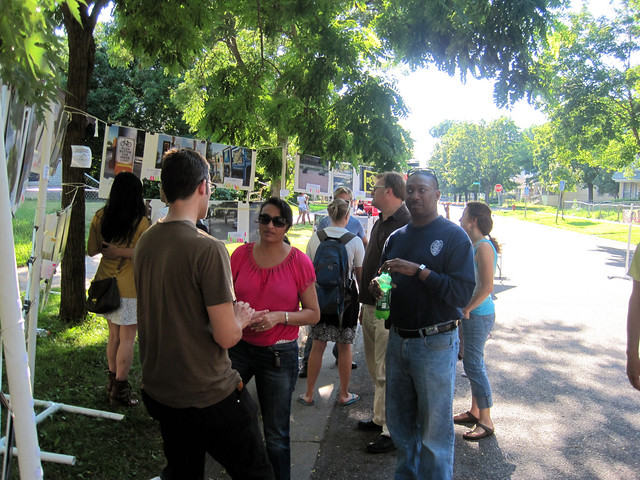
[People staring off into the distance as I point at the sun. All photos courtesy of Molly P. Thanks Molly!]
Well, I’m happy to report that the first official Twin City Sidewalks-led sidewalk tour of Minneapolis was an uproarious success. Turnout vastly exceeded expectations, and a good time was had by all.
I want to first thank all those who made the tour possible. Thanks to the kind folks at the Soap Factory and the Common Room, particularly Andy Sturdevant and Sergio Vucci who were crazy enough to invite me to lead a tour and provided me with both guidance and valuable psychogeographic bingo card-making skills. Judith Martin was, as always, generous with her time, meeting with me in her office to share some Nicollet Island stories. Thanks to Mike Brauer for his precious alleyway lore. I owe huge debts to Larry Millet’s invaluable AIA Guide to the Twin Cities (the origin of the majority of my facts) and Greg Brick’s literary historical excavations. Valentine Cadieux deserves thanks for introducing me to such a great group of people. And finally, thanks to Owen for co-leading the tour with me. Next time it’s on you, kid.
But more importantly, I want to thank the Minneapolis weather. It was a perfect day for a walk about the city, and that may be one reason why far more people showed up to the Soap Factory that I was expecting. Initially, I’d hoped for about a dozen folks to show up, maybe a few more. But then the entire MFA program from Montana State appeared, as well as a good group of U of M geographers, my BURP crew, and many of my loyal long-time Twin Cities’ friends. And then a whole bunch of other folks that I’d never met before appeared. Families with children, folks of all ages, all kinds of people gathered to experience whatever it was I had to offer. It was magnificent and not a little frightening, but my vocal chords held up through the event. Props to everyone who took “five steps forward” when asked.
[The planned route of the tour. I ended up cutting some corners along the way due to time.]
The tour began in the Soap Factory’s back yard, among the tall grass, abandoned train tracks, and the back sides of the old Pillsbury mills. There, as is my pedagogical wont, we talked vaguely about the nature of sidewalks. And after a short and largely failed interrogative exercise, I defined sidewalks for everyone. It went something like this: a sidewalk is “public space useful for moving between places.” Or, more intriguingly, a sidewalk is “the corona that surrounds movement.” At which point, intentionally obfuscating the issue, I explained how “many things that are sidewalks are not sidewalks, and many things that are not sidewalks are sidewalks.”
And with that made clear, we ventured off across the river. We stopped at the junction of the Metal-Matic factory and the Stone Arch Flats apartments, where my friend the ex-Cleveland urbanist Steven Gross told a story about living in the strangely industrial condominium complex.
[Standing on the old rail tracks under the Milwaukee Road Depot cum parking lot.]
[Under the cathedralesque arches where Nicollet Avenue ought to be in the old Gateway Park.]
We then delved deeper into the downtown core to examine the old Milwaukee Road depot, before proceeding to the underside of certain skyways. Following a lengthy and failed attempt to actually enter the longest skyway in Minneapolis (thanks for trying Valentine!), we went to the “plaza” underneath the entrance of the ING building, where I tried to resurrect the essence of old Gateway Park.
Next our brave tour traversed the traffic-laden crosswalks across Hennepin Avenue, and entered the vast alleyway jungle of the Warehouse District to emerge at the wonderful treasure that is the alley behind the One on One Bike Studio where my bicycle messenger comrades were happily loitering (as per usual).
[Owen and I addressing the public in the One-on-One alleyway.]
At this point the tour became slightly more Situationist, as I led the entire group down a tempting desire path that inadvertently took everyone across the freeway on- and off-ramps for I-394. (Curse you, I-394!) And so we wandered through the alleys, stopping briefly to admire the beautiful Commutator Building, before heading down the Cedar Lake Extension to check out the old foundations underneath the Hennepin Avenue Bridge.
[People heading down the desire path.]
[A large group of people attempting to cross the freeway at the beginning of I-394.]
Finally, as the sun was going down and the mosquitoes were rabidly descending, we went onto Nicollet Island where I talked about how close the beautiful island had come to being razed and turned into a freeway. Then we, at long last, returned to St. Anthony and its lovely Main Street to admire its two failed urban renewal projects and its many beautifully restored ancient factories.
And so the tour was complete, many folks retreating to their homes, many others enjoying a few drinks at Vic’s (which was the only place large enough to seat us all). Thanks for the champagne, Janaki. And thanks to everyone for coming out. I’ve rarely enjoyed myself so much!
[Stopping to feed the mosquitoes on Nicollet Island.]
[The end of the tour, facing the neon lights of Main Street.]
PS. There are more Common Room tours each of the next two Wednesdays. Come along for the Smell-o-tour or the Wish List tour. Meet up at 6:30 at the Soap Factory. You probably won't regret it!