Showing posts with label environment. Show all posts

2015-09-28

Rest Assured that Car Culture Will Not Go Gently to the Grave


This car commercial caught my eye this weekend. Here’s the transcript:
[Menacing male voice.] We don’t have to worry about predators like our ancestors did.

No saber tooth tigers stalking from the brush. No dire wolves circling the camp.

There are no more monsters to fear... And so we have to build our own.

The commercial is a Dodge, and I mean that in the most dual sense of the word.

Yet the metaphor is apt, as cars are increasingly becoming a simple transportation technology. In today’s congested wired cities, many younger people no longer view cars as an intensely personal thing. Most simply buy cars because “they work” (hello Honda Fit!) and not for nostalgic or Freudian reasons. The affect of the automobile is evacuating.

And this places car companies in a situation where they have to create their own justification, invoke their own monsters. They have to sell people on driving as excess. And for many machines, invoking auto desire is a desperate affair. They can’t peddle the growl.

Cars as Class Performance

[Not GM, but Imperial.]
In a sense, this is nothing new.

Car makers in general, and General Motors most of all, have long understood that the lure of the automobile goes far beyond simple transportation. The appeal of the automobile is affect: the feel of leather, the growl of an engine, the techno glow of the dash, the curves of the fender.

Here’s an article by sociologist David Gartman called "Three Ages of the Automobile: the Cultural Logics of the Car," which describes the relationship between GM and (French sociologist Pierre Bourdieus’ theory of) class distinction:
General Motors head Alfred Sloan sensed the emergence of what he called this ‘mass-class market’ in the mid-1920s, arguing that many buyers were now willing to pay a bit more for a car beyond basic transportation. His corporation began to compete with Ford’s Model T by creating mass-produced cars with the superficial style of the luxury classics. One of the most successful of these was the 1927 La Salle, a smaller, cheaper model of the corporation’s luxury car, Cadillac. Unlike the craft-built Cadillac, the La Salle was mass produced to lower its price. But to borrow the prestige of the nameplate, Sloan wanted the car to have the look of handcrafted luxury. To design this ‘imitation Cadillac’, he hired a Hollywood coachbuilder, Harley Earl, who created custom bodies for the movies and their stars. Earl was so successful in capturing the superficial look of unity and integrity for the mass-produced La Salle that he was hired by Sloan to do the same thing for the entire line of GM cars. In 1927 Earl joined General Motors as the head of the new Art and Color Section, later to be renamed Styling.
[…] The working class also wanted to appear distinctive and superior and, given the chance, imitated the goods of the bourgeoisie to do so. Workers may have initially consumed simple, functional cars because they could afford nothing else, not because they had an ingrained taste for them. The rising incomes of American workers during the 1920s, however, allowed them to abandon these goods and demand cars with style, thus entering the game of distinction for the first time.
A glance at a classic car convention reveals that the “golden age” of the American auto is synonymous with the pioneering GM car/class hierarchy, when the difference between a ’58 and a ’59 Chrysler was both everything and nothing. But today, the brands are mothballed; only four remain. (And really, how much longer can Buick last?) The symbolism and meaning of the American car has been replaced by functionality — and even there, with the on-board wi-fi, the “foot-actuated trunk”, and a wide variety of other gimmicks — car companies seem increasingly desperate to generate distinction.

Face it: cars are elaborate expensive toasters.

Deception and Desperation
 
[Truck Viagra.]
And in this vacuous space, lies have been breeding. The new car smell is toxic, and even something as simple as the roar of an engine turns out to be amplified and recorded, just like the bell of a light rail train. Worst of all is the Volkswagen scandal, where the advance and wonder of German technology is employed not to save humanity, but to deceive it.

The fraud flies in the face of the techno-environmental narrative, where state-led liberal good governance somehow survives the apocalyptic onslaught of Congressional politics. The story suggests a seamless transition out from the auto age: CAFE standards will rise, cars will shrink, corporations will turn over new Nissan Leafs, and slowly but surely we will evolve from the stink of everyday driving.

[CAFE plans.]

But that’s not the reality on the new car lots of the ring road, where automobiles and hucksterism have long been synonymous. Instead of Jerry Lundegaard’s “trucoat”, today’s cars are cloaked in lies, from EPA ratings to gas tax politics.

The most disturbing part of the VW story is that this kind of cheating might be commonplace. The second-largest car company is surely not the only one to flout the letter and intention of the law.

This is from The Guardian:

Max Warburton, an analyst at the financial research group Bernstein, said: “There is no way to put an optimistic spin on this – this is really serious.”

A British expert in low-emission vehicles claimed the manipulation of air pollution data could be “very widespread” and that tests in Europe are “much more open to this sort of abuse”.

Greg Archer, a former government adviser and head of clean vehicles at the respected Transport & Environment thinktank, said: “I am not surprised. There has been a lot of anecdotal evidence about carmakers using these defeat devices. All credit to the EPA for investigating and finding the truth.”

Archer, the former managing director of the UK’s Low Carbon Vehicle Partnership and non-executive director for the government’s Renewable Fuels Agency, said the scandal could spread into petrol cars and CO2 levels. “It is probably not limited to diesel and not limited to emissions,” he added.

Car culture is so central to the economic networks of the mid-20th century, the freeways, suburbs, gasoline, and automobile companies that are no stranger to corruption. How can you reconcile the death of fossil fuels with the life of the automobile?

Cars are their own worst monster, and they will dodge on their last legs like a boxer on the ropes until the very end. No, cars will not go gently into that good night. They will lie, cheat, and growl their way to the grave.

[The emissions Volkswagen and the Back to the Future DeLorean.]

2014-05-06

Blank Walls of Saint Paul #1

Given current momentums, the blank walls will continue to spread, even in the most exemplary of cities. Such as Saint Paul, Minnesota. It is the blank-wall capital of the United States. You would not expect it to be. It is a most habitable, attractive, and friendly city; it has one of the most resourceful and effective mayors in the country; its Lowertown redevelopment is of an eminently human scale and has a fine street presence.

[Blank wall, 4th Street.]


 [Blank wall, 4th Street.]
 [Blank wall, 4th Street.]
[Blank wall, 5th Street.]


[Blank wall, 6th Street.]


[Blank wall, 7th Street.]


 [Blank Wall, Kellogg Boulevard.]


[Blank wall, Minnesota Street.]


[Blank wall, Minnesota Street.] 


 [Blank wall, Minnesota Street.]


[Blank wall, old 7th Street.]


[Blank wall, Saint Peter Street.] 


[Blank wall, 5th Street.]

2012-10-17

Cities and Inner Life

[Young's work involves performative walking.]
A few weeks ago, I found myself at an all-day retreat meeting in downtown St Paul to discuss the city’s forthcoming Complete Streets Manual. It was early in the morning, the room was full, and everyone was drinking coffee. We began the meeting by going around the room introducing ourselves. Each person in attendance stood up and described who we were, and what our interests were.

As it turned out, I found myself sitting next to Marcus Young, the official artist-in-residence for the city of St Paul. I've long been a fan of Young's work, and consider him one our keenest thinkers about the connection between cities and art. Marcus was the brains behind St Paul’s inexpensive and innovative sidewalk poetry program, and his other work involves things like performative walking and public art. At any rate, Marcus stood up, introduced himself as the city’s artist-in-residence, and said he was interested in “the intersection of environment, behavior, and inner life.”

Maybe I was too sleepy, but I thought little of it at the time. We went on through the meeting, which lasted pretty much all day and involved a lot of brainstorming about things like the MUTCD (eeek) and different kinds of design manuals. By 5:00, everybody was both encouraged about, and weary of, urban design.

Later that day, when I was chatting with Young about the meeting, he asked me a question. During the meeting, one of the moderators had made a reference to Young’s stated  interests.  Curiously, when described them, he removed the term “inner life” from list. He said something like, “I too am very interested in the relationship between environment and behavior.” “Why,” Marcus asked me later, “was nobody interested in having a discussion about inner life?"


Planning's Determinist Legacy

[For reformers like Riis, slums bred vice.]
Young’s question got me thinking about urban professions. Planners, architects, and designers are generally agnostic about inner life. They have almost nothing to say about how spaces affect our emotional well being. Meanwhile, artists like Young are eager to link space and the self. They believe that how we move about the city, and what kind of space we inhabit, has a profound effect. Whether we walk or drive, and what kind of homes we have, changes our ability to think about the world. Consider the connection between walking and thinking, between getting lost in thought and wandering the city.  Consider the connections between contemplation and public space. (Rebecca Solinit’s two books about walking make for an encyclopedic guide to this relationship.) In short, our physical spaces provide us with mental space. Our streets deeply affect how we understand ourselves, and how we relate to each other as a society. Environment, behavior, and inner life become almost inseparable.

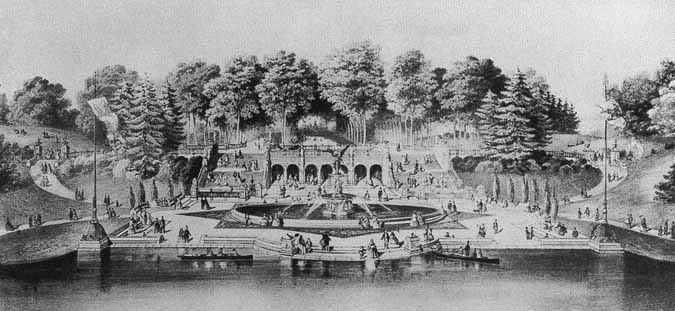
For architects, planners, and urban designers, however, the connection between inner life and environment is nowhere to be found. Today, these disciplines have nothing to say about how spaces affect our thoughts. There are lots of reasons for this curious omission, mostly having to do with politics, power, and the long history of connecting space to morality. For example, the early history of US city planning traces its roots back to the urban reform movement in late 19th century cities. At that time, huge teeming slums were synonymous with immigrants. Page through a book like Jacob Riis’s How the Other Half Lives, and you quickly see that there was little distinction made between substandard housing and crime LINK. At that time, the connection between environment and inner life was quite clear: slums bred immorality. The way to reform the city was to build better buildings, to inspire dirty and densely packed immigrants to embrace temperance and respect for the state through classical architecture, grand boulevards, and bucolic Olmsted-ian parks.

[Olmsted's Central Park was a moral project, as much as anything else.]
Over time, planning and architecture gradually left this kind of spatial determinism behind, turning to a more modernist ideal of space. Assumptions connecting environment and thoughts meant privileging certain (White, male, bourgeois) cultures over others. These attitudes were unabashedly racist and sexist, and reading them today is an exercise in atonement.  Instead, urban professions adopted the theoretical concept of the autonomous individual, the idea that human beings have an essential inner self that remains the same regardless of environment. In other words, we are always essentially the same person, no matter where we live. We have the same values and thoughts, no matter how the city is designed. Space doesn’t matter.

Today, planners and architects almost insist on this principle, refusing to suggest any link between environmental design and inner life. Linking them would be condemned as “social engineering,” probably the cardinal sin of planning. This insistence on the abstract external world mans that architecture might be considered beautiful, but it’s not inspiring. Cities might be liveable, but they’re not spiritual. Motivations for good urban design must always be described using abstract measures and external reasoning. Anytime designers cross this invisible barrier between outer world and inner self, they become visibly uncomfortable.

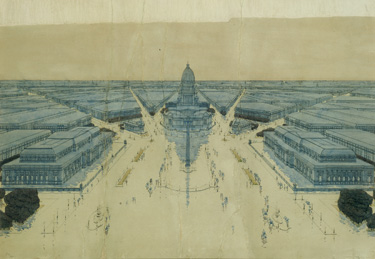
[Unlike Burnham's Chicago, planners and architects no longer explicitly conect cities to inner life.]

Inner Space: The Final Frontier


This attitude is unfortunate. Of course there's a connection between environment and inner life. Our spaces make us who we are. By insisting on abstract concepts devoid of feeling, cities are lose some of their most compelling justifications. There is something very important about walking that isn’t just about exercise or environmentalism. Walking is much more than that. It allows people space for contemplation, opportunity to experience the wind and the sun and the stars. There is something crucial about living amidst other people in a community, about having public spaces that bring represent our shared future. My point here is that inner life is a key element often missing from conversations about urban design, because of the desire to avoid political or deterministic assumptions.

It would be nice if there was some way to talk about the connection between environment and inner life without turning into a 20th century moralist. Words and concepts like “place,” “community,” and “quality of life” can point toward the conversation, but don’t really get us there. Maybe this is a role for artists. How do we begin to talk about how spaces make us feel, and why this is important? I don’t know, but stamping poetry into the sidewalk is probably a good start.

[Tonight in the dark kitchen only the stainless steel sink holds the moon.]

2011-06-21

Twin City Public Character #1: Michael Gould, mayoral candidate who spends each day shirtless on the Northrup Mall

[Grassroots mayoral candidate and free speech practitioner Michel Gould playing his guitar.]


INTERVIEW IV


[A bright sunny humid morning, the kind of morning where the air tastes a hint of impending drama, the sun shining down onto a large manicured mall of a large urban university campus in a middle sized midwestern city in the summertime. Few people walk the wide sidewalks leading past the imposing pillar'd buildings.

MICHAEL GOULD, a shirtless man stands on a chair in bright white pants. The bright sun glints off the pants, and shines brightly off his dyed blonde hair as he stands on a metal chair holding a bible and reading loudly, directing his high-pitched voice at the large set of empty stairs before him. Behind him is a guitar case and a message board covered in fliers for events and music shows.


Gingerly placing aside his blue bicycle, TWIN CITY SIDEWALKS (TCS) approaches and asks for an interview. MICHAEL GOULD quickly agrees and TCS turns on the tape recorder, holding it up to the man perched on the chair.]


Michael Gould: [Leaning way in close to the microphone, speaking with an intentionally creepy almost ironic voice] My name is Michael Gould. I’m the mayor of Minneapolis!

[grin followed by a dramatic pause]
I’m not a “street person.” I was raised in Edina, Minnesota. I graduated from the same high school that Al Franken, Senator Al Franken, graduated from, Blake School. He graduated a little bit ahead of me. I graduated in 1976. One of my classmates name is “Chandler Polling.” He’s the keyboard player and vocalist for The Suburbs, a very popular punk rock band.

[Turning from the microphone and looking up] But what’s your name, who’s interviewing me?

Twin City Sidewalks: Bill Lindeke.

MG: Bill, alright. Nice to meet you Bill.

TCS: I’m a sidewalk blogger, a sidewalk philosopher is what I call myself.

MG: [with cheer] Allright, Bill. My brother is named Bill.

TCS: So I’m just curious about what brings you out here. Why are you here?

MG: [grinning] I’m here for the illicit sex…. [laughs] No I’m just kidding. [Adopting a tone eerily similar to Jack Nicholson playing the Joker in the first Batman movie.] I’m a family man. I’m a one woman man. I have three lovely daughters.

One of the reasons I’m running for mayor is because I’d like more access to more money. I feel that I’m ready to have a job with a salary, as opposed to working for $10 an hour.

TCS: [agreeably] OK, OK. So, is this part of your campaign, being out here on the mall today?

MG: Uh, usually I work my way through the book of Luke every day.

TCS: You come here every day then?

MG: Monday through Friday you can find me out here Bill. [sweeping his arm against the sky] Uh, let’s make a movie!

TCS: What hours? What hours are you out here?

MG: Usually between ten AM and four PM.

TCS: That’s a long shift!

MG: [laughs dramatically] Hahaha. It’s a gas! [laughs again]

TCS: [curiously] What do you mean by “it’s a gas”?

MG: Let me get my guitar. [gets guitar, plays] Is the microphone picking this up?

TCS: Yeah sure.

MG: [plays.] I’m not sure if Jim Morrison is still in style.

TCS: Man I remember that stuff. Well I wasn’t alive, but I listened to it growing up. I like the keyboard player, man.

MG: Ray Mansurak, yeah. One of the reasons The Doors are called The Doors is that it’s not only about the doors of perception, but there’s a term in music theory called the Dorian mode.

TCS: [knowingly] Yeah yeah.

MG: Ray Mansurak liked to use that mode a lot.

TCS: Sure he did. Kind of a minor key feeling.

MG: Come on baby light my fire. [pause] … Can I ask you Bill, are you a student?

TCS: Yeah, I’m a graduate student.

MG: All right, and what is your field of expertise?

TCS: [Not unpompously] Geography and urban space, public space in cities… My question for you man, is the tradition of speaking out on a public place. Are you aware about that and the history and speaker’s corner in London?

MG: Oh, Hubert Humphrey blah blah blah.

TCS: Oh I don’t know about him, I’m not talking about politicians, man, I’m talking about everyday people.

MG: Everyday People! By the band Sly and Family Stone!

OK, um, Bill, I want to say you know one of the things about this environment thing, I have four platforms for my campaign. Education! Environment! … I wanna make sure we save all the parkland of Minneapolis and we’re not giving any of the parkland away to any corporations. We need these parks to protect our sanity, you know.

TCS: How do they protect sanity?

MG: The green leaves of the tress! And the recreation that goes on, uh, um… See, I’m trying to remember the four ‘E’s. Um… equality! Equality is a myth in American society. Um, but since the advent of Barack Obama we’ve got chocolate in the white house. Um. I’m … I’m a supporter of Barak Hussein Obama, I’m gonna vote for him again in two thousand and fourteen or whenever it is.

Ah, I usually I tend to vote for Democratic presidents starting with Jimmy Carter in 1976. Jimmy Carter was a born again Christian! People sometimes forget that Martin Luther King he was not a Muslim he was a Christian.

Um, Bill Clinton, “slick willie!” God bless Monica Lewinski!

TCS: She needs all the blessings she can get now. I don’t know what she’s doing.

MG: [laughs suggestively] She can come be a part of my campaign any day of the week.

TCS: OK. You had three ‘E’s right. You have environment…

MG: The fourth ‘E’ is Eckankar…

TCS: Eckankar? “Sing hu”?!

MG: [jubliantly] Sing hu!

TCS: But how does that fit with the book of Luke, man?

MG: The book of Luke is … music! Music is magic. [strums guitar] I’m gonna tell you who my favorite guitarist is. I dig Prince a lot.

TCS: Yeah.

MG: But Prince is still alive so you can kinda compare your career to Prince and you can go, oh shit! I’ve never done anything, you know. But uh…

TCS: He’s… yeah man, that’s easy to do. There’s a lot of people you can compare yourself to like that, man.

MG: Yeah.

TCS: What about students? What do you think students think? Do they like you?

MG: [confidently] They love me! Yeah! … I don’t know if some of you remember some of the traveling preachers… the barnstorming preachers like Brother Chad. Uh… Have you met Brother Chad?

TCS: No, I don’t … I know Reverend Billy in New York. I’ve heard about him.

MG: OK. Well he seems, a big part of his thing is preaching against homosexuality. Which probably means he’s a latent homosexual himself! Uh…. [laughs]

TCS: It tends to be that… Isn’t that the case?

MG: [laughs] I’m all for love, ya know? And uh, God is love. So the whole fear of hell thing is, uh, um… I don’t really believe in an eternal Hell because how could a merciful God be torturing souls for such a long time?

TCS: Yeah yeah yeah [nodding]

MG: Hm, so um... [strums] I wrote this song, its called The Mountains of Minnesota. And I wanted to find a really dissonant chord to start off with so, um… I discovered this chord here, and I’ll give it to you full blast. [holds guitar to microphone]

TCS: [apologetically] I’m a terrible guitar player…

MG: It's gonna hurt your ears man! [strums a terribly dissonant chord four times]

TCS: That’s not uh, that’s…

MG: [keeps strumming, not badly either] The rest of the chords are pretty standard. It’s a G# something weird to an E to a D and to a B and, um, I, uh, let me tell you about a… I want to be the first mentally ill mayor of Minneapolis!

TCS: Its too late, man.

MG: [laughs]

TCS: Good luck with that one.

MG: RT, is he… ?

TCS: You have to be mentally ill to want to run for higher office.

MG: Jesse Ventura! … There was a mayor of Saint Paul back in the day, maybe the 70s, Oh darn I can’t remember his name, but uh, he wrestled a bear, for one thing.

TCS: Huh.

MG: I think his name was McCarty, or something. He had a little button in his car that could turn the lights from red to green.

TCS: Oh yeah? Hey, I got two more questions for you man. One of them is, what’s the weirdest thing that’s ever happened to you out here in the public space? That you had an encounter?

MG: Well, it was being arrested for spray-painting my name on the sidewalk.

TCS: Oh yeah?

MG: And I got a little free tour of Hennepin County jail for that.

TCS: Do cops ever give you crap in other ways?

MG: Actually, I have sort of a high respect for police officers, so usually I get off pretty easy. Uh uh uh… some call him “pig” [really drawn out] … but I’m not one of those people… uh… what would we do without… I joined the good side, you know, I joined the good side.

TCS: Hey the other question is why do you pick here, and why not somewhere else in Minneapolis?

MG: OK, uh, well I do kinda rotate between here and the Nicollet Mall. but I see a lot of my friends out here and I make new friends, man… [pause] Let’s make a movie!

TCS: OK, well, hm, I’m not really ready to do that.

MG: Think of a title!

TCS: What would the title of the movie be? Actually, good question!

MG: Let me see, say uh… [dramatic pause] “Jesus Returns!” [triumphantly]

TCS: [laughs] That’ll be very much controversial, I believe... All right man, well, take care.

MG: Thank you, Bill. You brightened up my day. [shouts to me] You can use that in any way you want to…

TCS: I’ll put it on the web, put it on the web.

MG: …I’m just a fictional character!

[And TWIN CITY SIDEWALKS walks away, heading for his office in an anonymous modernist office tower, leaving MICHAEL GOULD on his chair playing the guitar and preaching to nobody and everybody.]

[A passer by approaches.]

2011-02-16

Putting Food on the Sidewalk with the Sisters' Camelot

I have a new piece up over at Twin Cities' Runoff, a great new online magazine, about the Sisters' Camelot. They're a wonderful nonprofit that picks up free food and delivers it to street corners in poor neighborhoods throughout the Twin Cities. Its a magic thing to see and be a part of, as the look of joy on people's faces as they come across this colorful mountain of free vegetables put out on the sidewalk is hard to top.

Here's a taste of the sidewalk scene:
Today the bus heads for one of the most reliable drop-off spots: the corner by the bus stop at Nicollet and Lake, across the street from the Kmart. Eric pulls the harlequin bus up to the wide sidewalk and almost instantly people start gathering round. Volunteers unload half the food onto the street, putting out a wooden sandwich board sign that reads “Free Organic Food” in English, Spanish, and Somali. The folks along Nicollet seem to be speaking a dozen languages as they wait patiently for volunteers to stack food along the street.

For the next two hours, the stream of people wandering past the corner are treated to armloads of free food, as much as each individual can carry. The tomatoes and grapes are the most popular. Smiles appear on faces almost without fail, and the whole scene feels like Christmas or a birthday party.

Check it out! I'm putting up a few more photos from my trip with them. (And thanks to Emily, Deborah, Valentine, Adria, Jerry, Heidi, Vinay, and Rob for all their help with the piece.)


2010-08-12

Hypothesized Air Conditioning Feedback Loops

#1. The more we use air conditioning, the more we close all windows.

Result: Breezes are for naught. Sounds of the city are unheard (e.g. ice cream man, church bells).

#2. The more we use air conditioning, the more sidewalks suck.

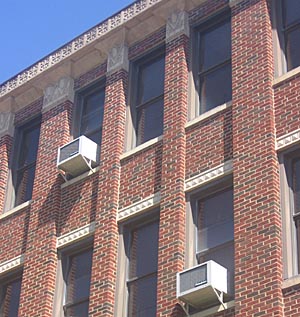
Result: Drips from air conditioners land on your head. Annoying and constant whirr from machine.

#3. The more we use air conditioning, the more people move to hot places.

Result: Huge population shift in the US to the sunbelt, living more and more in places where you can’t possibly survive without air conditioning.

Extra Result: More people use air conditioning. More people vote Republican?

#4. The more we use air conditioning, the less we design buildings that keep cool by themselves.

Result: Windows that do not open. Houses with no cross breezes. Fluorescent lighting. Modernist, shiny, reflective, and boring office towers.

Extra result: More need to use air conditioning. Cities increasingly "climate controlled".

#5. The more we use air conditioning, the more we get used to only one kind of environment.

Result: More separation between inside and outside. Stores that are kept super cold. Less temperature tolerance. Less flexible clothing. Increased whining tendency.

Extra Result: We don’t go outside as often. We don’t even know what its like out there.

#6. The more we use air conditioning, the more we use air conditioning.

Result: On cooler summer days, more likely to say ‘screw it’ and just keep the A/C on.

Extra result: We use more energy and electricity.

Extra extra result: Planet warms.

Extra extra extra result: Use more air conditioning.

2009-06-23

Plant Parts on Sidewalks #1

[Catalpa flowerpetals. North End, Saint Paul.]


[Cottonwood fluff. St. Anthony Main, Minneapolis.]


[Cottonwood fluff. North End, Saint Paul.]


[Some sort of flower petals on a bike path. I can't remember where this is, for some reason.]


[Maple parts. North End, Saint Paul.]


[Red berries and pink petals. Northeast, Minneapolis.]


[Catalpa Leaves. North End, Saint Paul.]

2009-02-11

The Sound of Wet Sidewalks


[The large bus loudly splashes dirty grey muck onto the sopping sidewalk.]


Walking around on sidewalks the other day in the wet rainy muck-a-muck, I felt generally melancholic. A malaise seemed to have sunk down on the Twin Cities, grey clouds and fog smothering good spirits like a soggy Koosh Ball.

It struck me as odd for the longest time until I realized something... my grey mood was all about sound!

All of a sudden, I noticed the effects of water on the roads. Exacerbated by the wind's persistent moan, the car tires were fingernails on my mental chalkboard. All the water, the pools of stormdrops lingering in city's gutters and streetpuddles, was a limitless amplifier for car tire acoustics. The persistent whirr and splash and high pitched hiss of traffic's white noise must be two or three times as loud during long rainy days, and it grates on the pedestrian's mind like a dentist's drill.

In other words, rain rain go away, you're making cars too loud for me!

It'd be one thing if there were rain puddles and sidewalks and a nice quiet street. In that case, you might hear the little drips and drops, the windchimes on porches, the spash of the occasional footboot landing mid-puddle, or the crazed shrieks of adolescent squirrels.

But walking down busy streets to hear the unceasing splash of infinite tires, throwing dirty water up into mid-walking calves... this is blasé, morose, and very depressing. I do not like what water does to sound, and as the sounds of streets moved from background to foreground, I longed for a bit of carless, careless quietude.

Yes, I longed for snow. Snow has the opposite effect on car noise. It deadens and quiets everything. Snow is like a big acoustic damper, hushing constant tires, and covering the world with peace and quiet. Maybe winter isn't so bad after all?

2008-12-29

Aminals on Sidewalks

This terrible story about the dog frozen to the sidewalk in Sheboygan, Wisconsin got me to thinking about how animals and sidewalks interact. A friend of mine once told me that the sign of a good neighborhood is lots of people walking their dog, and I think that's just about right. Dogs serve wonderful functions in community building, mostly because they get their owners out of the house with great regularity, forcing them outside and walking around on the sidewalks where they can look around at neighbors' yards, experience the freshitude of Minnesota air, and maybe even meet a few people that live near them. Which is why anyplace where people walk dogs (AND pick up their poo) is probably a good neighborhood. Dog parks, vet clinics, sidewalk trash cans, and doggie-treat-wielding shops all form these little symbiotic nexuses of interaction, working together to create neighborhood interdependence.

So its sad when a dog gets left outside, and has to rely on its morbid obesity to save its doggie skin.* Firstly, let me say to all you winter dog walkers: Get doggie booties! Take precautions!

Secondly, it made me want to share some photos of dogs on sidewalks, so that we don't start thinking that dogs and sidewalks cannot peacefully coexist.

When I traveled to Berlin, Germany a few years ago I was amazed at how many well-behaved dogs I saw in public places in the city. It seemed everyone had a dog, but nobody had a leash. Dogs would follow their owners into little bars and cafes, and sit peacefully at the foot of the table waiting patiently for an occasional table scrap. Even the young vagabond-types had really well-behaved dogs with them. It made me less sad for 'city dogs' that can never run around and experience the true joy of chasing a porcupine overland through the thick brambled woods. It made me realize that sidewalks are for the dogs.


[A sidewalk dog waits out a shopping trip on a summer's day in Uptown, Minneapolis.]


[A sidewalk dog on a nice snowy day in St. Anthony Park, Saint Paul.]


[A sidewalk cow on the streets of Mumbai, India -- h/t thanks Kate!]


* The relevant part of the frozen dog story:
Police say Jiffy, a morbidly obese border collie mix, survived the single-digit temperatures Dec. 4 due only to insulation from layers of fat, officials have said.

2008-09-14

Minnesota's "personality"

Apart from the Twin Cities, the only places I've ever lived have been on the East coast. And according to this recent British psychological study, the "personalities" of Minnesota and states along the Boston-DC corridor are very different. According to this study, East Coast-types are more stressed, neurotic, and unfriendly. Minnesotans, on the other hand, are "extraverted" (#5), "agreeable" (#2), but not very "neurotic" (#41) or "open" (#40).

The one that might surprise you is "extraversion". According to the study, that means that people:

tend to seek out socially stimulating environments, whereas people high in N [lack of extraversion] tend to avoid highly stimulating environments.

I wonder if they're talking about the State Fair?

Garrison Keillor aside, I think that regional difference has less to do with ethnicity and far more to do with the economy, levels of regional in- and out-migration, and patterns of urban form. And in my opinion, the Twin Cities has a pretty unique culture simply because of its distance from other large metro areas. Much like Denver, Colorado, we're a long way from anywhere else.


[Chart from Renfrow, P. et. al., A Theory of the Emergence, Persistence, and Expression of Geographic Variation in Psychological Characteristics. Perspectives on Psychological Science Volume 3, Issue 5, Pages 339 - 369. -- Click to em-biggen.]


Of course, my octogenarian uncle is convinced that weather causes dramatic differences in behavior, and that long winters discourage violent behavior, creating peaceful societies and social democracy. I keep telling him about ragnarök.

2008-07-13

Jane Jacobs: Development v. Destruction

[img of Pakistani schoolchildren -- fm. NYT]

One of the NYT opinion columns today, from Nicholas Kristof, is a lovely look at the comparative costs and benefits of schools v. missiles in US - Pakistani foreign policy. It asks whether or not it's more effective to fight against or empower the villages and tribal areas of Central Asia. Tough question!

This is the money quote:

Each Tomahawk missile that the United States fires in Afghanistan costs at least $500,000. That’s enough for local aid groups to build more than 20 schools, and in the long run those schools probably do more to destroy the Taliban.


(Of course, is it worth wondering how important it may be that the half a million dollars goes into the "US economy": the coffers of Raytheon, KBR, and Lockheed. The school, on the other hand, just saves us the bother of producing such fine weapon systems.)

The story reminded me of some of the lessons from the book I'm reading right now, Jane Jacobs' The Nature of Economies.

In her weird way, Jacobs is trying to describe alternative methods of economic development, based, strangely enough, on her arguments about city sidewalks. She argues that economic activity follows the same rules as ecological growth, developing increasingly complex chains of energy usage and interdependencies. Whether or not you're talking about co-dependent relationships in a ecosystem, or the kinds of mutually beneficial relationships that exist between firms in cities, each reflects basic rules of creativity that stem from diverse uses of natural and human resources.

So in this model, the missile represents capital entering the local economy, making an "impact", and leaving no economic trace beyond increased demand for anti-missile systems, military training, AK-47s, etc.

The school represents investments in human capital like literacy, allowing for a far broader types of resource uses in the future. Jacobs' ideas seem to be increasingly accurate, particularly meshing with ideas like microlending. And she's particularly interested in how these sorts of metrics can be applied to cities, which she believed were localized stockpiles of human capital and interconnected, webs of relationships that were "alive" with the ability to adapt, change, and develop new kinds of economic activity.

2008-07-03

The Rise and Fall of the Saint Paul Smokestack

[Cameron Diaz frolicking 'neath the High Bridge smokestack in a publicity still for Feeling Minnesota.]

Probably the only movie to feature the word “Minnesota” prominently in its title was 1996’s Cameron Diaz/Keanu Reeves vehicle Feeling Minnesota. (Even the Coen Brother’s own ode to the North Star, set entirely in Minnesota, chose a North Dakotan town to serve as a namesake.) It was an escape tale set in rust belt Twin Cities, as Keanu's character rescues Cameron, Bonnie & Clyde style from her working class home underneath the giant looming smokestack of the Saint Paul high bridge plant. In the film the stack serves as a symbolic backdrop, standing in for the forces of urban poverty and geographical isolation that are just as much a part of our fine state as Oldenberg's Spoonbridge or Keillor’s magical lake.

I mention it only because that smokestack is no longer with us, having fallen to the forces of gravity and progress last week. I grew up in Mendota Heights, not too far from the High Bridge that joins Saint Paul's West Side with Downtown and Summit Avenue. I used to ride my bike down in Lilydale Park, have birthday picnics on the Cherokee bluffs, and spent a lot of time looking down Smith Avenue towards the capitol dome. The giant ugly concrete stack stands tall in my memories like a pretzel stick in a bowl full of Combos.


[The stack falls like a deck of cards.]

As a young and impressionable child, I attended the demolition of the High Bridge. I can barely remember the long-winded event, but I recall the excitement of going down to the bluffs to stand with the crowd as the huge, spartan bridge fell into the river. Likewise, I was hanging around the Mississippi last August when the Interstate 35-W bridge performed a similar (though unplanned) plummet. Apart from the obvious tragedy, their losses don't bother me.

But, silly as it sounds, I am worried about losing the Saint Paul Smokestack. Ugly as it was, I loved the way it served as a thermometer on the coldest Winter days, where the colder it got, the longer the trail of steam would extend from its tip, tracing a smoky finger across January's pale skies.

But more importantly, the stack served to remind the city where our energy came from. When Xcel made the decision to replace the two most visible (and smallest) of its coal plants with cleaner, natural gas plants, it was good news. It alleviated some real pollution injustices, like emissions of particulate matter that causes asthma.

But on the other hand, the Twin Cities are still just as dependent on coal-fired power as ever before. Much of tour energy comes from the huge coal plant in Becker, which is many times larger than the two that were recently shut down. The only difference now is that those coal emissions are conveniently located fifty miles North, far from the glistening crowd.

When I was in High School I went on a school trip to Japan, where I stayed with host families in the Osaka and Kyoto areas for a month. The thing that surprised me most when I arrived on Kyushu's densely packed shores was that everywhere you looked you saw the signs of factories, shipyards, and industry. Red and white smokestacks towered over the clean and modern homes, while the green mountains rose into the background. The Japanese seemed to live hand in hand with their industrial base.

For me, the Saint Paul smokestack was a reminder that every time we flip a lightswitch, a little puff of smoke comes out of a chimney. Let's just hope that new, smoke-free Saint Paul skyline doesn't mean we're putting our environmental responsibilities out of sight and out of mind.


[You think Saint Paul had it bad? The nickel-smelting Inco smokestack in Sudbury, Ontario is the largest smokestack in the Western Hemisphere. -- img. fm. Ann Brown]