Showing posts with label nostalgia. Show all posts

2016-09-06

That Feeling when Big 10 Closes, but Washington Avenue is Thriving


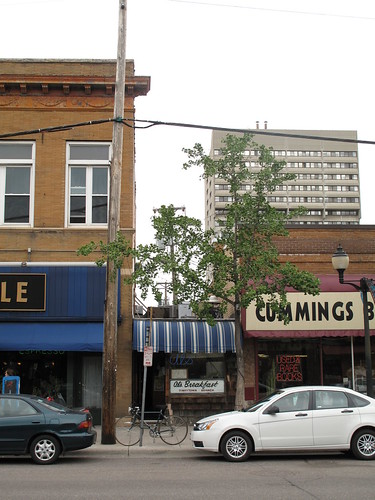
[The Big 10 building.]
The Big 10 Bar and Sandwich Shop in Stadium Village closed for good last week, and I consider it a personal loss because I loved their pastrami sub. Not just the sandwich, of course, but the whole experience of the sandwich. The the way that the old wooden walls held traces of generations of Gophers, the laid-back attentive staff, the clean unfancy atmosphere.

The pastrami itself was a living sandwich tradition, an old-school creation: toasted bun with a huge heap of lettuce atop the cheese on the quality pastrami, all doused in a light oil. Nobody makes them like that any more, and it had a unique flavor and texture that I can taste with the slightest mention.

Yet right now, the entire two-story building is covered in “auction" signs, as one of the last historic brick buildings on Washington Avenue, is coming down for a new 26-story mixed-use apartment tower.

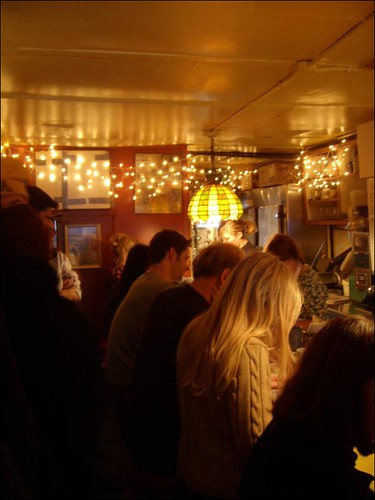
[The pastrami.]
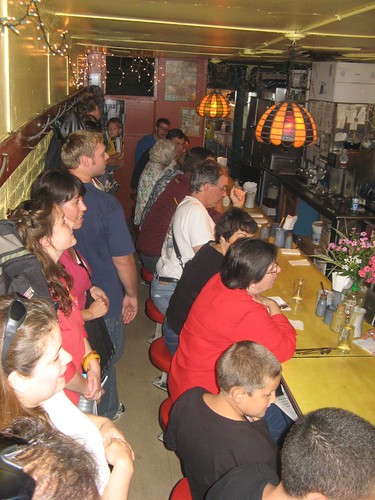
[The bar.]

It’s tempting to be sad about the loss of a building like the one at Washington and Harvard, especially when it houses tenants that have been around for decades, especially when its the last in a long line of buildings that have bitten the dust on an old commercial street. But in this case, I’m not that upset. There should be word for this feeling, loss combined with the knowledge of a bright future. Let’s call it “buildingsroman freudenschade": the bittersweet taste of the loss of innocence that accompanies the coming-of-age of a neighborhood.

Outside of a few truly irreplaceable historic sites, when faced with a preservation decision, the key question that I ask myself: What is the proposed alternative? The context is critical, and the question “should we save this building” has to be accompanied with the answer to the other question: “what are we replacing it with?”

Back in the post-war building boom, the majority of redevelopment and preservation debates involved tearing down buildings for roads, parking lots, and less-dense auto-centric development like strip malls or industrial parks. But in today’s development context, the question of preservation is completely different because it often sits in a context of transit-oriented mixed-use density. Now the Nye’s Polonaise block, mostly surface parking, becomes a 22-story apartment tower, the shoddy Totino's building becomes seven-story apartments, or the old three-story high school building in Dinkytown becomes a six-story apartment building with a Target store. Or here, where a two-story mixed-use building increases in density by over an order of magnitude. The question of preservation looks a lot different in that light, and as CM Cam Gorden explained in the Star Tribune piece on the building’s history, you feel sad but you move on because these are the kinds of changes you need to make to create a sustainable city.

[All the old wooden booth joints are disappearing.]
Commercial and retail environments are constantly changing, and neither sub sandwiches nor Chinese food carry the same meaning today as they did a generation or two ago. I’m not sure how many sandwich shops thrived in Stadium Village the 70s, but I’d bet that there were fewer than today, when a half-dozen places will make or deliver affordable sandwiches for the campus hungry. Admittedly, they're all chains these days — Erbert and Gerbert, Subway (of course), Jimmy Johns, Potbelly, Davanni’s — and to me, they all seem kinda the same next to the Big 10 sub. But regardless of taste, the world of quickly made sandwiches is still thriving, even without Banh Mi and Big 10.

And despite the new buildings with less affordable rents, the same goes for the diversity of Washingtion Avenue in general. Stadium Village has dozens of independent, unique restaurants, many of which are in buildings that have been built in the last ten years. Beginning at University Avenue, you have Blaze Pizza (don’t know, don’t care), Hong Kong Noodle (last of the old school), Kowloon (generic chinese), Burger King (been there for a long time now)…  But then there are a whole bunch of small and/or local places including Haiku Japanese, Little Szechuan (amazing place!), the Kitty Corner Café (don't want to know), Punch, a newer Vietnamese restaurant, Tea Garden, SenCha, Bar Luchador, and more, along with the usual suspect chain restaurants like Noodles, Bruegger's, Dairy Queen, or Dino’s Gyros. Even with the loss of the old building, Stadium Village has more restaurants in fewer blocks than just about any street in Minneapolis, up to and including Nicollet!

More than most places, a large college campus reflects rapidly changing tastes. (Heck, even the "Big 10" itself has like 12 or 13 teams now...) Stadium Village, named after a stadium that existed, then didn't exist, and now sort of exists again, has always been a place where the bulk of the population changes completely over all the time. Few people have institutional memories past a five-year horizon, so it’s no surprise when older places succumb to the new — for example, on today’s campus there are thousands of young Chinese students, actually from China, who have little interest in eating bastardized 80s-era “American Chinese” food.

One one hand, it's sad that the loss of an old building means the loss of the cheap rents that allowed a place like the Big 10 to hang on for so long. If they had wanted to stay in business, they’d likely have had to invested quite a bit of money and take a substantial risk, like Sally’s Bar did down the street when their building was knocked down, and given the volatile unromantic nature of the student body, it’s likely the owners decided to take the money and retire.

So much worse for the nostalgic, but the loss of Big 10 and the building that housed it comes at the gain of a new homes for a thousand young people who will start their own traditions at the heart of campus. If any place should reflect the optimism of Minneapolis's urban future, it is here at the heart of campus, next to a light rail line, in a place where (finally!) walking has become the default way of getting around. I guess I’ll have to bike to Hopkins for my pastrami sub now, but in the meantime, we’re one step closer to creating a dense, walkable, urban city. Buildingsroman freudenschade indeed.
  
[See also, the last days at Serlin’s, Bonnie’s, Stasny’s, and Nye’s.]
  

2013-12-13

Ode to Serlin's Café

Tomorrow is the last day of operation for Serlin's Café, a breakfast/lunch diner up at the top of Payne Avenue on Saint Paul's East Side. Payne Avenue as a special place, easily the most contiguous stretch of century-old building façades in the Twin Cities. Walking down Payne Avenue you can really imagine what the street might have looked like in the streetcar era. There used to be a lot of streets like this, with 2-3 story mixed-use buildings with cornices, windows, narrow frontages, and a diversity of entrances. But during the post-war ear, most of them were badly eroded by parking lots and strip development. Payne Avenue, tucked away north of the old Hamm's Brewery, far from the economic and social centers of the Twin Cities, is out of sight and mind. It managed to escape and survive, and reminds me a bit of Cincinnatti's gorgeous Over the Rhine neighborhood -- historically beautiful and economically depressed.


But Payne Avenue has retained a good measure of its working class businesses and residential quality of life. Anderson's Shoes is still selling good quality boots and shoes, and I've personally purchased linoleum from the linoleum sales guy. When I was growing up, my dentist used to be located on Payne (an unfortunate name for the street when you're a kid). But one of the oldest businesses on the whole stretch has long been Serlin's Café, started by Irving Serlin, who was navy cook during the war. A lot of the recipes are from the ear. For example, I had one of the classic Serlin's meals the other day: Navy Bean soup, hot meatloaf sandwich, and rhubarb pie.

[Men cooking.]


[The menu.]


[Alas, they were out of jewish bread.]


When people think of a 50s diner, they probably think of a Porky's style drive-in, neon and glitz and roller skates. Serlin's on the other hand, was a 40s diner. It's a completely different kind of experience, and going to Serlin's you can begin to imagine what it might have been like during the depression and the war.

In fact, eating old-school food is a bit odd for my generation. The foodie revolution emphasizes everything that old-school food rejected: local sourcing, hand-made ingredients, moving away from sugar and refined products. On the other hand, I imagine navy food to come in large bulk crates all labeled "US Govt beans." I imagine Wonder bread and sugar and a spice-free palette. I imagine Spam. Contrast that with the new Payne Avenue restaurant, Ward 6, which has a whole different concept of food.

Since Irving died, the business has been run by "the boys," Irving's two step sons who are now in their 60s. Apparently the boys have been looking for a buyer for the place for some time. One of them explained to me that he was looking forward to retiring, "because he's never been to Mount Rushmore."

[Christmas deçor.]


[Navy Bean or Split.]

[Looking past the coat nook and the pie plates into the kitchen.]


Everything about Serlin's is from another era, not likely to be recreated ever again. The booths are small, with small cushions and straight-backed wooden seats. They're not comfortable at all, but they're entirely practical. Credit cards are not accepted, but you're welcome to go to the ATM at the SA nearby. When you sit down, they ask you "Do you need a menu?" (Most people don't.) The walls are covered with Saint Paul patriotism, strange food collages, framed newspaper clippings, and Christmas cheer. There's the inevitable Herb Brooks picture, a photo of the 1992 Saint Paul Winter Carnival Ice Palace (the best one), a faded collage map of East Side businesses from 20 years ago (including the Whirlpool factory and Mr. Movies).

Everyone at Serlin's the other day seemed a bit sad about the close. They finally found a buyer, a couple that one of the "boys" kept saying were "30-year olds" as if it was a miracle. Payne Avenue is amazing, but won't be the same without its real 40s diner.


[A booth at Serlin's is the best place to read the Pioneer Press.]


[The Payne Avenue sidewalks.]

2013-11-04

On Returning to New York


I'd forgotten how tall I feel in New York City. Sure it's not Japan. But here, too, my six-foot two-inch body literally sticks out on a subway car. Odd to turn your head and be looking over a trainful of people. I suppose going underground weeds out the the tall. It goes without saying that subway riders tend to have darker skin than mine, not to mention the city uniform: drab colors, nice shoes, lack of expression.

Of course writing about the difference between the big city and Midwest is a cliché. "Country life" etc. So much has been said. One of the best was the oddball German-Jewish sociologist Georg Simmel, whose essay "The Metropolis and Modern Life" on the bustle of 1880s Berlin still resonates. He argues that stimulation desensitizes people, makes them less reactive, seek out greater and more spectacular forms of experience. Being in a vast crowd of people continually swimming through the spaces of others, we lose our individuality, and must replace strong ties with the weak link of money. Cities become fertile ground for capital. Where nobody knows each other, only our credit lines remain.

I agree with him about that last part, but I'm not so sure about the first. I rarely feel so alive as when walking around Greenwich Village with a bit of money in my pocket. It's like the first day at a new school, potential spinning through every moment. Your shoes float on excitement like a pen hovering over a blank page.

Jane Jacobs, another great city writer, has another observation about New York. She suggests that in big cities, privacy is at a premium. Because dense cities carry with them the weight of public display, one is always seen, always public, one's retreats from public life are carefully guarded. Meanwhile, you quickly learn how to present yourself in public, how to act differently on the street or the bus or the train. 

I feel this even in my legs as I walk. On peopled sidewalks, I am conscious of my gait, my coat. I am suddenly aware of exactly how I am swinging my arms, and the exact posture of your lips as you brush your eyes off cheeks of strangers. Are my shoulders back? Do I move with purpose? Am I cool? (No.)

This is an awareness of the body rarely found outside yoga or meditation, questions that don't enter my mind back in Saint Paul. They don' t have to. There is no other, no public to present oneself before. In Saint Paul, only the occasional disinterested distant shapes of people shuffling to and from cars. Nothing like this continual steam of faces and half-heard conversations. This is a public. This is to to be in public. We don't have this where I come from, not really.

Later I am talking to an old friend of mine who now lives in Manhattan.

"It's great to be surrounded by so many people, to walk around in the city, to have stories to tell," I say.  "But I suppose that gets old after a while, day after day..." I continue more quietly.

"Not really, no," he replied smiling.

A city like this, constantly changing. Would I ever get bored?

Visiting friends in New York City, I'm re-amazed at the simplicity of small homes. The flipside of the complex dance of the street is a forced minimalism. There simply isn't room for things, unlike the rest of the country. One bookshelf. Just that many books. One room. A kitchen no larger that it must be. The fear of having to move always looming, accumulating stuff is not the point any more. It can't be. I wonder how New Yorkers view a show like Hoarders?

The night before I left, a friend asked me, "What is the best thing about living in Saint Paul?"

For some reason, I couldn't come up with an answer. Yes it's cheaper. But on the other hand, I can imagine getting by paying New York rents. (You'd have to have a roommate, but that's not the end of the world.)

I'd like to say that I appreciate Saint Paul for its beauty or for the culture, but New York can offer all of those things, albeit in different ways. (Stoops and sidewalks are beautiful too.)

Another answer is simply "space," construed in all its dimensions. Along the mile from my apartment to downtown, I pass through a large open field, a slice of the river flat floodplain abandoned for fifty years. The kind of open sky and solitude are hard to find in the city. Likewise, my back yard is quiet. You can hear wind chimes, the wind rustling and swirling the leaves falling in to the yard, the sound of train horns and church bells and an occasional barge.

[Gourmet kolacy place in Bed-Stuy.]
But then I remember how even in Manhattan, the densest place in the country, there were always moments of space. A half hour in the park or a quiet street on a Sunday morning or wandering along the river. Space isn't an absolute concept, it's relative. It has more than three dimensions. There are moments of space in a crowded room, spaces of potential and possibility. Sometimes a wide open town can suffocate, and stadt luft macht frei.

I guess my favorite thing about living in Saint Paul is that I know it. Friends and family are here. After years of meeting places and people, I recognize faces and remember stories.

Moving to Brooklyn, I'm sure I could develop these networks of memory. But it would take time, and the pace of change is so rapid in the city, volatile social crystals.

In many ways, that's exciting. But if there's one thing that the Twin Cities can offer that you can't find in New York City, it's the promise of stasis, that the pace of change is human scale, more humane.

This isn't a resounding endorsement by any means. Inertia comes at a price. The Twin Cities can seem inflexible and insular, sometimes even defensive. Living here often feels far removed from the rest of the country.  

But it's good to notice again the differences between a fast-changing East Coast city and my slow-moving Midwestern one.

Each time I return, my first step off the train to New York leads right down Broadway, a walk past the delicate waving walls of Flatiron Building. Returning home, climbing up to downtown, the river below flows through the four bridges of a city that sleeps.

2013-01-29

All I Really Need To Know about Dinkytown, I Learned in Al's Breakfast

For a small place, there’s a lot happening in Dinkytown these days. The old high school that's been sitting behind the commercial area, serving as a business incubator and parking lot, is being redeveloped into a large mixed-use multi-story building. And there's a proposal to put up another big mixed-use apartment building on the mostly vacant North side of neighborhood's key block. The block currently houses a bunch of surface parking lots, two run-down homes being used for retail, and the 60s era one-story building housing the House of Hanson (a corner store) and The Book House. The proposals have sparked a lot of debate and opposition by the local neighborhood group and the area's business association.

I have been pondering this debate for a few weeks, thinking about how we might weigh the changes in the area. I was thinking about it so much that I went to Al's Breakfast last week. It was a cold day, so I got a seat right away. And that's when I realized that Al's Breakfast was the answer to all of my questions. I've written before about Al's unique social geography and opaque rules. Maybe Al's can teach us a thing or three about how to design a city.


[Save this historic parking lot!]


Lesson #1: Density is Good

Al's Breakfast is rightly famous for being the smallest restaurant in the Twin Cities. The history of the spot is suitably complex, as Wikipedia describes:
The restaurant as it is today came into being in 1950 when Al Bergstrom parted ways with another neighborhood restaurateur. Bergstrom had gained experience at the griddle and in kitchen management in the 1940s while working for John L. "Jack" Robinson during summers at a popular Minnesota State Fair cafeteria. The Dinkytown building he purchased dates back to 1937 when a neighboring hardware store erected a shed in the alleyway to hold sheet metal and plumbing parts. This was eventually rented out and was a Hunky Dory hamburger stand by the time Bergstrom took it over. The new owner renamed the diner to Al's Café and first opened the doors on May 15. Initially, he produced three meals a day, seven days a week, but scaled back the operation to simply be a breakfast outlet after one year

At only ten feet wide, Al's Breakfast consists of 14 stools crammed into a tiny alleyway with a roof and a tiny kitchens in the front and back. There are series of rules about how to eat there (more on that below), and while the food is good, the experience is the real treat. (Picture eating the same food in a spacious strip mall Denny's. Oh, that's terrible. Stop!) So, on the one hand, Al's Breakfast proves that smaller can be better, that less is more.

On the other hand, Al's Breakfast also shows that more is more. The main take away from Al's Breakfast is that density is good for cities. If someone today were to suggest turning an alleyway into a breakfast café, they'd likely be met with all sorts of opposition. I'm sure that the building doesn't meet any code requirements, and it's likely that the alley would be a crucial access for something for someone. I doubt it'd get built. But back in 1937, these kinds of rules weren't so important. Dinkytown has always been a place where every last square foot of space came at a premium.

Al's is a good example of how you can turn nothing into something. There are all kinds of similar opportunities in the Twin Cities, places you might put granny flats, or places to park a food truck. Minneapolis is chock full of underused spaces waiting for a good idea. Density is a good thing for cities. It keeps the streetscape alive and interesting, rewards them for walking. Let's fill those parking lots and remnant grassy knolls with more buildings and carts and pop-up action. Density is what makes a city worth visiting. 


Lesson #2: People Will Do Almost Anything for a Unique Experience

Q: How much money do you think Al's Breakfast spends on advertising every year?

A: Yeah right. The last thing they want is more people coming into their door. (Although, they do have a Facebook page.)

Going to Al's is tricky because you are continually placing your morning into the hands of a stranger. (I once tried to take a friend to Al's before his flight out of town. That is living dangerously, friend.) You have no idea before you head to Dinkytown whether or not Al's is going to have four open seats or a line out the door.  But this just shows you that Al's proves that people will do just about anything for the right kind of urban experience. And people do.

The way that Al's works is that once the 14 bar stools fill up, folks begin standing in line, queuing up in the tiny space behind the stools. It's like a crowded bus with food. The patient queue (who must move all the way down) stand behind the people eating, and watch the backs of their heads until the right number of seats opens up. (Sometimes this requires one of the famous Al's Breakfast "shifts", where some of the people move up or down the bar stools to consolidate empty bar stools.)

The point here is that people will do just about anything to eat at Al's. They'll endure waits and discomforts that Perkins can only dream about. (St Paul's Blue Door Pub is a similar packed 'stand and wait forever' example.)

People waiting at Al's is just like people parking and walking to an interesting part of the city. If you focus on making your city or neighborhood exciting and unique, filled with activity and density, then people will go out of their way to travel there. If you make a neighborhood interesting and alive, people will park and walk for significant distances to arrive there. They'll pay more, work harder, and commit themselves just to be somewhere truly urban. People waiting for a half-hour standing behind stools at Al's don't really get bored, because there's so much to see, and so much free eavesdropping available. In the same way, people strolling down a vibrant urban street because they parked six blocks away won't get upset as long as that street is truly alive, interesting, and has quality pedestrian space.


Lesson #3: Population Trumps Parking

[Someone using Dinkytown's new dynamic parking meters.]
So many city battles are fought about parking spaces, particularly on-street spaces in front of stores. What's interesting to me about Al's Breakfast and Dinkytown is that the on-street parking spaces are usually available. The meters here still charge only $1.25 / hour, which is very cheap for a precious spot on one of the city's most in-demand corners. The reason why on-street parking isn't a big deal here is that the majority of the market doesn't drive. There are thousands of people who live nearby, and Al's Breakfast is rarely short of customers. Most of the people who eat there walk or take the bus, and the last thing that Al's needs is off-street parking.

The first thing to note here is that Al's independence from parking can be an example for other areas. Anytime a city trades a surface parking lot for housing units, you're exchanging a flexible commodity (parking) for a fixed population of future customers, people for whom your store or business will be the first stop out the door. Provided you've invested in comfortable interesting sidewalks, the more density you get in your neighborhood, the more business you'll have. A good example is the development going up on Snelling and Selby Avenues in St Paul. A large off-street parking lot is being replaced by over 300 new apartments. If you think that each of them will have one or two people, that's hundreds of new customers for the corner, people who will spend lots of time and money in the area. I wish area businesses would look at this in a positive light. Instead of seeing a new development as a loss of parking, why not see it as a gain of local customers (the most loyal clientele anyone could want).

The second part of the parking situation has to do with off-street parking requirements. One of the main problems with any new developer building in Dinkytown is that the University area has onerous parking requirements. While commercial businesses in the area don't have to provide minimum off-street parking (it's in a pedestrian overlay district), any new residential unit has to have off-street parking spaces on a per-bedroom basis, rather than a per-unit basis. Basically, what these parking minimums do is drive up the cost for students trying to find housing, while providing space for cars far beyond the actual demand. Most students don't have cars, but if you provide them with a mandatory parking space, they might be more tempted to get one.

For example, here's a flier I saw on a campus bus stop the other day, advertising an apartment in one of the new Dinkytown area buildings. (It's the new building that houses the re-located Purple Onion.) The flier had been hilariously "graded" by undergrads.

Here's the important part:


Forcing students to pay for parking in the most walkable part of the city, where you least need a car, is not a good idea. The University / Dinkytown area parking requirements  incentivize driving in the area, making traffic problems worse for everyone. There are plenty of parking ramps all around the U. If on-street spaces were priced appropriately, maybe people would start using those ramps. My  advice would be to focus on the streetscape and the vitality of the neighborhood, use smart pricing, and parking will take care of itself.


Change is a Sign of Life


I went to the U of MN for a year back in 1996 as a post-secondary enrollment student. I remember the Dinkytown from those days, with the divey Purple Onion on the corner, filled with smoke, seeming like the coolest place on Earth. Years later, one of my first memories of going out to see a show in Minneapolis was at the Dinkytowner, a basement bar if there ever was one. The bar was actually padded, so that your forearm wouldn't get sore as you sat there and drank all day. They had an intimate stage, and I have fond memories of going there to "watch movies" and drink pitchers of beer.

The thing is, in retrospect, neither of these businesses was unique or irreplaceable. Both were unkempt holes in the wall, and both got the boot by the ever competitive market economy. And that's the thing about Dinkytown. This tiny little corner of the city is a hotspot of demand, practically off the charts. There are literally tens of thousands of customers walking and biking and taking the bus through this area every day. That's not something you can say about anywhere else in the city, outside a few corners in downtown Minneapolis.

But Dinkytown might be the future of Minneapolis. More and more people are living like students: living alone, demanding smaller apartment units, not owning or not driving cars. Demographics, economics, and cultural shifts mean that the kinds of developments in Dinkytown are a sign of things to come. Replacing a surface parking lot with a multi-story apartment building is a win-win situation for everyone.

I believe that if more of our city was like Al's Breakfast, we'd all be happier. I was there last week, and got the corned beef hash with poached eggs on top. ("I need CBH over here!" shouted the cook.) I would have stood in line for a half hour for the chance. It was delicious, but the real treat was the urban experience. That's priceless.
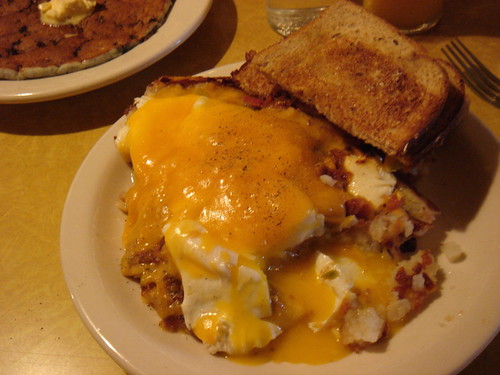
[Best poached eggs in town.]

2012-05-30

The Beauty of Forlorn Windows

[One of the windows in the Artists in Storefronts project.]
I like to think that empty windows are widows, longing for their loves, that if windows have a desire, it’s to be actively invisible, not to petrify. I think they come to life only when looked through, when the gaze of a thousand unique eyes passes their glass seeking the other side, that windows are happiest in translation between inside and outside, and that a forgotten window is impossibly lonely. Longing makes it dirty, the glass collecting a chalk film of dust, rusting, aging, graying, growing pallid. Each day it is forgotten, a forlorn window pales slowly more opaque until one day, unheralded, someone looks up and the glass has become bricks, has become yet another blank wall, its transparent past legible only in the careful inspection of stones.

Our world is filled with these widowed windows, still waiting to turn heads, old windows that display long memories. The windows remember the time of streets, earlier sidewalks filled with wondering wanderers, when the shops inside gathered treasure behind them. Dioramas. Piétas. Displays of impossible wealth. Deals and sales and specials and signs and jokes in many languages. Today windows once filled with life are but liabilities for a parabolic rock.

[Shopwindows at Nicollet & 15th St c. 1945. Img fm. MNHS.]
The problem is that windows, like much of the old city, are trapped in chains of cause and effect. The fewer people who walk by, the fewer heads that turn to glance glassward, the less any business pays attention to their window, and the more boring windows become. And conversely, the more bleak and blank the windows, the fewer interesting sights placed inside them, the less that people feel enticed to walk the sidewalk, the more the street will abandon itself to exhaust. Everything is connected by the gaze. Pedestrians and shop windows need each other to be happy. Today, alas, shop windows and the heads they turn are estranged. Both sides are lonely, forgotten, depressed. Shop windows don’t know what to do, and spend their days in the dark waiting their end, while pedestrians go on endless forgettable dates with lackluster walks through malls that don’t excite them. Somehow, we need to get these two back together!

And that’s when the Artists in Storefronts project appears. I had the recent pleasure of participating in an effort by Twin Cities’ artists Joan Vorderbruggen, a local artist and public space practitioner. Joan’s artistic medium is the shop window, designing window displays for businesses to catch the eye of the distracted consumer, and in an earlier time she wouldn’t have to go about drumming up interest in her craft. You can read all about it elsewhere, and I won’t waste your time tooting that particular horn. (The tour was great, and so is the project, etc. How wonderful it would be if we  could it were replicate it all through the city!) There's another tour this Saturday!


[The cat in the window.]
The first thing is that store windows blur the line between art in commerce in a way that would make Warhol green. One of the stops on the tour is a window display made by a blind woodworker who lives in the Whittier neighborhood above his shop. He’s constructed a beautiful set of shelves for his shopwindow, and they display a fine collection of pottery made by another local craftsperson. Is it art? Who cares? There’s a cat, and it’s beautiful.

A artful shopwindow sits right on the line of art, commodity, and aesthetics. A good shopwindow is the art of everyday life. Why shouldn’t our streets and buildings be beautiful? Why shouldn’t our walks be rich and filled with detail, with careful attention. If each shopwindow contains something rich and intriguing, if every doorknob is beautiful, and every railing and every lamppost a thing to stop and admire, if every patch of green contains a flower, then the world has become a work of art and each clerk and barista and bouncer has become an artist.

The second thing I realized while walking through Whittier was that there are some abandoned shopwindows are already beautiful, already everyday artworks in their own right. In fact, some of these windows were infinitely more interesting than the ostensible art installations on the tour. One of my favorites is the strange and mysterious Past Present Future building across Franklin Avenue from the Electric Fetus, an old hotel that sits deeply alone next to the freeway wound. Though nobody is there to see it, this windows of this building are stacked with old furniture, and form a antique kaleidoscopic snowglobe of dust that feels like being bathed in the memories of ghosts. This shopwindow isn’t technically on the art tour, but attracts me like an Earth magnet.


The other DIY art shopwindow is right on 25th Street, between the Whittier neighborhood group headquarters and the Spyhouse coffee shop, an old storefront that has become an old man’s home. I chatted with him one day and asked him about his unusual window décor. He said it’s just something he does, displaying some of his collections of old stuff. That doorway is an everyday wunderkämmer.

Today cities have finally started to recognize the importance of windows in everyday life, and have done things like pass transparency requirements for new building construction, trying to frustrate the attempts of developers and businesses to keep their spaces to themselves. Of course, as anyone whose ever tried to peer into the Snelling CVS can attest, some of these ordinance windows remain symbolic windows, part of a growing plague of façade urbanism, fake second stories and fake neighborhoods and fake parks for our fake cities.

We need windows as much as windows need us. If everyone had an interested in their window, maybe we’d all walk again. Take a moment right now, look around whatever room you’re sitting in and find the window closest to the street. Now place something interesting inside it, maybe a small sign or a tiny plastic dinosaur, a big red 'A', or a dry flower. Be creative, and then close your eyes and imagine the face of someone who notices.

[The wonderful crepuscular windows along 25th Street.]

2012-05-24

Pete Lebak & the Price of Progress

[A sign pointing to parking.]
I bet that I remember every barber shop I’ve been to in my entire life. The first was on Smith Avenue in West Saint Paul, and had fake wood partitions topped with wooden bars and frosted glass light fixtures attached to a ceiling fan. There were green plants. My mother only took me there once, for some reason.

The first place I went to on my own was a barber shop in Diamond Jim’s Mall on Highway 13. The barber there was the father of a kid I knew from Boy Scouts, and so that’s what we always talked about. That was the first time that I ever gave someone a tip, and I remember how weird it felt. There was the sports barber in college who pointed out my bald spot for the first time. There were a wayward series of barbers in New York. I'd just wander around the city with long hair and go into somewhere that looked interesting. I remember one well-lit place near Greenwich Village with a Latino barber who had never heard of Minnesota.

I remember the place on Grand Avenue that I went to most often, with Dick the barber. And the other place on Grand, and the place on West 7th across from the thrift store, and the fancy joint downtown with great tall windows onto the sidewalk outside and the shoeshine man lingering nearby the whole time. There was the one on Selby next to the coffee shop, and the one in Northeast by the old Slovakian church that has the statue in the steeple with the arms stretching out trying to reach the sunset. But all that was years ago. Ever since then for a long time now, it's been Pete Lebak Barber Stylist, a small dirty shop on the top of University Avenue that seems like a fossil fragment of some ancient large animal.

Now that I let myself think, it’s funny that I have so many memories of barber shops, that I can hop carefully along them like stones crossing a stream leading back all the way to the earliest images in my mind. Maybe its because the experience of getting your hair cut by someone else, a half-stranger, is so different from everything else in our lives. They touch your head and there’s a special chair. The sharp scissors are close to your ear so that hearing their particular whipclick is almost like thinking a thought. And this is not even to mention the intricate layered cultural dynamics of the barbershop, which have rightly become the stuff of legend, and demarcate a whole subtle cultural set of worlds surrounding race and ethnicity and gender and age and cultural traditions (e.g. sports) and varying uses of language being passed on (e.g. the telling of jokes). Barber shops are probably the last bastions of stereotypes, which makes them even more intimate and important in some ways. I’d bet that more political opinions are solidified in barber shops than in all the robocalls and door knock visits in all the swing states in all of America.

The cutting of hair (for men or for women, by the way, women who have their own separate and distinct set of social architectures surrounding “the salon” about which I know very little, and am happy to stay ignorant about the whole thing mostly out of respect for autonomy, but also because it's frightening) is very special. It’s not too much to say that this ritual is the last remnant of an earlier era of intimate servitude which was surprisingly varied and commonplace. Not to mention that, despite the efforts of Great Clips, haircuts remain one of the last domains of the independent businessperson, still uncolonized in our standardized robot world of chains. All of this is why, under normal circumstances, I’d never tell you about my barber Pete. Normally, Pete would remain a closely guarded secret, disclosed only to the worthy, offered like a precious sweet thing purchased at great price.

But these are not normal times, and I will divulge. I first came across Pete Lebak, barber stylist, on a recommendation from one of my oldest friends, the kind of friend whose advice you unhesitatingly follow, whose taste has been vetted over decades of long conversations and exchanges of music, books, or shared stories. He told me that “I had to go to his barber, Pete”, and then told a highly compelling Pete story. As I was wandering sans coiffeur at the time, I gave it a try.

Pete’s shop is in one of the old buildings on University Avenue on the top of the hill across from the KSTP television antenna, and to get to it involves going down a narrow dingy beige hallway with incredibly old carpeting and a little metal box hanging on the wall that has the words “we are now entering the electric age" written on it with permanent marker. You snake around a little bit past the room that is continually recycling tenants (the most recent being a masseuse), and past the secret back door to Schneider’s Drug Store (itself a small business legend) before finding Pete’s little shop room on the other side of a door.

On the threshold you'll inevitably encounter a yellow Labrador sprawled out on its side, barely interested in moving, over whom you'll have to step. There have been two such dogs in my time at the shop. The first was named “Useless”, but she died. This one is named “Bug”, short for ladybug.

Next you'll look to find Pete, usually alone, sometimes smoking a cigarette, and usually reading a popular history book checked out from the library (e.g. something about World War II, something about colonial era America or something like a biography of Balzac). Pete's a man with a grey beard and a belly barely contained by its shirt. He's always wearing a pair of suspenders, either rainbow or red. After you step over the dog, he’ll look at you with sharp eyes for five long seconds without saying a word, and then return to his book, turning the page. So then you sit down in one of the old brown chairs next to the door and wait, surrounded by old coathooks and endtables bearing a heap of reading material ranging from Outdoors Weekly (the local hunting periodical) to middlebrow novels to historic airplane restoration magazines to almost yellowed copies of Playboy.

You’ll sit there for a minute that lasts forever while Pete finishes his chapter, and you'll let your eyes wander around the room to take in the amazing décor mounted on every wall… an old Wellstone sign next to one that says “gun control means using both hands”, a picture of FDR underneath a deer head, an entire wall covered in stickers from bananas, another wall filled with old photographs and business cards held up by pins, a hunting bow, a two-foot spittoon, a big mirror with more old political stickers, and then Pete will ll thump the book closed and say something like “Allright get in the chair,” or “What do you want?” or “I suppose you want a haircut” or (one time only, when I’d let my locks get particularly long) “You look like a blowed up couch.”

Then he’ll cut your hair for $14. Pete’s haircuts are pretty good for me. They're probably not for everybody, to be perfectly honest. But that's really not important. The reason my friends and I go to Pete is for the stories. Each time I’d run into one of my fellow Pete clients in the hallway or on the street or at a party, we’d inevitably start swapping Pete stories like kids with baseball cards.

To hear Pete’s stories is to collect rare artworks. It seems like there’s nowhere he hasn’t been, and nothing he hasn’t done. I remember once having my hair cut in wintertime and mentioning how cold it was, and having Pete say “Oh that’s nothing,” before recounting his time in Newfoundland, the Aleutian Islands, and Tierra del Fuego, all of which paled next to the indescribably cold winters of the Yukon. That Pete has almost literally been to the four corners of the hemisphere is only the beginning of Pete’s collection of experiences, which are almost Forrest Gump-like in their breadth and historical serendipity. There’s the secondhand Pete story about the shipwreck and the other one about the CIA in Africa. And there surely are stories about Vietnam that are told only in the silences when one of his war buddies appears and sits in the shop for an afternoon. There are stories about his Acadian roots in Quebec and Louisiana and stories about places he likes (South Dakota, Arkansas) and places he doesn’t (Texas, almost any city). I can’t tell you any of these stories, as doing so would be a huge violation of barber-client privilege.

In fact, the only reason I’m even talking about my barber Pete in the first place is because these are unusual circumstances. These are strange times. Pete’s shop is one of the many businesses on University Avenue being impacted by construction. Pete has the added bad luck of being right on the seam of two of the “phases” of construction, so that he’s to endure twice the amount of construction chaos as most places. Business is down as a result of people avoiding the area, and Pete’s demeanor has changed noticeably.

[Outside Pete's shop. Img fm Minnesota Daily.]
For example, it used to be that I would come in and get my hair cut, Pete would grumble about the shop and talk about quitting. Multiple times he threatened to give it to me. Now, though, Pete couldn’t be more sentimental. He says things like “I don’t want to lose my little box” and “It would break my heart if I had to leave this place.” One of his customers actually made him a website, and there’s a sign on the window with the url even though Pete’s never actually seen what the website looks like. The last time I was there, Pete held up a giant QR code and said, “What the hell is this thing?” But he still put that strange pixelated blob in his window, hoping that somehow he can stay in business for the next year.

The idea of losing shops like Pete’s, or the wonderful old buildings slated for demolition on Lyndale for the new Trader Joe’s, certainly should give pause to anyone excited about new development. While I’m very excited about the future of University Avenue with a train going down the middle of it, there must be a way to try and hang onto the little shops that provide all the diversity and character that I love about the Twin Cities. Maybe it’s something like strengthening the Twin Cities Independent Business Alliance, which has for a long time been trying to boost local small retail with only medium success. OR, perhaps a “keep St Paul weird” campaign like the ones they have in Portland or Austin Texas would help. In the meantime, I’ll be getting my haircut a bit more often than usual.