Showing posts with label parades. Show all posts

2013-12-20

The Last Holidazzle

[Gazing into the Holi-Abyss.]

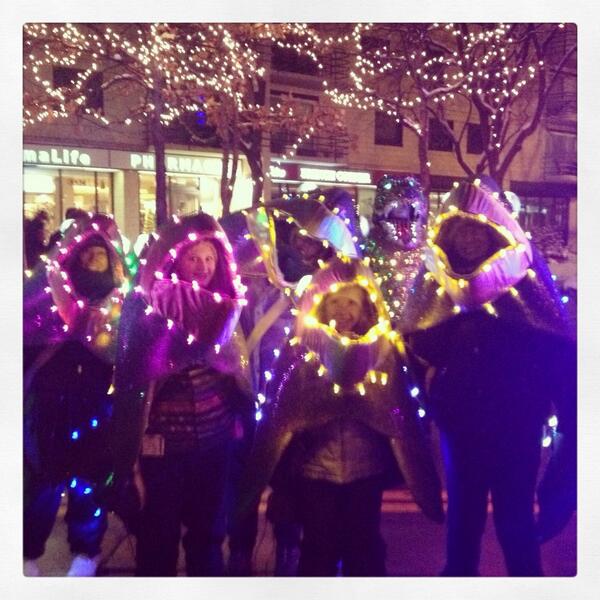
 If you ever wanted to see a bunch of volunteers trudge slowly down a cold winter street wearing light-up costumes resembling various childhood tropes, tonight and tomorrow are your last chance. The Holidazzle parade is quietly holi-fizzling away this year with surprisingly little fanfare.

I went with a group of intrepid urbanists last week to see the penultimate Holidazzle weekend. We wandered through the skyways on our way there, and with notable booster R.T. Rybak at the head of the parade, it was not a disappointment.

[Remember these?]
The story of the Holidazzle is a neat combination of the mundane, the fantastic, and the technological. Basically, downtown retail interests started to get really concerned back in the early 1990s when the Mall of America was being constructed. Those responsible for the downtown department stores and the retail district along Nicollet got rightfully worried that the impending Megamall was going to seduce all the holiday shopping traffic with its titanic enormity, three levels of Victoria's Secret stores, and large Snoopy statue. (In retrospect, they were right.) There was much wringing of hands and biting of nails.

Meanwhile, the last of the major department stores was still called Dayton's, and they had long trumpeted a rotating holiday-themed display spectacular on their 8th Floor. I remember going there as a kid to see Santa Bears, and various holiday display adventures. Back then, window displays were still a big deal. Downtown retail really invested a lot of time and energy into doing things like this. It was another era...

And that's when Holidazzle was born. I chatted the other day with Michael Murnane, who founded and ran the parade for many years. As he told it, it was during one of these brainstorming hand-wringing sessions that some of the Dayton's 8th Floor designers pitched a new parade for downtown that would draw people to the retail district during the Holiday shopping season. It would be a parade themed around various childhood stories and fantasies, and the main attraction would be that the whole parade would be made out of lights.

At first there was some skepticism, particularly about the high cost of such an endeavor. But after conducting some research down in Disneyworld, Murnane and a childhood electrician friend began re-wiring many many many strings of Christmas lights so that they would run on batteries. Then the fun began. They started building floats and costumes, and launched the first Holidazzle in 1992. It grew for a long while, and evolved into a series of themed floats and costumes sponsored by various downtown interests.

[Last stop for the Twinkle Bus. Last stop...]
My personal highlights are the Metrotransit "twinkle bus", the Minnesota Twins snowman that spins around, and the string of individual Christmas lights costumes. (I was told by a longtime parade-goer that they used to have a 'plug' trailing after them...) Also, it's fun to yell "booo!" at the evil witch who almost eats Hansel and Gretel.

The other takeaway from the Holidazzle experience is that it continues to attract a large crowd! There were lots of people cramming into an otherwise empty-after-six downtown, and it was quite fun to see the city packed on a cold winter's night.

[Please, will somebody please volunteer????]

[Twirling snowball gets more hits than Drew Butera.]

[Dunno what these are but whatever! Lights!]
But the same downtown retail powers-that-be (now Macy's and Target) have decided that the cost of the parade isn't worth it any more. And they're probably right, as I highly doubt that many of the parade-goers stopped to do any Christmas shopping while they schlepped their über-bundled kids to and from their parking lots. The basic problem is that people driving downtown to do retail shopping isn't a model that makes any sense. The vast majority of the downtown retail market is people who already live or work downtown. If we want our downtown retail environment to thrive, we need to double the downtown population, and make sure to keep a dense number of jobs in the CBD. Those projects have little to do with a cheese sparkle parade.

At the same time, it's difficult to think of downtown civic events that have been as much of a consistent attraction as the Holidazzle parade. Kitschy as it might be, it's at least as good as the Aquatennial whatever-it-is. (Barring, of course, the awesome fireworks display.)  Back in 2007, the Holidazzle management got changed, and (so I hear) they started cutting back on some of the expenses and maintenance. The old days of downtown department stores are never coming back, no matter how many bedazzled floats we throw at it. Maybe it was always inevitable that the Holidazzle would twinkle and sparkle and fizzle into that good night.

[After all, no snowman is an island.]

2013-01-26

Reblog: Red Bull Gives You Crowds

[I wrote this last year, and it seems like the time has come to post this again.]


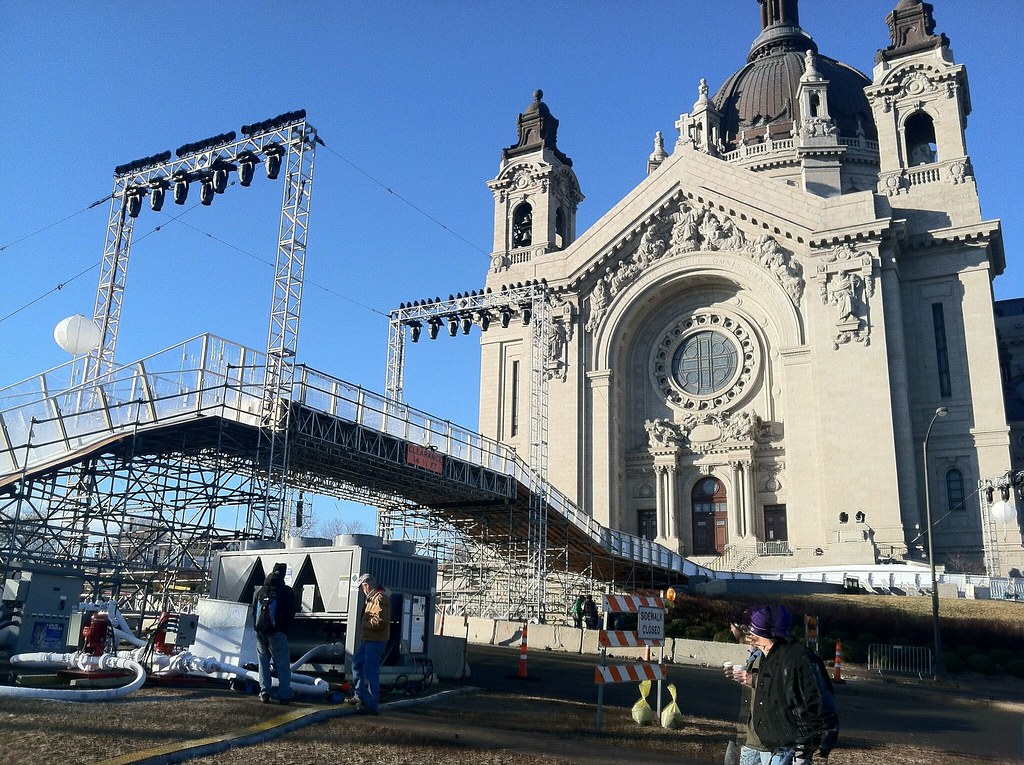
[Tongue contraption extending from the Catholics to the Interstate.]
I hang out around the St. Paul Cathedral a lot, and a few weeks back I noticed the strange construction occurring on Summit Avenue. I guess I didn't think much about it, but it turns out its part of this event called Red Bull Crashed Ice, a semi-crazy skating / luge race that started in Sweden and is sponsored by Red Bull.

Apparently, Red Bull's marketing approach is to have these huge crazy events set in various cities around the world. And its a great thing for cities! A year and a half ago, Red Bull brought their "Flugtag" contest to the riverfront in downtown St Paul, and I have never in my life seen such crowds in my Midwestern small city. It was great fun.

And now Red Bull is back with another huge Rube Goldberg event. I'm glad they like St. Paul so much. Maybe repeated association with Red Bull will help us re-brand our quiet town. Until this point, I've always considered St Paul to be "the city that sleeps."

Massive crowds are expected (75,000 people). And so everyone who's anyone in downtown or Cathedral Hill is talking about the Crashed Ice (Especially those in the restaurant industry.) It's quite the exceptional moment!

[Just an average day in downtown St Paul in 1935.]
For me, though, an event like this is a rare chance to glimpse what downtown life was like back when downtowns had high densities on a regular basis.

As I mentioned after the Flugtag, St. Paul, Minneapolis, and every city in America used to be able to generate crowds on a regular basis. This amount of foot traffic was semi-normal. This amount of people wanting food and drink, strolling around the city, and clustering on the Cathedral steps was not that unusual. It's one reason why so many department stores, shops, and cafés were located downtown. 

If you happen to find yourself in St Paul for the Crashed Ice spectacle, pause for a moment and imagine a world with downtown density. Imagine what St. Paul would be like if the streets were filled with people. I'm not saying that downtowns were always packed and crowded. They weren't. But crowds that today seem shockingly large wouldn't have been out of the ordinary in the pre-suburbanized city. Even in a place as seemingly average as St. Paul, Minnesota.

 [A large crowd gathered on the steps of the St Paul Cathedral to watch the 1938 Winter Carnival parade. Img. MNHS.]


2012-11-01

Classic Sidewalks of the Silver Screen #90

Ferris croons on a float...


... in John Hughes' (1986) subtle piece of market propaganda, Ferris Bueller's Day Off.

2012-01-13

Red Bull Gives You Crowds

[Tongue contraption extending from the Catholics to the Interstate.]
I hang out around the St. Paul Cathedral a lot, and a few weeks back I noticed the strange construction occurring on Summit Avenue. I guess I didn't think much about it, but it turns out its part of this event called Red Bull Crashed Ice, a semi-crazy skating / luge race that started in Sweden and is sponsored by Red Bull.

Apparently, Red Bull's marketing approach is to have these huge crazy events set in various cities around the world. And its a great thing for cities! A year and a half ago, Red Bull brought their "Flugtag" contest to the riverfront in downtown St Paul, and I have never in my life seen such crowds in my Midwestern small city. It was great fun.

And now Red Bull is back with another huge Rube Goldberg event. I'm glad they like St. Paul so much. Maybe repeated association with Red Bull will help us re-brand our quiet town. Until this point, I've always considered St Paul to be "the city that sleeps."


Massive crowds are expected (75,000 people). And so everyone who's anyone in downtown or Cathedral Hill is talking about the Crashed Ice (Especially those in the restaurant industry.) It's quite the exceptional moment!

[Just an average day in downtown St Paul in 1935.]
For me, though, an event like this is a rare chance to glimpse what downtown life was like back when downtowns had high densities on a regular basis.

As I mentioned after the Flugtag, St. Paul, Minneapolis, and every city in America used to be able to generate crowds on a regular basis. This amount of foot traffic was semi-normal. This amount of people wanting food and drink, strolling around the city, and clustering on the Cathedral steps was not that unusual. It's one reason why so many department stores, shops, and cafés were located downtown. 

If you happen to find yourself in St Paul for the Crashed Ice spectacle, pause for a moment and imagine a world with downtown density. Imagine what St. Paul would be like if the streets were filled with people. I'm not saying that downtowns were always packed and crowded. They weren't. But crowds that today seem shockingly large wouldn't have been out of the ordinary in the pre-suburbanized city. Even in a place as seemingly average as St. Paul, Minnesota.

 [A large crowd gathered on the steps of the St Paul Cathedral to watch the 1938 Winter Carnival parade. Img. MNHS.]

2009-04-20

Sidewalk Traces

One thing that vexes me about sidewalks is that they have no memory. They forget so easily.

It'd be really nice if, like footprints in snow, we all left some kind of trace while we walked down the sidewalk. If, somehow, our footsteps, our wanderings, our gazings, and our speech left little traces on the streets? What if people could see and hear traces of past walkers on the sidewalks all around us?

Well, there are indeed ways to trace our steps, to turn streets into recording devices for human beings. One way is this thing, called the Contrail, that leaves little chalk marks behind your bicycle. No longer will you bike alone. Rather, each bicycle will leave a colored trace behind it, and you can literally follow in the wheelsteps of your bicycling brothers and sisters. As you ride, you leave a path for others to come, and the street becomes alive with the presence of all hours of bicycles.

Another way to trace our steps, so to speak, is through the camera lens. You're probably familiar with those time lapse images of cities, showing everyone rushing through an intersection like ants, or cars blurring into long streaks of red and white light on the freeway.

This is a photo by Russian photographer Alexey Titarenko, showing a long exposure of people descending a staircase. (h/t Weschler for the link.) The bodies become a black and white blur of shape and shadow, and people are lost in a crowd of humanity moving out of the hard and fast lines of the building walls. Here, there's nothing left but the trace. People become lines for flights of stairs.

As wonderful as Titarenko's photos are, though, they're not even my favorite sidewalk traces. For those, we have to turn to American photographer Peter Funch, who has these amazing photoshopped photos of streetcorners in New York.


[A world where everyone has an envelope.]


He camps out on a streetcorner and takes a heap of photos of the same sidewalks, and then photoshops together people into groups across time (but within space).

You end up with these bizarre and wonderful alternate universes of streets and sidewalks. These photos work like Calvino's Invisible Cities. What if everyone in the city was carrying a manila envelope? What if the entire world smoked cigarettes? What if everyone had a dog with them, all the time? What if the entire city wore green? What if everyone was homeless?

[A world where everyone is moving equipment.]


Sidewalks bunch people.These photos are alternate universes, explorations of urban emergence. If everyone pushed around carts when they walked through the city, the world would be a very different place. Here, the traces of our everyday behavior are gathered together and shown as groups. Moments of the city are grouped, and the tiny ways that we shape our lives are traced and tied together.

This last one is a dead ringer a dead ringer for Cartier-Bresson's famous 1932 photograph of a man jumping over a puddle in Paris, only here everyone is in mid-jump. Nobody is grounded, and everyone skips lightly over the concrete, flying through the air if only for a split second.

Check out all the images. Sidewalks group people. It's absolutely wonderful.


[A world where nobody touches the ground.]

2009-01-22

Crossing Guards of the World, Unite!

I've written about this corner before, which despite its bourgeois pretension, is really a terrific Twin Cities neighborhood with terrific sidewalks.

But I was hanging out near Carter Avenue the other day, and saw what must be a twice-daily sight in the St. Anthony Park neighborhood... the crossing guard parade.


[Kidlins crossin' the streets on Carter Avenue.]


It's such fun to watch these kids fearlessly parade out into the crosswalk and wave their giant orange flags in front of cars, which become utterly helpless before this group of highly-visible munchkins. I like it for a lot of reasons:

First, it completely upends the typical power relationship between machines and people, so that even the smallest people rule over even the largest SUVs. Compare this to the way in which children are clutched by parents along every other busy street. This image strikes me as far and away more just.

Second, to all appearances, the kids are actually in charge. Sure, there's probably an adult hovering overhead somewhere, making sure sharp sticks stay out of eyes, etc. But, these kids seem to me to be self-determined, in charge of their one task... making the streets safe for pedestrianism.

[Adults watching trustfully as their children stand in the middle of the road.]


And finally, crossing guards are a sign that kids are actually walking to school. No more paranoia about abduction... down with lazy, bored, and fat children! Instead, we have the noble virtues of fresh air, exercise, and exploration. Plus, it's far cheaper and better for the environment.

Of course, I'd like to see more of this, but it's an incredibly difficult task to change a school dynamics from a car- to a foot-culture. Growing up, my schools all had huge parking lots.

2008-05-06

I Love a Parade!

I wasn't sure that I was going to head over to Minneapolis for the Mayday Parade on Sunday. With finals week coming up, I'm not getting any real sleep for a while, and the responsible thing to do would have been to lock myself into a library somewhere.

But then the funniest thing happened...

I opened up the front door on Sunday and stepped outside, and ... Well... (I don't know quite how to put it)... the rays of the sun warmed me.

It was so weird! I was standing there, and as per usual the sun was shining and everything it had been kinda wet and clammy and I had my sweatshirt and wool hat on and everything, but something was different. I felt this warming sensation on my skin, kind of like in an oven, and it was coming from somewhere high overhead.

To be frank, at first I didn't know what to do. I took off my winter wear and shielded my eyes from the harsh rays as I stood there for I don't know how long, blinking and warm, trying to figure out what to do with myself and all my wool sweaters.

Somehow (I don't know how!) the sun's rays were warming me, and it could only be a sign! I had to go to the Mayday Parade.


[This is how sidewalks were meant to be... Completely crammed with people and everyone outside.]


Parades are an awesome use of sidewalks, and the Mayday Parade particularly so. People crowd the streets and line up in giant groups, leaving a little narrow people-alley for you to walk down should you so desire. People and more people and families and people of all ages cluster together and form ranks along streets filled, not with cars, but with people walking and running and dancing and playing music as they walk through the street a-smilin'. Songs and puppets and all sorts of things happen, and for a brief hour or two the streets of the city transform into a giant party. It's absolutely fabulous.

And the Mayday parade takes all the normal things that are good about parades -- their diveristy, chaos, and glee -- and amplifies them to absurd proportions. There are totally wild puppets and butterflies on stilts and hordes of little children with tiny drums and everyone's outside at the same time while all sorts of political and ethnic groups -- Hare Krishnas(!) -- come walking by all leisurely and strolling. The music is wonderful, and it's a completely unoppressive, equal-opportunity parade where you can enjoy as much or as little of its message and mythology as you like. It really is a parade for everyone, and an amazing example of inclusive social formation.

So, it's always nice to go down to see it.

[There's a totally complicated mythology to each Mayday parade, with bridges and animals and metamorphoseses and politics and materiality... each year it's kinda the same but each year its quite different. This one had windmills and a giant mushroom-puppet-face-head and butterflies and "bridges".]


But what I really love about parades is something alltogether different. I used to live on Saint Paul's Grand Avenue, and I remember waking up one Saturday morning in the early summer kind of hung over. I stumbled downstairs in my pajamas, because this strange noise had trickled through my bedroom window. I came downtstairs rubbing my eyes, and looked out the front porch to find a parade going past my house. It was the Grand Old Day parade, and there was a clown at my front stoop!

So, I grabbed a coffee and watched as the world walked past my doorstep, completely unexpectedly, and I had the rare pleasure of booing Norm Coleman in my pajamas from the comfort of my front lawn.

My favorite thing about parades is when you come across one unexpectedly. I love the people who don't know what is going on, and are going about their everyday life when all of a sudden thousands of people descend on a street and all of a sudden -BAM!- there are clowns and a marching band. I love to watch the look on people's faces as it slowly dawns on them: there's a parade, and they're not going anywhere for a while, and maybe they should relax and enjoy it.

A good parade magically transforms a street from simply way to get from Point A to Point B into a place for public performance and hanging out... Parades are transformative, and maybe its a coincidence, but I am giving full credit to this year's Mayday parade for this whole sunshine / warmth thing that just fell down upon the Twin Cities like a bucket of pillowfeathers. Yay!

[After eight long months of winter, I didn't even know this many people lived in Minneapolis.]