I've been reading through J Fletcher William's 1875 book, A History of the City of Saint Paul, which has aged better than I initially thought. It's a colorful and rather encyclopedic accounting of the stories of the city's first settlers and notables, and if you look past the glaring anti-indigenous racism, is worth some time.
For example, I came across this anecdote which claims to be the story of the city's first American flag. It's from the section on Sergeant Richard W. Mortimer, an Englishman who arrived at Fort Snelling in 1835, retired from the army a few years later, and moved to Saint Paul in 1842:
Sergeant MORTIMER was really uniftted for the new life in which he had engaged... He was a liberal and public-spirited man, and, had he lived, would have been a prominent citizen. The first flag every [sic] raised in Saint Paul, was procured by him, at the expense of $35. He had one of his men raise it on a pole, in front of his house, on Christmas, 1842. There seems to have been almost as much rivalry between upper and lower town, those days, as there was subsequently, for the flag had been flying but a little while, when some wicked scamp, from the lower part of the village, cut it down. MORTIMER was terribly enraged when he found it out, and was about to put it in force Gov. DIX's famous order -- "if any man hauls down the American flag, shoot him on the spot." He went to load a gun, and ordered his horse to purse the offender. His wife, fearing there would be bloodshed, unloosed the horse, and there was so much delay before he was caught, that MORTIMER's anger cooled down.
According to a very ambitious inflation calculator, $35 in 1842 is about $1,000 in today's dollars. Meanwhile, you can get a Saint Paul flag right now for only $15.
I first discovered Christopher Lydon's work when he guest hosted the MPR flagship talk show program over ten years ago, in the brief interim between Katherine Lampher and Kerri Miller. I've been a fan ever since. He's an amazing interviewer and his discussion with Lewis Hyde is a good example of that. Hyde was a sociology major at the University of Minnesota, and his new book is called "A Primer for Forgetting," and includes some info about Minnesota's traumatic 1862 Dakota Wars and their aftermath.
Here's the excerpt about Little Crow and Minnesota history, from about 12 minutes into the conversation. Hyde describes the story of Little Crow and his burial:
Little Crow… Yeah so the 1860s in Minnesota, he was a Dakota Sioux a leader of what was called the Sioux rebellion. The Sioux had entered into a treaty with the US government in which the Sioux would settle along the river and they would be given annuity and certain goods and then what happened was that the US government reneged on this treaty, so the Sioux were mad. They rebelled. The rebellion was put down. Many were killed.
Little Crow escaped, but then there was a bounty on his head. There was a bounty on a head of any Sioux to be captured and killed, and there was a double bounty on Little Crow’s body. And he was shot while foraging for berries in Hutchinson, Minnesota by a farmer. And they took him into town, took the body and they dragged it through the streets with dogs picking at his head. And they scalped him.
And when I was in college in the late 1960s the scalp of little crow was owned by the Minnesota Historical Society. I knew this because I was friends with the poet Robert Bly, and the Vietnam war had one of its almost hidden motivations a kind of ancient American racism. It was easier for us to kill people of color in a foreign land, because we had been killing people of color in our own land 100 years ago.
So it’s almost like cases like this require the proper burial, the remains of the Indians who were killed the Indian Wars in the 19th century. I have aphorisms in this book and one is to be steeped in history, but not in the past. And to be steeped in history is to be steeped in many of these stories and to know what our past contains.
And in this case, I would say that the proper burial of Little Crow’s scalp would be an act of foreign policy, in that it would lay to rest a kind of local impulse that has been exported into our foreign wars.
If you leave the bubble of Minnesota, you quickly come to realize that not everyone calls a multi-story building where empty cars are parked by the same name. Sure, these grey concrete buildings are a ubiquitous part of our landscape. And yes, here in Minnesota, these things are called "parking ramps."
But not so elsewhere in these United States. In fact, much like the great "pop / soda / coke" divide or the Minnesotan "duck duck grey duck" exception, one quickly finds that the term "parking ramp" is rather unique to the Upper Midwest and that elsewhere in the United States people will park their cars on second stories in other kinds of buildings!
Let me break it down for you, using Google Trends maps.
The first key point is that the term "parking ramp" is a geographically specific regionalism...
Minnesota is the center of the "parking ramp", and once you leave the state, the term starts to disappear quickly.
Instead, by far the most common term for these buildings is "parking garage"...
All across the country, except in Minnesota, that 's the #1 name for these buildings.
But wait, there's more...
In the south, a multi-story building full of empty cars is often called a "parking deck"...
And in the west, such a building is repeatedly called a "parking structure"...
Meanwhile, our neighbors to the north have a whole different term for such a building full of temporarily-stored empty automobiles, particularly in the western provinces: the odious term "parkade."
So there you have it. Parking decks. Parking ramps. Parking structures. Parking garages. Parkades. Sadly, a multiple-story place for empty cars might be one of the most distinctive parts of the North American linguistic vernacular.
You can't explain fireworks. There's something deep about how they mesmerize, about how a hundred exploding lights in the sky enthrall. It's that same feeling you have watching a campfire, but exploded outward so the campfire becomes the entire big bang universe. Somehow giant booming lights streaking through the dark sky never gets old.
Well, this much we know. The mysterious appeal of explosions and power and fire and light. But there's something else that I really like about fireworks. I love how they light up their neighborhoods.
Fireworks quite literally bring people together. They surprise you. You stop and wonder and stare. The boom reminds you that you share your city with so many others in so many homes with so many festivals and ballgames and holidays.
Fireworks startle and rush and people creep like zombies from their houses, drifting about in search of a good precipice. They're equal opportunity, the most democratic language. You don't need any cultural literacy in order to enjoy them. You don't need any books to understand them. And the whole neighborhood comes together for free entertainment.
Fireworks are always local. You can't watch them on TV. You can't download them. The only way is to get out on your feet and walk down to the very center of town to join the crowd of people. Everyone rings around the water or roosts on rooftops or balances on balconies or bridges or bluffs and all of a sudden we all look up and for a half an hour time seems to slow to a crawl and our minds normally overstuffed with worries and pressures and lists to do turn off and our child eyes take over, and no matter how old there's that gentle feeling of awe and joy wrapped in togetherness, the whole town lit by the glow of something both impossibly large and intimate, one of the very few things in our instant magic media age where you actually “had to be there.”
Bang! and then they're over. The echo rings your ears. The smell of sulfur hangs in the air and the yellow smoke slides along the street, slow drifting along the tops of houses and everyone gets up off their chairs and blankets and off the grass and slowly sinks back into homes and cars and wherever they came from.
But when you shut your eyes there is still that faint image of light, that far away sense of being together, the memory of a feeling just beyond words, something living all around you like a city.
[No photo will ever capture the feeling of a firework.]
[Fans in Minneapolis for last night's USA-Argentina Copa America match.]
Everyone, especially Bill McGuire, seems to know that soccer is trendy now. Breweries, bikes, and soccer form the Millennial trifecta, combining like witchcraft to summon the gods of digital change. Bow before your inner Portland!
But despite the cliché, despite years of watching world cups, despite the merciless defeat of the US Men by the feet of Lionel Messi, watching a soccer game in real life in Minneapolis in 2016 can provoke. Here are a few thoughts that bubbled up from the resilient gloom…
Reframing Patriotism
By far my least favorite chant is the simplest: “U-S-A! U-S-A!” Whenever I hear it, whoever I roam, it has always turned my stomach. The celebration of hegemony, the will to stupid. To chant this is to place one’s head inside a sun-warmed keg of Budweiser America (owned by a Belgian corporation). Its beat never fails to make me dumber.
["Best fans in America."]
Yet the “U-S-A!” chant in the hands of the American Outlaws soccer fan club seems innocuous, despite the fact that so many of the drunk young people decked out in American flag apparel epitomize white male privilege. (Seen in the wrong light, this is a fraternity nightmare.)
Somehow there’s something refreshing about an American patriotism that has been removed from the echo chamber solipsism of the NASCAR and NFL, and placed in a global context. Here the US national anthem, flag, and chant are simply one among hundreds of others, a chance for Argentina to kick our ass. Espirit de corps is a French term, after all.
Not that we should forget about American colonialism, military hegemony, or its Neoliberal agenda, but rather that here is a chance encounter where American might is placed on a level playing field. Here we are not “Number One,” and never have been. (But for FIFA's bizarre system, I am told, we were never "Number Four" either.) Instead, soccer is played on the grave of American exceptionalism.
[See also my World Cup decision tree.]
Audience Participation
A fan-dom corollary is the singing itself. Never have I heard people sing the national anthem more unabashedly than at a US soccer screening. (The contrast between US and Canadian hockey fans illustrates this nicely.) How many places do you see men, in particular, singing in public? A Bieber concert? A birthday party?
Reading through old books, and Joyce’s Ulysses comes to mind, I imagine that Euro-American everyday life used to be full of singing. But in today’s America song has been absolutely abolished from our habits and rhythms. So much the worse!
Not here. In fact, the originary status of the American anthem as an 18th century drinking song comes to the fore in the room full of beer-addled US soccer fans. Here is our anthem's proper home, not an Olympic podium or military parade ground, but a crowded downtown bar.
Jingoism aside, it’s a refreshing change. At the beginning of his annual State Fair shows, Garrison Keillor always insisted that the audience stand and sing — actually sing — the national anthem. The national discourse should be participatory, he seems to proclaim, and not a passive spectacle. We should grip our country’s mythology, all the better to someday manipulate it. If democracy began with a song, would it not be poetry?
An Open America
[Leaders of the MSP American Outlaws chapter.]
Not to idealize soccer fans. Certainly there’s an endless list of social atrocities to which one can point. At least in Europe, soccer teams and their fans have long had a double-edged relationship with national identity. Think of Zidane playing for France, Ozil for Germany.
The US team is a similar hodge-podge dipped from the national stew, and so too with the fans. In fact, the Outlaws US soccer screening reminds me most of the “meet-up” event I attended a few months back at a bar only a block away. The room was full of dozens of people, half of whom were somehow international, meeting each other, mingling, playing ping-pong, chatting about what it was like to live in Minneapolis in 2016. Nothing particularly special, but in a reclusive Minnesotan culture that so often idolizes its stoic roots, a breath of fresh air and unfettered conversation.
Not that one can meet people during a the soccer match itself, but I’d hazard that no Minnesotan sports clubs are more accepting and open to newcomers from around the world than this one. (OK, maybe the Loring Park Shuffleboard Club…) At halftime, the two leaders of the American Outlaws welcomed everyone in the audience. They were cheerful despite the score, and at risk of the dramatic, their words seemed a balm to modern isolation.
"This isn't just about watching soccer together," the scarved man shouted. "This is a community. If you're new to town, we're all about that. We don't care how weird you are, so everyone have a good time."
The first time I ever watched a World Cup soccer match was in 2002. I was living in New York City, in a shabby part of Brooklyn before it was cool, and my brother was in town with a friend from his college dorm, a Korean international student. They invited me to come to Manhattan to watch the South Koreans play Italy.
We packed into a basement bar in Koreatown in the middle of the night, and somehow the South Koreans managed to win. A group of us, most wearing Korean red, poured out into the street. I remember holding a strangers' hands and dancing a circle dance while everyone sang some sort of Korean victory song.
You can't explain fireworks. There's something deep about how they mesmerize, about how a hundred exploding lights in the sky enthrall. It's that same feeling you have watching a campfire, but exploded outward so the campfire becomes the entire big bang universe. Somehow giant booming lights streaking through the dark sky never gets old.
Well, this much we know. The mysterious appeal of explosions and power and fire and light. But there's something else that I really like about fireworks. I love how they light up their neighborhoods.
Fireworks quite literally bring people together. They surprise you. You stop and wonder and stare. The boom reminds you that you share your city with so many others in so many homes with so many festivals and ballgames and holidays.
Fireworks startle and rush and people creep like zombies from their houses, drifting about in search of a good precipice. They're equal opportunity, the most democratic language. You don't need any cultural literacy in order to enjoy them. You don't need any books to understand them. And the whole neighborhood comes together for free entertainment.
Fireworks are always local. You can't watch them on TV. You can't download them. The only way is to get out on your feet and walk down to the very center of town to join the crowd of people. Everyone rings around the water or roosts on rooftops or balances on balconies or bridges or bluffs and all of a sudden we all look up and for a half an hour time seems to slow to a crawl and our minds normally overstuffed with worries and pressures and lists to do turn off and our child eyes take over, and no matter how old there's that gentle feeling of awe and joy wrapped in togetherness, the whole town lit by the glow of something both impossibly large and intimate, one of the very few things in our instant magic media age where you actually “had to be there.”
Bang! and then they're over. The echo rings your ears. The smell of sulfur hangs in the air and the yellow smoke slides along the street, slow drifting along the tops of houses and everyone gets up off their chairs and blankets and off the grass and slowly sinks back into homes and cars and wherever they came from.
But when you shut your eyes there is still that faint image of light, that far away sense of being together, the memory of a feeling just beyond words, something living all around you like a city.
[No photo will ever capture the feeling of a firework.]
No, I'm not talking about the usual anti-urban Federal subsidies. I'm not mentioning pro-sprawl policies like the US interstate highway system, FHA redlining, the mortgage interest deduction, the low gas tax, or the uneven geography of military spending. Those are all political outcomes, things that happen (mostly) fair and square through our system of representational democracy.
What I'm talking about here are political inputs. These are ways that the traditional (as of the mid-20th century) one-person one-vote system of democracy is skewed against cities, in favor of rural and suburban (largely white) America. The game is rigged against urban life, against the very places where the most people live. Jeffersonian agoraphobia lies at the very heart of our constitutions and procedures.
Here they are, in order of least to most egregious:
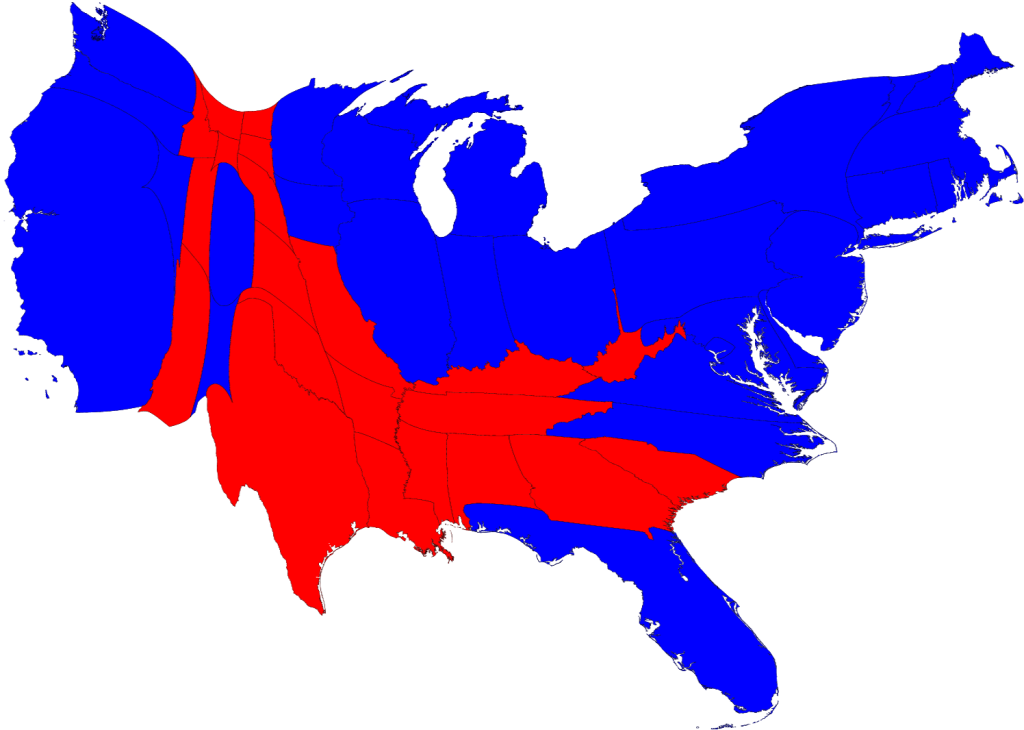
Map Projections: This may seem like small potatoes, but its sets the table for the meal of undemocracy you’re about to enjoy. When you glance at a US electoral map on the television, you see an ocean of red surrounding tiny islands of blue. It makes it seem like a vast conservative majority is somehow outweighed by little blue measles. In reality, it's the other way around. These maps reflect the basic American imbalance between population and geography that makes it so difficult to have fair representation in our vast and sprawling country.
[A population cartogram that reflects the true weight of the 2008 presidential race.]
Primary Elections: In our presidential primary system, New Hampshire and Iowa are the “first in the nation” to vote. These places get a disproportionate amount of attention from ambitions politicains. They are also places with almost zero cities. (No offense, Davenport!) This system is stupid for lots of reasons, but privileging the rural is one of them.
Locations of State Capitols: Harrisburg, Springfield, Albany, Sacramento... These are not the largest cities in America. When deciding where to put state capitals, back in the early days of the USA, those in power chose to locate them far away from the major cities. There were some good reasons to do this, because cities were extremely corrupt. But one goal was also to minimize the potential for grassroots democracy. It’s a lot harder to protest when you’re three hundred miles away. The kinds of direct action tactics that occurred in Madison, Wisconsin two years ago would never have happened if the state capitol was in Marinette, up on the Michigan border.
[Albany, New York: located far from the maddening crowd.]
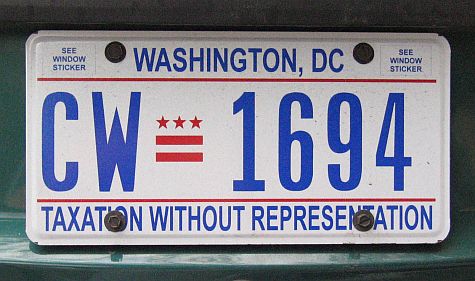
District of Columbia: Our nation’s capital is also one of nation's largest travesties of democracy. It has no official representation in congress. By complete coincidence, DC is terribly poor and disproportionately home to people of color. It’s basically a microcosm of how the American political system screws its cities and black people. If DC were an official state, it would have two senators, but it still wouldn’t be the least populous. That honor would still belong to Wyoming.
[The best license plate in the country.]
Lack of Competitive Districts: Almost without exception, competitive races are out in the suburbs or in rural areas. It only makes sense that, given this system, parties that are trying to win a majority will promote federal policies that benefit more competitive districts. Thus, you get a military base or freeway project or some other other white meat out in the swing suburbs. Meanwhile, politicians in urban districts are absolute locks for re-election. They can go ahead and spend more of their time concentrating on building a national majority (which means catering to suburban and rural voters).
Redistricting: When faced with the political clout of many people living in a city, a hostile state government is not without options. One popular choice is redistricting, drawing the boundaries of the districts to minimize and/or ‘pack’ urban areas. Sometimes that means creating the aforementioned highly uncompetitive districts. Sometimes that means drawing districts like the ones in Cincinnati or Austin, dividing up urban areas like slices of a delicious undemocratic pie.
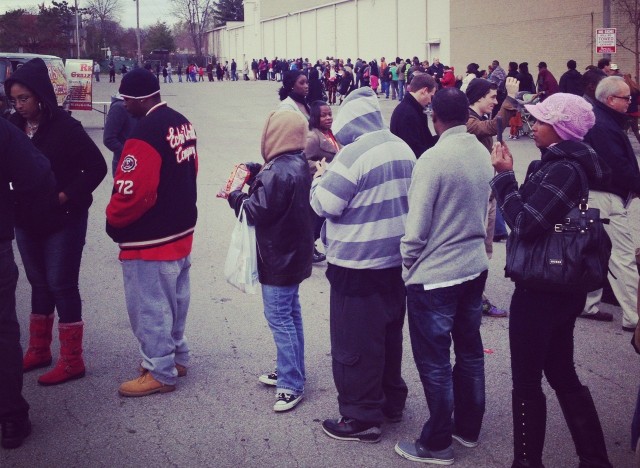
Polling Places: In the US, local jurisdictions are responsible
for running polling places. Often this means that voting is more
difficult and time consuming in urban areas. For the last few decades, Ohio and Florida have been particularly unequal. Having to wait in line for 10 hours
to cast your ballot, while people in rural and exurban neighborhoods
vote smoothly, is one outcome of our election system. Intentional or
not, it does no favors to our cities.
[A line for early voting in Miami-Dade county from yesterday.]
Electoral College: It’s a little known fact that someone voting for president in Montana gets three votes, while someone voting for president in California only gets one. OK, that’s not technically true, but it may as well be. Our fossilized electoral college system allocates votes unfairly, and disproportionately to states with low population. In Wyoming and North Dakota, there is one electoral vote for every 140K people. In Florida and New York, these is one electoral vote for every half million people. Where do you think the cities are?
The US Senate: Congress has two bodies. One of them is extremely unfair. Wyoming gets two senators, each representing a population of 568,000. California also gets two senators, each representing a population of 37,691,000. On top of this travesty, Senators are very powerful. They have long terms and are given the power to wield the the anti-democratic (increasingly abused) filibuster. As Hendrick Hertzberg explains, 10% of the population (the senators from the most rural states) can effectively block the will of the vast majority of the people. This means that passing a (pro-urban) bill through the Senate can technically require a ‘supermajority’ of 90% of the people. The undemocratic Senate holds our cities hostage to the demands of farmers and industry from our most remote places.
[Mr. Smith goes to Washington, screws the people.]
There you have it. Have fun voting tomorrow. Try not to live in a city, though, because your vote won’t be as important. If you really want to affect your nation's democratic system, call your old aunt Agnes in Beach, North Dakota. Her vote is worth double.
Well, it took a while. After years of riding a bicycle around this city, I finally got a ticket from the Minneapolis Police Department for running a red light / stop sign. One morning a few months back, I was bicycling to work down SE Como Avenue. I was a bit zoned out from my long bike trip the day before (to the far side of Lake Minnetonka and back), and do be honest, I’d forgotten that people even enforced laws about stoplights at sparsely populated intersections. And I certainly didn’t notice the police car sitting right in front of me at the intersection.
I proceeded as I normally do on a when trying to ride a bicycle to get from place to place. I came to a stop at a red light at a calm untrafficked intersection, looked to see if there was any traffic coming on the cross street (there wasn’t). And I went slowly through the intersection.
A flash of lights and a quick breeeep from the siren. Uttering the words "you have to stop just like everyone else," a police officer gave me a $120 white piece of thin paper.
A lot was running through my head. First I cursed. I thought about how stupid it was that this cop was giving me a ticket for something that endangered precisely zero people. Didn't he have anything better to do? I felt myself wanting to get upset, but I said nothing. The only thing I did was to take this photograph.
[Nothing says "USA #1" like a flag license plate on a police car giving a ticket to a bicyclist.]
A lot of people have reacted to this story with schadenfreude. “Well, you got what you deserve,” or “That’s what you get for bicycling like that.”
I guess that’s one opinion. I don't want to start a fight. And I really don't want to starting an endless asinine “cars vs. bikes: who are bigger scofflaws” argument. That’s a discussion for another day, and for the Pioneer Press comment section.
What I want to do is declare this week to be the inaugural Bicycle Freedom Week.
In case you're not familiar with it, Bicycle Freedom Week is an age-old celebration of the freedom of being on a bicycle. This week, more than all other weeks, we celebrate the freedoms that come with riding a bicycle. This week we will ride bicycles through crowds of cars stuck in traffic to attend fireworks displays. This week we will ride bicycles to the beach. This week (just like all other weeks) we will not stop at every stop sign. This week we will ponder the inevitable civil disobedience that comes with riding bicycles in cities that don’t have them in mind.
(Civil disobedience?! Are you declaring the velo-revolution? Are you a bicycle anarchist?)
Thankfully no. What I mean by civil disobedience isn’t precisely the sort of resistance to government that Thoreau intended while getting pissed about the Mexican-American War. Rather, it’s the idea that the architecture of our public spaces – the streets, lines, laws, regulations, etc. – aren’t set up for bicycles. They’re overwhelmingly intended to support and maintain the movement of cars. This system makes it very difficult to efficiently and comfortably ride a bicycle from place to place. Until it changes, most cyclists find themselves continually making personal choices about which sorts of rules to accept and which sorts of rules to reject.
These "rules of the bicycling road" differ depending on the individual and the situation. For example, the % of cyclists who actually come to a complete stop at every stop sign must be asymptotically close to zero. (Some, yes; others, no; many are in between.)
On the other hand, the percent of cyclists who would proceed without stopping through an intersection like the Lyndale-Hennepin bottleneck is similarly microscopic. (This is a good example of a self-fulfilling prophecy, as doing so would be suicidal.) Though precious few will admit it, some degree of civil disobedience is an inevitable part of riding a bicycle through the city.
[Suffrage activists on bicycles, c. 1915.]
Bicycles have long been a tool of liberation. They’re a way for people to break free from spatial constraints. Whether you're a little kid just learning to balance, a teenager traveling the city without the yoke of parents, a 19th century woman moving unescorted through the city for the first time, or someone who has lost 320 lbs through the joy of bicycling, bicycles can set you free. They free up all sorts of capabilities that many of us never thought we had. They free your mind from worry and let you feel the city in a new way. They free your senses from claustrophobia and let you smell the air, hear the birds, and get that good feeling in your legs when you really get them moving. They free you from being a selfish individualist and the tyranny of parking tickets and traffic jams and gas pumps.