Showing posts with label rivers. Show all posts

2016-02-23

The Complete "Beer By The River Test" Rankings

[This photo taken while drinking beer.]
At a recent meeting, I got to enjoy a presentation on the proposed “river balcony,” an ambitious-but-achievable proposal to build a pedestrian-only walkway along the river bluff in downtown Saint Paul.

At one point during the presentation, the City Planner paused on the below rendering and started talking about the desire for patios along the balcony route. She said something along the lines that science suggests people like being outside, drinking beer, and watching water gently flow.

Then she said, “this Mayor really wants to have a beer by the river”

I quietly chuckled. At first glance, it seems a bit nuts to spend a bunch of money and shape city policy based on where the Mayor wants to have a beer.

But than I thought, actually that’s not a bad idea. Having a beer by the river is a pretty straightforward and worthy goal

In fact, the idea scratched something I’d been thinking for years. Why don't Minneapolis and Saint Paul have any patios by the Mississippi?

[First rendering of the "river balcony" from 2013; pictured are people, beer, patio, and the river.]


Fluviophobia: the Irrational Fear of Rivers

[Minneapolis riverfront in 1921.]
For most of the 20th century, the big shots in the Twin Cities, and Minneapolis in particular, had an deep-seeded hatred of booze and the Mississippi, seeing both these things as synonymous with moral and industrial pollution. They were necessary evils to tolerate on your way to the Lake or the church.

Well it turns out they got it completely wrong. Craft beer and the waterfront have become twin pillars of the 21st century Twin Cities urban landscape, and we're better off for it. But unless you take a six-pack down to the park hobo-style (which I highly recommend by the way), it’s still to this day all but impossible to drink a beer by the river.


So I'd like to introduce what I call the “beer by the river test.”

Here it is.


The Beer By The River Test

Requirements:

#1. A place where you can legally drink a beer outside
#2. You have to be able to see the Mississippi River
#3. (Extra points for being closer.)


And here’s an exhaustive list of all the places within the borders of Minneapolis and Saint Paul that pass the test, ranked according to quality of (beer + patio) experience:


The Complete Beer By The River Test Rankings

[Psycho Suzi's patio.]
#1. Psycho Suzi’s Motor Lounge, Northeast Minneapolis

Number One with a bullet is Psycho Suzi's, really the only place where you can almost touch the water.

The image at right is carefully cropped to not show the scrap metal recycling facility across the Mississippi over in North Minneapolis, which is too bad because I find that view even more compelling. This is the Twin Cities' best BBTR spot, and it's not even close. The owner, Leslie Bock, should get the key to the city.

Plus their patio is large and the pizza and cheese curds is good (though those qualities don't affect the rankings).

[Updated as of 9/16]

#2: Red River Kitchen, Saint Paul's Upper Landing

I’m happy to say that Red River Kitchen is the only BBTR experience that can give Psycho Suzi’s a run for its money. The only downside is that the “patio” which offers the best riverfront view, only has a few benches. The picnic tables inside are nice enough but a bit removed from the amazing riverfront-plus-beer concept that continues to haunt my dreams. So, compared to the riverside tables at Suzi’s, Saint Paul still falls a bit short.

On the other hand, this particular riverfront location is an absolute A+ when it comes to urban visual interest. At Suzi’s, the river is pretty quiet. There’s not much traffic, and the view of facing riverbank is dominated by a metal scrapyard. Sure it’s honest and gritty, but it’s hardly riveting. 

[big gap here]


[Aster Café patio, the blue railings of Vic's in the background.]
#3. Aster Café, St. Anthony Main

The next three BBTR spots are all along the same stretch of Saint Anthony Main, where you can kind of see the channel of the Mississippi River that runs along Nicollet Island. None of these places are particularly close to the river. Rather, you know it's there and if you look you can kinda sense the spray from St. Anthony Falls.

Aster gets ranked higher for its superior style points and well-designed patio with bricks and tasteful fencing.


#4. Vic’s Dining, St. Anthony Main

Same as above, only with a weird 1870s-meets-1990s vibe. That said, you're a little higher up on the Vic's patio, and can probably get a slightly better angle on the river viewing, so it's a close call.

#5. Tuggs Tavern, St. Anothony Main

This is there too. Why the name? Uggs.


#6. Nicollet Island Inn, Nicollet Island

This is literally across the river channel from the St. Anthony Main restaurants. I have never been here but if they have a patio, and I am told they do, then presumably if you're on an island in the river you can see the river?

I'm going to put it here as a placeholder for now, but would appreciate input.


[Longfellow Grill patio is on the riverbluff, pretty much.]
#7. Wilde Roast Café, St. Anthony Main

Same as above, as Wilde Roast down the street serves beer too. Their patio isn't that great, but it qualifies.

[another big gap here]


#5. Eagle Street Grill, West 7th Street, Saint Paul

Saint Paul's lone entry is the back patio at Eagle Street, just across Kellogg from the Xcel center. I think if you squint you can see the Mississippi.

[I am told that the river view is no longer extant thanks to a next-door development.]


#8. Longfellow Grill, Longfellow Neighborhood

This patio is on the off-ramp from West River Road and Lake Street, and I think you can kinda see the river from there. It's way far down though, because here you're in the Mississippi gorge area, which 50-100' bluffs.

Still though! River (even if far away) + beer + patio = recipe for success.


[crickets]


In Conclusion, We Suck

Frankly, I don't know what to say. The Mayor is right.

The Mississippi River runs for 30 miles through Minneapolis and Saint Paul and it's our #1 natural amenity. Having a patio that serves beer by the river is not difficult. Every (non-heavily-polluted) city with a river anywhere in the world has figured this out. By the way, the river is clean now. Beer is "classy" now, too.

But still to this day, with one notable exception, there's not a riverfront or even river-overlooking café to be found. The second it's warm enough, I want everyone with money to go to Psycho Suzi's to sit on their patio and drink a beer. Then I want to see some budgets and architectural plans.

Let's get to work people. The Mayor is waiting.

[This is what the Mississippi River looks like.]

Update: Thanks for the feedback. I have added Longfellow Grill and Nicollet Island Inn, and subtracted Eagle Street. Sorry Saint Paul fans!


Update #2: See the new addition to the list, a complete post here.
In conclusion, I’m very impressed by the new Red River Kitchen. They exceeded my expectations, particularly in the short timeline. Go down there and drink a beer by the river. The view is unmatched anywhere in town.

Ranking: 

Solid #2, right behind Psycho Suzi’s. (With better patio furnishings, they would be #1.)

2013-07-09

Sidewalk of the Week: West Side Flats

Water is always moving. In Minnesota, with our lake fetish, its easy to forget this. Rivers flow. Oceans current. Tides rise and fall with the clockwork moon, swallowing and re-swallowing great swamps of beachfront. Rivers too stage great feasts, rising up and expanding their sides like a snake digesting a piglet, the river edges always moving, always living with a murky threat.

Riverfronts and riversides and riverbanks, then, must be carefully fortified behind city walls for fear of liquidation. Land left unguarded remains, reserved for disaster and emptied of value.

[The middle of the vacant flats.]


It wasn't always this way. The river's edge through Minneapolis and Saint Paul were lined once with lost civilizations, wagers against nature. Bohemian Flats, Lilydale, and many nameless other spots along the river housed homes built from spare lumber and anything else worth scrounging. And none of these riverside settlements had grown so dense as the West Side Flats, directly across from downtown Saint Paul, sitting atop its bluff like a castle. The area filled with factories along the streets by the bridges, warehouses along the streets behind. In between rose the unfancy homes of the city's newcomers, social climbers starting at the bottom. Sidewalks galore ran through the flats, and gangsters, factory men, families filled the streets.


[The '52 flood.]


[The flats in '52.]

['52 Streetcar boat.]


[Plumbing.]


As in most cities, topography mirrored class. (James Hill was on top.) Only the poor lived on the flats, and there was a good reason for this.  The river would rise up when spring snows melted and flood the streets. I suppose people handled it as best they could, and things went swimmingly until the '52 flood, bigger than all the rest put together.

That spring, navigating the flats required a boat. Seemingly everything was lost. In the first act of wholesale slum bulldozing in the Twin Cities, the city simply scrapped the neighborhood. Wood, tires, buildings were tossed. Some of the old flats neighborhood still sits entombed in caves inside the bluff, sealed up like a pharaoh.


['52 flood detritus entombed in a bluff behind the Wabasha Street Caves.]


[One of the vacant lots.]


[Path leading to a industrial park fragment.]


What came next was not pretty. Ironically, soon after clearing away the streets and homes, a levee was built to protect the land from future floods. Today the flats are an empty mix, its sidewalks still abandoned in the shadow of downtown. Most of the old streets circle one-story bunkers, parking lots surrounding some barely windowed bit of beige. Is it a Mexican restaurant or a hospital supply warehouse? Is it a clinic or home to MN-DOT's airport division? But for the signs, you cannot tell. Empty parking lots mass against the horizon, and once in a while odd groupings dot the landscape: an old remnant building, two dozen motorcycles, a metal yard, a cave with a locked door. Few buildings reach the sidewalk. The tallest among them a Red Cross center, and if the wind blows from the East the dry pungent smell of preserved blood washes through the air. 


[One of the only buildings meeting the sidewalk.]


[Clinic?]


[Office?]

[Mexican restaurant?]


[Empty office?]


[Flock of motorcycles.]
 
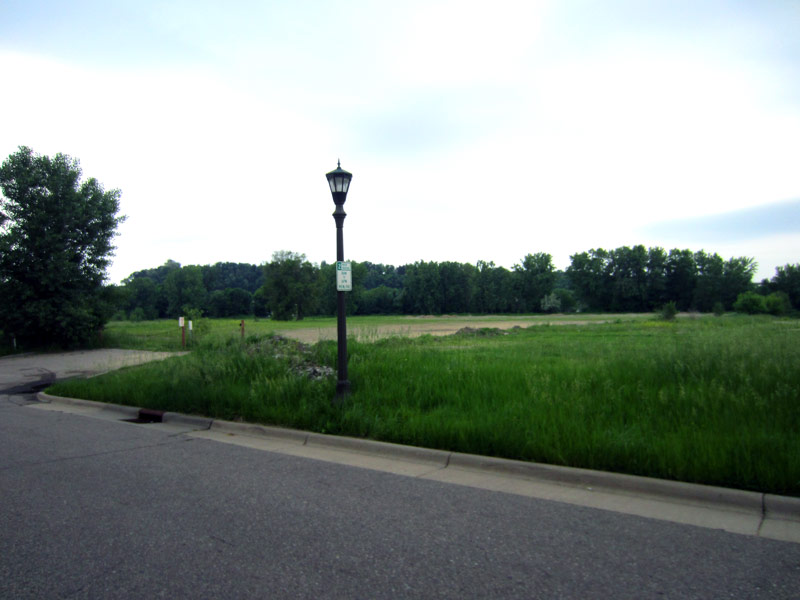
The very center of the flats is the strangest of all. Here the land still sits empty. It is just nothing, shrubs and trees, an occasional lamppost, a fire hydrant in the woods, a dumpster, a cell tower, an unclosed fence. Empty is not the correct word, of course, but vacant. Paths wend through the green lots, cutting between gaps in the hedges, leading to places with no names. Here is the city's blank shadow, the lacunae, a sixty-year forgetting, too close to city hall to see clearly. Always the river flows by the flats, now safe behind the barge wall. Each summer night the excited moan of the riverboat horn sounds here, bouncing along the tops of concrete strips, into vacant forest lined with paths through the gravel and grass. The sound suggests to me that someday the sidewalks of the flats will fill again with people, but tonight you can still feel the floodwater.  


[Just like back in '52.]


[Desire path leading to a dumpster.]

[Abandoned lamppost.]

[Corner for sale.]

[Flat vacancy in the shadow of the city.]


2013-02-12

Today on Streets.mn: A Love Note to the Mississippi

There's a special Valentine's Day theme this week on Streets.mn. All of us were challenged to come up with one thing we 'loved' about our city. Here were the instructions:
Here are a few ground rules:

- Be genuine
- Don't be ironic (no MOA, 494-169 interchange or skyway posts)
- Try to be somewhat original / unique
- Don't share ideas (if something comes up twice, that's cool)

Lets title them all with "I Love ___".

I wrestled with this assignment, particularly with the rule: "don't be ironic." Damn! I brainstormed possibilities, and rejected them almost as quickly for partial irony. For example, I was going to declare my love for NIMBYs, why despite everything I still appreciated them. But that would have been not a little snarky. I thought about my love of the city's dive bars, but that was too alcoholic. I pondered my love for the city's old working-class neighborhoods, but I don't quite feel sincere about that either. Lampposts? Sunlight? Biking?

Finally, I realized what I truly loved about the city: the river. And, importantly, not the dead river of a landscape painting, but the living river of the floodplain. Here's the main point of the essay:
Though lovely, what I love about the river isn’t its landscape. Crossing the Mississippi bridges, as I do so many times each day, you can look down at the vanishing point, the bluffs that climb up each side giving relief to the seasons. Here the river is beautiful but so distant. I supose that all cities have a backdrop, something to place outside the window, mountains or an ocean. The river is just another one of these still life paintings, and architects take great pains to arrange their views. Here the river remains untouchable, lifeless.

No, what I love about the river is how it flows through the city, how it floods and settles, how it disturbs the land and stakes its raging claim. The riverfront is a wild and open place, refusing to solidify. When I was a kid, growing up in a suburb near the Mississippi, I used ride my bike down to explore the river flats along Lilydale park. Elm trees rose up around ruined foundations of abandoned homes, and you could find occasional antedevulian artefacts, bathtubs or bottles.
I spent the last few days remembering all my riverside stories, all the old adventures. They could fill a book.


2012-06-25

Sidewalk of the Week: Prescott, WI

River towns are older then the rest of them, and river sidewalks more so. Because rivers are the oldest roads, have always massed marvels on their banks. Because when you walk through a river town you follow many paths, some faded or flooded or forgotten, walking a forest of footprints by water. River sidewalks disturb my categories and I don’t know where to aim my eyes.

River towns are important, and Prescott doubly so. Here just past the rail bridge lies a confluence. Two rivers coming together, colliding, mixing, the muddy river flowing into the clear river until they are the same light brown. These river meeting here means that behind the main street of this river town there’s another sidewalk even older than the brick one, fronting the river street. The riverbank is a sidewalk, it’s the path along the edge where people gather and land, dis- and re-embark, trade supplies and rumors. This isn’t a street corner, it’s a river corner.

That’s why the buildings in Prescott have two fronts. On the main street you’ll find the front(back), like any other town with trains and automobiles. It has its shops and windows. But behind you’ll find the back(front) side, with terraced topography and decks rising from the water. River towns are like that, pressed up to bluffs climbing steep to the sky, a few streets flatly fitted. Next to the flowing water, the actual sidewalks of Prescott seem neglected, far the stage like a theater balcony where the rules are relaxed, where you can put your feet on the railing and whisper more loudly.

[Boats under the railbridge.]


[The riversidewalk.]


[A clocktower with two clocktower banners.]


[Parallel parking with a boat is easier than with a car, methinks.]


[Townfront parking.]


One thing is beyond doubt: few Wisconsin sidewalks are lacking for bars. Gravity seems to pull people down to the street where they collect like rainwater to eat cheese and drink beer. In the summertime this sidewalk, like all the sidewalks along the river, fills with grumbling motorcycles and convertibles with women in hats. In the winter it must be lonely. These people flow through here like streams, living out grimy escapes through time, reaching for the youth of these river towns to recollect when rivers meant more to us.

In Prescott, there’s a banner of the clocktower on the side of the clocktower so that everyone knows where to look. They’ve painted long dead people on the sides of empty streets, and the illusion holds for a moment until you realize that nobody blinks or moves or shouts your name. River towns are wrapped in illusion, the fantasy that the river is still carrying fates. Any maybe they’re right, because no matter how empty the aging brick buildings, the river is still there, moving quickly past the riverbank sidewalks, a swirling sulking musty flooding ebbing power that couldn’t care less about what we think it means.


[Old paintpeople on a sidewalk in Prescott.]
[Main street Prescott with angle parking.]


[Folks watching traffic go by on a sunny Prescott day.]
[One of the few sidewalk front(back) cafés.]
[A back(front) riverfacing bench.]