Showing posts sorted by relevance for query target field. Sort by date Show all posts

2010-06-16

Target Field’s delicate LULU dance [The Sidewalks of Target Field Part 2]

[Click for Part One of this series on Target Field. The image at Right illustrates how Target Field's elevated sidewalk takes fans over and through the previously impenetrable moat of parking garages just to the West of 2nd Avenue N in Downtown Minneapolis.]


During the long debate over the funding and construction of Target Field, one of the most common and most compelling criticisms was that it made no sense to place a $350 million baseball stadium directly next to the HERC plant, the county’s huge industrial facility solely devoted to generating electricity by burning foul-smelling garbage.

Indeed, Target Field sits at a vortex of different parts of downtown Minneapolis. It borders the night club-centric 1st Avenue/Warehouse district area on the East, touches the residential / riverfront North Loop on the North, and, on the South and West sides, rubs up against the city’s neglected and overlooked LULU zone.

[An angle of Target Field you'll never see in the brochure, emphasizing its proximity to the elevated 394 freeway and the Hennepin County garbage burner.]


LULUs is urban planning lingo* for Locally Unwanted Land Uses, which includes homeless shelters, halfway houses, garbage burners, and other loud light industrial businesses like metal smashing and car crushing and whatever else comes with ultra low property values. LULUs are the logical consequences of NIMBYs (Not In My Backyard), as every time property value laden homeowners get outraged over some zoning change, cities tend to place unwanted or politically difficult projects in places that already have politically difficult projects. So, the end result is that all the homeless shelters in the city tend to get clustered together, and placed next to the garbage burner and the bus depot. And so Target Field is next to the garbage burners and the homeless shelters and a bunch of other ‘interesting’ places in ‘near North’ Minneapolis that you’ve probably never been to or heard of.

[You can still see what the stadium site used to look like on Google Maps. The field lies within a section of town cut off by 3 or 4 freeways, train tracks, and other impenetrable infrastructural barriers.]

As a result, the stadium’s design performs a delicate land use dance, opening itself up to the neighborhoods on the South and East, and shielding itself off from areas to the North and West. In fact, compared to any other contemporary stadium, Target Field’s site is incredibly compact. (I’ve heard a little as 8 acres, so this seems ridiculously small to me.) It was built on a site that was once a surface parking lot, just on the on the non-downtown side of the mid-90s I-394 & parking lot project. The (misguided) 394 project erected an elevated 8-lane freeway leading directly from downtown to the wealthy Western suburbs, which placed a huge barrier between the now-gentrifying North Loop area from the LULU zone. And, on the South Side, placed a giant complex of city-owned five-story parking garages that essentially formed a fortified wall between the downtown office buildings and the LULU zone. Target Field is on the ‘wrong’ side of both of these large barriers, but manages to bring people over the divides in very elegant ways.

And, through a few design tricks, the stadium does this without really seeming to. Most of the fans are encouraged to enter via entrances that link up to the light rail stop or the 1st Avenue / Warehouse district area. Particularly with its connection to East, the stadium uses an elevated sidewalk and plaza to make this transition fairly seamless, so that you don’t really notice that you’re next to a freeway or going through an area surrounded by large parking garages. Fans can enter without really even seeing or noticing the extensive freeway and parking infrastructure.

[An elevated sidewalk and plaza, and a clever "Chino Latino" mask for the pre-existing parking lot, is one way that Target Field manages to disguise its infrastructural surroundings.]

At the same time, the stadium places a scrim wall all along its Northwest-facing ‘backside’, ostensibly featuring the history of Minnesota Twins greats (including my favorite, Ron Davis), but actually preventing people from seeing the industrial land uses directly adjacent to the stadium. Only with close careful inspection and no little amount of peering can you tell that there are power transformers, homeless shelters, scrapyards, and a HUGE garbage burner directly next to the stadium.


[The scrim on the Northwest side of the stadium, shielding baseball fan's eyes from the unsightly smokestacks and homeless shelters of the city's LULU zone.]


In this way, the stadium connects a little section of real estate that was previously unconnected to the downtown street life, including a number of wonderful (and large) historic buildings, like the huge 10 story warehouse across 5th Avenue from the stadium. When the stadium was built, there was (and still is) a lot of concern about how the ballpark land use would fit with the industrial and social service land uses nearby. For example, how will homeless people be treated if they hang out in the ‘public’ plaza in front of the stadium? Will the huge county investment in the garbage burner next door to the stadium be limited by the fan’s or the team’s intolerance of any unusual odors? Will industrial businesses near the stadium, like Shapco or Northern Auto Parts be able to stand the disruption of baseball games 82 times a year, or will they flee to the suburbs and take their increasingly endangered urban industrial jobs with them?

At any rate, when compared to a sparsely-settled site out in the suburbs, or a depopulated site surrounded by surface parking lots (like the old Metrodome), the site of Target Field is a very interesting place, surrounded by a diverse set of land uses. The stadium does a very interesting architectural dance, managing to draw people in from the active areas of downtown across some majorly disruptive infrastructural barriers, while keeping people and stadium street life away from the industrial areas of the city. For fans of the both the Twins and the city of Minneapolis, seeing how this area changes during the next few years will be very interesting.


* 94% of urban planning lingo consists of the Construction and UTilization of Acronymns (CUTA).

[Even on an off day, you can find Twins fans walking next to the previously remote Shapco manufacturing company and historic warehouse building.]

2010-08-24

Target Plaza's Surprising Sidewalk (The Sidewalks of Target Field Part 4)


[Target Plaza. Click to enlarge.]

If you’ve been to one architectural presentation, you’ve been to them all. They typically have flashy graphic design and lots of catch phrases. They for sure have those ‘architectural renderings’ that have those fully-grown green trees and happy looking racially-diverse middle-class fakepeople walking around in family groups. They’re typically filled with carefully thought out pleasant-sounding phrases like “promenade” and “tectonics” and “esplinade” and “façade” and “[insert latest trendy jargon here]”. If architects are good at anything (besides building buildings), its giving a good powerpoint presentation.

Well, I happened to be at a number of these presentations when the stadium was first being pitched to the state and county governments, and I distinctly remember rolling my eyes and tuning out when the stadium architectural firm started talking about the stadium plaza. It would connect the entrance to the street and create community space and blah blah blah snooze. Really, they always say something like that. And, as any fan of William Whyte’s wonderful work will know, most large building’s plazas end up being completely vacant, soul-sucking spaces devoid of life that only look good from a large distance or in an pretty architectural sketch.

Well, I’m happy to eat crow on this one. Because Target Field Plaza is one of the best (newly) designed spaces I’ve ever experienced. Let me tell you why.

The Tale of the Entrancing Entrance

The first time you go to Target Field, I really, really hope you get to enter through Gate 34. It’s the gate that’s oriented towards 1st Avenue North. If you got to the statdium on foot, from the general vicinity of Downtown Minneapolis, this is probably how you got there.

You see, because of the small footprint and inconspicuous siting of Target Field, the stadium is quite hidden. It doesn’t ‘loom’ above anything, really. Instead, it sits low down behind the Target Center on the very periphery of the city, wedged between huge rows of parking lots and a bunch of industrial and freeway-oriented spaces. As a result, you can’t even glimpse it from anywhere downtown. The first time you go there, you won’t even know where it is.

In fact, the first sign that you’re entering the vicinity of the stadium will be, not a giant looming white marshmallow bubble poking up over the nearby parking lots, but a gradual increase in Twins shirts density, first one then two then three scalpers asking for tickets, someone slowly turning up the volume of street life, families getting out of trains, folks crowding bars. But you won’t see the stadium.

[This is the view of Target Field from 4 blocks away.]

[This vague corner is the main entrance to Target Field.]

Walking down 1st Avenue from the warehouse district area, you’ll eventually a little tiny marker with an arrow on it pointing towards “target field”. And, rather than a huge stadium concourse, you’ll find yourself walking down the sidewalk in between the (looming) Target Center and the historic Butler Square building.

It’s an odd sidewalk that gradually slopes upward toward a skyway that runs between the two giant parking lots. It funnels people a bit narrowly into this strange space, past a hideously ugly Joe Mauer statue, around the corner of the newly-relocated Hubert’s Bar, and over the 2nd Avenue North streetcorner.

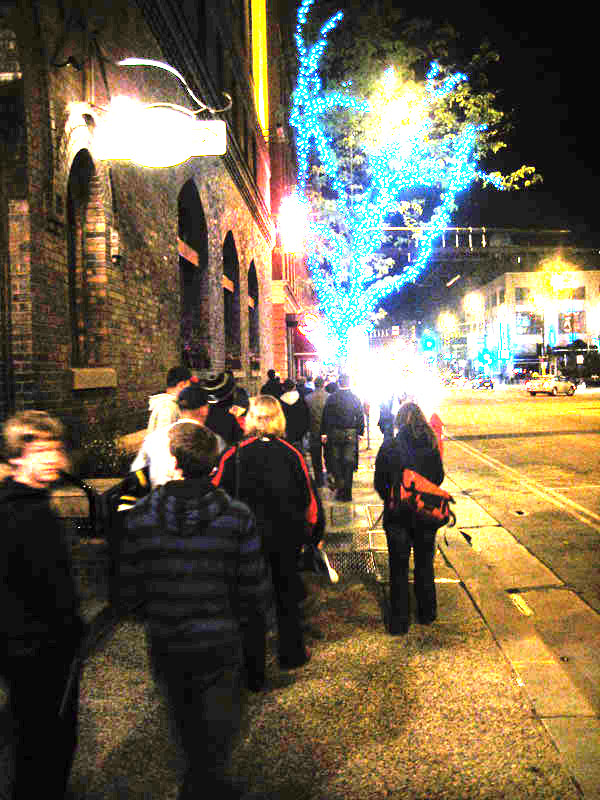
All this while, the excitement level builds. Your sense of anticipation starts to jump all over the place as the crowd becomes ever-so-slightly denser and more excited. You can feel that the stadium is nearby, you can hear the sounds of many voices, but, still you can’t see it.


[You ask, into what sort of post-industrial wasteland have I wandered?]

[At this point, you're know you're getting warm. The ballpark is somewhere very close by.]


Finally, you end up going past a bronze statue of Harmon Killebrew hitting a home run and pointing his bat at a skyscraper, and proceed underneath a low skyway bridge between the two massive parking lots and then - WHAM!- the full impact of Target Field hits you.

All at once, you’re in the middle of a large open space filled with baseball. In front of you are the stadium lights and the sight of thousands of fans in the seats that arc behind home plate. All around you are stadium barkers calling out, selling peanuts and cracker jacks and everything else. You’re in Target Plaza, and the place is filled with excitement. Its almost as if the main gate (where they take all your money) doesn’t exist. It’s almost (almost, but definitely not) as if the sidewalk leads right into the seats, as if the stadium is a seamless part of the city, as if the field’s green grass is just another city park and the concourse is another block of Minneapolis sidewalk.

[The pre-game hurly-burly hurdy-gurdy hustle-bustle hullaballo.]

[The field beckons like a sidewalk siren.]

What I’m trying to describe is the elegant way that the space in Target Plaza connects the stadium to the streets of Minneapolis. The low bleachers in Right Field open up right into the street, bringing a little bit of the city right into the stadium. During games, I’ve seen folks without tickets hang out near the metal fence for innings, just to be part of the action. You can’t see any of the field of play from there, but you do get a sense of the camaraderie that makes baseball so good at building community.

And after the game, the process seems to work pretty smoothly in reverse. People flow out of the stadium. Even if there are concerns about whether or not the space is truly ‘public’*, Target Plaza is a wonderful addition to the interface between the new Target Field. The way the plaza connects the 1st Avenue sidewalk and the stadium is an architectural masterpiece. Let’s just say I was pleasantly surprised.


[A pleasant green buffer between the parking lots points toward the city, and provides a nice place for sittin'.]

[The Plaza opens up space in what was previously the creepy crappy land behind the Target Center.]

[There are benches and waste bins.]

[This long, low skyway connecting the two parking lots predates the stadium, but provides an excellent 'contrast point' demarcating where baseball excitement truly begins and ends.]

[Even when the Twins are out of town, people can hang out on the Target Plaza.]

PS. This is it, by the way. The end of the road. I'm not writing anything more about this stupid stadium.

PPS. It's not stupid. I like it.

*This is surely something that we need to keep our eyes on. It should be a public space, with all the freedom of speech that entails.

2010-08-17

Target Field's Economic Boon (The Sidewalks of Target Field Part 3)


[Fans outside the Loon Cafe on gameday.]

For a long time during the 80s and 90s, sports stadiums were billed as the crucial big ‘megaproject’ that would resurrect downtowns. For planners, politicians, construction companies, the media, and sports team owners (and that’s a large chunk of any city’s local power base), stadiums were shiny silver bullets with silver linings and silver tongues. They could bring people back to downtown, increase economic activity, attract tall buildings in a single bound, etc.

In an argument that will be familiar to anyone whose ever attended a public/private partnership powerpoint presentation, stadium boosters attempted to undermine critics by talking about how stadiums would increase local economic activity, and therefore boost a city's and region's tax revenue. Stadiums would "revitalize neighborhoods", bring in tax dollars, return people and their wallets to the city, lead to an avalanche of new sports apparel shops, sports bars, and local giant-foam-#1-hand factories. Shiny, large, and ribbon-cuttable, plus they practically pay for themselves? They were the ultimate in ‘win-win’ projects.*

Well, as the vacant lots surrounding the Metrodome will testify, it turned out that stadiums were not necessarily supercharged economic magnets. Beginning with Baade and Dye’s influential 1988 article “Sports stadiums and economic development: a critical review” (which suggested stadiums might not have actualy have a positive impact) and then their subsequent 1990 expansion of the argument, (which suggested that stadiums were not only neutral, but had "possibly negative impact" on the surrounding area) the urban economic planning world began to turn on the idea of stadiums as economic development tools. Since the good old days of the 80s, urban economists have systematically debunked the slick claims and magic bullets and of the stadium's snake oil lobbyists. As it turned out, stadiums weren’t that great. Nobody really wanted to be near them. They were uncomfortably large and looming. They caused tremendous amounts of traffic congestion whenever they were in use. Any economic activity that they did generate was probably just shifted from some other place nearby, cannibalizing other retail or entertainment dollars spent in the city.

But, on top of that, there was a basic paradox at the heart of the economics of stadiums. For city planners and local boosters, the goal was to have the stadium’s activity ‘trickle down’ and spread out, having ‘multiplier effects’ that cascaded through the local entertainment and hospitality industries. But, for the owner of the sports team, the goal was to keep as many of those entertainment dollars as possible within the team’s income stream. Stadiums were built with an ever-expanding suite of team-controlled revenue streams. Stadiums were built to include their own bars, restaurants, sporting apparel stores, parking lots, and even hotels. Stadium owners attempted to design places where every last dollar spent on the day’s outing went directly to the team. So, when it came to having local economic impact, teams and cities were very much at odds.

[Wrigley Field is surrounded by a neighborhood filled with buildings not owned and operated by the team owner.]

The economic paradox at the heart of stadium economics means that there is a lot of variability when you look around the country when it comes to how economically friendly each stadium is designed to be. At one pole, you have the classic old stadiums: Fenway Park in Boston, Wrigley Field in Chicago, or (old) Yankee stadium in New York. These were built on small footprints, without a lot of internal amenities and entertainment revenue streams. And, surrounding any of these places, you will find whole neighborhoods of small businesses and bars that have sprung up nearby. On gamedays, these places fill up with fans who hang out somewhere a few blocks away, having pre- or post-game drinks or food, happily spending a portion of their ‘sports dollars’ at someplace out in the city.

[From a local economic development perspective, Dodger Stadium sucks.]

On the other hand, you have the ‘stadium complex’, a la the old Metropolitan stadium, LA’s Dodger stadium (somehow now the 3 oldest stadium in the majors), or (worst of all) the new Dallas Cowboys ‘complex’ (though anything in Arlington TX would qualify). These stadiums aren’t in neighborhoods. Rather, they surrounded by a vast moat of surface parking lots, and the only thing they’re ‘close to’ is a highway exit ramp. Among other consequences, this allows the team to keep something close to 100% of the revenue from the sports fan. There simply isn’t any alternative to spending money with the team’s organization. And, the double-edged result is that the team owner makes off like a bandit, while the ‘local economic impact’ of the stadium is reduced to a minimum of income and business taxes.

There are various iterations of this concept, lots of stadiums that, even when they’re located in downtowns, are still try to keep all the dollars ‘within’ the stadium. Cincinnati is a good example: the stadium is surrounded by a big freeway and a much bigger river, too far from any other ‘neighborhood’ to have a great deal of impact. The Metrodome is another good example, even though its revenue streams were very small. The only businesses that received any benefit from the dome being there were surface parking businesses, Hubert’s, and that crappy “Twins and Vikings museum” that nobody ever went inside.

[The city of Cincinnati has systematically placed its stadia where they will have the least amount of local economic impact.]

Well, for a number of reasons, Target Field seems to be doing really well on this spectrum. It’s small footprint, located in the heart of a neighborhood that is already filled with activity, buildings, bars and restaurants, means that there are many ways that the economic activity of the stadium on game day spills out and trickles into other areas of Minneapolis. In fact, a while back the Strib had a column which is pretty much the best-case scenario for a sports stadium booster:

Not only are 40,000 people showing up night after night during home stands, but they're showing up with smiles on their faces and money in their wallets and a new desire to actually stay a while.

"The crowds are happy; they're not too drunk, and they hang out," Ober confirmed. "It's been great."

Of course, you're going to hear all about Target Field's ripple effect from Twins officials and the mayor and especially the Hennepin County commissioners who put up the tax money for the ballpark. But take it from the people who were on the battle lines, or tap lines: The mania for the Twins' new home has vicariously turned into something of a love affair -- or at least a rekindled likeship -- with downtown Minneapolis.

On top of that, hotel occupancy rates are up, and transit ridership has gotten a boost.

In short, unlike a great many new stadiums built in the US, the location of Target Field seems to be having lots of positive economic consequences for Minneapolis. Because the stadium is right smack dab in the middle of the area’s ‘entertainment’ district, places that usually rely on the weekend party crowd now seem to have a completely different set of customers and traffic from which to draw business. (Even the naked lady industry tried to get in on the action.)

It's impossible to say for sure. Studies of this stuff are notoriously unreliable. But judging from the anecdotal evidence of my own two eyes, its no small thing that the servers at both Pizza Lucé and Cuzzy's are now dressed in Twins garb throughout the summer. And, while it probably means that the teams revenue strem isn’t as full as Jerry Jones’ wallet, it’s a good thing for Pizza Lucé. And, if you ask me, what's good for Pizza Lucé is good for America.

[Even when they lose, there's a party on 1st Avenue after a Twinkie game.]

*Any time you see this phrase, squint your eyes and look suspicious.

2010-06-02

Finally an Real Urban Ballpark! (The Sidewalks of Target Field Part 1)

I’m about as big a baseball fan as they come. And while I’m critical of poor people’s tax money lining the pockets of local bazillionaires, as well as the culture of reactionary homerism that vaguely afflicts the Twins organization, I was dying to see what the new stadium felt like.

Back in 2005, when the stadium bill passed, I was working at the state legislature and got to sit in on a lot of the house committee meetings about the stadium. I saw endless different stadium plans appear on posterboard and powerpoint. I sat through the endless company talking points about “fan friendliness” and “intimacy” and “urban” and “bike trail” and all the other stuff that sounds good to a DFL legislator. The process was heavily charged, and given the constant stream of cuts to education, health care, and everything else under the sun, giving away $350 Million public dollars to what is undeniably a private business is unconscionable. The only saving grace is that the Pohlad family (unlike carpetbagging Zygi) doesn’t seem likely to sell the team after its dramatic increase in value and revenues.

But, be that as it may, I grew up going to lots of Twins games at the horrible Metrodome. My dad would take us to the games and my brother and sister and I would ‘circumnavigate’ the far upper reaches of the upper deck, wandering around the empty seats. The Metrodome, like skyways, giant public housing towers, and Spam canned ham, was a Modernist fantasy whose death (at least for baseball) was long overdue. I’ll miss going to baseball games there only because of childhood nostalgia, plus the occasional moment of excitement when the pressure’d air blew you out of the exit doors.

So, what is Target Field like? I’ve been lucky enough to be there three times so far, and honestly, I can’t find a single negative thing to say. (And that’s despite the fact that two of the three days it rained on me, including that accursed ‘rain suspension’ against the Yankees.) It’s just wonderful, and reminds me of all the best things I love about America’s great baseball parks. It has the Wrigley Field concourse, old Yankee stadium bleachers, Fenway’s small footprint, and that ‘new car smell’ that you find San Fransisco’s Pac Bell Park. It’s a great place to be for baseball.

But, what about for the city of Minneapolis? How does the new stadium fit into the city? Does it catalyze activity downtown? What kind of impacts and effects does it have on its surrounding land uses and neighborhoods?

From a urban planning perspective, there are two things that I absolutely adore about the stadium, and one that I find half intriguing and a half troubling. Over the next few days, I’ll tell you about each of these things in turn.


[Even the inside of Target Field is filled with good sidewalks.]

2016-04-19

UNANSWERED QUESTIONS ABOUT THE SNELLING-UNIVERSITY DEVELOPMENT AND SOCCER STADIUM

[The place we're talking about.]
There's a "public meeting" tonight co-sponsored by Neighborhoods First, a group I quite like that has spearheaded the efforts to re-think Ayd Mill Road as a pedestrian, park, and bicycle space instead of a half-assed freeway.

To me, re-developing the "superblock" at Snelling and University is the same kind of thing: taking a space for cars and making it a space for people.

But there are lots of unanswered questions like these:


Q: WHERE WILL I GO TO GET DRIVE-THRU FAST FOOD ONCE THE MCDONALDS IS GONE?

I worry about this a lot. If this development happens as planned, soon there will only be the drive-thru at the Taco Bell, Hardees, Wendy's, Arby's, White Castle, Popeye's, and Culver's to get fast food while sitting in my idling car.

(Thankfully there's always the bank McDonalds and the McDonalds two miles to the West.)

[I'd like to get rid of this drive-thru as well.]

Q: WILL IT FINALLY BE SAFE TO CROSS SNELLING AVENUE ON FOOT?

Good god I hope so, but history tells us otherwise.


Q: SOCCER IS DYING YOU GUYS

Soccer is the most popular sport in the world.


Q: WILL THEY BE ABLE TO EXPAND OR IMPROVE THE SNELLING AVENUE SIDEWALKS?

One big tragedy about the situation is that MnDOT just spent millions of dollars reconstructing Snelling Avenue and the I-94 bridge but didn't really figure on safely accommodating lots of pedestrians. Of course, they even came up with a plan to do so full of good ideas.

But, you know, MnDOT.


Q: DO I TRUST BILL MCGUIRE?


[Private park built by Bill McGuire and "given" to the city of Minneapolis.]
About as much as most billionaires.

Which is to say, no. I'm not a fan of the for-profit health care business, for example. But at least he's better than Zygi Wilf? (Note: very low bar.)

I'm also not a fan of privately owned "public" parks. But Gold Medal Park could be worse? It's OK for meeting up for large group bike rides and it's photogenic, even if it is mostly useless as a true public space.

So I don't know. At least he's been coming to meetings and answering questions.

To me, the important variable is the surrounding development, and at first glance, the initial plans are very encouraging

But plans are one thing, and actual construction is another. It would suck if the development didn't actually happen. Getting strip mall owners to redevelop their property is difficult. That's my #1 fear.

[Planned land use.]


Q: WHAT WILL BECOME OF THE BOWLING ALLEY?

I hope it can move into new space, but bowling pin machines are extremely unmovable and the alley has sixteen (!) thirty-two (!!) of them.

[The bowling alley is under here.]


Q: WHAT WILL BECOME OF THE LIQUOR STORE?

It's a good liquor store. It's kind of like Saint Paul's Chicago/Lake Liquors, if Chicago/Lake Liquors had a parking lot that was twenty times larger.

I bet it'll be able to move into a new building if the owners want, though the timing might be tricky. Target sells booze now but I don't shop there if I can help it.


Q: WHAT ABOUT FINANCING?


[Early Metrodome rendering.]
From a simple financing perspective, the Metrodome was the best stadium of all time. But it sucked.

Point being that stadium financing is a terrible thing. I wish there was a blanket ban on public dollars going to fund private sports stadiums. So thanks Obama for that.

Even if there were a ban, it's likely that government would still pay for things near sports stadiums such as roads or other infrastructure (e.g. almost useless pedestrian ramps to light rail platforms heading the wrong direction).

Tax-funded infrastructure is a thing that happens for many developments, from a parasitic Walmart store to a residential cul-de-sac development to the very existence of a thing like a freeway or a transit line (at least, if it's not using a "value capture" financing model). This relationship holds true about a lot of things, and the city would likely be spending millions of dollars building new streets for any development that went into this site. (There were plans on the books years ago.)


[From the already-existing Snelling-University plans for a re-built street grid.]

I respect people who adopt black-and-white attitudes about stadiums, but for me the question is more relative. For example, I think Target Field is really well-designed and just about the best baseball stadium we could have built in Minnesota. I wish it hadn't cost so many tax dollars because I don't like that at all.

(Note: I also wish the Minneapolis Convention Center didn't get big subsidies. And oil companies. And freeway construction and maintenance. And the defense industry. More stuff too.)

Thus the relativity. If Target Field hadn't been built, would there have been tax-paying development on that site? Probably someday. Maybe even today. Would there be as much development in the North Loop? I don't know. It's awfully close to the garbage burner and the city's homeless shelter "LULU" zone. So it's hard to say.

Financing aside, I think Target Field is the best-case scenario for stadiums in the Twin Cities. The Vikings stadium is the worst. Actually, Target Center isn't that great either.

But that's a big caveat. Including financing, you'd have to say that this proposal seems like the best-case scenario. Then I'd rank the regions' stadiums like this: Saints (scale!) > [tied] Gophers football  =  [tied] Wild >  Twins (because of the $$$) > Wolves > Vikings (death star).

Would the Twin Cities be better off if all these stadiums simply had never been built? I have no idea.

Probably maybe?


Q: WILL THERE BE "TEMPORARY" SURFACE PARKING LOTS ON THE SITE WHILE WE WAIT FOR THE PROPOSED MIXED-USE DEVELOPMENT?

If so, I hope it's VERY short-term.


Q: WHEN WILL THE RAINBOW FOODS SEE THE WRECKING BALL?

I hear it's the first to go, but it still won't be soon enough.


Q: WILL THERE BE TRAFFIC?

Yes. The corner of Snelling and University will always have lots of car traffic.

Should we keep half of University Avenue as a giant surface parking lot because traffic is bad on Snelling Avenue? Hell No.

Is traffic better or worse with the Green Line than it was before? I think it's about the same. Maybe even a bit lower. Certainly, people drive a bit slower and more safely. That's kind of interesting if you think about it.


Q: WHAT WILL BECOME OF THE DIVE BARS?

[Hot Rods.]
Won't someone think of the dive bars?

I'm thinking about the dive bars. I hope half of them stay around for a long time to come. I really don't want to see the old two-story University Avenue buildings torn down.


Q: WHAT ABOUT NOISE?


Hm. Honestly, a lot of people were worried about noise at the Saints ballpark, but it hasn't proved to be a problem at least not according to my Lowertown friends who have a performance space next to the Farmers' Market. I have heard that soccer stadium designers think very carefully about noise.

You know what noise really sucks? The constant sound of a thousand cars and trucks driving on a freeway or on Snelling Avenue which is pretty much a freeway at least by technical designation. Soccer fans literally sing, which is better to me than the sounds of an engine-braking semi truck. But like I said, I doubt anyone will be able to hear it from very far away.


Q: HOW WILL I BIKE TO THE STADIUM?

Let's say I'm a 22-year-old person living in somewhere to the Southwest in either Minneapolis or Saint Paul, within about a 10-mile radius of the new stadium. Riding a bike would be ideal! Too bad there's no direct way to get there.

Here's the route suggested in a recent city presentation:
[Pascal doesn't connect to Selby. which means you have to ride on Snelling or Hamline, which both suck.]

I think the team and the planners should take this problem very seriously. I doubt they will spend any meaningful money on solving the problem, which would be too bad.

One idea would be a few more Charles Avenue-style bike/ped crossing medians.

Another grander idea would be turning one lane of St. Anthony Avenue into a protected bike lane. Maybe even Concordia, too. Someone suggested that to me a while ago and at least it's intriguing.

Even bigger idea? Ayd Mill Road linear park / bike connection to Pascal Street.

The biggest idea? Greenway connection to Minneapolis.


Q: WILL THERE BE A TIF DISTRICT FOR THE MIXED-USE DEVELOPMENT?


We don't know. At least CM Noecker raised the issue. I'm skeptical but open-minded on TIF but would like clarity and transparency about how it's used and the conditions for termination.


Q: WHAT WILL BE THE NON-MOTORIZED MODESHARE FOR SOCCER GAMES?

In Portland, I heard it was 70%. In Ottawa, I heard that they have a unique ticketing/parking system that reduces demand to the point where they didn't build very much on the stadium/development site.

This is what we should be focusing on.


Q: WILL PEOPLE PARK IN THE NEIGHBORHOOD?

Yes, sometimes I'm sure that will happen. People park in lots of neighborhoods. Lots of people thought that when the Green Line was being planned, that the neighborhoods would fill with cars. Has it happened? I don't know. Not much?

Will it be hard to park near your house if you live in Hamline-Midway? Slightly harder maybe.  It depends on where exactly you live. How many cars do you own? How far can you walk while remaining in a good mood?

There will be 12 17 soccer games a year. I think it'll be OK. If it's horrible, there are some quick-fix solutions, though like traffic, the "parking problem" is not going to magically disappear.


Q: WILL THE NEW SKYSCRAPERS BLOT OUT THE SUN?

Hey they're pretty tall! It's kind of mindblowing to see the before-and-after photos.

Here check them out:


The big change reminds me of two or three other neighborhoods, all in Minneapolis, that have been utterly transformed in the last decade or so. I'm thinking of the Mill District, which used to be a sea of surface parking lots and a one-story liquor store and is now a dense mixed-use neighborhood providing thousands of people with homes and lots of tax revenue for the city. For me, the change is one for the better. In 1996, my friend and I used to pay $1 a day to park in a parking lot where the Guthrie is located today. I'm not nostalgic about it.

Stadium Village around the University, and Washington Avenue in particular, is almost unrecognizable compared to 5-6 years ago. It used to be a car-choked death trap with a few middling stores, a car repair place, the Army/Navy recruiter (still there!), brutalist institutional architecture, and unromantic "student houses." Today there are thousands of new units of housing and shiny new retail places (though Big 10 is still my favorite), and the street has become a walking/biking/transit paradise full of people.

You might say the same thing about the many new apartment buildings that have been built along the Midtown Greenway in Uptown. It's a dramatic positive change.

For decades, Snelling and University has been a giant trash-strewn parking lot with a run-down strip mall, a Radio Shack, a few vacant lots, a couple drive-thrus, an underground bowling alley, and a decent liquor store. It's been a terrible place to walk or bike or wait for the #21 to show up. Nearby development like the CVS (or even the Spruce Tree) have left a lot to be desired.

To me, these plans look revolutionary in a good way. It's about time Saint Paul started seeing some dramatic steps forward. Minneapolis has a few examples and Saint Paul has lots of opportunities for similar positive change. Details are important, but let's not lose sight of the big picture in the mind-numbing chaos of a lifetime of parking lots and honking cars.

http://tcsidewalks.blogspot.com/2016/03/tc-sidewalks-booklets-now-available.html

2013-09-09

Twin City Streets Musicians #12

[Target Field, Minneapolis.]


[Minnehaha Park, Minneapolis.]


[Rice Park, Saint Paul.]


[Drums. Target Field, Minneapolis.]


[Conga drummer. State Fair, Saint Paul.]


[Irish pipes. Lowertown, Saint Paul.]


[Drums. State Fair, Saint Paul.]


[(Walking) Bass. Downtown Saint Paul.]


2010-12-30

Best of Twin City Sidewalks 2010

[The snowy sunset over Como Park in February 2010.]

I set a new record with 148 posts in 2010. It's amazing how many times you can write the same diatribe about cars without getting bored! Here are my favorites from this year...
Let's hope next year is as fun as this one!

[The too-narrow sidewalk along West Lake Street leaves room for improvement.]