29.6.09

Sidewalk Closed Signs #3

[Sidewalk closed sign on 1st St. Downtown, Minneapolis.]


[Sidewalk closed sign on 1st St. Downtown, Minneapolis.]


[Sidewalk closed sign on Como Avenue. Saint Paul.]


[Sidewalk closed sign along East River Road. U of MN campus, Minneapolis.]


[Sidewalk closed sign along East River Road. U of MN campus, Minneapolis.]


[Sidewalk closed sign on Cedar Avenue. West Bank, Minneapolis.]


[Sidewalk closed sign near 28th Ave S. Phillips, Minneapolis.]


[Sidewalk closed sign. Downtown, Saint Paul.]


[Sidewalk closed sign. University of MN campus, Minneapolis.]


[Sidewalk closed sign along Portland Avenue. Downtown, Minneapolis.]

The Rise and Fall of Denny "Hecker" Hecker


[Grandpa Hecker explaining easy financing to 19th century speculators.]

Alas, I had to listen to MPR's high-profile panhandling this morning. They devoted a prime-time Kerri Miller slot to a "debate" over the social worth of the super-rich. (The title, and I'm not making this up, was "How the Super-Rich serve society". Think: Tad Piper: Great Minnesotan or Greatest Minnesotan... Call now to donate to MPR's Legacy Fund!) When even our 'public' radio can't take class politics seriously, it made me think again about how far from the left this country really is. And it made me think again of Denny Hecker.

Almost a year ago, I vented some frustrations about a Denny Hecker ad that caught my eye. It was a big picture pasted on the side of city buses with Hecker's smiling mug that said "Nobody Walks". It wasn't much of a post, and though I still think it was a slanderous anti-pedestrian taunt, it certainly didn't amount to much.

[That one little post became my most widely-read by no small margin.]


What's interesting, though, is what's happened since then. For quite a long time, that post rose to become one of the top-10 hits for Google searches relating to Denny Hecker. And it has accounted for a huge percentage of this blog's traffic ever since Denny's suburban empire has fallen like a house of casino cards. The post has received over 8,000 hits, and dozens of vituperative comments. It's like a great anti-Hecker graffiti wall, a public shackles filled with rotten tomato condemnation. Judging by the comments that appeared on this blog, many from ex-Hecker employees, Denny was a singularly repulsive human being.


[An abandoned Hecker home sits in the middle of nowhere. Img. MPR.]

The rise and fall of Hecker reminds me about how central suburban greenfield development, home construction, and auto sales have become to the US economy. It's depressing to think that so much of the US GDP depends on the mindless-construction of planned obsolescence homes in empty farmland, and selling new homeowners the broken dream of remote country living. Hecker honed this to a fine art, attaching his name to a package of car loans, home loans, and easy financing. It turns out, it was all a sham. Now he's up to his neck in law suits, while the US auto companies, parts suppliers, mortgage brokers, investment banks, and construction firms go belly up one by one.

Suburban growth seems like a terribly wasteful way to operate a national economy. Much of the time, it means constructing brand new homes, shopping centers, schools, and sewers at the outskirts of town while simultaneously depopulating and tearing down homes, shopping centers, and schools in the middle of the city or in the first-ring suburbs. The network of real estate developers, banks, home construction firms, food corporations, big boxes, and auto dealers line US freeways in an endless loop of new construction and obsolescence, peddling giant homes and an endless stream of shiny products that nobody really needs... Is this really all we have to offer? Shouldn't there be another way to make money? Isn't new retail development just vulturing away the old retail development? Does economic growth have to come at the expense of our cities?

The depressing thing about Hecker is that I know that when and if the economy turns around, someone exactly like him will rise up to take his place.


[Denny Hecker thinks you're getting a good deal on that TrueCoat.]

26.6.09

Snelling Avenue needs a long-term sidewalk solution

[Pedestrian activists tilt at windmills along Saint Paul's Snelling Avenue.]


As much as I like what they're doing, Saint Paul is taking the wrong approach to pedestrian safety. Neighborhoods along Snelling Avenue, along with the great bike & walk organization, Saint Paul Smart Trips, kicked off a campaign to change car behavior along Snelling Avenue. Cops and activists worked together to increase awareness of the state's crosswalk laws, which require cars to stop for pedestrians in crosswalks. They got a lot of news coverage for their effort:
Police say it's a law too many drivers don't know about—pedestrians who step into a crosswalk always have the right of way. But on Snelling Avenue today, 5 EYEWITNESS NEWS found hundreds of drivers ignoring it.

"I almost got run over and I had a uniform, a clip board and radio—it’s bad," said St. Paul Fire Chief Tom Butler.

It’s these kinds of close calls that prompted police to begin a weeklong crack down on drivers who don't obey the crosswalk laws.

In 2007 through 2008, there have been nearly 400 pedestrians and bicyclists struck by vehicles in St. Paul alone. Officials say many of those victims were hit in crosswalks by drivers who don't know the rules.

Apart from the way in which each of these articles point at pedestrians as equal parts of the problem, the thing that chaps my hide here is that this enforcement campaign won't really solve anything. The big problem with Snelling Avenue isn't a lack of police or awareness, its that the road is designed for really fast-moving cars.

The problem is that the police are telling you one thing, but the design of the road itself is sending a very different message. In his book, Traffic, Tom Vanderbilt explains the paradoxical nature of traffic safety:

"The first thing to think about it, What is a road telling you, and how?

The truth is that the road itself tells us far more than signs do. 'If you build a road that's wide, has a lot of sight distance, has a large median, large shoulders, and the driver feels safe, they're going to go fast,' says Tom Granda, a psychologist employed by the Federal Highway Administration. "It doesn't matter what speed limit or sign you have. In fact, the engineers who built that road seduce the driver to go that fast.

But those same means of seduction -- the wide roads, the generous lane widths, the capacious sigh distances, the large medians and shoulders -- are the same things that are theoretically meant to ensure the driver's safety. This is akin to giving a lot of low-fat ice cream and cookies to someone trying to lose weight. The driver, like the would-be dieter, is wont to 'comsume' the supposed health benefits.


[The four wide lanes of Snelling Avenue encourage cars to go too quickly.]


Snelling Avenue, particularly between Summit and Hamline University, is a wide road with four wide lanes that encourage drivers to go really quickly. The road discourages drivers from even seeing pedestrians, let alone slowing down and stopping for them. (In fact, if a driver in one lane slows down for pedestrians along Snelling, they might be inadvertently contributing to that person's injury or death if the driver in the next lane over continues on ahead.)

Simply put, there's no way that a four-lane road without a median can be safe for pedestrians, no matter how many police, crosswalks, or warning signs you put on the side of the street. A longterm solution for Snelling Avenue has to re-think the speed and width of the street, and start to make it make sense for cars and trucks to drive more slowly.

A median that reduces the width of the traffic lanes, provides safety for pedestrians, and makes the street seem like a neighborhood rather than a freeway is exactly what Snelling Avenue needs. And this is exactly the solution that is proving so controversial closer to the Macalester College campus.


[Sidewalk politics on the TeeVee.]

Sidewalk of the Week: Hudson Road


[The single-sided sidewalk of Hudson Road. The old commercial strip on the left; Interstate 94 on the right.]


There are a lot of one-sided streets in the Twin Cities. These are places where, for various reasons, only one side of the street has houses, sidewalks, people, buildings, and activity. The other side of the street is a giant black hole, an blank and empty wall, a vast open space, a canyon, chasm, or void.

In the old days, one-sided streets happened because of cemeteries or large parks or wilderness or cliffs or railroad tracks. Good streets thrive on density and use, where the more people you have using a street the more interesting, safe, and economically active it becomes. But because one-sided streets can only generate half the density of two-sided streets, they are almost always unsafe and unappealing. One-sided streets are usually the loneliest places in any city.

But Hudson Road in Saint Paul's Dayton's Bluff neighborhood, high on the East Side, is a different kind of one-sided street. Like a great many Twin Cities half-streets, it was created by the freeway system. When planners built these giant freeways through the middle of dense urban neighborhoods, the giant roads created a lot of one-sided dead zones. Old neighborhoods (e.g. Rondo, Whittier/Stevens) became urban amputees, with only half their usual parts.

[If you stand on your tiptoes, you can see the freeway over the wooded wooden wall on the opposite side of Hudson Road.]


Some of the time, if these streets were lucky, the DOT would erect a 'sound wall', which kept some of the freeway noise and pollution away from the street's houses and businesses. But most of the time, these freeway-fronting streets were left to just dangle there. There's very little you can do to salvage a streetcorner once an interstate highway has been placed alongside.


[P. J. Donndelinger Saloon on Hudson Road, c. 1910. Photo from MN Historical Society.]

But even within the pantheon of freeway streets, Dayton's Bluff's Hudson Road is a very special amputee. It was a thriving commercial node, chock-a-block full of businesses, bars, stores, and a beautiful movie theater. It's hard to imagine what it was like before the coming of I-94, but today it's a very strange sidewalk that feels like the edge of the world. One one side sit a slew of great old two-story, mixed-use buildings. On the other side is a wild looking wooded berm, and the constant drone of the car chasm.

There is still life here, though. Somehow, probably because of the looming emptiness of the interstate, things on Hudson Road seem to have slipped through the 20th century's greedy fingers untouched. At least on the inside, the Mounds Theater is a beautiful place to watch a film. And the buildings (a corner store, a barber shop, a bar, a Chinese restaurant) are rough but intact. There are lots of people hanging out on this street, a community node on the edge of the East Side.


[A great green mixed-use building off Hudson Road.]


[The chow-mein shop on the corner of Hudson Road and Earl Street.]


[The still-standing remnants of the commercial corner along Hudson road.]


[The Mounds Theater, first opened in the 1920s.]

It still seems depressing to me. One-sided streets have a certain sadness, like one of Plato's descriptions of love: the two sides of a separated whole searching for their long-lost twin. Where is the other side of Hudson Road?

The sound and smell of the freeway is like sandpaper on my brain. In a way, it captures the strange feeling that I get in the East Side. The topography, history, and destitution all mixing together around this beautiful corner on the edge of a freeway. A stream of people rushes past in their speeding cars, locked inside their bubbles. Nobody knows that they're passing a old neighborhood, that the folks standing outside the barbershop can hear their horns.


[A doorway with half an address on the half a street on Hudson Road.]


[An old alleyway bars parking next to a chimney-laden, boarded-up brick building along Hudson Road.]


[The light fixture illuminates a second-story window in the old great green building on Hudson Road.]


[The sidewalk of Hudson Road leads off into the sunset, in search one-sidedly of its other half.]


23.6.09

Plant Parts on Sidewalks #1

[Catalpa flowerpetals. North End, Saint Paul.]


[Cottonwood fluff. St. Anthony Main, Minneapolis.]


[Cottonwood fluff. North End, Saint Paul.]


[Some sort of flower petals on a bike path. I can't remember where this is, for some reason.]


[Maple parts. North End, Saint Paul.]


[Red berries and pink petals. Northeast, Minneapolis.]


[Catalpa Leaves. North End, Saint Paul.]

22.6.09

Classic Sidewalks of the Silver Screen #21

Goofy plays mild mannered Mr. Walker, who falls victim to the Mr. Hyde-inducing effects of the automobile...


... mowing down pedestrians in the famous Disney animation, Motor Mania (1950).

19.6.09

Pothole Pawlenty's Desert Course

[Pothole Pawlenty and Darth Tim finding new ways to motivate Minnesotans at a Capitol press conference. Img. fm. Star Tribune.]


I've been rather easy on our governor over the years, bequeathing him with a rather benign and ineffective nickname: "Pothole Pawlenty."*

Yet latest round of Governor-induced Government destitution seems to call for a rather more harsh condemnation. First there's the cutting the very very poor people off General Assistance health care all for the sake of saving a few bucks for people making over $300K.

Second, there's the even greater slashing of the LGA funding, which as I've mentioned before, is a rather fore-sighted program that Minnesota instituted back in the 1970s to counteract some of the tendency toward regional inequality in the US.

See, what happened in most cities after WWII was that wealthy people increasingly moved to suburbs. These were schools with separate municipalities with separate schools, separate police forces, and often separate social service infrastructures. Well, because this new living arrangement left the great majority of the poorest people in the old cities, it was these cities that were paying for the bulk of care for the poor. It meant much higher property taxes in older cities v. newer cities.

[Rising property taxes since Pawlenty took over the reigns.]


You still hear this. One big reason that many people give for living in the suburbs is the low tax rate. The cities with the lowest property taxes in the metro area (like my home city, Mendota Heights) are almost always the ones with the highest average incomes. This is one of the reasons that property taxes are a bad way to fund government compared to income taxes. Inequality tends to grow under this system.

The state instituted the LGA program in Minnesota many decades ago, which is basically a kind of tax base sharing structure between wealthy suburbs and poorer central cities. It's one way to help alleviate the inequality. Without LGA, the difference in services in wealthy cities and poor cities [See list below] would be far greater. And that's the segregated future that we're headed for, where there is a huge difference between rich schools and poor schools, hospitals for the rich and hospitals for the poor.

According to Cam Gordon, the difference in Minneapolis's budget pre- and post-Pawlenty is pretty drastic:
Yet again, he has chosen to balance the State's books on the backs of local governments. Local Government Aid to Minneapolis will be cut by $8.5 million in 2009 and $21.3 million in 2010, for a total cut of $30 million through 2010.

With the Governor’s action today, on top of his previous draconian cuts to LGA, the City of Minneapolis receives 43 percent less from the State than we did six years ago.

[A close-up of one of Pothole Pawlenty's cavity-filled molars. Img. fm MPR.]

This will mean more 'public-private' developments and streetscapes, places that are designed to cater only to certain exclusive private interests as cities look for other sources of money. It will mean far less ability of cities to design and implement their own visions of how to build and shape streets and parks. And it will mean a hell of a lot more potholes.


[The Dead Kennedys work on privatizing bloated Government social service budgets.]


*Only the Fergus Falls Journal has picked up this nickname. You have to start somewhere.

Appendix:

List of Minnesota cities by mean income:
(Examples of cities that pay into the LGA fund)

Wayzata, Minnesota – $63,859
Edina, Minnesota – $44,195
Minnetonka, Minnesota – $40,410
Mendota Heights, Minnesota – $39,407
Eden Prairie, Minnesota – $38,854

v.

(Examples of cities that were just cut)

Minneapolis, Minnesota – $22,685
St. Paul, Minnesota – $20,216
Brooklyn Center, Minnesota – $19,695


List of Pawlenty's LGA cuts:

1. Minneapolis: $44.6 million in 2009; $102.4 million in 2010
2. St. Paul: $5 million in 2009; $11.6 million in 2010
3. Rochester: $1.7 million in 2009; $3.9 million in 2010
4. Duluth: $1.5 million in 2009; $3.5 million in 2010
5. St. Cloud: $1.2 million in 2009; $2.7 million in 2010
6. Winona: $531,000 in 2009; $1.2 million in 2010
7. Moorhead: $489,000 in 2009; $1.1 million in 2010
8. Brooklyn Center: $464,000 in 2009; $1.1 million in 2010


18.6.09

Reading the Highland Villager #2 (June 17 - 30 Edition)

[Basically, the problem is that the best source of local streets & sidewalks news in Saint Paul is the Highland Villager. This wouldn't be a problem, except that its not available online. I'm reading the Highland Villager so that you don't have to. Until this newspaper goes online, sidewalk information must be set free.]

Total # of stories about sidewalks: 10
Total # of stories about sidewalks written by Jane McClure: 7


Title: Pawlenty's axe casts a shadow over city budget
Author: Jane McClure

Short short version: Pawlenty's LGA budget slashing sucks for St Paul. Particularly for the police force, who have less people to do things like beat police, traffic enforcement, and have to instead just respond to crimes in progress. Ounce of prevention v. pound of cure.

Title: Rondo group file complaint over LRT's affect on minorities
Author: Jane McClure

Short short version: Civil rights lawsuit alleging discrimination against LRT because of its "potential negative impact" on minorities. story heavily quotes the PBHRC [Crazy acronym. -Ed.] group, who give the list of problems associated with construction and increasing property values. The usual LRT complaints: loss of parking, problems during construction, etc. Contrasts treatment from the MetCouncil w/ the public battles w/ MPR and the U of MN. Quotes Peter Bell saying that he hopes this doesn't delay the project.

Title: Customer parking in era of light rail
Author: Jane McClure

Short short version: LRT on University Ave will take away most of the street parking. [b/c the plan for the street insists on keeping all the lanes of traffic, instead of some of the more pedestrian friendly alternatives. -Ed.] Businesspeople are complaining, and want money to build parking lots off street. The LRT powers that be have 11 areas where they are thinking of having some sort of institutional 'parking solutions', including using alleyways for parking. They have no money to pay for it. Quote from the owner of Ax-Man [Ax-Man! -Ed.] about the problem, the lack of money, the irony of trying to help 'revitalize' an area but at the same time making it more difficult to have businesses here.

Title: St Paul seeks funding for long-awaited Ayd Mill Road trail
Author: Jane McClure

Short short version: Ayd Mill Road bike trail still doesn't have money. St Paul is asking MNDOT to build it and fund it, but only for part of the trail along the road, and not b/w Selby and Summit. This pisses off people in those areas. Talks about history of the project and that the city couldn't get federal $$ for the trail b/c of the CP Railroad not agreeing with the project.

Title: Federation wants West 7th removed from high-speed bus study
Author: Jane McClure

Short short version: W 7th neighborhood council voted recently against a BRT study that Congresswoman McCollum wants to do along the street. Again the problem is "loss of parking" and "loss of private property to new transit stations". MN Leg approved $44 M for the study, but the money was cut by the Governor in 2003. [Again the age old battle of transit v. parking, present v. future. -Ed.]

Title: Commission recommends changes to Grand sign district
Author: Jane McClure

Short short version: StP planning commission changes Grand Ave sign ordinance to allow sidewalk sandwich board signs which are illegal throughout the city.

Title: Shamrock's is allowed liquor service on its sidewalk patio
Author: Jane McClure

Short short version: Shamrocks on 995 W 7th St can now serve booze outside, even though they don't have permission from all their neighbors. [Compare to Wild Onion from last fortnight's paper. -Ed.]

Title: Confessions of a cat-stroller
Author: Aimee Houser

Short short version: Lady lines her sidewalk median strip with mulch, and puts her cats in a stroller and pushes them around the neighborhood. Funny picture included.


Title: Drug store war: purchasing power is the only deterrence
Author: Michael Mischke

Short short version: Editor Mischke tries to rally the troops about a new Walgreen's drug store that is slated to be built across the street from a Snyder's drug store. He wants to stop the Walgreen's, but admits he's on shaky ground as even the 'locally owned' drug store is subsidiary of a Canadian [Furriners! -Ed.] corporation.

Title: Readers sound off on Snelling median
Author: Readers

Short short version: People who like the idea of a median in the middle of Snelling Avenue, just South of Grand Avenue, organized a coordinated letter writing campaign.

Northern Reaches

[This content recycled from my now mothballed website, www.excitablemedia.com. Please enjoy!]

They say that "up North," people won't look you in the eye until they shake you in the hand. It's true what they say. I've been there, past the miles of shrub-strewn peat, its narrow strip of pavement bordered by moats that seem neither ditch nor stream. I've been past outposts of forgotten times, people who will bring their way of life to their graves. They watch me pass, outsider wary.

"Mighty fine place you've got here," I call out.

I might as well have skipped the song and dance routine. They act as if deaf, heads down and feet shuffling as the group of North woods folk puts final spit and polish on a pristine glass case filled to the gills with old models of older horse-drawn fire engines, and, later, the collection of Indian wigwam photos. When three quarters of the population is on social security, you can't get cell phone reception, and the only jobs come from the pulp mill or the government, decorum is backseat to survival.

[Kelliher historical auditorium and watertower.]

There's something about the place though. Relicry isn't just holed up up in old fruit boxes or amassed in the school gym. It's also out in the woods where they've got horse flies the size of pistachios, surrounded by signs declaring "Private Property," and "no trespassing." Out there, under the water tower stamped from the same cylindrical and pointy mold as a tin man from Oz, lie the bones of an Indian princess. I'd tell you more, but it takes a skin thicker than I've got to last long in this wind. It'd take a head wilder than mine, arms more hardy, and feet bound for glory. Apparently, it also takes a pair of heavy-duty sunglasses, worn as far back as you can push 'em.

Yep, they've got me pegged as a city boy right off the bat. It's gotta be the spectacles, and the way I walk around with my wonder-all hair-do and shadowy shirt. The moment I crack a smile every one of them will look away, until I shout out my line with an "I'm from the city," or "just passing through... got any root beer?"

What little cheer I can muster is lost and wandering around like a dowser in a desert. They've seen me before, and they'll see me again, every few weeks after I've gone. There's Mennonites, Jehovah's, Hutterites, natives and Natives, hunched-out lumberjacks, suspicious well-wishers, and the stray Canadian. But I don't belong. You can be sure that all of them fall a few rods short of a portage when it comes to out of town checks. Same holds for public nudity.

That said, anyone you ask will gladly tell you about the glory days, when jobs flowed like water through a dam. They tell me this town peaked back in 1920, before all the trees were clearly clearcut. Over there was a hamlet down the road aways, where people could pull sturgeon out of the river from dawn til dusk. Until the fishing went the way of the dodo. And way over here, see on the map, there was a town lasted for about five years, back in 1896 to 1901, while the gold rush was on. Here, its not so good... we've lost ten percent of the population since the last census.


[Main Street. Virginia, MN.]


Back before she ever knew me. You'd think the only happy days she's ever known were in her father's home, or at the Convent, praying and playing the piano.

Jealous resentment in his bitterness.

As I've told you before, you must take her memories with a grain of salt. Her wonderful home was ordinary enough.

--Eugene O'Neill, A Long Day's Journey Into Night


[Statuary at the Bronko Nagurski Museum. International Falls, MN.]

17.6.09

Other City Sidewalks: Las Vegas NV: Sidewalks as Spatial Spectacle

[This is a re-worked essay I wrote for Landscape Architecture Prof. Kristine Miller's class about public space at the University of Minnesota. It was originally called: "Las Vegas Sidewalks as Spatial Spectacle".]


[People picnicing and relaxing in the privately-owned and controlled astroturf green space off the sidewalks of Las Vegas Boulevard.]


Recently, I went to Las Vegas for a geography conference. Like most of my friends, I was dreading it. I hate casinos and don't really like shopping, and the thought of a million people sitting in front of slot machines staring at a blinking light seemed pretty nauseating. The only silver lining was that the weather would be much warmer than the cold, quasi-winter climate of Saint Paul in March.

Yet, at the same time, Vegas has always fascinated me. The city has long been at the forefront of American consumer culture, and as a result, a lot of the cultural and social theorists that I like to read have focused on Las Vegas as some sort of dystopian hell, an incarnation of superficiality, a futuristic post-industrial form of capitalism [1]. Because Las Vegas makes its living selling dreams, the economy works through the consumption of superficiality. In Vegas, imagination itself becomes a product. In Vegas, the economy is made from images. In Vegas, the divisions between culture and industry, artifice and reality, signs and meaning seem to erode. In Vegas, everything is a confusing mirage.

Las Vegas' urban landscape offers a paradigmatic moment of what one my of favorite urbanist critics, French social gadfly Guy Debord, has termed the “society of the spectacle”, a certain form of transformation from industrial to consumer forms of capitalism. According to Debord, the spectacle presents a kind of social life where relations are mediated by images, to the point that they “colonize” and shape everyday life. Images within consumer society become an advanced form of money, or the “accumulation of capital to the point where it becomes image” [2]. Importantly here, appearance is a good in itself. Images are self-justifying, so that everything that the spetacle produces is treated as a ‘good’, simply because it's a consequence of the market. (For a good sense of this, think of the way in which popular culture tends to deify fame… so that fame becomes an end in itself, anything that appears on TV is inherently good because its popular, and Paris Hilton becomes a household name.) Because appearance itself is treated as value, the kaleidoscopic world of cultural images, symbols, and media representations ends up minimizing the opportunity for political intervention and the possibility for what Debord calls a “unified” social life.

[Venturi, Scott Brown, and Izenour's illustration of two types of architectural symbolism: the duck and the decorated shed. For the former, form and structure are symbol. For the latter, the surface becomes a space for communication, while the form of the building becomes irrelevant.]

I think of Debord when I walk around in Las Vegas. The sidewalks of this city seem to be the epitome of the society of the spectacle, an out of control mish-mash of consumption and image, a series of consumable symbolic interactions that has long fascinated architects, scholars, and practically everyone else in the United States who has any money. A good example comes from the 1960s, when a group of well-known architects took an architecture class to Vegas, and surprisingly ended up defending Vegas to a skeptical architecture audience [3]. They wrote that Las Vegas epitomized an “architecture of styles” that formed an explicitly “antispatial” landscape [4]. For them, Vegas represented the future. In contrast to the “pedestrian-scaled” and “intricately enclosed space” of classical urban spaces (like town squares, or Italian piazzas), Las Vegas styles replaced spatial encounters with spaces of communication. The Las Vegas casino was “play of surfaces”, where depth disappeared, replaced by architecture that adopted the form of a “decorated shed” [5]. Signs proliferated, and ‘the strip’ became the default architecture of America’s postwar car culture. In a way, Las Vegas was the fore-runner of the post-modern, where aesthetic engagement with space would take place only at surface, structural form and public space would disappear, all to be replaced by the images of the spectacle and an endless play of surfaces.

Yet Vegas has changed quote a bit since the 1960s. Dean Martin and the Rat Pack are gone, and these early critiques and interpretations of the Las Vegas landscape don’t seem to gel with some of the newer casinos that I saw. For example, the places I found particualrly fascinating, ‘New York, New York’, ‘Paris Las Vegas’, ‘The Bellaggio’, and ‘The Venetian’, seemed to move beyond the superficial play of images to include ideas of the city and urban space within their presentations of spectacle. In a way, instead of relying on the surface, these casinos present a return of "the duck”, where the structural form of the architecture itself becomes part of a symbolic landscape [6]. These casinos rely on the re-creation and presentation of public space as a spatial component of the image, and thus turn away from the antispatial semiotics of earlier forms of the Vegas landscape.

These efforts are further reinforced by a number of recent public transit investments executed by the city during the past few years, which focus on increasing connectivity between buildings along Las Vegas Boulevard [7]. Taken together, these new engagements with public space require a re-thinking of how the Las Vegas consumer landscape operates as a spatial spectacle. How do these new Vegas casinos engage with public space? How is the potential for public space limited and channeled into consumption by the urban spaces of the Vegas strip?

[The New York, New York Hotel and Casino features a replica Brooklyn Bridge as part of its sidewalk. Exits lead into the casino, which reproduces a New York streetscape.]


[The Paris, Las Vegas Hotel and Casino has a miniature Eifferl Tower and fountain bracketing 'cafés' which overlook the sidewalk.]


[My favorite, the Venetian Hotel and Casino, has a fountain, Rialto, and Piazza San Marco that create a nice urban space underneath a second story Doge Palace balcony.]


Public Space and Sidewalks on the Vegas Strip

Las Vegas is notoriously privatized. Not only does it lead the US in the construction of gated communities [8], but even some of its most important sidewalks aren’t public. Las Vegas Boulevard runs for about five miles through the heart of the city, and is the main site for consuming the city’s dominant gambling industry. But while historically public, the sidewalks along The Strip have been increasingly privatized as casinos have offered to pay to widen, develop, and ‘improve’ the sidewalks in exchange for receiving control over the space [9]. The first casino to privatize its sidewalk space was the MGM Grand Hotel and Casino, constructed in 1993, and since then, multiple casinos have adopted similar strategies that push the public sidewalk space off the edge of the wide automobile street and onto privately owned land.


[The privately-owned sidewalk runs up an escalator and over the wide and busy Las Vegas Boulevard.]


[The sidewalk ends with a fence, and pedestrians are reigned in by hedges on both sides of the sidewalk before being channeled up an escalator and into a shopping mall.]


The proliferation of privately owned and controlled sidewalk spaces makes walking along the Strip a disparate, disjointed, labyrinthine experience. The flow of pedestrians is frequently pushed up and onto the second story retail. The sidewalk flows up and down private escalators, onto bridges over the busy four-lane roadway, along separated and controlled sidewalk spaces, and even occasionally all the way into the interiors of casinos and shopping malls. As privatized public spaces, these sidewalks have their own security guards and occupy an ambivalent legal position where rights of free speech and public assembly are continually being negotiated [10]. The ambiguity over the control, limits, and access to public space along these sidewalks has resulted in a series of contentious battles over rights to assembly and speech [11]. Because the sidewalks are neither public nor private, it is unclear what rights exist for people in these spaces.

[Illegal vendors selling bottles of water on one of the Las Vegas Boulevard's sidewalks. The sidewalk forces pedestrians to cross the street via this skyway bridge over the roadway.]


In addition to the privatization of sidewalks and pedestrian rights of way, newer casinos such as ‘New York, New York’, ‘Paris Las Vegas’, and ‘The Venetian’ (constructed in 1997, 1999, and 2000, respectively) explicitly incorporate public space as a component within the production of spaces for consumption. Like Disneyworld, these casinos produce a symbol of a city, an urban imaginary that relies not only on a spectacular surface image, but recreates forms of public space within their architectures and interfaces with the sidewalks along the boulevard. For example, the exterior surface of ‘New York, New York’ runs along a recreation of the Brooklyn Bridge that includes park benches and New York City sidewalks, ‘Paris Las Vegas’ contains a recreation of sidewalk cafes underneath a replica of the Eiffel Tower, while ‘The Venetian’ offers a recreation of the Piazza San Marco that includes the Campanile tower, a balcony that mimics the Doge’s Palace, a miniature Rialto Bridge that runs over a miniature gondola-filled canal, and a large central fountain. In a way, these casino spaces expand the privatization of the boulevard’s sidewalk because they create a relatively seamless and unclear transition between the connectivity and flow of the boulevard, the urban iconography of the privatized public space, and the tightly themed interiors of the casinos. When you walk along The Strip, identifying which spaces along Las Vegas Boulevard are public or private, inside or outside, presents a dizzying challenge that presents challenges for sidewalk bloggers, consumers, property owners, activists, and government officials alike.


[On the publicly owned portions of the sidewalks, dozens of Latino men and women hand out flyers advertising 'girls' to pedestrians passing by. These people's rights to vend are restricted on the privately-owned portions of the sidewalk.]


Politically, the privatization of sidewalks and public space along the boulevard has become a flashpoint for debates over rights within public space. Ironically, given my hatred of the city, Las Vegas is the most highly unionized city in the United States, with the vast majority of the casino employees belonging to one of the city’s many service employees unions [12]. Yet assertion and protection of these labor rights has taken place despite the city’s limited public spaces for assembly and protest [13]. For example, labor organizers proved victorious in a strike against the Frontier Hotel and Casino that lasted over six years, the longest successful strike in almost half a century [14]. In a strange way, the privatization of sidewalks along Las Vegas Boulevard has assumed a key role within the battle between labor and management. One famous example of this was "the great sidewalk battle” after the opening of the then non-union MGM Grand and Mirage casinos with private sidewalks in 1993 [15]. The right to speech along these privately owned spaces became a flashpoint for a 1997 legal dispute that went all the way to the US Supreme Court, which ruled that a lower court had correctly decided in favor of labor protesters [16]. (These sidewalks have even been used to protest non-labor concerns, for example, regarding the issue of animal rights for the tigers used in the famous Siegfried and Roy stage show [17].) Despite the private control over these spaces, their status as public space has been upheld by law, making these private-public hybrid spaces a unique example of how privately controlled space is negotiated within a consumer economy [18]. In a way, the sidewalks along Las Vegas Boulevard have become a unique example of a post-industrial “public forum”, where public concerns can be voiced and negotiated even within an economy of images [19].

The irony of the creation of public space for private gain becomes all the more apparent with the inclusion of public space within the economy of the spectacle, particularly in the case of the still non-union Venetian casino, which boasts some of the most well-maintained public space in Las Vegas [20]. All in all, the debate over private and public rights along the sidewalks of the strip points to a tension between political control and economies of consumption that reveals the paradoxical push and pull within a post-industrial consumer economy.

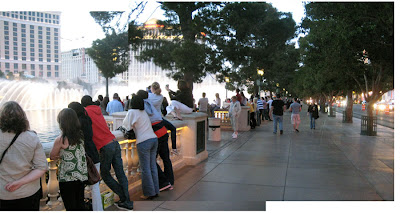


[Two photos of the sidewalk space alongside the Bellaggio's famous musical fountain. The sidewalks here are the widest on The Strip, and almost always packed with toursists admiring the balcony, trees, and water music.]


Tensions of Public Space within a Consumer Economy

Explaining his notion of the society of the spectacle, Debord argues that images entail a “negation of life” that can undermine “unitary” urban environments [21]. As part of the Situationist critique of modernist urban planning principles [22], Debord and his colleagues called for a holistic and un-segmented form of social life, where a whole range of ways of living and human needs can be satisfied in the city. Debord's arguments seem very similar to the calls for greater social engagement within much of the public space literature. Yet, ironically, the very spaces that offer the most vibrant public spaces within the consumer-oriented landscape of Las Vegas’s casino industry are the ones that are the most highly privatized and controlled. The Italianate plaza outside the Venetian Hotel and Casino offers a paradigmatic example of the tension between public and private within a post-industrial consumer economy, affording the most opportunity for tourists to engage with each other while simultaneously minimizing the potential for political activity. Strangely, the best public spaces in Las Vegas are also the most private spaces in Las Vegas.


[Two photos of the privately-owned plaza in front of The Venetian Hotel and Casino. This space is the widest, and most well-appointed space for relaxing and people watching along the sideawlks of Las Vegas Boulevard.]


It seems that, within a post-industrial economy, public space contains a complicated tension between the desire to create spaces of consumption and excess, and the desire to minimize political activity that might disrupt consumerism. In other words, space must encourage excessive and out-of-control desire, while at the same time limiting people’s political demands and controlling their ability to form social movements. Yet because the new architectural regime of Las Vegas increasingly incorporates space itself within its presentation of image, it begins to move away from a postmodern ‘nonspatial’ symbolic order, and toward embodied and spatial urban relations that incorporate cultural and public activity [23]. These processes of cultural and spatial production seem to increase the tension between the production of consumption and maintaining political order.

To me, the highly controlled public spaces of the new Las Vegas urban casinos present a particularly vibrant example of the negotiation of this tension. Thinking through how public space channels street life along particular lines of consumption seems to me a crucial task for analyzing post-industrial consumerist cities. While on the one hand, the public space of casinos like the Venetian might seem to be an extreme case of the consumer image economy run amok, perhaps it is the new future before us. Perhaps more historical public spaces will increasingly begin to resemble the ‘artificial’ spaces of the Las Vegas strip. For example, Colonial Williamsburg in Virginia, the Mill District in Minneapolis, or South Street Seaport in Manhattan all blur the lines between artifice and reality, while at the same time creating real urban spaces. As public space moves toward particular forms of the production of consumption, geographers, architects, and social scientists should re-think how the spatial practices of Las Vegas embody some of the opportunities and challenges of spectacular public space.


[Happiness activists talk to pedestrians in front of the Bellaggio Hotel and Casino's privately-owned sidewalks.]


References

[1] See Baudrillard, J. (1988) America. New York: Verso. or Chapter 7 of Taylor, M. (1999) About Religion: Economies of Faith in Virtual Culture. Chicago: University of Chicago Press.
[2] Debord, G. (1994) The Society of the Spectacle. New York: Zone Books. P. 24.
[3] Venturi, R., Scott-Brown, D., and Izenour, S. (1977) Learning from Las Vegas. Cambridge, MA: MIT Press.
[4] Ibid p. 8.
[5] Ibid p. 17.
[6] Ibid.
[7] Sofradzija, O. (2007) Las Vegas monorail: 2006 a ridership train wreck. December was system’s worst month. Las Vegas : Las Vegas Review-Journal. 30 January.
[8] McKenzie (2003) Private Gated Communities in the American Urban Fabric: Emerging Trends in their Production, Practices, and Regulation. Paper presented at “Gated Communities: Building Social Division or Safer Communities?”. 18-19 September 2003, Department of Urban Studies, University of Glasgow, Scotland
[9] Gottdiener, M., Collins, C., and Dickens, D. (1999) Las Vegas: the social production of an all-American City. Malden, MA: Willey-Blackwell.
[10] Fox, W. (2005) Desert of Desire: Las Vegas and the Culture of Spectacle. Las Vegas: University of Nevada Press.
[11] Ofgang, K. (2001) Hotel sidewalk is public forum. Los Angeles: Metropolitan News-Enterprise. 13 July. And also, Packer (1999) Drawing battle lines on private sidewalks. Las Vegas Sun. 15 Feburary.
[12] Greenhouse, S. (2004) Local 226, ‘the Culinary,’ makes Las Vegas the land of the living wage. New York Times. 3 June.
[13] McKenzie (2003).
[14] Mosle, S. (1998) At hotel-casino, triumphant shouts of ‘union!’ Over six year successful strike of a hotel. New York Times. 5 February.
[15] Gottdiener, M., Collins, C., and Dickens, D. (1999) P. 17.
[16] Packer (1999)
[17] Fox (2005) p. 73.
[18] Fox (2005) p. 57.
[19] Ofgang (2001)
[20] Robison (2008) Adelson survives like ‘cockroach’ as fortune dwindles. Bloomberg News. 12 November.
[21] Debord (1994) p. 14.
[22] See Knabb (1981) Situationist International anthology. Berkeley: Bureau of Public Secrets.
[23] See Mele, C. (2000) Selling the Lower East Side. Minneapolis: University of Minnesota Press. And Zukin, S. (1995) The culture of cities. Cambridge, MA: Blackwell.

16.6.09

The Two Downtowns of Maple Grove


[A lady walks on the well-manicured sidewalks of one of the two downtowns of Maple Grove.]


I've long been fascinated with Maple Grove, Minnesota, one of the northwest suburbs of Minneapolis. It's a 50K population city with a few corporate HQ's out past the beltway, and they've arguably done more than any other suburban Twin City to try to create a downtown area in the midst of the sprawl.

For example, the city built a semi-large shopping development area called Main Street, where the city lay down a stretch of well-sidewalk'd commercial space: a long stretch of one- and two-story retail, a new library, the city hall, and a few residential complexes in the distant background.

[Hanging flowerbaskets, fences, street trees, faux two-story buildings, and inset brick crosswalks and sidewalks adorn the streets of Main Street Maple Grove.]


[A slightly mixed-use building with actual second story office space above restaurants and shops in Main Street Maple Grove.]


[Delicate overhanging signage and flowerbeds along intricately patterned brick walkways in Main Street Maple Grove.]


One criticism of the Main Street area would surely be that it is surrounded by parking lots. Commercial streets in the city are centers of density in the midst of residential neighborhoods, all connected to them by a network of trafficked sidewalks and streets. The Maple Grove Main Street downtown is pretty much an island in a sea of parking, shopping, and road infrastructure, so that if you look down the street past the edges of these buildings you'll see something akin to the Grand Canyon, or the blank wall of a nearby PetSmart or Best Buy. It gives the streets a strange feel of isolation that feels very different from a comprable place like 50th and France in Edina.

Or, on the other hand, if you look down the road in the direction of the big highway, you'll see Maple Grove's other downtown, the Shoppes at Arbor Lakes (and the big AMC movie theater), which surrounds the large parking garage that forms the Maple Grove Transit Center. The Shoppes is one of these new 'outdoor malls', a privately-controlled and privately-owned space the is meant to look like its a nice little village downtown. (There are similar efforts in Woodbury, and in similarly demographic'd cities all over the country.) It's a mall in the sense that it has all the private ownership structure, and all the stores are the corporate retail chains you'd find at a place like Southdale. But it's a 'downtown' in the sense that it is outside, has sidewalks, benches, a plaza, public events, and streets (with parking places) that run through its middle.

A criticism of this space would have to mention its lack of diversity of uses, and its private control, the way in which there's not much to do in this space other than go shopping. Also, I am assuming that there are more stringent restrictions on the kinds of speech and behavior that can take place, because the streets are privately owned by a single company.

[A decorated roundabout with ornate lamposts, hanging flowerbaskets, flowerpots, ornate brickwork, and a pillared trellis adorn the streets of the Shoppes at Arbor Lakes in Maple Grove.]


[A nice sidewalk tree with flowers and music speakers blaring commercial pop planted in the sidewalks of the Shoppes at Arbor Lakes in Maple Grove.]


[A private security guard ensures the safety of teenage girls at the Shoppes at Arbor Lakes in Maple Grove.]


[A mother takes especial care crossing the street while walking from the parking lot to the Shoppes at Arbor Lakes in Maple Grove.]


Comparing the two downtowns, there's a way that they're not much different. They're both good 'new urbanist' sidewalk spaces compared to your traditional second-ring suburban space: they have 'public' spaces, they make you walk around, they make you encounter others people, they are attempts to bring some urban pedestrian life into the landscape of suburban auto-dependency.

Sidewalks shouldn't be limited to certain kinds of cities, or certain kinds of spaces (older spaces). They should be everywhere, because walking is interesting, fun and healthy, and people should be able to walk to and from their shopping malls, libraries, city halls, restaurants, and walk from place to place in Maple Grove.

But these two downtowns are actually pretty different. The public Main Street has stores I've never seen before, and its streets have a very different sensibility. Some of the buildings don't just have facades of second storys, but actually do contain second story office spaces where (presumably) people like lawyers and accountants are working from 9 to 5.

There are sidewalk cafes (one or two, very small), and there's a Dunn Bros coffee shop. There are some decent restaurants.

Also, finally, there is a distinct lack of people in this Main Street (at least at noon o'clock, when I was there). For some reason (maybe because nobody lives or works anywhere near here), people don't tend to flock to Main Street during the day.

But I walked over to the private downtown (the Shoppes) and there were many more people going into and out of the Trader Joe's, teenagers hanging around, (mostly) women going into a few stores. There was a private security guard, presumably paid by the business owners to keep any unsightly people out of the privately-controlled downtown. (The public Main Street, on the other hand, hand, would probably have to obey some sort of free speech laws.) You definitely got the sense that there were very different procedures and rules for what kind of things could occupy these two superficially similar downtowns. The Main Street had a teddy bear sitting in a chair on the sidewalk. The mall street would never have anything that didn't match it's branding image.

[A teddy bear sitting in a chair on the sidewalk.]


Or am I wrong? Is there not much that's different about these two spaces? There's a way that private control and private interest drives a ton of the ostensibly 'public' spaces in our cities, and (let's face it) Maple Grove isn't exactly the poster child for diversity. Both downtown areas were pretty much uniformly devoted to shopping, and I'm sure were equally policed, limited, and restricted in the kinds of use they encourage. Both were a far cry from the 'public' space you might find in South Minneapolis or somewhere like Richfield.

Maybe the only difference was that the private Shoppes street had little speakers embedded in its sidewalk flowerpots, blaring out a constant stream of Top 40 hits? Maybe the only difference was the extra 'e' and 'p' in the shops of the privately-owned downtown? Is the line between public and private really so thin?


[The sidewalks of Maple Grove's mall main street are alive with the sound of music! (But only because some marketing expert programmed the speakers hidden in the flowerpots to play an endless loop of upbeat saccharine pop.)]

Twin City Street Musicians #2

[A trumpeter on Nicollet Mall. Downtown, Mpls.]


[A drummer on Grand Avenue. Summit Hill, StPaul.]


[An accordion player on Nicollet Mall. Downtown, Mpls.]


[A guitar player on 4th St. SE. Dinkytown, Mpls.]


[A saxophonist on 4th St SE. Dinkytown, Mpls.]


[Two guitar players and a tambourine on 7th Place. Downtown, StPaul.]


[A guitar player on N 3rd Avenue. North Loop, Mpls.]


[A harmonica player on Grand Avenue. Summit Hill, StPaul.]


[A guitar player on Grand Avenue. Summit Hill, StPaul.]


[An accordionist on 13th St NE. Northeast, Mpls.]

12.6.09

Twin City Lampposts #2


[A black plastic lamppost.]


[A light green lamppost with black non-pointed top and blue concrete base.]


[A grey-brown lamppost with matching pointed top.]


[A two-tone double pointed lamppost in a state of disrepair.]


[A turqouise lamppost with rounded bulb top.]


[A grey-brown lamppost with domed 'gaslight' top.]


[A yellow lamppost with black square windowed pointed top.]

***Sidewalk Weekend***

Sidewalk Rating: Halcyon

I've been walking and biking a lot lately and it feels great. Lots of kids on the street, lots of people at sidewalk cafes.


<<<>>>


This is a great invention...


<<<>>>


Council caves; concrete construction calamity!

Sidewalk signage forces feet foes to grassy end!


<<<>>>

This is my life in a nutshell:


<<<>>>


[Chairs along the new old railroad track park in Chelsea. Img. fm. David Byrne.]

The high line opened up in New York City, and it looks quite nice. Its an elevated sidewalk, and if it gets enough use, should make for a great way to escape the city and see things from a different perspective.


<<<>>>


Its strange to read about how cities 'gamble' like this. Biotech is one of those get rich quick schemes that Pawlenty would always talk about.
Second, biotech is a relatively tiny industry with a lengthy product-development process, and even in its largest clusters offers only a fraction of the jobs of traditional manufacturing. In the United States, only 43 biotechnology companies employ more than 1,000 people, according to BioAbility, a consulting firm in the Research Triangle Park in North Carolina.


You know, a whole lot of urban economic development is total B.S. Still, the T.C. seems to have a ton of biomedical jobs, and we might be one of the places with "strengths" on which to capitalize.


<<<>>>


A call for more taco trucks... they're a great idea for sidewalks, that's for sure.


<<<>>>


[A cartoon about suburbia.]


<<<>>>


Walker/biker people tend to romanticize the older days before the automobile. Well, they weren't always that safe. I remember reading somewhere about how many people were killed by speeding carriages in Victorian London.

And this photo of what streets looked like when filled with horses is pretty interesting.


<<<>>>


For different reasons than me, Adam Platt agrees that Trader Joe's (their wine contains the blood of small children) needs to play by the rules on Lyndale.

I didn't realize these zoning codes meant that you cannot open up a little wine store anywhere in Minneapolis... e.g.
Because of the school/church stricture, these geographic monopolies have made it impossible for a new wine retailer to open in South Minneapolis without another one closing first. A friend and I considered opening a wine store in South Minny over a decade ago and couldn’t find a legal site in a viable neighborhood. I long ago gave that hobby horse up, but these laws still need to go.

Or the city could create a separate license for small scale retailers who do a majority of their business in wine, or allow such stores blanket waivers to the 2000-foot rule.


There are unforeseen consequences to any zoning decision, and this seems like one of the dumber ones. But if it keeps evil Trader Joe's (their cheese is made from soylent green) from moving in and brainwashing all of South Minneapolis, I'm OK with it.


<<<>>>


A movie about North Minneapolis:


[via Mediation.]

<<<>>>


Here's some interesting history of the years of independently-operated buses in the Twin Cities. For example, this description of the Rice Street bus company:
Before 1975, North Suburban was called Rice-Edgerton Lines (and way before that it was called North Star Lines, a name my mother apprently remembered). The Edgerton part was taken over by MTC in 1975, that's what prompted the name change (and yes, this company is why the name Edgerton is so important to me in politics and religion). The problem was that Rice and Edgerton weren't two seperate routes; the Rice-Edgerton route went from Saint Paul out Rice Street to Little Canada Road to Edgerton to County Road F back to Highway 49 to County Road J.

There's a bit more where that came from.


<<<>>>


A tryptich for you!

1) A CU of the pavement around Lake Calhoun. (Img. fm. Mitchster.)


2) Bambi window shopping at Macy's. (Img. via. CityPages.)


3) A street scene sketch. (Img. fm. Avidor.)

10.6.09

You too can have a car-blocking block party!

I ended up going past my dad's house the other day for his block party. Apparently in Saint Paul you can apply for a permit to block off the ends of your street (provided you get neighbors to approve, or something) and go ahead and have a party in the street.

This one, on Portland Avenue, was in honor of a high school graduation. The Lex-Ham Community Band (a fine organization) played some rousing marches while older folks sat around in chairs listening and drinking cool beverages.

Kids twirled fire in the street, and there were a whole bunch of street games like football throwing, basketball basketing, and the subtle art of standing around and being high school students. Whole families came outside and kids ran around without their parents.


[Kids playing in the street.]


[A high school student extravagantly twirls fire while other high school students look on.]


[The Lex-Ham Community Band playing a rousing tune.]


A nicely-dressed lady came out of her house with a beautiful plate of fresh lemon bars, and I was lucky enough to get offered one. It was straight out of one of those movies that makes fun of the 50s.

To me, it seemed so easy to have a block party. And it seemed like such a good idea. All you'd need is a good excuse (a high school graduation is a good one) and some neighbor connections, and all of a sudden you've got a reason to chat informally with people on the block, in a very low-key way that demands little of the relationship. You can just meet people, or hang out and listen to music together, but its a loose-tie position that's in the valuable middle ground between "I don't know you" and "let's be best friends".

Of course, you also need to have a sufficiently blockable block, one that has sidewalks and front yards and isn't too wide and isn't a crucial through street. I've heard of suburban neighborhoods doing this on culs-de-sac, which seems like a nice idea. Or you can scale it up and do something like Grand Old Day, where you block off a whole street for a few miles.


[Residents of Portland Avenue uncommittingly mingle.]


[All age ranges exploring the material possibilities of the sidewalk.]


[One example of the perils of playing in the street with cars.]

When I was a kid, my brothers and I used to play football in the middle of the street. Every once in a while, we'd end up moving out of the way for a car, but it was totally do-able to play in the street. Still, though, we could have been run over and squashed by a reckless driver. It was possible!

My point is that just closing streets off to cars for a little while can make such a difference to your streets, yards, and the space around your house. It's a surprisingly easy thing to do. It just takes one orange and white barrier, and some precisely parked cars. And then, all of a sudden, you have a playground park in the middle of your street!


[A pair of cars is all it takes to double the amount of parkland in your neighborhood.]

9.6.09

Twin Cities Doorways #1

[Doorway on Grand Avenue. Summit Hill, Saint Paul.]


[Doorway on Hudson Road. Dayton's Bluff, Saint Paul.]


[Doorway on Central Avenue. Northeast, Minneapolis.]


[Doorway on Grand Avenue. Lyndale, Minneapolis.]


[Doorway on Selby Avenue. Cathedral Hill, Saint Paul.]


[Doorway on Selby Avenue. Snell-Ham, Saint Paul.]


[Doorway on Grand Avenue. Kingfield, Minneapolis.]
Classic Sidewalks of the Silver Screen #20

Viewer discretion is also advised for quite possibly the most notorious sidewalk scene of the 70s...


... as Divine engages in some uncut sidewalk corprophagy in John Waters' Pink Flamingos (1972).

Tunnel of the Week: Lowry Hill Tunnel


[This content recycled from my now mothballed website, www.excitablemedia.com. Please enjoy!]

Out of town visitors are quick to discover the rigorous planning behind the Minneapolis city streets. The grid is most often alphabetized, usually numerologically ordered, always sliced ordinally and sub-ordinally by the points of the compass, and depending on one's tenacity, can even offer a chronological listing of America's presidents. Minneapolis, true to its Greek root, offers a veritable catalogue of cataloguery.

But to my mind the intersection of Lyndale and Hennepin Avenues seems to predate planning, their crossing unenviably misguided, always a traffic tangle of terrific proportion. Here, for more than a century, at the base of old Lowry Hill, has lain the intersection of Chaos Street and Order Boulevard.


[Digging towards the Basilica.]

The modern challenges facing the transportation engineer shifted following the creation of the Interstate Highway System in the late 1960's, and gave a fresh twist to the Lowry Hill bottleneck, as Interstate 94 was slated to run right through the densely populated area. And while superhighway construction uprooted a great many neighborhoods throughout the metro, the buildings of Lowry Hill were, and still are, one of the Twin Cities' richest collections of Victorian homes, grandiose churches, public parks, museums, and the like. Hoping to minimize the damage, State Highway Department engineers spent three years and over thirty million dollars digging a 1,500 foot-long six-lane tunnel underneath the intersection, a triumph of modern engineering meant to decrease traffic congestion far into the future. While miniscule when placed next to the great tunnels of the world, those of New York City or Western Europe, the Lowry Hill Tunnel (LHT) was to be the last and greatest Minnesotan dig.

Building a tunnel is never an easy task, and perhaps the biggest LHT challenge was the Hennepin Avenue United Methodist Church, located right next to the tunnel's slated path. For three months during construction the church would be perched on a 35 foot drop-off, consternating engineers and preachers alike, and to safeguard against sacrilege the Highway Department hired the Mile High-Deilmann firm of Denver, Colorado, who buried a series of 87 tubes deep into the ground surrounding the church, in order to create a protective "freeze wall." The tubes, filled with circulating brine chilled to minus-five degrees, created a 120 foot long, 50 foot deep, 20 foot wide wall of permafrost that stabilized the ground underneath the church for three months during the most difficult stages of tunnel construction. Apparently it worked, because the United Methodist Church is still standing proud, despite the ever-present danger of being swallowed by the concrete on and off-ramps that swirl around it like Medusa's head snakes, bringing an almost uninterrupted line of idling cars to the far side of its stained glass windows.

When the tunnel finally opened in September of 1971, the Lowry Hill Neighborhood Association threw a tunnel party, inviting the public to roller-skate around in the tunnel while listening to a local rockers play in perhaps the best acoustic environment in the history of Minnesota. Nobody knows why the band never showed up, perhaps it was the cold, but balloons and cider flowed like wine as hundreds of people enjoyed the rare meeting of a long low yellow room and ample florescent lighting. As one long-haired youth put it, "it's like a big long shower room." When another replied, "it's like the high school I went to, it has the same thoughtful atmosphere," I couldn't help wondering which school he meant.


[The tunnel party inaction.]


Today when our roadways bear the scars of the late 20th century automotive explosion, the LHT has become the shortest plank on the barrel, the point past which the commuter water cannot rise. Minneapolis traffic flow stops here, and the examples of LHT-related incidents form a long list indeed. In the most notoriously ironic anecdote, the Great Beer Rollover of '92, an intoxicated driver of a beer truck overturned his semi during rush hour on a shining June afternoon and caused traffic delays from Wisconsin to Minnetrista. And every workday drivers headed East from I-394 are forced to merge into a single lane before they enter the LHT, habitual congestion that rivals that of the globe's largest metropolises. Every few years the roadway pundits talk of widening the tunnel, but most of us know adding a lane is a pie-in-the-sky pipe dream.

[Under the hill.]

Yes, tunnels prove yet another piece of evidence that our ability to control the landscape has a limit, and like astronomers peering through telescopes searching for the beginning of the universe, Alfred North Whitehead's valiant attempt to mathematically explain the whole of logic, or the struggle to know the motives of a lover, the boundaries of understanding recede ever farther into the horizon, entropy always interjecting a last word, which is why on and under this particular patch of earth, double-decked automotive gridlock drifts along through the days.

7.6.09

Sidewalk Ballfield

One of the best sidewalk experiences you can have in the Twin Cities is to be randomly in the neighborhood of Randolph and Hamline when a ballgame is going on.

You see, legendary Catholic sports high school, Cretin-Derham Hall, has one of the most sidewalk-friendly setups imaginable for a baseball field. Their ballfield is nestled snugly into the Ran-Ham neighobrhood. They play their games right on the streetcorner, with the 3rd base fences and the outfield walls pretty much flush against the street.

It means that anyone walking around this intersection on a nice day, lined with a bunch of interesting shops, will find themselves unexpectedly involved in a baseball game.


[The sidewalk warning track.]


I happened to find myself going to Kopplin's Coffee the other day and ran into a coach wearing the uniform for my old high school. I proceeded to get a coffee, and read a book while lounging on the grass and watching the Warriors win a close game against the CDH squad.

As the game goes on, you have different types of spectators: regulars who come to see some pretty good high school baseball, family of the players, and then there are just passers-by who typically lean against the highly-leanable ballfield fence, resting their feet on the bottom rail, and pausing for a while to see the baseball action.


[Two men demonstrating proper fence-leaning technique.]


Otherwise, you can sit at the Kopplin's cafe tables and see some of the game. Every once in a while a foul ball will escape the bounds of the field, and land onto a parked car. Then it's the duty of the closest pedestrian to fetch the ball and toss it back to whichever high school benchwarmer is running to get the strays.


[Home plate acheives peak voyeur density, two layers of leaners.]


It's a real neighborhood event, and there's just no way that a huge suburban high school campus can compete with the intimacy and personality of the Cretin-Derham ballfield. It's my favorite place to to see a ballgame this side of Wrigley or Fenway.


[You know you've really hit a home run if your baseball lands in The Nook.]

5.6.09

***Sidewalk Weekend!***

Sidewalk Rating: Unimproveable

Srsly folks... too much sidewalk fun these days.

If you haven't resoled any shoes by July, I will be disappointed.


<<<>>>


This list of traffic jokes is great.

My house is on the median strip of a highway. You don’t really notice, except I have to leave the driveway doing 60 MPH.

I hooked up my accelerator pedal in my car to my brake lights. I hit the gas, people behind me stop, and I’m gone.

I replaced the headlights in my car with strobe lights, so it looks like I’m the only one moving.


Steven Wright is one of my all time favorite comedians.


[Wright on Letterman in 1990.]


<<<>>>


After my comment about gentrification earlier this week, I came across this article from a year ago...

“Gentrification” is a process of neighborhood change that historically has included a strong racial component, replacing Black and low-income residents with higher income White residents. Many Black residents of North Minneapolis are expressing concern that just such a process is underway in the neighborhoods they call home.

I think it's worth asking what 'development', 'vitalization', etc. really mean. Are they code-speak for pushing poor people out of cities?

This question is particularly important in light of this lawsuit, involving the entirely too-politically named Preserve and Benefit Historic Rondo Committee. I think the name alone shows that this battle isn't really about the Central Corridor. Rather, they're focused on the past, on the terrible travesty that was the I-94 development, and on a long legacy of disinvestment in African-American neighborhoods. That's the real problem, not the pros and cons of a LRT running along the street.

(Of course, having a lobbying group threaten to sue the LRT people seems to be the only way to get concessions out of the project these days.)

In my opinion, there is so much underused land along University Avenue, that there will be room for all sorts of different livelihoods on that street. Just drive down the road and count the vacant lots, large parking lots, abandoned auto dealers, auto parts stores, empty storefronts...

University Avenue, particularly between Lexington and Rice, is so far from gentrified that its barely worth discussing.


[A group of schoolchildren outside Rondo Library on University and Dale. Frogtown/Rondo, Saint Paul.]


<<<>>>


The sidewalk poetry crazy is sweeping the state!


<<<>>>


I'm a peeved that so little of this Twin Cities Metro "street fashion" takes place on the street...

e.g.


[An example of "street fashion."]


That's a fake house! "Street fashion" should be required to take place on sidewalks!


<<<>>>


However, this "street art" is sufficiently street-centric! (Click the 'Street Art' button at the top right of the page menu.)

e.g.


[Street art takes place on the street.]


<<<>>>

Here's a chart of fuel efficiency gains for US cars and trucks for most of the 20th century:


It doesn't seem very impressive, does it?


<<<>>>


Meanwhile, LED streetlamps do seem like a technological advancement. I'm particularly excited about their directional qualities.
Another issue is that current LEDs generally provide only “directional light” rather than a 360-degree glow, meaning they are better suited to downward facing streetlights and ceiling lights than to many lamp-type settings.


A lot of light pollution is caused by diffusion lights that scatter light in all directions, instead of aiming them downward at the sidewalk where the light belongs.


<<<>>>


This seems like a pretty good list of the top #25 restaurant patios...


... and this U of MN-focused article suggests how important these patios might be to a visitor.


<<<>>>


A sidewalk triptych for you:

1) A hydrant sketch. (Img. fm. Avidor.)


2) What LA smog looked like in 1945. (H/T Matthew Kahn)


3) Peavy Plaza. (Img. fm. TCDailyPhoto.)

3.6.09

Jazz and Traffic #1: The Jazz Bus


[Rob Thompson, the driver of the Jazz Bus, grooves to Horace Silver as he drives U students across campus.]


I'm a big fan of jazz music, and I'm struck once in a while about the parallels between the organized chaos of jazz music and the organized chaos of streets and traffic.

This great story in the Minnesota Daily about the "Jazz Bus" reminded me of that recently. The U of Mn runs a bunch of local buses that go back and forth from the Saint Paul to the Minneapolis campus, along the school's dedicated transitway. The buses are pretty straight forward, and free of charge, but there's one of the buses that's special. It's the jazz bus, and I'll let Matt Brickweg describe it:

I had never ridden on the Jazz Man’s bus before, but I had heard about it from multiple people. It turns out he has a long track record of credibility built up with students. He uses the music he plays to connect with his “captive audience” of passengers. I had heard from friends that he was so into jazz that he’s going to start a jazz radio station when he retires.

Even with this forewarning, I was still taken aback when I hopped on the Jazz Man’s bus. Numerous times he said goodbye to passengers and then gave them a courtesy honk as they walked away.

As I was sitting on the bus, the music stopped. The Jazz Man turned around, looked back at us passengers and said “Who’s feelin’ some B.B. King?” Smiles and nods ensued.

I have been lucky enough to find myself on it a few times, and since I love jazz, I always consider it to be a stroke of great fortune, like finding a golden ticket, or coming across an old friend randomly on the street.

The other day I was on there and the jazz bus guy was spinning some sweet hard bop. It was this driving, upbeat, blues-y piano stuff. When I asked him about it, he told me it was the Horace Silver Quintet, and that I should get the two great Silver albums, "Blowing the Blues Away" and "A Prescription for the Blues". They're both great albums, and as I rode down Washington Avenue, I was enchanted by the transit-jazz potential.

What if all buses had drivers who were DJ's, and who spun music to match the traffic patterns? On evening rides, you'd have cool, mellow music. When it was raining, you'd put on something melancholy. During rush hour, you'd blast some up-tempo be-bop. Mornings would be for brass instruments.

And then particular buses would match particular genres, so that you'd take the bus line that fitted your particular tastes. You'd move to the jazz neighborhood, or the folk neighborhood, and the buses there would match your taste in music.

I was talking with a friend of mine a while back about the greatness of the jazz bus, and he told me that he'd memorized the jazz bus driver's schedule. He'd wait until he knew that the Jazz Bus was going to make its run, and then intentionally head to the curb and try and find it.

I think this idea has endless possibilities!


[Horace Silver playing at Newport in 1959.]

2.6.09

Signs of the Times #14


Arrow Indicates Grain Direction
Remove Masking Immediately

[Sign above door entrance. Dinkytown, Mpls.]


Restroom admittance is
limited to card access only.


[Sign outside locked restroom in public shopping mall. Downtown, Mpls.]


As we're constructing a new City (Center), we're also
committed to creating a stronger community. We invite
you to tour this gallery of downtown workers and
downtown residents. Catch up n their current commentary.

Now there's something interesting on both sides of this wall.


[Sign outside empty and locked room in public shopping mall. Downtown, Mpls.]


NO
Trucks
Cycles
-Or-
Trailers

[Sign in parking lot. Downtown, Mpls.]


Leave
A
Book

Take
A
Book

[Sign in indoor convenience store in converted warehouse / atrium office building. Downtown, Mpls.]


Lightly "Touch"
Yellow Strips

Push Here

[Sign on new bus doors on MetroTransit #16 Bus.]


Yoga

Exception Framing
Affordable Prices

[Sign on Lyndale Avenue. Wedge Neighborhood, Mpls.]

1.6.09

Sidewalk of the Week: Broadway and Penn


[The liquor store proudly displays the long history of Broadway Avenue in its windows.]

The sidewalks on Broadway Avenue are very nice indeed. They're new and wide, fresh and clean. The alabaster cities gleam.

Broadway Avenue in North Minneapolis is, of course, one of the most interesting streets in the city, and is the main commercial drag through the long-struggling Minneapolis neighborhood (many of the storefronts are underused today).

You can see the history of the neighborhood in the old buildings that sit along the street, and particularly at major corners like the Penn Avenue intersection. The street has a very central feel, as if the whole community comes together here. Plus, Broadway has gone through a streetscaping in the recent future, making it all the easier to visit El-Amin's Fish Cafe at the corner of B'way and Penn.


[Quite a nice sidewalk.]


But, despite the nice sidewalks, there seems to be an emptiness hanging over the intersection. Maybe its the mysterious, almost Saharan lack of street trees? But there's a lot of space at this strange 5-way corner. Everything seems paved, and it reminds me of the wide open parking-lot feel of my neighborhood (Como/Front/Dale). "Hello", you want to shout, hearing a distant echo reverberate from far across the car canyon. Walking out into the canyon surely is a fools errand?

[Brand new sidewalks adorn the corner of B'way and Penn, sitting next to the four and more lanes of car traffic.]


A big part of it is the four-lane roads that run past, and the wide expanse of pavement. Despite the secure and comfy sidewalks, this is space for cars. And drivers realize this, and speed down the street. For some reason, its always the poorer neighborhoods that have the urban streets with four lanes that run like freeways (Dale Street in Saint Paul, Park and Portland in Phillips, Central Avenue in NE). This is true even though lower income neighborhoods are the most likely to have elderly and young pedestrians, and populations dependent on transit. I'm always surprised that more people aren't killed on streets like these.


[A mural over the Penn Avenue bus stop.]


There's a wonderful life to the space along Broadway, too. It's like there's an open-ness to the street, so that it doesn't seem to be claimed or filled in ... the hole of the donut (if you will.) There's a feeling that nobody is telling you what the streets should be used for. Unlike the overly symbolic spaces of many fancier neighborhoods, there is a freedom here that seems to open the sidewalks up to new kinds of use. Murals proliferate. Whether taggers or artists, a lot of the space is marked with paint, legible and trying to tell you something. There is a creative energy here, as if anything could happen.

[The most highly decorated garbage receptacle in town.]


Or maybe I'm just nervous? When walking around the sidewalks of B'Way and Penn, I always try and fail to avoid a kind of anxious excitement. I can't escape a feeling of adventure that kind of bothers me. Maybe its because I'm from way on the other end of town over in Saint Paul, but more likely its the way that people always talk about North Minneapolis, as if its some kind of no man's land, a danger zone, and to go there is to embark on some sort of colonialist exploration of some new territory.


[The sidewalks around the Fish Cafe are wide and spatious. Somehow they still seem a bit empty.]


Geographer Neil Smith describes how real estate interests tie lower-income neighborhoods to the notion of the 'frontier', associating places like North Minneapolis (or NYC's Lower East Side) with the Wild West, empty space, or some kind of USS Enterprise-type exploration. The way people talk, when you go to North Minneapolis, you "boldly go where no man has gone before".

I, too, have this feeling when I head over to North. Its problematic, mostly because it suggests a lack. To view these sidewalks as unused or empty is to highly undervalues the kinds of culture and life that already exist in these neighborhoods. The very notion of "development" is kind of an implicit judgment on a place, as it the place isn't OK as it is, and needs to be "developed", "civilized", "revitalized" into something else more worthy and worth-while.

On the other hand, most people you'd ask who live in North Minneapolis desperately want to improve the neighborhood, make it safer, provide more local jobs. It's just a question of how these sorts of new activity and 'improvements' will relate to the valuable and valued activities that are already going on. This seems to be the crux of gentrification.*

Anyway, if there's an emptiness to these sidewalks, its not because of the space. It's because sidewalks alone can only do so much. They can connect people, they can make the streets safer, but they cannot generate an economically self-sufficient neighborhood. They're excellent sidewalks, but so much more depends on them.


[You can't shake the feeling that the sidewalks of Broadway Avenue are trying to tell you something.]


*You hardly have to worry about gentrification during a receession.

What do you think of the Minneapolis skyway system?