Showing posts sorted by relevance for query test median. Sort by date Show all posts

2011-01-27

LiveBlog from the January 24th Mac-Groveland Community Council Transportation Committee Meeting

[The "test median" that was installed at the Jefferson and Cleveland intersection from August 24th to September 24th, 2010.]

6:58pm: I walk up the street toward the Edgecumbe Recreation Center, thinking I'm going to attend a vital meeting about bicycling in Saint Paul, my home town, thinking I'm going to be attending a meeting that will make or break the future of bicycling in this city, that will help determine whether or not I live in a town that encourages or discourages alternative non-fossil-fueled transportation, that cultivates humane lifestyles, that catalyzes healthy people and healthy lifestyles and healthy cities and communities, that says: "Yes, you can bicycle safely down the street even though you're not a 20-something daredevil, even though you're a mother and maybe overweight and maybe don't feel 100% comfortable on a bike," a city that says everyone is welcome on this street, we're going to take the huge leap of faith and let .1% of our public space be for people NOT in cars, and that's O.K., that's not a revolution (99.9% of car-culture is enough!) and that bike boulevards are not Molotov cocktails thrown haphazardly at SUV dealerships...

I think about this as I walk through the lovely January evening air past the outdoor hockey rink, past the dad teaching his daughter to skate by having her push a metal folding chair, past the sound of hockey sticks slapping down onto the ice, along the snowbank'd sidewalks, down Saint Paul's quiet dark snowy streetlit Griggs Avenue towards the community meeting about bicycling, perhaps the farthest thing from most people's minds in this cold climate...

7:02pm:
The room is packed. Somehow the meeting has already started. People are standing near the entrance, collecting there looking lost.

I push my way into a seat near the front, right next to a very concerned looking woman who is currently testifying about parking problems near her home.

As it turns out, the discussion is about adding a restricted permit parking area near a school in Highland Park.

7:05pm: A blonde woman begins complaining about parking enforcement giving tickets during holidays.

7:06pm: The meeting's moderator, who sits along a pair of white plastic tables with about nine other not entirely happy looking people at at the front of the room points out that there shouldn't be any enforcement of parking permit zones on holidays. He does this to no avail.

7:08pm: The committee members at the tables look bedraggled, soft spoken. More than two arms are crossed. As people file into the room, they don't seem to be getting any happier. The atmosphere in the room already seems testy.

7:12pm: Discussion of school parking permit zones comes to an end. It's agreed that someone in the audience (the blond woman?) will start a neighborhood petition to instate a permitted parking zone near the school, at which point the Mac-Groveland Community Council Transportation Committee (MGCCTC) will take up and study the motion, perhaps to recommend it to the city, at which point it will have to go through a number of city council committees. The process seems impossibly lengthy, and its difficult to see anyone receiving short-term satisfaction.

7:14pm:
At this point, the moderator “Jay” suggests ending discussion of the parking situation, and further suggests that those concerned might want to leave the meeting to make room for all the bicycle advocates standing in the aisle. This happens. A dozen people leave, a dozen people sit down. Chairs are found, arranged, and sat upon. Now the only people left standing are a group of a half-dozen Macalester students with bike helmets who arrive a bit late to the party. They look lost.

7:16pm: Now comes the moment of truth. We get to the bike boulevard median situation.

Jay makes a great deal about how the meeting today is just to report the findings from a study that was done on the the “test median” at Cleveland and Jefferson. (This is a long story, and I won't go into it here.) He then introduces two men from the city of Saint Paul public works department, Paul Saint Martin, traffic engineer, and Dave Something (?), traffic engineer. Both are 40-something bearded white men wearing button up shirts with pens in the pockets.

7:17pm: Paul Saint Martin, who seems to be in charge, briefly introduces himself, and then introduces Dave, who does most of the talking.

7:18pm: Dave, wearing brown, ends up pointing to a pair of pages of information that represent the findings of the study, and then goes about explaining them in some engineering-type detail.

He explains that the “test refuge” had two goals. First, it was intended to promote bike and pedestrian activity along the Jefferson bike boulevard, by allowing for an easier crossing of the street at the busy Jefferson and Cleveland intersection.

The second goal, he explains, is to divert through traffic on Jefferson, to reduce the number of cars that are using Jefferson as a through street, to restrict the traffic on that street only to local traffic, i.e. people who actually live there.

[One of the primary functions of the "test refuge" was to piss off drivers and make them log on to the internet.]


7:24pm: Dave then goes to great pains to emphasize that he is just sharing information, and not taking comments. I begin to understand that this meeting is not, in fact, an epic showdown of anti- and pro-bicycling forces meeting in a public arena and struggling to the rhetorical death etc. Rather, it is an objective reporting of facts ascertained by a careful neutral engineering-type study of facts neutral innocent bystander (or something like that).

7:26pm: The details of the study come next, and are delivered in the a dry fashion typical of numbers. You can read them for yourself here. There are two main components to the study. First, they looked at how the median affected traffic and speeds along Cleveland, Jefferson, and neighboring streets. As it turns out, the refuge didn't affect either very much.

Much to my surprise, average speeds on Cleveland didn't change more than 1 or 2 mph, and the 85% speed changed even less. (Of course, the median wasn't in fact a true median, and was instead a series of orange plastic things placed in the road. The median refuge had neither very effective calming qualities, nor aesthetic merits, both of which would surely exist with a real bona fide median. Which goes to show you, IMHO, that this kind of half-assed experimental approach is like "pissing into the wind," so to speak.)

The other part of the study involved gathering comments about the (inelegant and ugly) test median refuge boulevard, and, as you might imagine, many of these comments were negative. The split was about 60 / 40 weighted against the change, which actually to my mind seems pretty good considering its “test” status. Also, for some reason, the comments were then filtered through some sort of address matching process, whereby only those within a ½ mile of the intersection were counted. Also surprisingly, these results were practically identical to the larger sample.

7:36pm: "Jay" the moderator gives the two Transit for Livable Communities engineers, both 30-40 something men with beards but without glasses, a chance to talk about the test, and Tony Hull, TLC transportation specialist, briefly takes the floor to explain a few things about the concept of bike boulevards in general and this test median in particular. He keeps it very brief.

7:37pm: Now, the denouement! At this point Dave takes questions about the process.

Questions include:

7:38pm: Q: [older man with white hair] What about snow? The snow makes the street even narrower, and it will be impossible to turn the corner! Have they talked to bus drivers and snow plow drivers? Ambulance drivers? I'm not convinced it will “calm” anything!

A: [Dave.] Hm. We're talking to the fire department and the snow plow drivers. We might have to tweak the turning radius on the corners.

7:39pm: Q: [middle-age woman with black hair.] Was there any “due diligence” in counting the number of pedestrians using the median? Is this a good use of taxpayer money?

A: [Also Dave.] It's a “chicken and egg” kind of thing. Pedestrians and cyclists won't use it until we build it, so we can't wait for more pedestrians to come to justify building a median.

Man from the crowd: [Helpfully.] I live very close to the median and saw a lot of people using the refuge.

7:41pm: Q: [Middle-age woman with black hair, a different one.] There was no testing done on the alleys. Many cars are now driving down my alley, and my children play in the alleys. It's dangerous! Also, cars slow down at the median, but then just speed right up near Wellsely Avenue so its even more dangerous because they're speeding!

A: [Dave: no answer that I can remember.]

7:42pm: Q: [Another black coated woman with black hair.] What about snow removal when it snows a lot like in December when there is 3 feet of snow?

A: [Sparrows playing violins.]

7:43pm: Q: [Older woman in blue sweatshirt with white hair.] Instead of spending money on the median why not put up a stop sign? That way bikes can blow through it, cars can blow through it, and pedestrians can dance in the street.

A: [Chuckles pervade the room.]

7:45pm: Q: [Earnest bike-type fellow.] Will there eventually be a similar refuge on Cretin? That street is just as busy.

A: [Dave again.] Probably, if all goes well, and if the city decides to go through with the project. Cretin is scheduled for re-paving in 2014, and that's when we'd probably do it.

7:47pm: Q: [Someone.] Are there other plans or ideas that would allow for left turns off Cleveland?

Q: If a neighborhood streeet is one that has less than 500 cars / day (as was mentioned during the earlier wonky part of the presentation), and Jefferson already has less than 500 cars / day, why even bother with all this? Were the speed limit differences statistically significant?

7:50pm: At which point Tony Hull, TLC transportation and traffic calming guru tries to explain about bike boulevards, about how they involve a series of improvements and changes (e.g. roundabouts) designed to allow for efficient and safe cycling that, if done without also diverting car traffic, may have the opposite effect of increasing rather than decreasing auto traffic on the street, which is why the left-turn diverting medians may in fact be the crucial component of the entire bike boulevard concept..

This answer, however, resembles the waving of a red flag as seen by a bull, or a bucket of chum as smelled by a shark, and people just start to get more upset until Dave, the Saint Paul traffic engineer, diffuses the fracas by saying: “Don't worry. We killed all of those improvements anyway,” which strikes me as the single most absurd moment of the evening, where there is seeming pride taken in the fact that this boulevard would be, all in all, a half-assed attempt. (The half-an-ass approach being typical of Twin Cities state-sponsored cycling infrastructure, the “Minnesotan Way,” so to speak.)

7:52pm: Q: What about the county? Isn't Cleveland Avenue a county state aid highway?

A: [Dave, proudly.] The county pretty much ignores us, and we can do whatever we want, so that's not a problem.

7:57pm: The meeting comes to a close as one of the Mac-Groveland people tells everyone where they can get more information (macgrove.org).

8:01pm: As folks start to chat amongst themselves, and as the Macalester students begin to leave, not having any idea what had just happened, we start to chat, and the poor MGCCTC asks us nicely to leave the room as they have other business to attend to and would very much like to go home at Nine. We exit into the hallway where there are many youth and fathers in various states of wearing and not wearing hockey gear, and where it does indeed have that musky dank hockey smell that is a not-totally-displeasing combination of sweat and ice.

Whereupon I chat with folks from the Saint Paul Bike Coalition about various matters of the day, and someone decides that the city is “kicking the can down the road” and we all agree that the test median was a stupid idea to begin with, that they should, as the Nike ads say, “just do it” rather than dicking around all this time with test signs and websites and orange plastic crap and unnecessarily pissing off car-centric neighbors.

[Saint Paul's patron saint, Joe Soucheray, purses his wrinkly lips alone in a dim office contemplating ways to run over bicyclists with his SUV while on his way to inspect the tools in his garage.]

Update:

More links courtesy of CTC:

Less interesting recap of same meeting by Jeff Zayer.
Explanation of project by Ride Boldly.

2011-01-24

Big Saint Paul Bike Boulevard Meeting Tonight

This is important. We need to show up there! (I'm going...)

Jefferson Bike Blvd. Test Median - Important Meeting

7:00 pm

Greetings Saint Paul Bicyclists,

If you are going to attend one meeting all year, please make it this one. On Monday, January 24 at 7 p.m. at the Edgcumbe Recreation Center, 320 S. Griggs, the Saint Paul Public Works Department and the Macalester-Groveland Community Council will share the results of the test median on the Jefferson Bike Boulevard. It is incredibly important that bicyclists show up to support this project, not only for the sake of the test median, but to show support for the bike boulevard concept. As many of you are aware, this has been a hotly debated project and we need your support.

For more information on the project, visit our website atwww.saintpaulbicyclecoalition.org or contact me or Andy.

Warm regards,

Dana DeMaster

Co-chair, Saint Paul Bicycle Coalition


2014-08-27

Reading the Highland Villager #112

[Still waiting for yr Villager pics; snap 'em & send 'em, folks!]
[Basically the problem is that the best source of Saint Paul streets & sidewalks news is the Highland Villager, a very fine and historical newspaper. This wouldn't be a problem, except that its not available online. You basically have to live in or frequent Saint Paul to read it. That's why I'm reading the Highland Villager. Until this newspaper goes online, sidewalk information must be set free.]


Headline: Mayor balances budget with cuts as well as tax hike; $2.4M levy increase would help pay for street repairs, maintain library, rec hours
Author: Jane McClure

Short short version: The city has a budget deficit. They're going to raise taxes, and cut some employee positions. [City staff are overworked already? Maybe we should be smarter about investments.] PED will get a deputy director position. [Seems like they went over every department's payroll with a fine toothed comb.] Fees are also going up. [Salt costs more now.]


Headline: Mayor unveils $54M plan to repair streets; initiative would borrow from city's long-delayed Street Vitality Program
Author: Jane McClure

Short short version: Everyone things the roads in Saint Paul suck. [Well, I kinda do, but not as much as most people probably.] For example, the article includes quotes from Mayor: "no one in this city is satisfied with the conditions of our main roads." But there is a fight about how do do this. The Mayor's plan would come from an existing street repaving program that focuses on neighborhood streets. Article includes quotes from CMs Bostrom and Stark expressing their concerns. [Let's think about how to encourage less driving, and in particular, fewer large in neighborhoods trucks? For example, how about reconstructing some of the arterials to add traffic calming?] Article also includes mention of "the city's new 8-80 fund" aimed at bike and ped proejcts. [I haven't heard of this before?] Article mentions that this fund would pay for a Jackson Street bikeway, the first part of the proposed downtown bike loop. [Kind of a lot to include in the last paragraph of the piece.]


Headline: City finds DNR's river corridor rules too restrictive
Author: Jane McClure

Short short version: The city staff do not like proposed rules for environmental protections along the Mississippi that would make a lot of existing buildings "nonconforming" for various reasons. [These rules have been in the works for a loooooong time, like over a decade long time.] This might impact places like the Ford Plant site or Island Station or anything along Kellogg Boulevard. [That would suck. Those are all the places we need new buildings.]


Headline: Homeowners can expect increases in taxes and fees in 2015
Author: Jane McClure

Short short version: Taxes and fees will go up probably, some neighborhoods more than others.


Headline: Palace, Lexington projects will have to compete again for CIB
Author: Jane McClure

Short short version: Money taken from the budgets of two rec centers to complete a bike project that proved more expensive than planned will not be guaranteed. [If that makes sense to you, seek help immediately.] Apparently this is not a big deal because "there is an understanding" that these kinds of projects will keep their precedence. [The CIB committee seems like a rather precarious affair.]


Headline: Ramsey County owes Ford big tax refund for overvaluing its property
Author: Jane McClure

Short short version: A judge ruled that the Ford site wasn't worth as much as the county assessors thought. [Maybe because it's so polluted? Thanks Ford!]


Headline: Assisted living facility planned for site of old St. Mary's Home
Author: Jane McClure

Short short version: An old place for old nuns might become an new place for old non-nuns.


Headline: Midway Walgreens' move to Snelling-Univeristy approved
Author: Jane McClure

Short short version: The old [modernist, ugly] bank on the corner of Snelling and University will be retro-fit into a Walgreen's [kitty corner from the CVS] with a new building section and a smaller drive thru. [All we need now is a self-storage facility.]


Headline: TargetExpress eyes July 2014 opening in Highland Village
Author: Jane McClure

Short short version: The Barnes and Noble will be a Target sometime next year. Nobody knows what will become of the Starbucks. [I am not making this up.]


Headline: County tests new median on Ford Pkwy. at Macalester St.
Author: Jane McClure

Short short version: The county has installed a "test median" [o, the dreaded test median] to look at traffic patterns. [IMO, if it's a good idea to calm traffic, don't test it. You'll just piss people off. This seems like a good idea.]


Headline: Former Schmidt warehouse sought for self-storage biz
Author: Jane McClure

Short short version: A warehouse near the Schmidt brewery development might become a self-storage warehouse [the sure sign of urban revival].


Headline: Work continues on controlling residential teardown problem
Author: Jane McClure

Short short version: People are tearing down homes to build larger homes, but CM Tolbert is trying to make sure they have permits and proper dumpsters.


Headline: City awards $350,000 loan for homeless-youth residence
Author: Jane McClure

Short short version: The city gave some money for a building for homeless youth on University Avenue.


Headline: City approves liquor licenses for Sweet Pea's Public House
Author: Jane McClure

Short short version: A bar on Snelling can be open later.


Headline: Little Grocery is fined $900 for violating tobacco regulations
Author: Jane McClure

Short short version: A grocery store on University Avenue sold smokes to a kid.


Headline: Metro Transit postpones plan for 2nd bus rapid transit line
Author: Jane McClure

Short short version: The proposed arterial bus rapid transit project for West 7th is on hold for a bit while the county and city figure out exactly what they're doing.


Headline: Tweaking the experiment; EXCO studies new path for nontraditional classes
Author: Frank Jossi

Short short version: The Twin Cities "experimental college" teaches you stuff like how to ride bikes.


Headline: Firm appeals reuse of former College of Visual Arts site
Author: Jane McClure

Short short version: A social service non-profit wants to use the apartment building on Dayton as an office that was formerly offices for an art school but nearby property owners aren't allowing it, pending further review. [At least I think so. I don't know. *scratches head*]


2012-08-14

All or nothing: The Value of Doing It Right The First Time

[White plastic things!]
Riding in downtown Minneapolis last week, I was pleased to discover a shining white row of plastic things along the First Avenue cycletrack. Until this moment, I’d never realized how happy a bunch of white plastic thin two-foot long thingies could make me. Now they routinely visit my dreams, dancing like the broomsticks in Fantasia, and I’m starting to worry about my sanity.

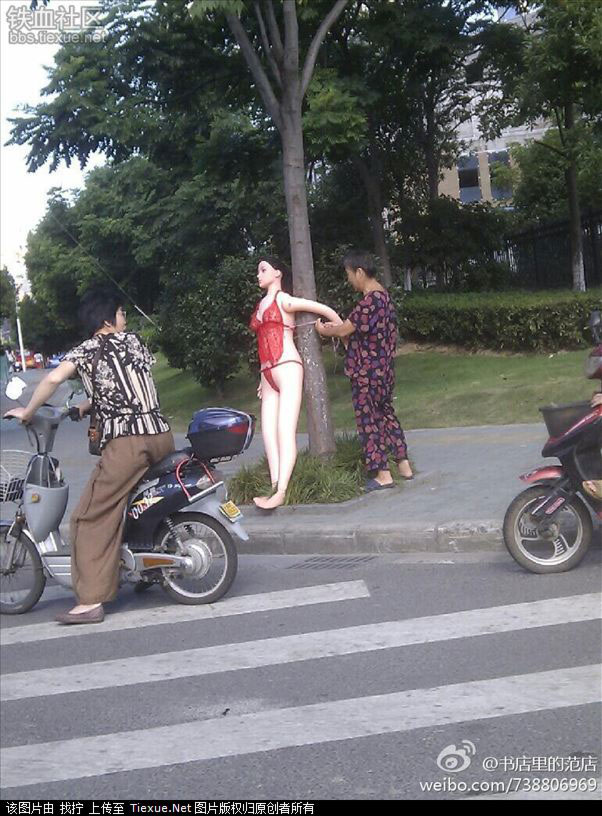
Am I turning into a crappy plastic objects fetishist? Recently in China, a woman started a DIY traffic calming movement by tying a sex doll to a tree at a dangerous intersection. I guess the idea is to get (horny male) drivers to slow down and pay more attention. I’m envisioning a future where I run around the city disbursing traffic cones with a a “real girl” doll strapped to my back so that sexually unsatisfied men don’t run me down with their cars.

[Maybe we could get Sexworld to sponsor the next 1st Avenue pedestrian improvement?]
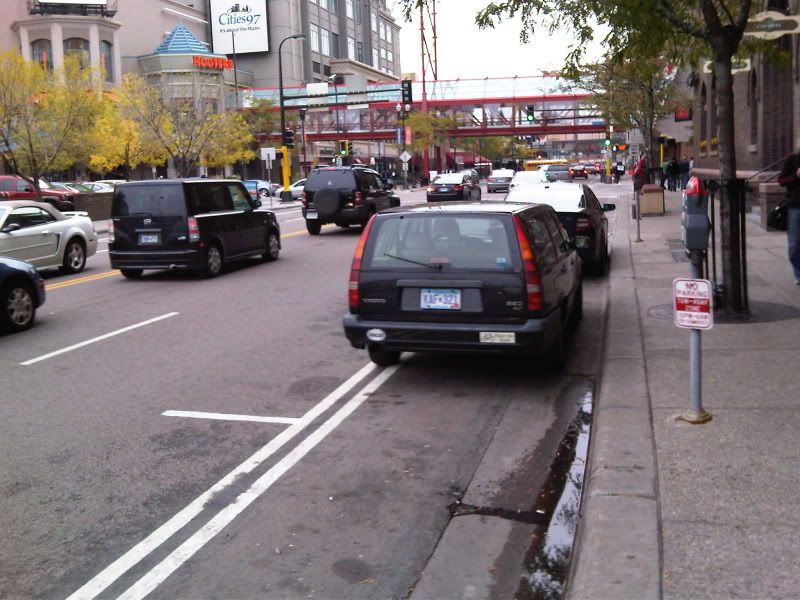
For those who don’t know, the First Avenue cycletrack is Minneapolis’ first quasi-bona fide cycletrack. A cycletrack is viewed by many as the gold standard of bicycle infrastructure. It’s a bike lane separated from moving traffic not just by a stripe of ‘bike lane’ paint, but by some sort of barrier. For example, you could separate cyclists with row of parked cars, a change in elevation like a curb, a row of plastic white thin things, or all of the above. Cycletracks are common in northern European countries with very high rates of bicycling. Many people (particularly those uncomfortable riding in street traffic) find them to be quite wonderful if done well.

That’s why I was happy when Minneapolis announced a few years back that they were going to build a cycletrack down First Avenue. Despite the protestations of business owners concerned about delivery trucks, the city went ahead with the project.

There was only one problem. They did a half-assed job. Instead of a clearly marked and separated bike lane, they just applied some paint between the parked cars and the curb. They also made the parking lane time-sensitive, so that during rush hour the row of parked cars disappears entirely. (That’s normal on many streets.)

The problem was that, without a some sort of clearly marked area to inform people where the cycle track was, nobody really knew what to do. People parked right in the middle of the bike lane, so the city put up more signs. People still parked in the middle of the bike lane, so the city put up some flashing electronic signs that makes First Avenue seem like Las Vegas in a kaleidoscope. 

Even the current signage funhouse doesn’t always work. You’ll still find people parked in the middle of the bike lane, people who are presumably illiterate or wearing two pairs sunglasses with a sombrero pulled down over their eyes or something. Until those plastic thingies appeared the other day, even the most ardent bike activist would admit that the First Avenue cycle track was a quasi-fiasco.

Minneapolis isn‘t alone in being reluctant to commit to the whole posterior. I’ve covered St Paul’s biggest bike debacle, the Jefferson Avenue bike boulevard, like a blanket in January. It's not a heartwarming story. And the way that it turned out, this bike boulevard should be probably only be labeled a “bike boulevard,” in the same way that Velveeta isn't really cheese.

[The Jefferson Avenue "test median.]
The problem is that the Jefferson project lacks many of the definitive features of a Portland-style bike boulevard (e.g. traffic diverters or traffic calming devices of any kind). And not only did the city approve a watered-down a plan, they built it in a "trial" manner. Instead of simply building a decent pedestrian median (designed to help calm the bicycle street and make it safer to cross busy roads), they built an ugly partially-effective "test median," and then placed a sign next to it encouraging people to call in and complain (which they did). Instead of just doing a good job the first time, St Paul's plan was to do half a good job, and then proceed with it slowly, painfully, displaying all the grace of a circus clown.


[Ha.]
... or get off the pot

I don’t want to be too hard on the Twin Cities. Both of these projects were something new. Both projects were politically difficult. Change is hard! Changing behavior takes a long time. Shifting prioities away from a slavish obsession with the automobile is what they call “a process.” That means that it doesn’t happen all at once. Getting people to bike and walk more is a matter of developing habits literally one step at a time.

At the same time, when faced with a difficult problem, cities are often tempted to compromise. Planners and city leaders end up torn between the politics of compromise and well-designed engineering. It seems that, much of the time, cities make so many compromises that they undermine the very thing they were trying to do in the first place. Sometimes, the perfect is the enemy of the good. Sometimes, you either do it right or you make a complete mockery of the very notion of urban planning. Sometimes, either you build a decent cycletrack that everyone can understand intuitively, or you compromise and construct a bicycle bewilderment with cars parked willy-nilly underneath a flashing LED circus filled with fine print. Then, two years later, you go back and gradually add in some thin white plastic things that you should have installed in the first place, and everyone on the street goes “Oh! That’s what its supposed to look like.”

I know which I prefer...


Update:

A report on white plastic things in Portland that got hit by cars and destroyed. TWICE. 

2011-01-19

Reading the Highland Villager #30 (January 12 - 25 Edition)

[Basically the problem is that the best source of Saint Paul streets & sidewalks news is the Highland Villager, a very fine and historical newspaper. This wouldn't be a problem, except that its not available online. You basically have to live in or frequent Saint Paul to read it. That's why I'm reading the Highland Villager so that you don't have to. Until this newspaper goes online, sidewalk information must be set free.]

Total # of articles about sidewalks: 12
Total # of articles about sidewalks written by Jane McClure: 11


Headline: University Avenue businesses plead for public assistance to weather disruptions of light-rail project
Reporter: Jane McClure

Short short version: [I wish I could have seen it when] A coalition of business owners "crowded into the Ax-Man Surplus Store" to desperately ask for help from the city and/or state to make up for revenue that will be lost during construction of the LRT line along University Avenue. [Only problem being that nobody has any money these days. -Ed.] Metaphors employed by business owners include "blood on the streets" and "swimming in an ocean with little life jackets." Business owners are looking for about $45M, but only $1.5M is on hand so far for construction mitigation.

Headline: Protecting LGA from further cuts tops city's legislative agenda
Reporter: Jane McClure

Short short version: St Paul wants to stop the incessant cuts to Local Government Aid (from the state to the city). [Fat chance! -Ed.]


Headline: Snelling median performing well in first months of use
Reporter: Jane McClure

Short short version: Report on the ["controversial"] median on Snelling Avenue. [Much to the surprise of reactionary Ward 3 Council Member Pat Harris, ] "Businesses are not seeing any decrease in customer traffic." Includes quotes from a Macalester official who observed slowing of traffic on the busy street. Also includes info about who maintains [i.e. waters & weeds] the plants on landscaped medians. Apparently in some places, this is done by volunteers! [Sounds like an opportunity for TC Sidewalks. -Ed.]


Headline: Renovation preserves pieces of Ramsey Hill's horse-drawn past
Reporter: Jane McClure

Short short version: A 1894 livery stable on Ramsey Hill is going to be renovated and historically preserved by being converted into a house. Article includes some interesting info about the history of livery stables. Somehow, carriages were stored in the ceiling.


Headline: Proposed changes to sidewalk cafe regulations get another going over
Reporter: Jane McClure

Short short version: Another update on the ongoing negotiation over sidewalk cafes in the Capitol City. Breaking news: "No one testified at the third public hearing on the ordinance on January 5." The debate is over whether to have minimum widths at 36 or 48 inches.


Headline: City ballot may allow up to 6 choices
Reporter: Jane McClure

Short short version: Story about IRV / RCV voting for the upcoming city council election.


Headline: Future of Jefferson-Cleveland median discussed January 24
Reporter: Jane McClure

Short short version: Report on the upcoming big meeting on the "controversial" test median for the bike boulevard on Jefferson Avenue. Includes typical McLure-ian language such as "so-called Jefferson Avenue Bike boulevard." [Please show up! Monday the 24th at 7:00 PM at the Edgecumbe Rec Center.]


Headline: Highland developer Mannillo is seeking seat on City Council
Reporter: Jane McClure

Short short version: Report on a candidate to replace [car-loving] Ward 3 Council Member Pat Harris, who is retiring. This candidate is a real estate developer and building owner who has lived in Highland Park for 33 years. Mannillo is also the former chair of the St Paul Heritage Preservation Commission. [$10 says he doesn't touch the bike boulevard issue with a 10-foot pole. -Ed.]


Headline: City Council settlement closes book on another billboard ban
Reporter: Jane McClure

Short short version: Clear Channel Outdoor [booo!] won a $25K lawsuit settlement from the city over billboard regulations.


Headline: I-94 resurfacing will continue this year west of Cretin Avenue
Reporter: Jane McClure

Short short version: MNDOT is repaving ramps along the freeway and installing a noise wall between Pelham and Cretin.


Headline: Op-Ed: Sounding the alarm for light rail in St. Paul
Reporter: Barnaby Weisner

Short short version: über-alarmist op-ed about how "neighborhoods will be destroyed" by the upcoming light rail train. Barnaby's concerns: street parking becoming difficult, the "spectre" of high-rises plaguing South Minneapolis, the sound of the train "alarms," and "alley traffic." The author cites the terrible image of Marshall Avenue after its conversion to a two-lane street as a warning to the disbelievers. [Truly, Marshall today is a nightmare!] The icing on the cake? The gov't will use eminent domain to steal your house to give land to a developer. [Wow! Even for the Highland Villager, this one is a mega-doozy. I'm tempted to re-print the thing in its entirety. -Ed.]


Headline: Culver's looks to bring butter burgers to University Avenue; Project would be one of the first under interim zoning rules created for Central Corridor
Reporter: Jane McClure

Short short version: Great. [Sarcastic tone.] They're opening a Culver's near University and Pascal, where the Spin Cycle laundromat is currently. It looks like they want a drive-thru window, but need a conditional use permit for that.

2012-04-04

Last Minute Amendment Strips Traffic Calming from Jefferson Bike Boulevard

[The Jefferson "test median", circa 2010.]
The story of the St Paul Jefferson Avenue bicycle boulevard is long and ugly, and is finally (maybe) coming to an end tonight. There's a meeting down at city hall this evening, where the City Council is going to most likely pass a compromise plan that strips out a lot of the traffic calming circles from the project.

The Story So Far

The problem is that the idea of bicycle boulevards are relatively new to a town like St Paul. They're streets designed to give pedestrians and bicyclists priority, to calm traffic speeds down to the point where only 'local' traffic is using it. They're intended to create spaces where auto speeds are far closer to bicycle speeds. In theory, boulevards are designed so that cars drive around 20 miles per hour, a speed at which any collision is very unlikely to result in the death or injury of small children, grandmothers, cyclists, or people out walking their dog. In theory, these kinds of streets would be seen as an amenity in the neighborhoods where they're constructed, as they create calm, quiet, walkable neighborhoods, accessible by car, that raise property values and quality of life for nearby homes and people.

Anyway, that's the theory. In the actual real world of Highland Park, St Paul, traffic calming that creates safe quiet streets is perceived as a quasi-fascist assault on the inherent freedoms of the automobile individual. (Or, at least that's true if you get your news from Soucheray.)

That might be exaggerating just a hair, because actually the project has received a lot of support and/or ambivalent shrugs. But for various reasons the proposed bicycle boulevard down Jefferson Avenue has for few years now been seen as controversial. The project has gone through a few different iterations, and finally now, after a huge number of community meetings involving hundreds of people, and after the city's Public Works department has spent countless hours doing research and analysis, a compromise plan has emerged that seemingly everyone can mostly agree about.

This plan isn't perfect. For example, it doesn't include any diverters that are common in bicycle boulevards elsewhere. These kinds of diverters do a lot to move 'through' traffic onto adjacent streets, while making sure that pedestrians and bicyclists can safely cross the busier streets that have higher traffic speeds (such as Cleveland and Cretin Avenues). You can see for yourself how these kinds of diverters work in South Minneapolis, where they seem to have not caused any kind of automotive apocalypse.

[An innocuous bike boulevard traffic diverter in Minneapolis.]


[Another Minneapolis boulevard diverter. Incidentally, neither of these diverters have caused the collapse of freedom and democracy.]

Anyway, the final St Paul proposal got rid of these kinds of traffic calming treatments in favor of traffic circles, which you will find elsewhere in the city. Traffic circles are a good compromise, I guess, because they do a nice job of 'calming' through the use of actual concrete that slows down speeds and makes streets safer for pedestrians and cyclists. Not only that, but traffic circles have little gardens on them! These circles have the potential to turn Jefferson Avenue into the kind of space where your kid might play football (as I did growing up with my brothers and sister on St Paul's Portland Avenue).

The Last Minute Deal

Or at least, that's the hope. I've heard that the proposal, passed unanimously through the Transportation Committee and the Planning Commission, is going to be semi-gutted by a last minute amendment during the City Council meeting this evening (5:30 - 6:30, roughly). From what I've heard, the new last minute deal will strip out all but two of the traffic circles from the project, while getting rid of the pedestrian crosswalk signage at the two busy streets, Cretin and Cleveland Avenues. This last minute deal will leave only two real traffic calming treatments on the Western portion of the bicycle boulevard: the traffic circle at Davern street and the one at Finn Street (which isn't scheduled to be built until 2017).

[The Public Works plan showing two of the traffic circles that won't be built under the new deal.]


To my mind, the last minute deal raises two key questions:

  • Should the council ignore all the public process that's happened so far, in favor of a backroom deal that has never seen the light of day? 
  • Is a bicycle boulevard without much traffic calming still a bicycle boulevard? 

I don't really know the answers to these questions. On the first, I want badly to say "No!" I want to say that the council shouldn't throw over a whole bunch of public meetings in favor of a few opinions of a few decisions makers.

But, on the other hand, most public processes are fraught with problems. If you hold a community meeting on some issue, the people that are most likely to show up are people with a lot of time and/or money on their hands. Those are the people with a voice, that provide "community input."

Meanwhile, not attending the meeting are many other people who almost never participate - people who rent, people with more than one job, young people, people with language barriers. Elected officials need to make decisions with the entire community in mind, not just those people with expensive homes and lots of hard-to-get phone numbers in their phones.

The second question is just as difficult to answer. To my mind, bicycle boulevards are a no brainer. They are streets that don't really mess with the status quo, as people can still drive around their neighborhoods, park on their streets, use their driveways, etc. But they're also streets that really emphasize and welcome the modes of transportation (bicycling, walking) that are the future of our cities. If St Paul wants to attract young people, or be safe for families, or be a place where old people can get around with dignity, they need to build streets that place people first. They have an opportunity to do this right now, basically for free, and it's too bad that it seems like they're going to do a half-assed job of it.

I guess something is better than nothing, here. But I really don't understand why the city cannot pass a common-sense measure that will improve the lives of almost all of the people who live here. Really the only people who 'lose out' when you build a bicycle boulevard are people who enjoy driving too fast through residential neighborhoods. Should we really make public decisions with them in mind?

In five years, nobody living nearby will think bicycle boulevards are a big deal. Neighbors will actually like the traffic circles once they are built. They'll blend into the background of the city and grow flowers. Ideally, Jefferson will subtly shift into a more quiet beautiful safe street for all types of people. Ideally, it'll be a place where even my mom would feel comfortable riding a bicycle and getting exercise on her way to the Highland Grill without feeling like she's 'in the way' of a pickup truck speeding down the hill.

That's the hope. I fear that today's vote will be somewhat different. It'd be nice if the City Council would pass a plan that really calmed traffic along this route. It'd be nice is St Paul embraced a healthy future.

The council meeting is tonight at 5:30 in the basement of City Hall. Show up and testify if you agree!


 [A traffic circle amenity welcomed by its neighbors in Portland, OR.]


[A traffic circle amenity welcomed by its neighbors in Portland, OR.]

2010-05-26

Reading the Highland Villager #17 (May 26 - June 8 Edition)

[Basically, the problem is that the best source of local streets & sidewalks news in Saint Paul is the Highland Villager. This wouldn't be a problem, except that its not available online. I'm reading the Highland Villager so that you don't have to. Until this newspaper goes online, sidewalk information must be set free.]


Total # of articles about sidewalks: 9
Total # of articles about sidewalks written by Jane McClure: 8


Title: City Council recommends financing for Carondelet Village; New senior housing awaits HRA approval of bonds, TIF district
Author: Jane McClure

Short short version: Nuns got the go ahead to replace their convent with a "home for retired nuns" on the corner of Fairview and Randolph. Planning commissioners are debating whether or not there needs to be a sidewalk from the facility to the corner of Randolph and Fairview, and whether or not there needs to be a sidewalk running along the Fairview side of the property. The project will be funded partially by $25M in TIF bonds from the city, and the sidewalk will cost $20K.

Title: Commission lays over request to reopen W. 7th tire ship
Author: Jane McClure

Short short version: The planning commission is haggling with a company that wants to open up a spruced up tire shop (to replace the old one) on West 7th St near the corner with Smith Avenue. The Planning Commission is prohibiting outdoor car work. The land use seems to annoy many of the commissioners and nearby residents, and doesn't fit with the "compact commercial" [i.e. not car-centric] comprehensive plan in the area. The Planning Commission will vote on it later, probably at the next meeting


Title: Historic designation for former Schmidt Brewery to be studied
Author: Jane McClure

Short short version: After prompting from [dogged] Council Member Dave Thune, the St Paul Heritage Preservation Commission is looking at getting historic designation. The request troubles some of the local neighborhood group board, who think that a historic designation will make it more difficult to develop the old brewery buildings. The brewery property has received $2.4M in grants for cleaning up the site, provided they can get a development plan in place "by this summer".


Title: Committee recommends that test of Marshall parking ban continue
Author: Jane McClure

Short short version: The Union Park district council voted to keep a test of a "once-a-week overnight parking ban" on Marshall Avenue. The ban was intended to make sure that bike lanes along the street remain clear in the winter, after the street went through a traffic-calming treatment that added a median and reduced the number of lanes from 4 to 2. The article also mentions that Marshall will soon have its speed limit reduced from 35 to 30 mph because of the bike lanes on the street.


Title: Land-use plans come into focus for LRT infill stations
Author: Jane McClure

Short short version: There was an open house this month to review drafts of land use plans for Hamline, Victoria, and Western light rail stations along University Avenue in Saint Paul. There will be public hearings in the fall look at the plans, which "call for small-scale neighborhood redevleopment4 and the preservation of most of the existing commercial and residential buildings." Also, they look to improve "connections for pedestrian and bicyclists". The plan includes a proposal to tear down the Old Home foods buildings [yogurt factory?] and build a "green space" there. The draft plans and minutes are on the city website.


Title: Council speeds up Geordies' bid to serve liquor on patio
Author: Jane McClure

Short short version: The city council unanimously waved a requirement for the extension of liquor service on the patio of Geordie's Bistro near Snelling and Randolph.


Title: City calls for vacant University Ave. building to com down
Author: Jane McClure

Short short version: The burned-out building at 1559 University must be "removed or repaired" in 15 days.


Title: Stark seeks moratorium, new zoning regs for tobacco shops
Author: Jane McClure

Short short version: Council Member Russ Stark wants stricter regulations for "tobacco shops, especially businesses where hookahs or water pipes can be smoked".


Title: June is busting out in Highland with new farmers' market; Business association lines up eight vendors of fresh mean, produce
Author:Larry Englund

Short short version: The new farmers market behind the Starbucks on Ford Parkway will officially open up on June 5th. There will be a lot of local vendors to sell meat, produce, herbs, flowers, and freshly packaged hummus.

2020-03-20

Still Further Thoughts on Ayd Mill Road

[Ayd Mill drone shot!]
It might seem incongruous to write about Ayd Mill Road in these trying times, but now more than ever, this road continues to be a thorn in the side of the city of Saint Paul. The public meeting, the existence of which was an outcome of the heated conversation at City Council three weeks ago, was supposed to take place this week. In its place, we have a 30-minute youtube video from Public Works explaining a few things.

The point here, though, is that this moment of social distancing and quarantine is the PERFECT TIME to send in a thoughtful comment in support of progressive low-car / no-car changes to Ayd Mill Road. So take some time out of your humdrum working-from-home schedule, brush your cat off your keyboard, and comment today!

Obviously a lot has happened since I last wrote about this concrete quagmire, and how Saint Paul “fixes” this road has rightly faded into the background. But the road must go on, and public works is still going to spend its allocated budget this year on maintenance and construction. So I wanted to post an update with some of the new information I've learned since I last wrote about Ayd Mill Road.

But first, let's watch this informational video!


OK well. Here are my quick takaeaways from the presentation and survey:
  • It is very nice that "repaving the status quo", i.e. the initial Public Works / current CM Thao proposal, is not one of the options mentioned in the video. Indeed, it is not mentioned at all. 
  • The "timeline" of Ayd Mill Road really glosses over former Mayor Randy Kelly’s highly-controversial "test connection" back in 2003, which is a key reason we're in this mess today.
  • Wow those renderings are cheesy!
  • Why does the 3-lane option require fewer drainage improvements than the two-lane option? Inquiring minds want to know. I'd imagine the drainage issues would be the same, regardless.
  • What is the reason for the claim that the Jefferson ramp is a minor adjustment for one, but not the other? 
  • They talk about reconstruction as a cost driver, but don't mention the reason, which is the the turn lanes. I wonder what the range of possible stacking length for the turn lanes was, and how that might have affected costs for the two-lane option.
  • What is the design speed of the new road going to be? And what will be the posted speed of the new road? That seems super important because...
  • The video glosses over the safety issues. Decreasing speed should be a major goal of this project. And yet the focus here is  “separating” cars going each direction with a median? That's a key design feature if you have a high-speed road (>40mph, like it is now), but if you are designing a low-speed road (<30mph a="" bikes="" boulevard="" buffer="" case="" design="" don="" especially="" have="" if="" important="" in="" is="" li="" like="" lower="" median.="" mississippi="" nbsp="" nearby.="" need="" or="" pedestrians="" river="" safer.="" speed="" t="" than="" that="" the="" this="" two-lane="" with="" you="">
  • A quote here from the second presenter: “It stands to reason that the three-lane operates more efficiently than the two-lane.” ...hm, does it? I don't see why that would necessarily be true. If you create more crashes with a three-lane road due to weaving traffic and contrasting speeds, it is less efficient and less safe.
  • Finally, I hate to say this, but the survey is terrible. I've never seen a worse one from anyone other than a hack PR firm. 
So, yeah. Well at least this video and survey is still better than an in-person meeting about Ayd Mill Road would have been. I can only imagine how terrible that experience would be. The focus groups alone would have set a new state record for mansplaining.

The Big Picture on Ayd Mill Road

Since I last wrote about Ayd Mill Road, and expressed my opinion that the best option for the City of Saint Paul would be to remove it completely from the city-funded motor vehicle network, I've had a few in-depth conversations with folks close to the project, both within advocacy groups and within City Hall.

While my mind hasn't really changed, and I stand by most everything that I have previously written about this project, I do want to share a few things I've learned. Here are a few things that I've learned.

First, the concrete roadbed underneath the degrading is in better shape than people (and myself) had thought. That means that a mill and overlay will theoretically last longer than one might have initially expected (maybe 15-20 years instead of 7-10).

The caveat is that there’s a particular spot near Grand Avenue where there’s a natural spring (that presumably once fed Ayd Mill Creek). There, the city needs to do something -- re-grading, or installing a new drain -- that will cost at leastr  $1M. I'd imagine that, in any roadbed re-paving scenario, including re-paving the status quo, that would would have to happen to keep the project from quickly degrading.

That said, I imagine that with a theoretical park/trail-only option, this cost could be avoided. Or maybe, the money could be spent instead on rainwater or daylighting.)

Second, the main cost driver of the two-lane road option is installing turn lanes, which would require pouring new concrete to create enough stacking capacity to allow people to wait for the light before exiting.

(More on this in a moment.)

#3. Finally, the city’s process has been admittedly flawed, with some missed opportunities to communicate and/or come up with consistent options over the last year or so. It’s understandable, as Public Works projects are constantly evolving and often the timelines are improvised depending on what money and resources are available.

But, that said, the current proposal is better than a lot of other outcomes.

Ranking The Options

Speaking of which, here’s my ranking of the options that are currently on the table…

  • #4. The $4m four-lane status quo repaving — as I’ve said, this sucks.
  • #3. Doing nothing — Honestly, this could be great or terrible, depending on what ends up happening. If the city “kicked the can” once more and didn’t repave it this fall, likely the road would have to be shut down over the winter. At the very least, though, that would give people a chance to think through the situation more completely, as well as demonstrate what traffic impacts might look like.
  • #2. The $9m 2-lane option — this is the best outcome, but it’s just costs too much money. For example, $9m could get you a long way toward completing the Capital City Bikeway, which would have many times the benefits of the Ayd Mill Road connection for bicyclists and for the city's economy.
  • #1. The $7m 3-lane option — Well, it’s a compromise, and at least it’s a change that would finally eliminate any freeway-connection pipe dreams. That said, I find it hard to believe that the bike lane would be very pleasant or useful in the short term, but it's better than nothing.
But, I still feel that there are two options that are not on the table, and that’s frustrating. Here's one...
  • #?. Closing the road, building a recreational trail and fundraising for a park —  I’ve already written about this, as have others. If you ballpark $2m for the trail, this would truly be the best choice, but sadly many people in Saint Paul are yet not ready to create a future with fewer cars on the city streets.
And there's this, lingering around in my head...
  • #?. A cheaper 2-lane option, somewhere in the existing $7m range — I still think, stubbornly, that there should be a way to design a two-lane road that falls close to the consensus budgetary range for this project.

[The St. Clair intersection is pretty useless.]
One way to do this might be to eliminate one of the access points. The obvious choice here would be the St. Clair on- and off-ramps. For one thing, this entire road offers only marginal benefits to the transportation network, but that’s especially true for the St. Clair intersection, where they’re less than a mile (and a 2-minute drive) away from the nearest 35E on-ramps and even closer to the Jefferson ramp. Simply closing this intersection has to shave a million bucks off the project cost.

I’d also be really curious about pricing out intersection alternatives, like a roundabout. In theory, it could save money on traffic signals, decrease speeds, and reduce the need for any turn lanes.

Conclusions

In short, I wish the City could have done more to come up with a more affordable, less compromised plan. I’m sure the consultant did their best with a very limited budget and the set of scope parameters they were given, but there have to be more design choices out there that could provide a quality recreational trail at a reasonable price tag.

This is to say that I reluctantly support the existing compromise, but the takeaway for me is that it’s a shame that we can’t make better decisions with city money and on city-controlled projects. Saint Paul is hampered right now by its lack of resources, both being short on critical staff in Planning and Public Works, and with a lack of tax base and revenue more generally. With a project of this size and budget, with such long-term implications, and with so many ambitions and idealistic plans on the city's books, this three-lane compromise project, while better than the status quo, seems like a missed opportunity. If we really want to make meaningful changes to our city, we need to do better.

So, go forth and take the "survey". At the very least, when this passes, I'll never have to write about Ayd Mill Road again!

2011-08-08

Reading the Highland Villager #42 (August 3rd - 17th Edition)

[Basically the problem is that the best source of Saint Paul streets & sidewalks news is the Highland Villager, a very fine and historical newspaper. This wouldn't be a problem, except that its not available online. You basically have to live in or frequent Saint Paul to read it. That's why I'm reading the Highland Villager so that you don't have to. Until this newspaper goes online, sidewalk information must be set free.]

Total # of articles about sidewalks: 11
Total # of articles about sidewalks written by Jane McClure: 9


Headline: Mannillo challenges endorsed Tolbert in Ward 3; Candidate takes issue with conduct of DFL endorsing convention
Reporter: Kevin Driscoll

Short short version: The runner-up for the DFL endorsement in Ward 3's (Highland Park's) city council race is going to stay in the race. Article includes list of alleged convention shenanigans [all of which are par for the course... DFL endorsement conventions are political equivalent of a trained cat circus. -Ed.]

Headline: City's seemingly yearly exercise in fiscal belt-tightening begins; State's unexpected $12 million cut in LGA has St. Paul scrambling for more cost savings
Reporter: Jane McClure

Short short version: The recent budget agreement cut $12M from St Paul's Local Government Aid money. The city has a hiring freeze in place. Article includes no other details. Article includes the fact that “next year could be worse.”

Headline: Inpatient facility, five single-family lots proposed for Bush site
Reporter: Jane McClure

Short short version: People in the Summit Hill area are nervous about how a new clinic for people with eating disorders will impact parking in the neighborhood. [In other news, mosquitoes bite your legs more often at dusk. -Ed.] An old empty building is being turned into the latest Emily Program clinic at the corner of Osceola and Grotto [in a fancy fancy part of town]. Includes anonymous quote from one neighbor woman about the increased use of the back alley: “steam is coming out of my ears.”

Headline: Jefferson Ave. traffic diverter may come to a vote Aug. 17 [Note the use of the noun 'traffic diverter' in place of the noun 'bike boulevard'.]
Reporter: Jane McClure

Short short version: The latest in the [interminable, frustrating, asinine, petty, petulant, Neanderthal] debate over the Jefferson Bike Boulevard. The [see previous list] Mac-Groveland Community Council is going to make a recommendation [they recently abstained from taking a side on the issue, if my Pioneer Press headline was correct]. The issue of whether or not to build traffic medians [like the ones along the Riverlake Greenway on 40th over in Minneapolis, which somehow got built without a great deal of hair-pulling and Soucheray-inspired car politics hystrionics] will come to a vote this month in all likelihood before the City Council. [The issue poses a political pickle for the Council, as it challenges the typical turf-centric stance that the Council likes to adopt, whereby each Council Member is allowed to effectively 'veto' projects in his or her own ward. Because outgoing District 3 CM Pat Harris does not approve of the pedestrian median, will the rest of the Council go against his wishes? Will the political lobby of the transportation non-profits such as TLC be able to outweigh the voices of Harris, poopular car columnist Soucheray, and assorted NIMBY neighbors? Stay tuned! Same time, same channel. -Ed.] Article includes tedious detailed history of Cleveland Bike Boulevard issue, including the [infamous farcical]test phase.”

Headline: Wild Onion's suit against city for patio license moved to federal court
Reporter: Jane McClure

Short short version: The owners of the [terrible] Grand Avenue bar / club Wild Onion have sued the City of St. Paul over the allegedly unfair enforcement policies over liquor licenses. The $50K suit is now in federal court. Article includes tedious detailed history of Wild Onion's patio liquor license issue, including the [infamous farcical] 90% consent petition requirement.

Headline: Council awards STAR funds for bike repair shop, other local
Reporter: Jane McClure

Short short version: A bike shop at Lexington and Hamline called “Youth Express” got a $8,500 grant for renovation from the city. Because of the money a bike mechanic will get a full-time job. Other things also got grants, including two churches and a handicapped-accessible apartment building. Some people did not get grants.

Headline: Public lines up on both sides of House of Hope fence issue
Reporter: Jane McClure

Short short version: A garden with a rabbit-proof fence built by a [large] Summit Avenue church is being challenged by ex-members of the Heritage Preservation Commission. Fence qualities found particularly egregious include its size, its “cedar and galvanized steel composition.” Article includes quote from CM Carter III stating that he will not make the church tear down the fence. [I do hope that this issue becomes a perennial evergreen Highland Villager bit, extending this debate for many many years into the future. -Ed.]

Headline: Editorial: What would Jefferson Say?
Reporter: Michael Mischke

Short short version: [Typically embittered] editorial from Publisher Mischke on how the bike boulevard, and the larger “so-called Bike Walk Twin Cities initiative” are destroying America, undermining the “values of self-sufficiency, self-government, and individual responsibility” and likely have [Thomas] “Jefferson rolling in his grave in Monticello.” Article includes [odd] claim that Publisher Mischke doesn't “have a dog in the fight over the addition of the traffic diverter.” [Article is accompanied by a rather neutral editorial cartoon featuring a bicycle and a debate.]

Headline: Federation begins renovating former brewery offices, rathskeller
Reporter: Jane McClure

Short short version: [After all these years] the old Schmidt Brewery is being restored by the West 7th/Fort Road Federation. It will be ready by next year. Includes admittance that the air inside the rathskeller was “dank.”

Headline: Despite service cuts, taxes are expected to rise in Ramsey County
Reporter: Jane McClure

Short short version: See above headline, earlier story on LGA.

Headline: With cleanup under way, city eyes 2012 reopening of Jimmy Lee fields
Reporter: Jane McClure

Short short version: The land for the proposed ball fields near the Jimmy Lee rec center is being cleaned up. The fields will be open by next year.

2017-05-26

Fight the Angry Flyers: Please Send Maryland Avenue Safety Comments


[Maryland today.]
So far I’m thrilled with the Maryland Avenue “field test” ofa 4-lane to 3-lane design, aka a “road diet.” I believe improving these dangerous streets by tweaking their design (swapping out thru lanes for a turn lane) is the #1 thing that Saint Paul can quickly, cheaply do to improve quality of life. Ramsey County -- quite reluctantly -- has striped a three-lane section of the street for a mile between Johnson and Greenbrier. 

And it looks surprisingly good! There's even a pedestrian median refuge at Greenbrier by the park, where Elizabeth Durham was killed. Just yesterday, some East Side folks from did another "stop for me" event there and it was a night-and-day difference from the first time they tried it. These changes will avoid hundreds of crashes and will quite literally save lives.

[Maryland and Greenbrier. Compare to the before picture below.]
And yet, not everyone is going to like the change. This week, an angry East Side man has started a single-handed leaflet-based "public enragement" campaign to save the deadly 4-lane design. He's even using Craigslist to hire folks at $10/hour to hand these fliers out at Maryland Avenue intersections for a few hours a day. (Honestly, I was thinking about applying. I could use the money. I could chant “Save the Death Road!” or “Honk if You Love Fatalities!” as I handed them out.)

Worse yet, the flier lists my phone number along with those of the local neighborhood group and Ramsey County Commissioner Jim McDonough. This isn’t the first time something like this has happened. There was the bitter City Council candidate going up and down Front Avenue with misleading fliers about a proposed bike lane, working people up. There was the whole epic saga of Cleveland Avenue, which ended in an embarrassing, expensive, and misleading anti-bike lane advertisement.

And this, the latest backlash against creating a walkable city. Check out the Maryland flier:

[Honestly, if there's one thing in this town that I would like to have my name on (other than the bathroom wall at the Gopher Bar, of course), it’s an arterial road diet on the East Side. Sidewalk philosopher… guilty as charged!]
To be honest, there’s not much I can complain about. The writer – a “very angry man” on crutches, as described by those who have met him – inadvertently hits on some truths here. 

But he gets his point in large print backwards. The goal of the design change is not to remove cars, but to slow them down and reduce dangerous passing behavior. The goal is to stop the often-fatal "whip-around" that has claimed lives

[Maryland and Greenbrier a year ago.]
In response to the flyer campaign, the Saint Paul safe streets community needs to be deliberate and sincere about why this design change is important. It’s all about safety and livability for folks living near these East Side streets. 

We need safe streets that people, young and old alike, can easily and safely cross. We need streets where cars will stop for people, with or without crutches, to let them cross the street. We need streets where there aren’t violent car crashes every day, and where innocent people aren’t sent to the hospital every month.

That’s why the Maryland Avenue sign campaign is a great idea, and why I have one request:

[Send feedback today!]


It’s really quick and will only take you a second. The County will weigh these responses, along with speed and crash data they are gathering.

Please do this and ensure that angry fliers don’t win the day, keeping the next generation of kids in Saint Paul at the mercy of dangerous street designs.


Update:

Here's a great video showing what the street looks like from a car drivers' perspective.