Showing posts sorted by relevance for query CWADS. Sort by date Show all posts

2014-10-02

The Best of the 5-County Manifesto (translated)

[This is what it looks like.]
You might have missed it, but on Monday the five non-Ramsey or Hennepin counties of the 7-county metro had a high-profile meeting where they expressed their disgust at transit funding that actually takes account of poverty. I will heretofore refer to the 5 counties as CWADS (CWADS = Carver + Washington + Anoka + Dakota + Scott).

Here's the best part of the Strib article on the meeting:
But the strictly suburban counties — Anoka, Carver, Dakota, Scott and Washington — say their pleas haven’t been taken seriously. And as a result, they say, the plan focuses on transit and nonmotorized transportation without paying enough attention to highways and freight, which they count as their lifeblood.
“It seems like they don’t hear us,” said Carver County Board Chair Gayle Degler.

Don't get me wrong. I grew up in Dakota County. Some of my best friends remain in Dakota County. (Hell, I'm in Dakota county right now as I type this.) In fact, not being able to walk or bike or take the bus in Dakota County is one of the main reasons why I am blogging on this here blogsite.

At the center of the issue is a document we might call the CWADS manifesto [scroll to the bottom], which consists of 13 melodramatic pages written almost entirely in engineering and planning techno-babble. Because of this language barrier, I fear most people would not be able to make much sense of the thing. But given the amount of attention that CWADS generated at their meeting, it seems important to bring it to the masses.

That's why I've taken the liberty of translating the best parts of this fine document into plain English for you. Keep in mind, the art of translation is a delicate one. Many a hand has been wrung over the difference between synonyms. Rather than serving as a literal translation of every syllabic nuance, this translation attempts to stay true to the intention of the original.

[See this is what it looks like...]
Here are the highlights!
4c. Citizen members of the TAB should provide balanced viewpoints that reflect the diverse modal needs of the metropolitan area. The representation on Transportation Advisory Board and the Council prevents all transportation modes from being represented equally. This results in TPP direction being skewed toward transit and non-motorized transportation modes which cannot address the future transportation needs of much of the suburban metro area population.

Translation: I know the committee is already stacked with CWADS engineers, but we want it all. Those transit and bike people really need to shut up. Balance = cars. Have you noticed that everybody keeps driving? Put that in your tailpipe and smoke it already.

[Know your CWADS.]
5b. The plan contains multiple statements that are not supported by accompanying data and are skewed to transit and non-motorized policy (a few examples include: people want expanded transit, congestion represents economic vitality, and focus on operating and maintenance to stay competitive). Statements related to improving the highway system are virtually non-existent.

Translation: Congestion is good? People don’t want to drive all the time any more? What nonsense! I’ve been living in CWADS for my entire life and never seen any evidence of any of this horse crap.

7.a.    The current revenue scenario plan predominantly focuses on MnPASS and preservation for the regional highway system and has limited vision related to strategic capacity enhancements.
    c.    There is not enough detail about the principal arterial needs in the region. The region lacks principal arterial capacity today and in the future based on established spacing guidelines, yet the TPP does not adequately address these needs.
Translation: Money goes for roads. And not just any roads, but new roads. Like roads that weren't there before, and more lanes for them and even more lanes for these new roads that we already put lanes on. If money isn’t building new roads, what is it even doing? CWADS need new roads! CWADS has arterial needs! Haven’t you seen Trainspotting?

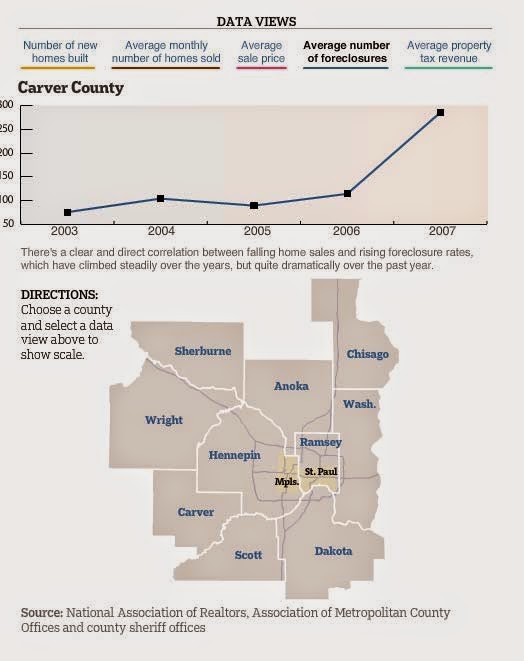
[Foreclosures in Carver County c. 2008]
8b.    There is little to no recognition of key local and trunk highway “A” minor and non- freeway principal arterial needs in the region.

Translation: OK I told you about my arterial needs, but you don't know how deep these run. We especially need wide new roads that go past still strip malls and brand new big box stores to replace the older empty big box stores. Oh, and have symbolic but unusable sidewalks.

    a.    Counties are truly Minnesota's subject matter experts when it comes to addressing poverty, and the causes of poverty. But these policy plans demonstrate no recognition of this experience and proficiency. Additionally, the plans contain no data demonstrating the effectiveness of the included strategies.

Translation: You don’t know me! Oh my god you have no idea what it's like to drive in this hellhole. CWADS exurban highway engineers know what’s best for us. They love us like a lover should, with wide new roads and park and rides that make us feel loved even if we never use them personally. Nobody knows us like we know ourselves. Oh yeah.

[Abandoned K-Mart in New Hope.]
10.a. The TPP does not recognize important resources suburban and rural counties contribute to improving and redeveloping the urban and urban centers and the entire region and State.
Translation: Where would Minneapolis be without CWADS and our resources? You know, things like… people who go to stadium concerts and ride on Pedal Pubs. How would the Coen Brothers make fun of their home town without a supply of suburban clichés about places like Normandale? Where would you put your Cabelas-es?
Item #11: The TPP should highlight the importance of advancing both transportation and recreational bicycle trails.
    a.    Counties and cities have worked for many years to develop a regional and local recreational trail system and have invested significant local and federal funds to these networks.
    b.    Many county regional trails provide both recreation and transportation, paralleling the county and State roadways, yet will not have equal standing when competing for funding. Regional trail networks make important connections to schools, community centers, parks, and activity centers that can be reached by bicycling and walking.

Translation: Why is everyone pretending that you can actually ride your bike to actual places (like the store, or school, or work)? It’s obvious that bikes are for riding around in parks for exercise on a Sunday. So why not lets just count all those bike trails along side the high-speed roads even though nobody is riding on them. Just please, please don't make us stripe any bike lanes. That would be silly.

[Average Carver County home: Norwood Young America.]
12a.    The minimum 20 dwelling units per acre for fixed/dedicated guideway exceeds FTA New Starts/Small Starts guidelines of nine to fifteen dwelling units per acre and is unrealistic for some transitway station locations. This requirement limits communities’ ability to consider input from their residents and market conditions.
    b.    If land use density minimums are perceived to be unattainable, land owners and some communities along transit ways could potentially resist new transitways and station locations and slow the region’s investment in new transit corridors.
Translation: Why do we have to build apartment buildings? That’s ridiculous! Nobody is going to do that out here, and having to pretend to try is going to put everyone in a bad mood. Like a seriously bad mood, you have no idea. Also, get off my lawn.

16.f.    The regional importance criterion favor projects near areas of high job concentrations but does not account for areas of projected regional job growth particularly in the suburban areas and beyond.
Translation: When we're doing planning and building transit systems, it's really important to be sure and count all the imaginary growth we planned in our heads when we platted our roads and political careers. Surely one imaginary corporate office park is worth at least 2/3 of an actual corporate office park? Can't we work on this?
[Cars in Coon Rapids = not enough roads.]
Item # 13: The TPP restricts certain types of land uses such as “surface parking lots” immediately around transit station areas.
    a.    While the logic behind encouraging higher densities, mixed use, and more walkable land use is sound, the prohibition of certain types of land use is overly restrictive.
    b.    Local land use planning decisions are a city/county responsibility that should be made by elected officials and should not be mandated by the Metropolitan Council

Translation: OK, this is the last straw. If we can't build surface parking lots next to park-and-rides and BRT stations, where can we put them? Also, "surface parking lots", as if there was any other kind of parking lot? We refuse to even acknowledge the distinction. If we can't pave it, it doesn't exist.

[An empty lot by a Northstar station in Anoka County.]

2014-10-07

Three Things You Should Know about the Suburban Equity Cry

[Woodbury.]
Last week, I wrote about the theatrical five-county meeting and whether or not the suburban counties’ claims to injustice had any merit. You’re welcome to pore over the suburban manifesto for yourself, or read my asinine translation. And over at Minnpost, I wrote about about how the normally opaque political wrangling over regional transportation investments had coalesced into a moment of clarity.

This story is important because it shapes how transportation (and especially transit) spending priorities will proceed in the Twin Cities for the next decade. Are we going to continue building culs-de-sacs and dangerous ring roads out into the exurban farmland? Continue to catalyze big-box cannibals? Continue pour millions down the vast parking lot drains chasing the mirage of suburban transit? Continue subsidizing developers and over-extended cities on the margins?

(Yes, of course we are. The next highway to Wyoming is well on its way.)

The issue of regional transportation politics is complicated, and it’s very difficult to sum it up gracefully. The more you learn about how decisions are made, the more you wish you didn’t care. But at the same time, the more you learn about the regional transportation balance the more the CWADS’ (CWADS = Carver-Washington-Anoka-Dakota-Scott) outcry seems absurd (and frankly immoral).

Here are three things that are rarely explained about the regional transportation funding situation.


#1) Highway Spending is Already Weighted Heavily Towards Sprawl

[Overdesigned cul-de-sac courtesy of Nate Hood.]
No matter the geographic scale, in Minnesota we disproportionately spend our road money in our least populated places. In fact, Minnesota proudly boasts of its long tradition of spreading highway spending around all our exurban, rural, and largely unpopulated ares at the expense of our cities. This is particularly true at the state and regional levels.

Understanding the complex details of this imbalance is the kind of thing for which lawyers get paid big money. And as I’m doing this for free, one example might suffice.

Let’s zoom in on the County State Aid Highway System (CSAH), which is a huge highway funding cash cow ($600M annually, as of 2013; please note that CSAH is an anagram for CASH).

Luckily, the state legislature’s House Research office has already produced a short document that explains the geographic inequality at the heart of CSAH funding.

For example, under the section “limitations on aid”, the CSAH formula requires that “counties must typically expend 60 percent of their allocation on construction projects and 40 percent on maintenance efforts” and that “counties are also required to expend a share of their aid on stretches of county state-aid highways located within small cities having populations under 5,000.”

Similarly, the “distribution formula” for CSAH dollars is almost entirely based on geographic area (rather than population): 10% is divided equally between counties, 30% is proportional to a county’s lane-miles, and 50% is “based on county construction needs to bring the system up to county engineering standards.” Only 10% of the spending distribution has anything to do with the number of people who live in each county.

Finally, in the Twin Cities’ metro, the metro-area motor vehicle lease sales tax is explicitly earmarked for “counties in the Twin Cities metropolitan area—excluding Hennepin and Ramsey.” (Note: I couldn't easily find out how much money is in this fund.)

The CSAH money pot isn't the only one that's weighted against central cities. Federal spending, MNDOT more generally, and intra-county decisions have similar problems (e.g. within the huge county of Hennepin).

[CSAH 22.]

#2) Twin Cities' Poverty is Heavily Concentrated

Despite some recent trends towards increased poverty in the suburbs, the Twin Cities’ is still extremely segregated according to race and income. Yesterday, I posted a map on streets.mn of the Twin Cities’ “(racially) concentrated areas of poverty.” The vast majority of these areas are located in the core cities of Saint Paul and Minneapolis.

Here are some data from the census:
[I made this myself.]

So, for example,  Scott County is the richest county in the state. The other CWADS counties are not far behind.

And these county-level data hide large inequalities within each county. So for example, here is a list of the top Minnesota cities according to per capita (not household) income:


[My Dakota County hometown comes in at #11; Joe Mauer lives in #3.]
By contrast Saint Paul sits at $20,216 and Minneapolis is only slightly higher at $22,685 per person. In other words, there’s a big difference between Wayzata and Hilltop. And within each city, there are areas of great wealth and deep poverty, typically disproportionately home to people of color. I hate to say it, but ignoring this geographic inequality is tantamount to racism.


#3) TAB Composition is Already Biased In Favor of the Suburbs

The final detail has to do with the way that the decision-making process is set up. As I explained in my Minnpost column, one of the key decision makers’ in the regional transit and road funding process is the Met Council Transportation Advisory Board. Here's how I explained it:
In order to understand the suburban counties' complaints, one must dive into the weeds of the Twin Cities’ unique regional governance system. In our area, the Metropolitan Council has shaped land use planning, sewer investments and our transit and transportation system since 1967. (Most U.S. metros are fractured and don’t have an independent metrowide governmental agency.)
However, the Met Council is appointed rather than elected, and so federal rules require an additional body — the Transportation Advisory Board (TAB) — to weigh in. The TAB has 33 members that include elected officials from all seven counties and some cities, as well as citizen and state agency members. The TAB makes decisions on Federal funding and sends recommendations to the Met Council, which retains the final say over regional planning. (See, I told you it was complicated!)

The key thing to know here is that composition of the 33-member board is already heavily weighted in favor of suburban and exurban interests. You’re welcome to take a look for yourself, but of the board composition has almost nothing to do with existing population density. Instead, members are appointed equally from each of the seven counties, and (somewhat arbitrarily) from individual cities. (Currently, there are city members from Saint Paul, Saint Louis Park, Maplewood, Minneapolis, Edina, Hugo, Newport, Apple Valley, Blaine, and Eagan).

(Opposed to all these members from suburban cities are the core cities' delegation, and three members representing so-called “transportation modes” like "transit" and “non-motorized.”)

That the existing TAB is so heavily weighted toward suburban cities might be one reason that the CWADS screed calls that "the Transportation Advisory Board must play a strong role in the preparation and approval of the TPP."

To be frankly, given its composition, that the recent economic equity changes to the TAB’s funding formula passed at all should be considered a minor miracle. 

[Thinking about the CWADS meeting is a little bit nauseating.]

Like Stealing Candy from a (Poor) Baby

[The current call for more “equality” reminds me a lot of this.]
It's hard to blame individual county politicians or city workers for demanding more money. After all, their job is to represent their own geographic interests.

But in the light of the Twin Cities' historical spending inequalities, the picture changes. Given how heavily the transportation funding deck has been stacked against cities, poor people, and sound investments, the fact that the five-counties are banding together to denounce so-called injustice seems disingenuous at best and immoral at worst. The only shame is that, because of the complexity of the funding and political mechanisms, more people can’t connect the dots and see last week’s meeting for what it is: a cry for help.


http://tcsidewalks.blogspot.com/2014/09/september-postcard-post.html


2016-08-29

Dakota County Shoots Future in Foot in War of the CWADS

Unless you’re a transit nerd, this summer’s news about Dakota County leaving CTIB probably seemed like “inside baseball.” (Most people’s response: “Ummm, see-what now?”) The story relies on knowledge about the intricate and compromised way that transit funding works in the Twin Cities. Even though I’ve spent years talking with people about it, I still don’t quite understand all the details (e.g. the exact differences between the CTIB and the TAB).

A quick explainer. Even though we have a seven-county metro area, shaped by the Met Council, lots of our newly-constructed transit is funded through the allocation of a five-county small sales tax governed by a separate board called the Counties Transit Improvement Board (or CTIB). That’s a big part of where “local match” money for projects like the Green and Blue LRT lines and their extensions, the Northstar rail, and other projects comes from.

The CTIB arrangement is voluntary. Counties sign up to tax themselves in exchange for some control over how the money gets spent. This delicate money pooling arrangement (on the board, each county gets two members, and the Met Council gets one) leads to challenges because both the majority of actually-existing tax revenues and transit usage exists in only two counties (Hennepin and Ramsey). Meanwhile, the remaining three counties (Anoka, Washington, and Dakota) have huge challenges implementing transit because of their existing land use patterns. (See also, the CWADS: Carver, Washington, Anoka, Dakota, and Scott...) This geographic imbalance of transit potential, transit need, and transit expectations helps explain how and why some of our decisions are so messy.

The existing balance changed this summer when (#brexit-style) Dakota County staged a mini-revolt against the CTIB system by officially withdrawing from the 5-county agreement. ("DaCexit?")

Here’s a bit from the June Star Tribune story on the decision:
Dakota County is planning to leave the regional body that funds transit projects across the Twin Cities.

The County Board voted in committee Tuesday to take steps to withdraw from the Counties Transit Improvement Board (CTIB), which pools tax money for projects such as light rail and bus rapid transit (BRT).

County leaders have raised concerns about whether membership is worth it. Though CTIB dollars have funded local projects including the Red Line BRT, a lot of the tax money that Dakota County contributes goes toward projects in other counties.

“I think we could do so much more if we kept it ourselves,” Commissioner Liz Workman said.

There you have it. Get ready for even more heavily subsidized opt-out buses bigger park and rides or something.


[Dakota County affordable housing is only in a few spots.]
Dakota County Geography 101

The decision to leave is a long time coming for Dakota County, which has teetered for decades on a knife’s edge between urban and exurban views of what the Twin Cities should look like. I should know, I grew up in Dakota County and still hang out there all the time. (Hi mom!)

For one thing, Dakota County is huge. It’s the same size as Hennepin County, i.e. massive, stretching from the edge of Saint Paul deep through farm country and all the way to the Northfield border. At the same time, it’s not very dense. The entire county population is about 350,000 people; compare that to Hennepin County’s 1.5 million. Its most urban (read: affordable, somewhat walkable) parts are first-ring suburbs like West Saint Paul, South Saint Paul, and small cities like Hastings. And then there’s a huge swath of second-ring cul-de-sac burbs like Apple Valley, Eagan, Burnsville, Inver Grove Heights, and more. Finally you get some third-ring and exurban places like Lakeville, Rosemount, and Farmington, where it’s not uncommon to have brand new homes literally planted in cornfields. This sprawling geography makes coherent policy a challenging political proposition.

Despite claims to victimhood from Dakota County Commissioners, Dakota County leaders are responsible for their own transit failure. The County, especially the Northern border areas, has a lot of opportunity for transit oriented development. But without leadership, they’re abandoning a walkable future and, years from now, Dakota County will be much worse off because of it.

[Annapolis Street may not look like much, but this is the border between two counties.]

The Classic Case of West Saint Paul and Robert Street

[The strip.]
The first-ring suburb of West Saint Paul offers the best example of how Dakota County transit politics plays out. West Saint Paul is a small square suburban city of about 20,000 people running from Annapolis Street, along Highway 52, South almost to Highway 110 and East over to Mendota Heights. The city is most famous for Robert Street, a massive post-war STROAD if there ever was one, a wide 50s strip lined today with automobile retail of every possible variety. Growing up, Robert Street is where our family went to shop. a wide 5-lane undivided road lined with parking lots and drive-thrus: Payless Shoes, Signal Hills Mall (B. Daltons, Herberger’s), Chuck E. Cheese, Ponderosa Steakhouse, the WSP library, Carbone’s, Cina 5 Theater, Granny Donuts, the non-super Target, the McDonald’s Playland on the hill, etc.

These days, I rarely visit, because I don’t like big box stores and the street is almost unbikeable. But if anything, in the intervening years the street has only become more of an automobile strip, adding things like B-dubs, Starbuxes, a massive WalMart, a SuperTarget, little places with great Latin American food, and every other suburban chain store you can think of (including a 5-8 Club franchise owned by a woman who was in my graduating high school class).

The other thing you’ll notice if you go to Robert Street these days is the construction. The street is being completely re-done, after much planning, to add medians and nicer ADA sidewalks. It was an expensive, multi-year project. When there was an election during the construction period, an anti-tax candidate  emerged to run against the road construction project, Scott Walker-style, under the “they’re wasting our money with sidewalks” platform. He channeled people’s frustration over road construction and taxes, and got himself elected mayor.

Since then, Meisinger has taken opportunities to lambast street amenities like sidewalks. And one of the consequences of Meisinger’s election is that ongoing planning for transit on Robert Street has been killed (as I was told) “pending land use planning changes in West Saint Paul.” It’s kind of like Scott Walker in Wisconsin, where transit or rail projects are waiting a magical political sea-change.

[Changes to school district composition over 30 years.]
Ignoring Suburban Poverty

West Saint Paul’s political situation is revealing because the city is in the midst of rapid change. When I went to high school here in the 1990s, the graduating class was just about all white; today, according to my old English teacher, it’s now 1/3 students of color and growing more so every year. Similarly, the city demographics are rapidly changing and becoming more diverse, even as much of the housing stock and infrastructure (like Robert Street) ages to the point of obsolescence.

West Saint Paul is also an exemplar of another more troubling dynamic, where race, poverty and housing form a distinct suburban pattern. This pattern becomes very noticeable for me when, from time to time, usually after the #62 bus service ends, I ride the #68 bus running down Robert Street South from Downtown. Even late at night, the bus is full of people of color riding to and from work and to homes in West Saint Paul or points further South.

In most post-war suburbs, especially first-ring cities like West Saint Paul, the bulk of the affordable housing is concentrated along narrow corridors of land near freeways. (See also, these two examples.) For many families, these slender swaths of apartment buildings represent the only places where they can find decent housing and good schools, especially in the crunched low-to-middle range of rental property. But moving into these suburban areas comes with a cost, as the sidewalks and transit in places like West Saint Paul are almost always lacking. And forget about riding a bicycle! It’s all but impossible (though people somehow do it anyway).

As they age and the homes get older and less fashionable, and as infrastructure like Robert Street comes due for expensive re-construction, cities like West Saint Paul (or many first-ring suburbs) get caught in an economic and political vice: struggling and/or aging middle-class homeowners decrying taxes and economic marginalization on one hand, rising costs and decreasing tax-base on the other. Cities can get caught within a vicious cycle where disinvestment threatens to spiral out of control. The end point is a place like Ferguson, Missouri, though (thankfully) nowhere in the Twin Cities is yet near that level of economic marginalization.

Quality transit investments are one of the few things that might help cities like West Saint Paul, catalyzing density that gives cities like these a chance to balance the tax books, creating mixed-use transit-oriented development that is in hot demand. Without it, the bottom line looks bleak.

Instead, the end result is that West Saint Paul, Dakota County, and the region will become more fragmented and polarized. For wealthier enclaves like Lakeville, the politics of urban separatism is appealing. Meanwhile, the transit riders close to the border will continue to struggle.


[South Robert Street wasteland.]

The Saint Paul Sacrifice

Living on Saint Paul’s West Side, a half-mile from the County line, it’s maddening to think that there will be no regional transit cooperation coming from the Dakota County side of the border. In Saint Paul proper, it’s no exaggeration to say that South Robert Street is one of the worst streets I’ve ever had the displeasure of experiencing. The sidewalk is abominable, narrow, and abuts the curb. There are no bike lanes, and the five lanes (!) of traffic move at very high speeds for a supposedly urban area. The absolute dignity vacuum here is one reason why the street is lined with half-century-old vacant lots, dilapidated surface parking, and abandoned commercial buildings the likes of which are rarely seen outside of ghost towns. And yet, these properties are within walking distance of booming downtown Saint Paul! The whole thing is an urban tragedy.

Robert Street doesn’t get much better as you travel towards the county border, with lots of historic buildings that need maintenance. Climbing the bluff towards Annapolis, the street becomes a bit calmer, and there are a few nice developments near the county line. But in general, this is a corridor full of unrealized potential. A transit connection from downtown into Dakota County would be a big boon for improving some of this underused property, and would dramatically improve the lives of thousands of people who’d like more options about getting around.

Given the way that the very idea of transit seems to infuriate the right-wing, I suppose it’s not surprising that Dakota County decided to scuttle cooperation. But for the thousands of people living on the seam between Dakota and Ramsey Counties, it’s a massive abandonment of those who would benefit from quality transit connecting Dakota County with Saint Paul.

I wish our political leaders could do better, but with the way that Dakota County politics is playing out, there’s little hope for Robert Street or Dakota County anytime soon. When Meisinger was elected, Robert Street transit planning was put on hold. To make matters worse, the “Dakota County pull out” comes on top of the de-funding of Southwest Light Rail (aka SWRLT aka Green Line Extension) at the legislature. Without the state share of the project, the money will come out of CTIB funding at the expense of East Metro projects like Riverview, Orange Line, or Gateway. The combination of political shenanigans leaves any notion of Dakota County transit investment about as plausible as Donald Trump winning over black voters.

This is to say that the county border seems more and more like an invisible border wall every day.

2016-02-25

Reading the Highland Villager #149

[Post-hibernation Villagers waiting for trash men to pick them up.]
[Basically the problem is that the best source of Saint Paul streets & sidewalks news is the Highland Villager, a very fine and historical newspaper. This wouldn't be a problem, except that its not available online. You basically have to live in or frequent Saint Paul to read it. Until this newspaper goes online, sidewalk information must be set free. See also: Three Reasons Why I Re-Blog the Highland Villager.] 


Headline: City may face a fight at Capitol over organized trash collection; St. Paul's $300,000 study of issue is just getting underway
Author: Jane McClure

Short short version: The city is studying whether to "organize" the currently un-organized "system" whereby everyone in the city hires their own garbagemen individually. [See my story on this in Minnpost.] Theoretically the plan would keep using the existing private garbage companies, only consolidating them into specific neighborhoods according to existing market share. A GOP state represntative from Farmington [which is, I am quite sure, exactly the kind of CWADS place where many of the people who own these "local" trash companies actually live] is introducing a bill at the state legislature that would introduce a five-year moratorium on cities organizing their trash. The logic behind this is that "it would give cities more time to study the issue." [Hm. Pretty sure there is no meaningful "logic" there, merely empty sounds assuming the garb of the English language.] 2/3 of the cities in the State of Minnesota have organized trash collection. Richfield, Edina, and Rochester are also studying organized trash collection. [Edina doesn't have organized trash? Every day I nod anew in astonishment.] Article includes some history of St Paul's trash collection. Article quotes CM Thao as being an "ardent supporter," and saying that the current system is "bad for alleys and infrastructure. [This is true.] Article quotes a garbage man saying "people are skeptical about organized trash collection."  [Another convincing argument! I thought Republicans believed in local control of things? It's not like there's any history of garbage collectors and corruption or anything...Wait, isn't that the "business" that Tony Soprano was in? I picture a Princess Leia like hologram image of a trash hauler appearing before the exurban republican saying, "help me Representative Pat Garofalo of Farmington, you are our only hope." PS. apologies for these "short short versions" getting a bit too long. Not sure what to do about it. I just CARE TOO MUCH.]


Headline: District councils build on cohesiveness of neighborhoods of old; St. Paul's system for citizen participation marks 40 years
Author: Jane McClure

Short short version: The "district council" system, of which there are 17, is now 40 years old. [There. See? That's better. Very short.]


Headline:
Author: Jane McClure

Short short version: [O Heck there were some good details in the story up there.] The district council system back in the 70s grew out of neighborhood associations like the Lex-Ham association or the Snell-Ham association. [But not the honey baked ham association.] The Midway Chamber of Commerce "worked to entice Henry Ford of Ford Motor Company to build a new assembly plant in Highland Park in the 1920s." [How did that turn out?] There used to be "ward clubs" that wielded influence over their parts of Saint Paul. Lyndon Johnson served as the impetus for the current councils. [I KNEW IT!] Some associations formed specifically to stop grocery stores from being built. [See also this article on citizen particiapation in local politics that I wrote a while ago.]


Headline: Plan restores parking lost for Cleveland bike lane [A much better headline than the Pioneer Press, by the way]
Author: Jane McClure

Short short version: The Cleveland Avenue bike lane, which is going to be built this summer, will require people to park a bit farther away in neighborhood side streets and in slightly adjusted "residential parking" areas. Article includes a colorful but confusing map of residential parking areas. [These should be adjusted based on market principles, which higher prices for permits and the ability of people to "buy" one depending on available space.]


Headline: Stadium task force awaits detailed plans; Meanwhile, project impact study begins
Author: Jane McClure

Short short version: People are still waiting to find out what the stadium and the area around the staium are going to look like. [Sounds like some active public engagement! PS. These details just came out yesterday.] Article quotes team owner [and really rich guy] as saying "I don't look at it is an establisihed bad place that can only get worse." [I can't even make sense of that.] There's also something called an AUAR ("alternative urban areawide review") but I don't understand what it is. It seems like a "more expeditious" alternative to an EIS. [Sounds a bit shady. I don't know. I do look at this as an establisehd bad place that can only get better.]


Headline: Test runs of rapid transit begin on Snelling; 'A' Line bus service will start on June 11
Author: Jane McClure

Short short version: Buses on Snelling will be nicer starting this summer. Article quotes Met council guy saying that the new bus "will have an exponential effect on ridership."


Headline: Grand Old Days? June street festival gets the nod for a second day of outdoor music; SHA compromises with GABA on expanding fest
Author: Jane McClure

Short short version: Grand Old Day will be two days now. You will be able to drink beer outside, buy things on the sidewalk, and listen to music on Saturday too. [Something about PROCESS IS BROKEN.] Quote from neighbor: "I'm tired f people urinating on my front stoop." [Amen, my brother.] Article includes references to vomit.


Headline: Legal settlement reached over more accessible curb ramps
Author: Jane McClure

Short short version: People trying to get disability and ADA-required sidewalks had to sue the city, which finally settled and agreed to upgrade ramps on Cretin, Fairview, Grand, Hamline and Summit, along with some others. This will have to happen for mill and overlay projects, not just full reconstructions, as had previously been the practice. Article includes detailed descriptions of curb cuts and sidewalk design. The city has until the end of 2017 and it will cost $1M. [Pretty basic stuff; the city screwed up when they didn't do it right the first time during the whole "terrible twenty" thingy.]


Headline: Support builds for TIF to help finance Ford redevelopment
Author: Jane McClure

Short short version: The Planning Commission [which I am a member of], City Council, and Mayors' office seem to want to keep "tax-increment financing" on the table as an option for the Ford site redevelopment, an old auto factory [mentioned higher up here]. Details are not known. Article quotes CM Tolbert as saying cities tend to overuse TIF.


Headline: In 7 years, ash borer has spread to almost every corner of St. Paul; trees will be treated still, but the benefit of containment 'is gone'
Author: Jane McClure

Short short version: Ash borers are killing ash trees everywhere now. There are 30K remaining ash trees. They're all gonna die. Article includes map.


Headline: Transit options narrowed in proposed Riverview Corridor; Shepard Road and I-35E nixed as possible routes
Author: Jane McClure

Short short version: When the committee that's deciding where and how to put transit along West 7th Street and Highland finally decides where and how to do it, they won't be deciding on putting it along the two freeways. [Well that should have been obvious.] Neighbors are concerned about traffic and parking and hazards for pedestrians and bicycles and also noise near houses. Article includes transit spokesperson saying "there will be tradeoffs." [Ominous but obvious.]


PS. Today's Reading the Highland Villager opera music was Puccini's La Boheme.