|
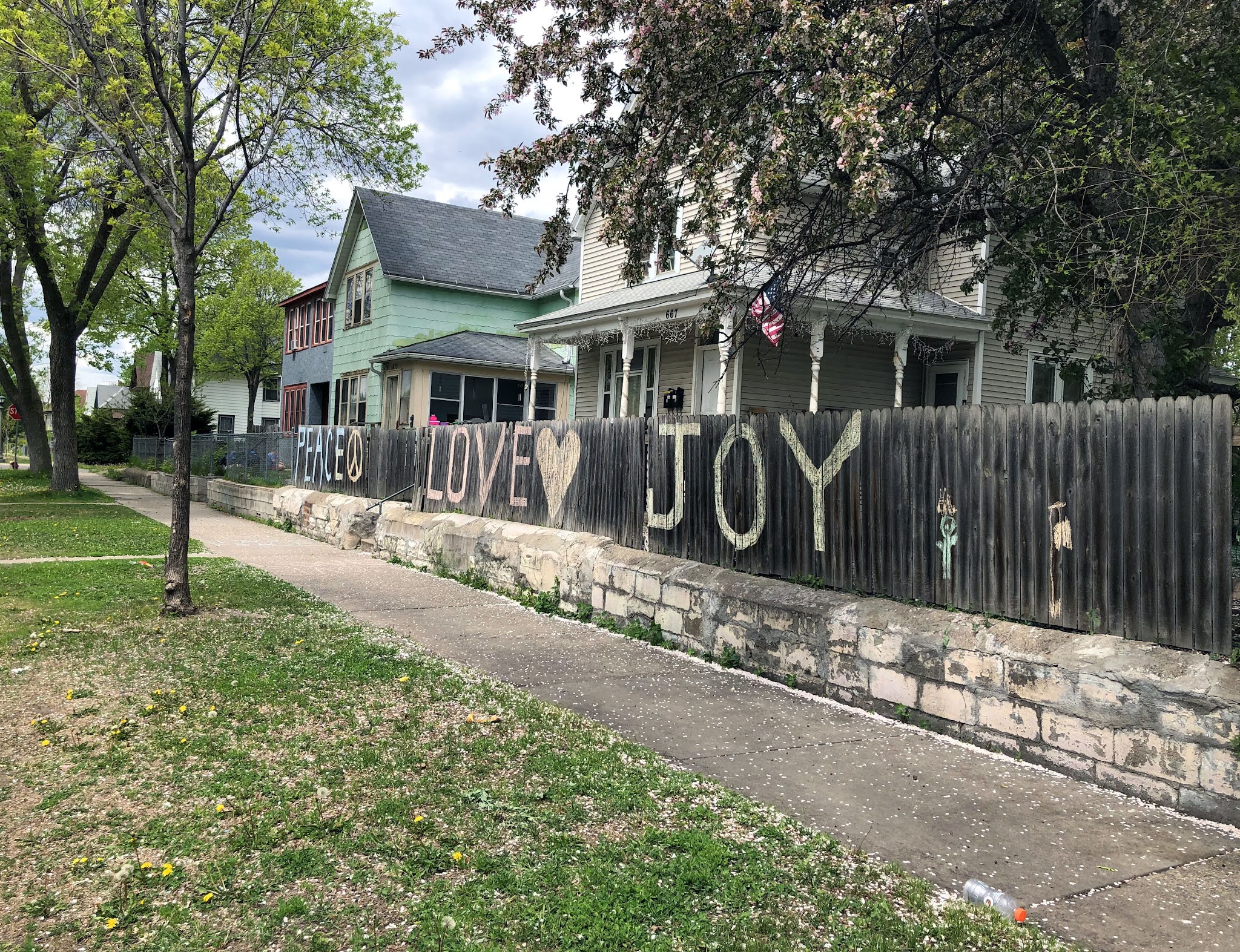
| [An apartment building in Frogtown.] |
If you read supportive narratives about the proposed Saint Paul rent control policy, depending on who you’re talking to, it will might have very little effect on most apartments — so little, that developers and landlords will barely even notice it — or it will usher in a new era of city-wide affordability that will decommodify housing and bring and end to centuries of real-estate capitalism.
Both of those things would be amazing, but consider me skeptical that either is a possibility. How rent control will affect housing lies somewhere in the middle, and it will be messy.
One thing I haven’t actually seen is any actual Saint Paul rental data.
Here are a couple questions I have:
- How bad of a problem is rent gouging in Saint Paul?
- How many properties would be affected by a 3% cap?
- What will it mean for the larger housing market?
So far, the only way to get a handle on this has been to look at the detailed CURA report on rents in Minneapolis, which is, to be sure, a different city. But Minneapolis and Saint Paul are in the same regional housing market. The two cities should fluctuate and trend roughly in parallel.
 |
[Long-term Minneapolis rent trends, with 10%-90% distribution.]
|
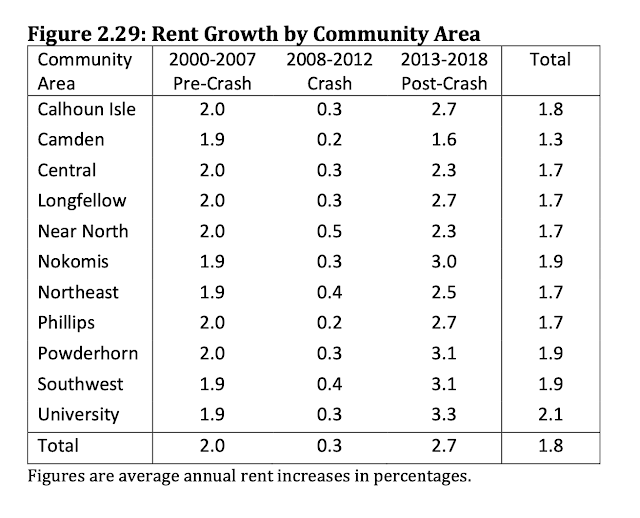 |
| [Long-term rent growth by neighborhood.] |
 |
| [Minneapolis rents v. income.] |
 |
| [Advertising rents for vacancy units, change-over-time, that includes the 2020 downturn.] |
If you read through CURA's lengthy study, you see there's a lot of variability. For one thing, rents go up and down. (This might seem weird to anyone who's been a long-term renter; I've never once heard of anyone having their rent lowered.) In the end, though, the data is clear: on the aggregate, rents are rising faster now than they have been historically, and thanks to our deep levels of racial inequality, it's a problem for working class and BIPOC folks.
This is the chart that makes the Twin Cities housing affordability problem very clear to me:
 |
| [This gets at the housing problem: rising rents combined with steep racial inequality. Zoom in and look at the income levels.] |
Tony Damiano’s recent Twitter thread has a nice summary of the situation. (Please note that he also admits that Saint Paul’s plan would be a “notable exception” to every other RS and rent control policy in the country.)
The CURA study on rent trends is solid, but Minneapolis is, in fact, not Saint Paul. They are actually different cities! The border is either the Mississippi River or Emerald Street. There's no overlap.
For example, I wrote a few years ago about how rent trends were diverging in Minneapolis and Saint Paul, with the former seeing more variability and an actual decrease in available NOAH rents for a time. Saint Paul’s rental market differs in quite a few ways, not least because we don’t build as much new housing, and it would be nice to see information about the actual place where the policy is being proposed.
Saint Paul Rent Trends
Well, I did what I could. A kind reader sent along
rent data complied for the metro area from the Met Council.
As far as I know, nobody has done this research on rents in Saint Paul. Certainly if there’s a comprehensive study on rental data produced by HENS, they haven’t shared it with anyone. (If you have one, send it my way!)
 |
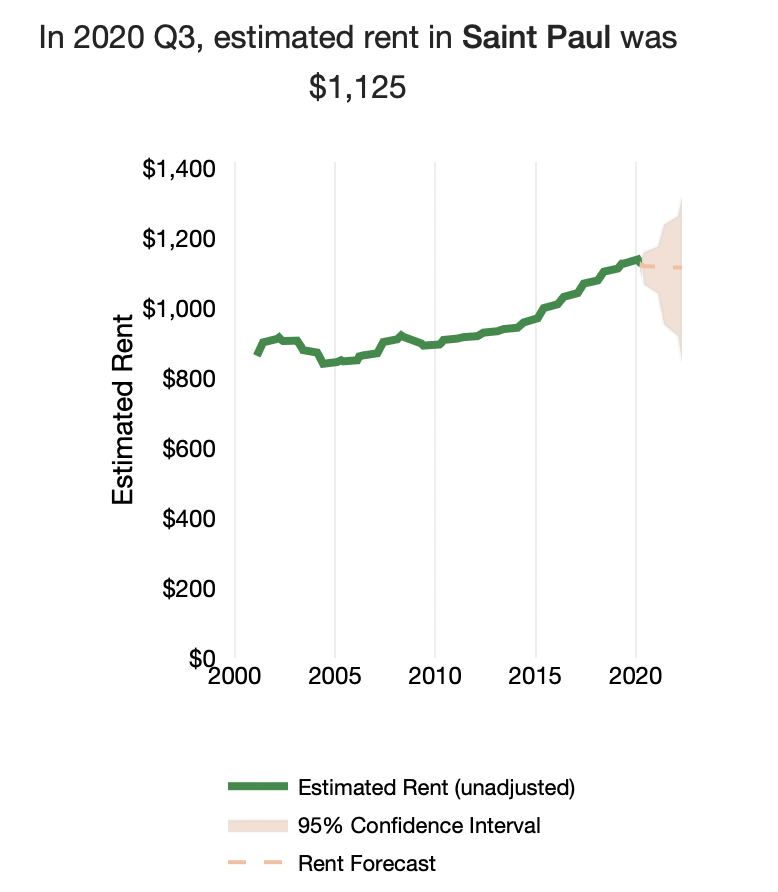
| [Rent in Saint Paul goes up and down a lot, it turns out.] |
Because the original Met Council data website shows quarterly trends, which fluctuate wildly, I put some key benchmark rental data into a spreadsheet to see how it looked longitudinally.
Please note: The Costar datasource is the longest, and its 20-year dataset indeed matches the CURA report average, showing about 1.6% rent growth over time. The Zillow data is the only one that separates rents out by neighborhood.
(The Rental Revue dataset is not nearly as good, and just shows available rentals, as opposed to the entire market, that are available at that moment. You can pretty much disregard it for these purposes, but it’s still interesting to the nerds among you, especially since it shows trends counter to the others.)
I’m honestly not sure what to make of all this. I would be interested in anyone else looking at this data and letting me know their thoughts. Feel free to comment!
But here are my initial takeaways:
#1: Long-term Rent Growth is Not That High
 Over a twenty-year span, rent growth is pretty flat. It's a lower rate than Minneapolis, though it seems there's more variability. Compared to nearly every other growing metro in the country, we don’t yet have a huge problem with rents and housing becoming astronomically unaffordable. Keep in mind that the "1.6% over 20 years" number is not adjusted for inflation, and just about matches that figure! In real dollars, rents have been flat. Relatively speaking, that puts Saint Paul in an enviable situation.
If you don’t believe me, talk to literally anyone who has lived in California or on the East Coast or in Denver or Austin or just about anywhere else with economic growth. It doesn’t take many of these conversations to make you feel pretty good about where we’re at, relatively speaking.
Also note: this good news is somewhat irrelevant because real wages have gone down for many BIPOC folks, though not all. This is one major cause of the housing crisis. Doing things like passing a living wage ordinance (or the Federal COVID relief and unemployment dollars) are very much helping to tackle this fundamental problem, but the problem remains.
#2: Saint Paul Rents are Rising Raster Recently, and in Certain Areas
The data also show that rental increases are getting worse, especially in working class and BIPOC neighborhoods.
Zillow is the only dataset that disaggregates rents by geography here, but you can see that certain neighborhoods (highlighted in red) are rising faster than others. Given the housing shortage and increase in inequality, this tracks with what you’d expect: working class and BIPOC folks, who are most vulnerable to rising rents, are seeing the largest percentage increases.
#3: I Can’t Believe Nobody Has Studied This
Why am I the one doing this? So far, the only information on city rent trends I’ve seen is the 1.6% over 20 years number cited by the advocates of rent control. Other than that, there’s a Minneapolis study and a lot of anecdotes.
I would think that, before we introduce a sweeping city-wide ordinance that I believe comes with a lot of negative consequences, we should have a clear picture of the problem we are trying to solve. Someone should do a more detailed analysis of rental increases!
But apparently my half-assed BS is all we have to go by.
So what does this mean? How do we react to the data?
This is where you have to do some predictions, and try and think through how a complex policy would impact the also very complex housing market. Please note that I would really like to have people study this stuff besides me, because I suck at studying rental data!
That said...
Prediction #1: What Rents Would Be Relatively Lowered by Rent Control?
Well, lots of them.
With this data, it’s hard to say how many apartments would be affected, but the number is in the thousands. There are overall 40,000+ apartments in Saint Paul, and the neighborhoods that are seeing over 3% rent growth these days is about half of them. You can guess that around 25% of the city's renters would see a benefit from a rent control policy, which would hold down rent increases to 3% in the specific neighborhoods where they are most needed.
Thus the rent control ordinance would cap rents for plenty of people in Saint Paul, making rents more predictable. It’s a pretty safe assumption that, especially in certain neighborhoods, rent control would limit rent growth fo thousands of people. It would make rental increases more predictable. Instead of large fluctuations, most Saint Paul renters could just about lock in a 3% increase every year.
This is a good thing, relatively speaking, though it doesn’t solve the real problems driving the housing crisis.
Basically, for the folks that would have seen the largest spikes, instead of a few years of large increases, you could count on a 3% rent increase every year pretty much indefinitely, at least as long as there was a housing shortage.
Certainly, a 3% increase is better than a 5% or 10% increase in rent. I mean, this is the goal of the policy. It will help thousands of people have more more stability in their housing costs, and the majority of these folks will be BIPOC or working class renters.
But also note that this policy does not step rents from rising. As long as inflation remains low, they would continue to rise faster than the 20-year median. So that's not great either!
Anyway, if this was all the rent control proposal did, I’d be for it. But it's not...
Prediction #2: What Rents Would be Relatively Increased by Rent Control?
Well, also lots of them. The bad news is that, because the details of the HENS ordinance limit growth in the city’s housing supply, it will also drive rents up for many people in the city. If you stop building new apartments, rental housing becomes more expensive.
How much? I don't know.
There’s a lot of good research on the connection between building new apartments and reducing growth in rents. If you don’t believe, me, please read this well-researched lit review on how supply affects rents, or this paper on how the “skeptics” that increases in housing lower rents are probably wrong. Building more housing helps keeps rents lower than they would otherwise be, and if you stop a lot of new housing from being constructed, you’re going to drive rents up in the city.
(For just a sample, here's a well-known study: "the data span 11 cities and tens of thousands of units. The authors find that rents for existing rental units within 250 meters of the new development fall by 5% to 7% compared to rents in buildings farther away, between 250 and 600 meters.")
By preventing thousands of apartments from being built in Saint Paul, the rent control ordinance places added demand on existing housing. Some percentage of the people that would otherwise be living in newly constructed apartments will look for rental housing elsewhere in the city. These folks will be generally well-off and have good credit stores, and will drive up prices for many apartments that would not otherwise be affected by the rent control ordinance.
The reduced supply will raise rents overall, especially for at the middle part of the market, especially in neighborhoods that would have seen housing construction: St. Anthony Park, Merriam Park, Hamline-Midway, Summit-University, Highland, West 7th, Downtown, the West Side, and (yes) even Frogtown.
Certainly we’re talking about slightly different groups of people with two trends, but eventually, it’s all the same set of apartments affected by the policy. A friend of mine calls this “downward displacement,” where people with more money and credit “take” apartments that would otherwise be in newly constructed buildings, leading to a chain of displacement that, eventually after a few steps, affects even the most affordable parts of the housing market.
Like it or not, rents go up when you stop building new housing. Overall, the effect of the rent control policy will be a mixed bag, and that’s a shame.
Rents v. The Big Picture
If all you’re looking at is rents, this policy is a net-positive. Many renters will be better off, a least for a while. While all rents across the city will keep going up, because you’re limiting the increase for a big chunk of the most vulnerable folks, the rest is noise. You're creating stability. Meanwhile, other renters will see larger increases than they otherwise might, locking annual 3% rent bumps for a large swath of Saint Paul renters.
But rents are one thing; housing is another. Even in the short-term, the big picture is where this particular rent control policy goes off the rails. This proposal does nothing to solve the real problems that are causing the housing crisis in the first place: income inequality and the housing shortage.
Income inequality is too broad to dive into here, but I addressed the housing shortage problem in an earlier post. Rent control does not increase the housing supply, and most likely shrinks it over the long term. There are also the problems of disinvestment, shortages, and discrimination that historically have made cities with rent control difficult places to find a decent home.
Meanwhile, owner-occupied home prices that are already spiking will to continue to climb steeply under a rent control policy that restricts new housing construction. A good percentage of the people that would have moved into new apartments will end up buying homes instead, and you should expect to see the kinds of 10%+ annual increases in Saint Paul home values that have been common over the last two years These increases will be largest in historical working-class and BIPOC communities, putting homeownership farther out of reach for these folks.
There are all kinds of problems that will accompany this trend, since so much of US policy and ideology is centered on homeownership as the primary way that people the country acquire wealth. Saint Paul already has a huge black-white homeownership gap, as well another racial and ethic groups. Putting homes out of reach of working class and BIPOC folks will further inequality.
There are some other issues too, but for now I’ll leave it there. If you’re only focused on rents, this policy is probably a net positive. If you think about the big picture around housing issues, it’s a real mixed-bag.
[See also my short column in Minnpost about the Saint Paul ordinance and my long-read with all the research about how this rent control proposal affects housing in Saint Paul, an explainer of why a 3% rent cap blocks new housing construction, short posts on how the policy would affect rents and taxes, interviews with housing policy experts on new construction and rent control, guesses about Mayor Carter's plan, and what I recommend we do about the housing crisis instead of the rent control proposal.]
Update: A dutiful reader put together a better-looking chart of the data, which you can see here.
 The Star Tribune reported some sad news this week, that the city's last real proper order-at-a stand and eat-in-your-car drive-in on the East Side.