Tragedy strikes on the auto-clogged streets of New York...
... as the unlucky protagonist of King Vidor's classic silent film, The Crowd (1928), loses something precious to a passing truck.

2009-09-23
Twin Cities Dog Poo Signs #1

Please clean
up after
your dog
Thank You
[Dog poo sign on tree in Chicago, IL.]
up after
your dog
Thank You
[Dog poo sign on tree in Chicago, IL.]

NO
DOGS
(Yes
Your Dog)
[Dog Poo sign in dirt along sidewalk. Location forgotten.]
DOGS
(Yes
Your Dog)
[Dog Poo sign in dirt along sidewalk. Location forgotten.]

Please
DO NOT
Dispose of
Dog Feces
In The
Trash
Receptacle
In The Lobby
Management
[Dog poo sign on door of office building. Downtown, Saint Paul.]
DO NOT
Dispose of
Dog Feces
In The
Trash
Receptacle
In The Lobby
Management
[Dog poo sign on door of office building. Downtown, Saint Paul.]

Pick Up
After Your
DOG
Being Watched
[And]
You're Being Watched
ITS THE
(Dogs) LAW!
To Pick Up
After Your Dog
[Dog poo signs on subsequent trees. Kent Avenue, Saint Paul.]
After Your
DOG
Being Watched
[And]
You're Being Watched
ITS THE
(Dogs) LAW!
To Pick Up
After Your Dog
[Dog poo signs on subsequent trees. Kent Avenue, Saint Paul.]
 Doggie owners:
Doggie 'poop' bags for
your use, well all forget.
Thank you for the
responsible doggie
owner habit ... picking
up poop!
And...
The POOP LEAVING
IRRESPONSIBLE
immature dog owners:
PICK UP YOUR DOG'S
POOP!!!!
...and leave sign alone!
[And]
Hey You-
Bag Snatcher
Go Find
Another
Thrill... Others
Enjoy Having
A Thoughtful
Convenience!
Get A Life.
Pet Your Dog.
[Dog poo sign, dog poo bag dispenser, and dog poo sign and bag dispenser maker. Brooklyn, NY.]
2009-09-22
Classic Sidewalks of the Silver Screen #25
In honor of Park(ing) Day and World Car-Free Day, enjoy this clip of small town sidewalks from the vantage point of windshield-watching, parking-spot-prowling, "Mrs. America"...
... in this General Motors produced piece of propaganda, Give Yourself The Green Light (1954), produced to lobby for the passage of the Eisenhower Insterstate Construction Act. (View the whole thing at the Internet Archive.)
... in this General Motors produced piece of propaganda, Give Yourself The Green Light (1954), produced to lobby for the passage of the Eisenhower Insterstate Construction Act. (View the whole thing at the Internet Archive.)
The Case of Bikes V. Cars
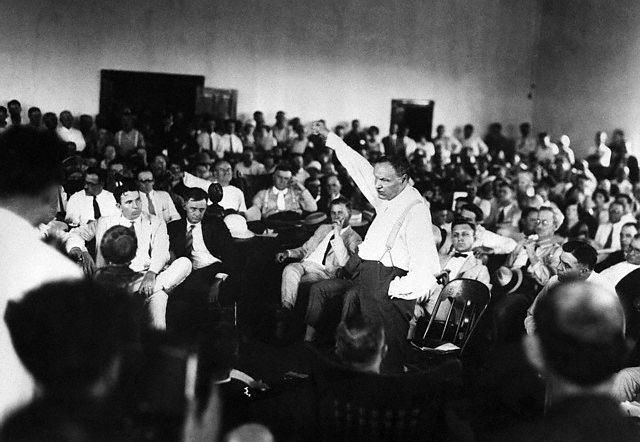 [How old is this debate? Here's a file photo of Clarence Darrow arguing "that bicycles should obeyeth all traffic laws or else suffereth the consequences."]
People on either side of the issue have good arguments. The 'bikes are cars' group, clearly frustrated by unpredictable lawlessness, argues that bikes should obey all traffic laws (just like cars do?), if they want to be treated with equal respect and deference on city streets. Here's an example from Sxoidmal during yesterday's conversation:
It's not an analogy. Bicycles are a part of traffic, regardless of your opinion, and your rationalization will not hold up in court. Take some time to carefully read MN Statutes 169.18, 169.19, and 169.222 to learn what your responsibilities (and rights) are. The fact that cars have the capacity for greater destructive force does not alleviate cyclist responsibility. However, you're right about the trip plates: after hours, when the traffic lights change from timed cycles to weight sensors, this can be a real nuisance for cyclists, and the answer to that is improved cyclist infrastructure. City planners need to be made aware of this legitimate concern.And then there's the other side, represented by JeffK, which is adamant that bicycles are not cars, cannot kill people, and shouldn't be treated the same way.
No. The analogy between bikes and cars is absolutely false, it's tired, it needs to die. Seriously. Your ability to injure another person when you're operating a bike is about a billionth of your ability in a car. This is why 99% of the population will walk across the street without a signal in this situation - because if somehow a car appeared out of the blue, only they can get hurt. Insurance companies, masters of statistics, know this: this is why it's peanuts to buy liability insurance for a motorcycle. Then there's the practical matter of bikes not tripping the sensors in the road to change the light.
I find myself making a similar argument once in a while, whenever (usually older) people complain to me about how cyclists break the laws by rolling through stop signs, etc.
I'm not exaggerating when I say that about half the time, when I stop my bike at a stop sign and wait for a car to go in front of me, they wait for me and wave me through. The other half the time they drive through in front of me after an extra-long pause.
My personal rules about cycling in the T.C. are something like this:
- Stop at every stoplight. Proceed through red lights only if there are no cars even close to the intersection.
- Slow down before each stop sign. If there are no cars at the intersection, roll through (sometimes rather quickly). If there are cars, defer to them.
- (When biking on a busy street, proceed with absolute caution and nervous anxiety at all times, especially at intersections, knowing that at any minute one could be severely injured by a driver talking on a cell phone and speeding around a corner.)
I developed this through a process of trial and error (and a number of close calls), seeing what works and what is expected of cyclists around town. Most of my friends have rules that are very similar to this. I might know maybe one person who always waits at every stoplight, no matter how deserted it may be, but I doubt it.
But the problem is that the rules here are so different from what is 'officially' expected of bicycles as they go around town. As Tom Vanderbilt points out in his book, the actual rules of traffic are something that emerges socially from the daily interactions of people sharing space on the street. We take it as a given that cars can go 5 - 10 mph over the speed limit on highways, even though that's technically illegal. (That number is quite a bit higher on the East Coast.) It's common practice to speed up to catch a yellow light, even though that is technically illegal. It should be (and sometimes is) illegal to text or mess with a cell phone while driving (or apply makeup or eat a complicated sandwich or tie your shoes, etc.), but people do this all the time. Jaywalking is illegal, but unenforceable and unenforced. Perhaps bike laws (such as the ones suggested by Mpls legislator Phyllis Kahn) that are more in line with how both bicycles and auto drivers actually behave, may be a good idea.

Twin Cities' streets are not designed to treat bicycles and cars equally. Streets are almost universally designed to make life easy for motorists, while bike infrastructure is about as rare as a Minnesota roundabout.
I was reading a study about different approaches to making cycling safer in US cities, and there are a lot of things that cities can do to create safe conditions for cyclists. The list includes bike-focused streets, separated bike lanes, "bike boxes" at the front of intersections, and special traffic signals for cyclists. The report quotes a study, that showed that, once a separate "scramble" signal for cyclists was installed at a stoplight intersection in Portland, cyclists started obeying the traffic laws in very high numbers.
The results indicated that the volume of cyclists using the intersection increased and the amount of illegal crossings significantly decreased after the scramble signal was installed. Specifically, 78.1% of all cyclists passing the intersection before the signal change did so illegally, while after the signal was installed, only 4.2% of cyclists made an illegal crossing.[p. 6 of "Intersection Treatments to Improve Bicycle Access and Safety", Portland State U's Center for Urban Studies.]
That's a pretty big change. The current problem, and one of the reasons that the Small Laws blogger will have no shortage of material, is that Twin Cities' bicycling laws and infrastructure are out of whack with how both cyclists and car drivers expect each other to behave. The new bike boulevard in Saint Paul and the new bike boxes in Downtown Minneapolis are good starts toward bringing actual cycling behavior more in line with the ideal world of transportation planners and lawmakers.
Meanwhile, I'm going to keep riding through deserted stop signs, having awkward moments interacting with cars in the neighborhood, and occasionally having near-death experiences as giant red Chevy Suburbans turn onto Lexington right in front of me while I'm in my bike lane on Como Avenue until I scream at them twice and they finally stop before running over my leg and ruining my only means of transportation.
[A report on a recent Bike V. Car fiasco in Toronto, Ontario, involving a high-ranking politician and a bike messenger who was killed.]
2009-09-21
Name That Sidewalk! #3
It's time once again for another Name That Sidewalk! (To the winner of the previous Name That Sidewalk!, your prize is finally in the mail. I promise.)
I saw this crazy car on the sidewalk one day, absolutely stacked to the ceiling with paper...
 [Click image to embiggen.]
... the only question is: Where in the Twin Cities is this sidewalk?
The winner receives a prized copy of Clyde Fans: part one, a graphic novel-type publication featuring wonderful antiquated urban landscapes and typewriters, drawn and written by Seth Weeks of Montreal Canada.

I saw this crazy car on the sidewalk one day, absolutely stacked to the ceiling with paper...
 [Click image to embiggen.]
... the only question is: Where in the Twin Cities is this sidewalk?
The winner receives a prized copy of Clyde Fans: part one, a graphic novel-type publication featuring wonderful antiquated urban landscapes and typewriters, drawn and written by Seth Weeks of Montreal Canada.
Subscribe to:
Posts (Atom)