2012-12-11

New Bike Infrastructure Means that Hennepin County, Univeristy of Minnesota Deserve Praise

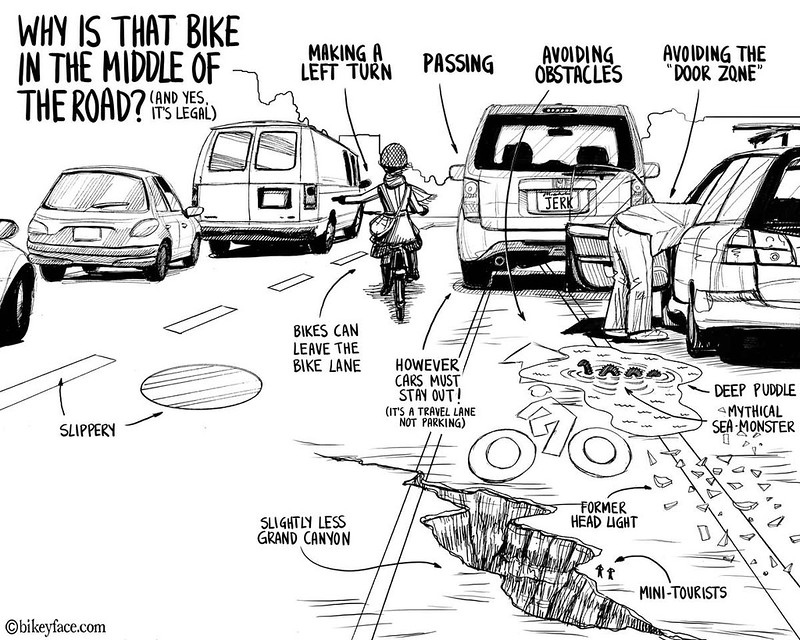
[The Smiley Face Bike makes its first appearance on this blog.]
Some time ago, I was mingling at a well-known urbanism conference and talking with a kindred spirit. He was a similarly positioned, quasi-professional transportation gadfly in a similarly positioned, mid-tier American city, and we were arguing about the proper ratio of praise to criticism in the almost meaningless small world of non-motorized transportation agitation.

"You should say four positive things for every one negative things," my new friend declared. "Politicians, the public and most importantly, city workers need constructive positive feedback. If you become too negative, they will quickly ignore you."

"I've thought of that before," I chirped. "I agree with you!" In the fine art of mingling, you can't go wrong by being agreeable.

But another part of me, my negative voice inside my head, quickly thought better of it. "But," I continued, "do we really need a four-to-one ratio? That's soooo hard! Almost impossible!"

I pleaded with him. "What about three positive things for every negative thing? Why not three-to-one? Can't we have a three-to-one critical society?" I was picturing a terrible future filled with civic boosterism, gold stars, and smiley faces. I imagined myself stockpiling complements, banking them each week simply in order to vent my spleen. It didn't sound very healthy.

"No," he insisted. "It has to be four. Only four will do."

Disgusted, I ripped my name tag from my chest, crumpled it into a ball, and threw it in his face, shouting, "No! I am a negative nag. I must speak the truth. So what if I'm only able to find ruin and pain in the world around me? I welcome my depressing hell. I will live inside layers of infrastructural animosity protecting me like an oyster's shell. I will polish my critique of everyday life until it is radiant as a pearl. Someday, the world will discover its beauty and weep for a lost city that might have been."

I spun around on my heel and marched from the room, stopping only to grab one more toothpick'd mini hot dog on my way out the door.

OK, I didn't say or do that. But when I started this blog one of my goals was to be positive about the city that surrounds me, to remind myself about the rich and subtle pleasures of the streetcorner, the sidewalk, and life in the cities of the Middle West.

That's hard. It's too easy to simply write another screed about how we need to change this street or have a more progressive tax code. More difficult is to tip one's hat and give credit where credit is due.

Here's an attempt...


[This is a creative triumph by Hennepin County.]


The Power of Positive Feedback 

I found myself riding the length of Portland Avenue this weekend, on my way to a holiday party at a friend's house. Though I'd seen the new design before, this time I was truly amazed at what a difference it made in my trip.

Before, a ride down Portland had been terrifying, clinging for dear life to a wrong-side bike lane, surrounded on all sides by parked cars with doors about to be opened or waves of 45 mph cars filled with drivers talking on their phones. 

This time, despite the darkness and the wintertime, a trip down Portland was relaxing and down right pleasurable. Except for one car trying to park, one can travel at one's leisure, unimpeded and far from the maddening bumpers.

The other thing to remember is that this kind of bike lane isn't just about bicycles. The new re-design also calms traffic and improves the street for anyone walking along the street. Families crossing Park Avenue today will find it far easier and safer. Anyone living in any of these houses is far more likely to relax in their yard, and enjoys an improved quality of life.

I often criticize Hennepin County, but here they did an amazing job. Following through on this unorthodox redesign took a lot of courage and it's an unequivocal success, improving the daily lives and safety of thousands of people who live near, and use this street every day. Good job, Hennepin County!

[The U just installed one of these at SE 15th & University.]
The second complement is for the University of Minnesota, and their new bike signal at University and 15th. For me, criticizing the U's bike infrastructure is a weekly ritual like going to church or flossing my cat.  And one of the biggest danger spots has long been the 15th Avenue SE bike lane, the #1 spot for bicycles in the whole city.

That's why its refreshing to see this corner is the location for the city's first (real) bicycle traffic signal, something I'd only seen before in the Europe's bike havens. (Don't get me wrong, the Broadway and 5th one is OK, but not a real intersection.) The light changes slightly earlier than the regular light for cars, giving bicycles added visibility and making it much safer for them at this busy corner.

Not only does adding a signal for bicycles gives them legitimacy, but it begins to recognize the fact that bicycles are NOT cars. They operate according to a vastly different physics, and have a different set of demands and expectations for safety and operation. If you begin to create a set of traffic laws and signals that make sense for the bicycle, people riding bicycles will follow the rules. 

Continuing to extend this system through the rest of Pleasant Street, and farther along the East and West Banks will be a big step forward for bicycling at the University of Minnesota. Compared to the criminalization and harassment of bicyclists at the University of Minnesota a few years ago (and its mockably condescending safety campaign), its nice to see the University using good design as its primary means of communication.

Congratulations to the Department of Too Much Parking and Transportation Services, and to bicycle coordinator Steve Sanders for thinking creatively about how to, not just accommodate, but actively encourage bicycling on campus. (I can't wait until the transitway extension is complete.)

2012-12-07

*** Sidewalk Weekend! ***

Sidewalk Rating: Impending

-->
“One among numerous witnesses attesting to the inconveniences and outrages suffered at the Grand Central Depot stated that the passengers “are passed in like hogs. Just before the train starts—sometimes only ten minutes, the doors are opened and there is a scramble pell mell. Hats are knocked off, people kicked in the shins, trampled on the toes and pushed this way and that. I have seen women treated shamefully in that way. I have known them to be left-behind for two trains after they have been waiting a whole hour, but could not get through the gate” (1).

[from Krystal D'Costa, on Scientific American.]


[Construction for I-94 in St Paul, c. 1967.]


*** CLICK ON IMAGES FOR LINKS ***


*** ***


*** ***


*** ***

*** ***


*** ***


*** ***


*** ***


*** ***

*** ***


*** ***


*** ***


*** ***


*** ***


*** ***


*** ***


*** ***


*** ***


*** ***
*** ***


*** ***


*** ***


*** ***


*** ***


*** ***


*** ***


*** ***


*** ***


*** ***


*** ***


*** ***


*** ***


*** ***


*** ***


*** ***
*** ***


*** ***


*** ***

*** ***
*** ***


2012-12-06

Sidewalk Mailbox #5: Turing Test

I've been stockpiling some letters received for a rainy day. Today is sunny, but whatever. See if you can tell which of them were written by actual humans!


Dear Bill (if I may),

Thank you for your important blog post about design issues and pedestrian accidents. I am a daughter of the two pedestrians killed early this month in Ramsey and the media coverage has been maddening to say the least. (And as a former journalist, I agree that they are overworked and underpaid but in this case the mention of alcohol use was entirely inaccurate and just lazy reporting.)

If there are any initiatives to build the long-discussed footbridge and/or move the highway that you know of, please let me know as I would happy to participate. I hope you keep writing about these issues.

Kind regards,
In Mourning

Dear IM (you may),

This is the most touching letter I have ever received. I am sorry for your loss, and hate to think that Twin Cities transportation system is responsible for so much sadness.

Yours truly,
Bill


Hey Bill, 

I really enjoy reading your blog and check in about once a week.  Even though your Villager rap up is more entertaining and would prevent me from banging my head against the dining room table, I'm still hooked into the agonizing paper version for some reason.  While out walking the dog the other day, I re-found these steps (attached).  Wondered if I could stump you on their whereabouts?

Thanks,
Hooked on Highland

Dear Hooked,

I am sorry to hear about your Villager addition. The good news is that you're not alone. There are an estimated 2500 people addicted to the Highland Villager in St Paul alone, but very few of them will receive treatment. That means that the vast majority of Villager readers are out there struggling with addiction alone. It's a lonely, terrifying existence for anyone that has ever experienced it. I know how it feels because I’ve walked in the same shoes.

There are several reasons why people in need of anti-NIMBY treatment don’t receive it.

    ▪    Money – as of 2011, the average cost of a 28-day stay at a residential rehab clinic was more than $27,000. Unfortunately, mental health insurance companies no longer cover NIMBY addiction, and most addicts simply cannot afford to pay for treatment on their own.

    ▪    Stigma of addiction – despite constant efforts to spread public awareness of NIMBY addiction as a disease, not a character flaw, many still look down on those suffering from addiction, which often causes addicts to remain silent and isolated.

    ▪    Attending neighborhood group meetings – many people find that neighborhood group meetings perpetuate their problem. A large number of addicts are introverts and began reading the Highland Villager early in life to overcome shyness, self-consciousness, and inhibitions. Take away the Villager and those personality traits soon re-appear. Try to drag them from a neighborhood group meeting, and many of them will tiptoe right back into the front door faster than you can say “keep coming back”.

    ▪    Geographical location – millions of people struggling with addiction live in "The Village", where there are few, if any, treatment facilities or support groups available.

Please take care, and find a non-misanthropic friend who can help you through this difficult process.

With love,
Bill


I just finished reading a post of yours from a bit ago and really enjoyed it!

Do you do advertising? I'm marketing out a site and can pay you via PayPal for adding a few text links to an old post of yours. These links would go to resources on education and topics related to the theme of your post.

Let me know if we can work something out! :)    

Thanks
Smiley

Dear Smiley,

My financial institution has issued me a notice to provide the you with consent to present you as a financial partner, so that the proceeds of this account can be paid to you for our mutual benefit. On
receipt of your positive response, we shall then discuss the modalities for transfer.

I have all necessary information and legal documents shall be processed to back you up for the claim. All I require from you is your honest co-operation to enable us see this transaction through. I
guarantee that this transaction will be executed under legitimate arrangements that will protect you from any breach of the law.

Please send your bank account number so that we may pursue this matter further.

Excitedly,
Bill


Hello, sir!  I'm a volunteer for the Bandwidth 2012 Music Festival on April 22.  This nonprofit event is free to the public and we are looking for ways to get the word out-- do you post this sort of thing on your blog?

Thank you for your time,
Tooting My Own Horn

Dear Tooting,

Yes, I do post this sort of thing. The only catch is that I only post it months after the events have taken place.

Belatedly yours,
Bill


Hi there,

My name is Najie C. and I work with the Sweet Elephant Music Group street team. We are a local hip hop organization that promotes local hip hop artists through bringing in big name indie hip hop artists to allow our artists to showcase for their fans. What we do as a street team is gorilla type marketing. We are very diligent in reach each and every community when promoting our events. We were very interested to see a group that was interested in giving a voice to Twin Cities Residents. That is a great asset to companies like ours.

We are interested in seeing if you could provide us with a list of the locations to all of the bulletin boards you came in contact with, or companies allowing bulletins to be posted in the store fronts? Thank you so much for your time and keep up the good work.

2 Pach-yderm

Dear 2-Pachyderm,

I've always wanted to see elephants doing gorilla marketing. Perhaps the Como Zoo might be an ideal location?

Good luck,
Bill


Hi Bill,

I'm a writer for an online resource looking at the intersections between psychology theory and management and I'm interested in contributing an article to your blog. I came across your blog http://tcsidewalks.blogspot.com/2008/07/jane-jacobs-development-v-destruction.html while I was conducting research about industrial organization and found your content to be very engaging.

So far South Carolina's Lieutenant Governor's Office of Aging and the Queensland Government's Health information services have listed the project as a resource for others.

I'd like to write an article relating to industrial organizational psychology, perhaps on positive psychology or prospect theory. Please let me know if you'd be interested. Thanks, and I hope to hear from you soon.

Best,
Quack

Dear Quack,

As you suggest, my blog peaked in 2008. Today it's a shadow of its former self. I doubt very much if you'd want to be affiliated with it.

Best,
Bill


Gosh, there is really much useful information above!
I totally match with anything you have written.
Pretty helpful data, lots of thanks for your post.
Thanks for your article, pretty useful piece of writing.
Wow, there is so much effective info above!

Hello there, I found your website by way of Google while searching for
a related topic, your website came up, it appears great.
I have bookmarked it in my google bookmarks.
Hello there, just became alert to your blog thru Google, and found
that it's truly informative. I'm gonna watch out
for brussels. I'll appreciate if you happen to proceed this in future. A lot of folks can be benefited from your writing. Cheers!

Dear Gosh,

What is this "Google"? I wish there was some way of looking it up.

Thanks for the warning about brussels, though. I just opened my fridge and this is what I found in the crisper:


You probably saved my life.

Best,
Bill

2012-12-05

Dayton Begins the DFL Transportation Debate with a Modest Proposal

["You're still there? Why are you still there? Get away from me!"]
It's been an interesting month. It began with a massive election night hangover from drinking too much RomneyFAIL Schadenfreude®, but not long after the headache started to fade, I found myself fantasizing. Waking up and finding the DFL in control of state politics after twenty years of watching Tim Pawlenty egowrestle with Jesse Ventura is like wandering through a vast desert in search of water, only to happen across a broken down Culligan Water truck sticking out of a sand dune. You're not sure if there's anything in there, but it's certainly exciting.

Naturally, I allowed my imagination to wander. I let fantasies carry my mind away into the world of urban fiction, places where you don't have to wait an hour for a bus, Walmart isn't subsidized, and bridges no longer fall into rivers. Yes, now is the time to dream.


The Governor's First Transportation Salvo

[All of this money will go to fund new freeway bridges to Wisconsin.]
Well, last week the Governor's office started the transportation conversation by releasing the draft results of a "task force" consisting of a few state legislators and a bunch of people from different state transportation agencies (MNDOT and Met Council). (Is a "task force" the same thing as a "blue ribbon commission?") It's a short document, listing a few vague priorities, but presents the initial "offer" for the coming debate over Minnesota's upcoming budget.

There are two key changes. First, fulfilling Tom Friedman's liberal obsession, there would be a ten-cent hike in the state gas tax (or, as the task force puts it with amusing delicacy, an "increase in per-gallon excise tax rate on motor-fuels”). This would go up a bit each year, and would raise $10-12 billion over twenty years, all of which would go to roads. (That's a 61% increase in funding.)

Second, there is a big 200% increase in the (five county) metro area sales tax devoted to transit. This would raise about $5 billion over twenty years, which would go to maintenance and construction for metro area transit. (That's a 59% increase in funding.)

There are a few other minor changes, suggestions about loosening the reigns on local governments ability to raise their own revenue, and increasing the role of MN-PASS (toll) lanes.

[An impossible confusing chart. Note the ratios of transit to road funding.]


Five Lingering Questions

First, there's the issue of the geography of transit funding. As part of my 'wish list' fantasy, I wrote the following:

But what's the best case scenario? Well, the first thing might be a more stable source of everyday maintenance revenue for Metro Transit. If there was a better pot of money that would keep them from having to desperately beg the legislature every two years (like there is with the state gas tax), that would take a lot of political pressure off groups like the Met Council. We'd actually be able to count on a stable transit system. (I remember this being a political issue a few years ago. I'm not sure how it got resolved back then.) In the best of all possible worlds, this funding stream would allow Metro Transit to actually cut fares in half, to levels that poor people can actually afford, and that would make taking transit as appealing as apple pie (in the sky).

The dedicated sales tax is a step in that direction. It would boost to the stability of the Metro Transit system. The only catch is that, by restricting the tax area to the metro area, it creates a geographical divide. Roads are paid for by everyone, including the core cities and suburbs, whereas transit is paid for by only the metro area. Would this make transit funding more unequal? Might it have negative political consequences (make it seem unfair for the metro area, especially the more suburban counties)?

Second, would this increase be primarily for everyday maintenance or for new capital costs? In other words, would this money be used to pay for things like the SouthWest LRT line (which will surely get funded in this year's session)?  Probably, yes. This is a good example of why the geographic funding mechanism is important. This plan would shift 'who pays' for the SW-LRT from 'the entire state' to being just the five (or seven) county metro area.

Third, there's a "passenger rail" wild card in the governor's funding spreadsheet. It lists "$5-7 billion for passenger rail", but doesn't spend any time explaining this. Is this pot of money for things like High Speed rail to Chicago or the Northern Lights Express? Where does this come from?

Fourth: Why is there not one mention of bicycling or walking? 

Finally, Will the gas tax actually happen? If it does, how much of the new road money will be for maintenance of the existing road and highway system? How much of it will be for expanding capacity? Will MN-DOT's priorities shift away from bridges to nowhere and toward expensive and badly needed upkeep?


[Might be time to update Pawlenty's MN-DOT logo?]
Not Great, but One Hell of an Improvement

There are two main conclusions to draw from the governor's task force. The first is that it's not good enough. This is a conservative plan, that hedges its bets. The draft document repeats over and over again how it wants to create an "economically competitive / world class transportation system," but only devotes 1/3 of the new money to transit. The measure of a world class system will be transit in the Twin Cities, and this proposal would keep the Twin Cities on its slow snail's pace, crawling toward its urban future. (For example, would this be enough to fund the proposed streetcar systems for Minneapolis and St Paul?) This plan might reflect the state's political geography, but it will keep Minnesota stuck in their cars.

The second conclusion is that we're sure a lot better off than we were last year. Compared to the exhausting 'no new taxes' mantra pouring out of the GOP tailpipe for the last few years / decades, having a debate about how much new money to invest in transportation is a big improvement. Instead of debating about whether our transit system should exist at all, we're debating how much new money to give to it. That's a big improvement, and I look forward to some more visionary suggestions (especially from the DFL house).


[This loon has been wandering the desert for the last twenty years. Maybe now it'll find some water.]


PS: Does anyone know if this task force began meeting before the election? Or was it convened afterwards?

2012-12-04

Today on Streets.mn: Will Rybak Follow Through on Washington Boulevard?

[One of the "visions" from Rybak's 2007 Washington Ave plan.]
I have a new post up today over at Streets.mn. It's about how today's public meeting about the future of Washington Avenue relates back to some lovely planning and visioning that Rybak and a team of talented designers and architects penned back in 2007. Here's the crux of the piece:

The best thing to come out of the Great City initiative was the plan for Washington Avenue, or as Rybak’s group christened it, “Washington Boulevard.” The planning document, which you can see here, is an extensive collection of impressive platitudes about sidewalks, streetcars, and cafés shaded by tree leaves. It begins with some of the “challenges,” pictures of how empty and alienating current state of Washington Avenue. Quickly, the plan begins overflowing with photos of Paris and more Paris and Portland. The “vision study” is filled with hopes and dreams.
Five years later, as it turns out, not much has changed on Washington Avenue. There are a few new buildings, mostly five-story condos with underused street-level retail, but Washington Avenue is still a terrible place to take a stroll, and you’ll not find a single sidewalk café (except maybe Runyon’s?).  The street is a smelly car sewer designed to get people to and from 394 and 35W. Crossing Washington instills panic, and makes you feel like Washington crossing the Delaware. Five years after Rybak’s watercolor vision, Washington remains a vast moat keeping people downtown from finding the Mississippi.

[Remove the trees, people, and median, and this is about right.]
This story is really close to my heart for two reasons. First, it dates back to the moment when I developed my mancrush on Minneapolis Mayor RT Rybak, when I accidentally wandered into an architectural pep rally that was right up my cobblestone'd alley. Second, it means that I've finally been around this town long enough to start seeing how things play out, slow motion style, in the world of local urban planning decisions.

You see, change in Minneapolis and St Paul happens incredibly slowly. Almost any debate you can think of has a long and tortured history that stretching back to the dawn of Central Standard Time. Almost any issue you can think of has probably already been discussed and debated by your mothers and your mother's fathers (and in the case of St Paul road design, probably far longer than that).

That means that it really helps to do some homework before you jump into the kaleidoscopic world of Twin Cities planning debates. It helps to have been around for a while, to have been paying attention for a few years or a few decades. This is a perfect example. Just looking at the announcement by Hennepin County about the Washington Avenue redesign, you might never know that the city and its mayor invested time and energy into this project already. You might never know about the designs and  the street in the Pedestrian plan or the Bike Master Plan or the Access Minneapolis plan. You might not have seen the historical photos of Washington, before the street was transformed into a viaduct for its freeways.

This is a great example of the "rubber meeting the road." I remember Rybak talking onstage about how great Washington Avenue could become. Thinking back to that moment and comparing it today's meeting throws into relief the difference between talking and doing, between actions and words. At last I've been around long enough to remember.

[The 2007 Great City Design event, where "Washington Boulevard" was born.]