2012-07-05

Possible Defenses for Challenging a Red Light Bicycle Ticket

The ‘Good Will Hunting’ Defense

What It Is:
like in the movie good will hunting, where Matt Damon is arrested for punching someone or whatever and then defends himself in the courtroom using his genius knowledge, citing all sorts of precedents from all the law books he keeps in his apartment he doesn’t let Ben Affleck into, saying all kinds of crazy shit really fast. This defense would be like that only you’d cite research on bicycling. You basically thrown a whole bunch of peer-reviewed articles at the court and hope that it sticks.

What You Say: [Speak as quickly as possible] “Your honor, this ticket is unjust and I want to go on the record as contesting it. Numerous studies show that compliance for bicycling laws rises dramatically if laws are changed so that they make sense. Wall's 2003 study shows how redesigning intersections to give cyclists "bike box" priority makes it safer and improves compliance. Wolfe's 2006 groundbreaking study of traffic compliance at an intersection in Portland shows that bicycle and automobile compliance rises dramatically if you install scramble signals that make the intersection start to work for bicyclists. After these signals were installed, red light running decreased to under 5% of cyclists. The problem isn't the bicycles, it's the street design. Many streets in Europe have a bicycle only signal phase, as Korve and Niemeier's 2002 report shows. Or look at the green wave street design, meant to encourage cycling by timing signals to the speed of the bike. If we started to change the system a bit so that they made more sense for people on bicycles, you’d have the majority of people on bikes starting to comply with the rules. That’s the kind of change that would make a difference. I’m only one of a thousand people just like me who are caught in a system where everyone is illegal. This ticket is clearly arbitrary and capricious.”

% Chance That It Works: 15% [Nobody likes a smartass. Matt Damon had the book thrown at him.]


The Pleading Ignorance Defense

What It Is: Playing dumb, like: “What? What’s going on? Who me?”

What You Say: [Speak as slowly as possible.] “Yurhonor, I had no idea. I didn’t know bicycles had to stop and wait at red lights. Since when? Nobody I know ever does this ever. If I’d known I was doing something wrong,  I woulda waited! But i thought it was OK. Nobody tole me it wasn't. How am i supposed to know that i have to wait here? I’m innocent, innocent I tell ya!”

% Chance That It Works: 4% [Ignorance of the law is no excuse, though in this case, I suppose it should be.]


[Sorry, I was on the phone.]


The ‘Red Light Law’ Defense

What It Is: In 2010, the legislature passed a red light law for bicyclists and motorcycles to accommodate them on stoplights that don't change unless there’s a car there. Though this law is intended only for particular cases where the stoplight is on a trigger, you can us this uncertainty to your advantage by invoking it. It’s basically a variation on the ‘playing dumb’ law combined with a Matt Damon-like level of knowledge of local bicycle ordinances.

What You Say: “Your honor, forgive me but wasn't there was a law on the books that said that if you come to a stop at a red light and look both ways with care and attention you can proceed safely through the intersection? Wasn't it Minnesota Statute 169.06 subdivision 9, or something like that? I thought I'd read somewhere that it was OK, and that you could do this. Am I wrong?”

% Chance That It Works: 89.5% [This is the kinda thing that lawyers really dig.]

[A possibly unchanging lamppost stoplight.]


The “I Did It For Science” Defense

What It Is:
First, to use this defense you have to be writing a PhD dissertation about bicycling in the twin cities. [Disclaimer: I am writing a PhD dissertation about bicycling in the Twin Cities.]

What You Say: [Spoken with wavering voice.] “Your honor. I am just a researcher attempting to understand how people ride bicycles everyday in our city. I don’t know your ways. Look, everyone agrees that bicycling is a really good thing: the county, the city, the nation, the world. We all just want to figure out how to get more people to ride bicycles through our cities as part of their everyday lives. This is a really important! I’m just a lowly researcher, and I have to bike the way everyone else does, the way that my target audience, the regular people, are riding their bikes. I'm just trying to understand how normal ride bicycles. I have to bike like they do. It's part of my project, I can't not do it. I am compelled. Please take pity on me. I'm a just a poor graduate student. Oh god." [Sobs.]

% Chance That It Works: 26% [Hail mary.]


The ‘Whole System Is Wrong’ Defense

What It Is:
An impassioned diatribe about the moral turpitude of American automobile-dependency and the hegemonic system that supports it.

What You Say: [With fire in the belly.] “Your honor. ever since Henry Ford first declared his love for Adolph Hitler, the automobile has been out to erode the very fabric of democracy. Ever since Firestone, Goodyear, and General Motors conspired to destroy the transit systems that used to be everywhere in our cities, the automobile has been the #1 scourge of the environment. Ever since greedy electric utilities used the automobile to increase energy consumption, ever since Robert Moses used the automobile to displace thousands of our poorest citizens, ever since entire cities were razed to the ground in service of this steel plague, the America that I know and love has been under seige. We need to stand up now to this polluting insatiable solipsistic death machine and say, No! Not today, not on my corner, not in my city!"

% Chance That It Works: 0.5% [Not a chance in hell.]


[Evil automobile executives shaking hands while the soul of the Twin Cities burns.]

The ‘It Was Windy’ Defense

What It Is: A blatant appeal to meteorology. 

What You Say: [Simply.] “Your honor, in my defense, it was very windy that day. A gust came up from behind me and just blew me through the intersection. There was nothing I could do. Honest!"
 
% Chance That It Works: 40% [I don't know, it might.]
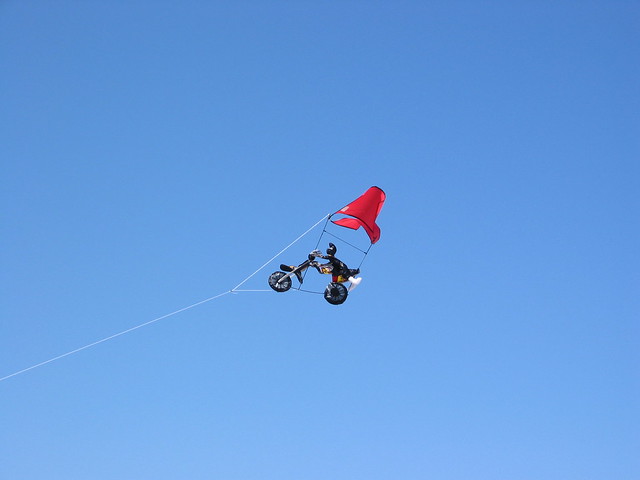
[Kitebike.]

2012-07-03

Re-Blog: Fireworks are What Cities Feel Like

You can't explain fireworks. There's something deep about how they mesmerize, about how a hundred exploding lights in the sky enthrall. It's that same feeling you have watching a campfire, but exploded outward so the campfire becomes the entire big bang universe. Somehow giant booming lights streaking through the dark sky never gets old.

Well, this much we know. The mysterious appeal of explosions and power and fire and light. But there's something else that I really like about fireworks. I love how they light up their neighborhoods.

Fireworks quite literally bring people together. They surprise you. You stop and wonder and stare. The boom reminds you that you share your city with so many others in so many homes with so many festivals and ballgames and holidays.

Fireworks startle and rush and people creep like zombies from their houses, drifting about in search of a good precipice. They're equal opportunity, the most democratic language. You don't need any cultural literacy in order to enjoy them. You don't need any books to understand them. And the whole neighborhood comes together for free entertainment.

Fireworks are always local. You can't watch them on TV. You can't download them. The only way is to get out on your feet and walk down to the very center of town to join the crowd of people. Everyone rings around the water or roosts on rooftops or balances on balconies or bridges or bluffs and all of a sudden we all look up and for a half an hour time seems to slow to a crawl and our minds normally overstuffed with worries and pressures and lists to do turn off and our child eyes take over, and no matter how old there's that gentle feeling of awe and joy wrapped in togetherness, the whole town lit by the glow of something both impossibly large and intimate, one of the very few things in our instant magic media age where you actually “had to be there.”

Bang! and then they're over. The echo rings your ears. The smell of sulfur hangs in the air and the yellow smoke slides along the street, slow drifting along the tops of houses and everyone gets up off their chairs and blankets and off the grass and slowly sinks back into homes and cars and wherever they came from.

But when you shut your eyes there is still that faint image of light, that far away sense of being together, the memory of a feeling just beyond words, something living all around you like a city.


[No photo will ever capture the feeling of a firework.]

2012-07-02

Classic Sidewalks of the Silver Screen #71

Toni takes out the corner store while the commies debate the finer points of occupation...


... in John Milius' (1984) timeless Red Dawn.

Welcome to Bicycle Freedom Week

Well, it took a while. After years of riding a bicycle around this city, I finally got a ticket from the Minneapolis Police Department for running a red light / stop sign. One morning a few months back, I was bicycling to work down SE Como  Avenue. I was a bit zoned out from my long bike trip the day before (to the far side of Lake Minnetonka and back), and do be honest, I’d forgotten that people even enforced laws about stoplights at sparsely populated intersections. And I certainly didn’t notice the police car sitting right in front of me at the intersection.

I proceeded as I normally do on a when trying to ride a bicycle to get from place to place. I came to a stop at a red light at a calm untrafficked intersection, looked to see if there was any traffic coming on the cross street (there wasn’t). And I went slowly through the intersection.

A flash of lights and a quick breeeep from the siren. Uttering the words "you have to stop just like everyone else," a police officer gave me a $120 white piece of thin paper.

A lot was running through my head. First I cursed. I thought about how stupid it was that this cop was giving me a ticket for something that endangered precisely zero people. Didn't he have anything better to do? I felt myself wanting to get upset, but I said nothing. The only thing I did was to take this photograph.


[Nothing says "USA #1" like a flag license plate on a police car giving a ticket to a bicyclist.]

A lot of people have reacted to this story with schadenfreude. “Well, you got what you deserve,” or “That’s what you get for bicycling like that.”

I guess that’s one opinion. I don't want to start a fight. And I really don't want to starting an endless asinine “cars vs. bikes: who are bigger scofflaws” argument. That’s a discussion for another day, and for the Pioneer Press comment section. 

What I want to do is declare this week to be the inaugural Bicycle Freedom Week.

In case you're not familiar with it, Bicycle Freedom Week is an age-old celebration of the freedom of being on a bicycle.  This week, more than all other weeks, we celebrate the freedoms that come with riding a bicycle. This week we will ride bicycles through crowds of cars stuck in traffic to attend fireworks displays. This week we will ride bicycles to the beach. This week (just like all other weeks) we will not stop at every stop sign. This week we will ponder the inevitable civil disobedience that comes with riding bicycles in cities that don’t have them in mind.

(Civil disobedience?! Are you declaring the velo-revolution? Are you a bicycle anarchist?)

Thankfully no. What I mean by civil disobedience isn’t precisely the sort of resistance to government that Thoreau intended while getting pissed about the Mexican-American War. Rather, it’s the idea that the architecture of our public spaces – the streets, lines, laws, regulations, etc. – aren’t set up for bicycles. They’re overwhelmingly intended to support and maintain the movement of cars. This system makes it very difficult to efficiently and comfortably ride a bicycle from place to place.  Until it changes, most cyclists find themselves continually making personal choices about which sorts of rules to accept and which sorts of rules to reject.

These "rules of the bicycling road" differ depending on the individual and the situation. For example, the % of cyclists who actually come to a complete stop at every stop sign must be asymptotically close to zero. (Some, yes; others, no; many are in between.)

On the other hand, the percent of cyclists who would proceed without stopping through an intersection like the Lyndale-Hennepin bottleneck is similarly microscopic. (This is a good example of a self-fulfilling prophecy, as doing so would be suicidal.) Though precious few will admit it, some degree of civil disobedience is an inevitable part of riding a bicycle through the city.

[Suffrage activists on bicycles, c. 1915.]
Bicycles have long been a tool of liberation. They’re a way for people to break free from spatial constraints. Whether you're a little kid just learning to balance, a teenager traveling the city without the yoke of parents, a 19th century woman moving unescorted through the city for the first time, or someone who has lost 320 lbs through the joy of bicycling, bicycles can set you free. They free up all sorts of capabilities that many of us never thought we had. They free your mind from worry and let you feel the city in a new way. They free your senses from claustrophobia and let you smell the air, hear the birds, and get that good feeling in your legs when you really get them moving. They free you from being a selfish individualist and the tyranny of parking tickets and traffic jams and gas pumps.

Happy Bicycle Freedom Week!


Forthcoming posts:

Potential Defenses for Challenging a Red Light Ticket Bicycle Ticket
How to Contest Your Bicycle Citation in Hennepin County Court in Three Easy Steps
DIY Bicycle Infrastructure: A User's Guide

Stay tuned. This time (unlike my future Trader Joe’s series) I’m actually going to follow through.

Classic Sidewalks of the Silver Screen #70

Marie and Jess hail a cab...


 ... in Rob Reiner's and Nora Ephron's (1989) extremely romantic When Harry Met Sally.