Showing posts sorted by relevance for query jefferson bike. Sort by date Show all posts

2012-08-14

All or nothing: The Value of Doing It Right The First Time

[White plastic things!]
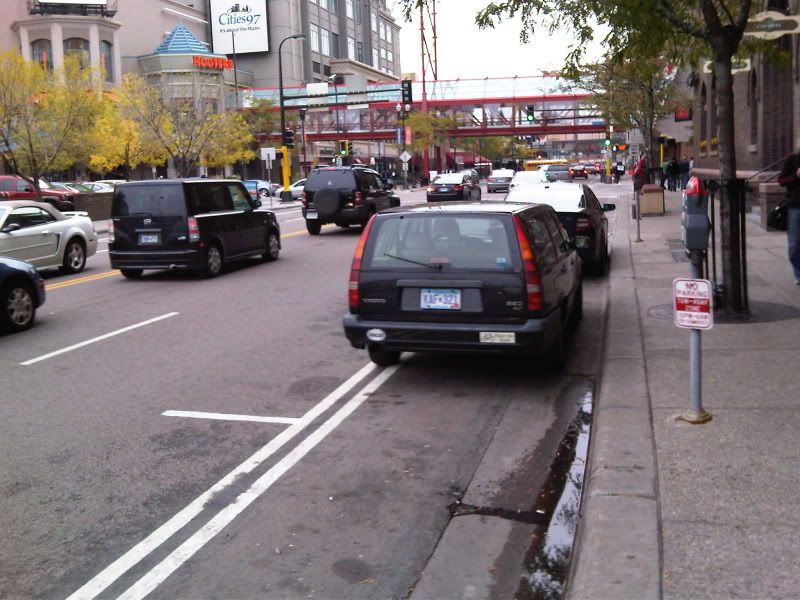
Riding in downtown Minneapolis last week, I was pleased to discover a shining white row of plastic things along the First Avenue cycletrack. Until this moment, I’d never realized how happy a bunch of white plastic thin two-foot long thingies could make me. Now they routinely visit my dreams, dancing like the broomsticks in Fantasia, and I’m starting to worry about my sanity.

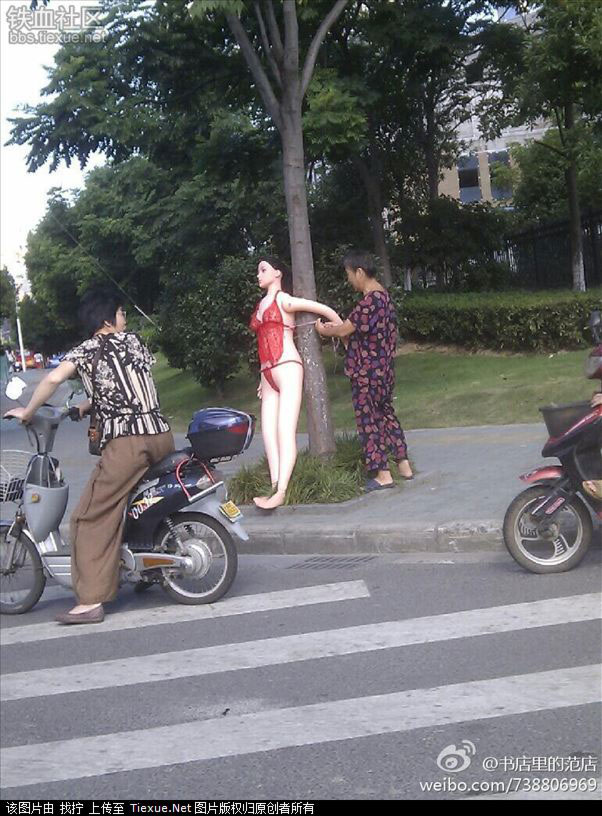
Am I turning into a crappy plastic objects fetishist? Recently in China, a woman started a DIY traffic calming movement by tying a sex doll to a tree at a dangerous intersection. I guess the idea is to get (horny male) drivers to slow down and pay more attention. I’m envisioning a future where I run around the city disbursing traffic cones with a a “real girl” doll strapped to my back so that sexually unsatisfied men don’t run me down with their cars.

[Maybe we could get Sexworld to sponsor the next 1st Avenue pedestrian improvement?]
For those who don’t know, the First Avenue cycletrack is Minneapolis’ first quasi-bona fide cycletrack. A cycletrack is viewed by many as the gold standard of bicycle infrastructure. It’s a bike lane separated from moving traffic not just by a stripe of ‘bike lane’ paint, but by some sort of barrier. For example, you could separate cyclists with row of parked cars, a change in elevation like a curb, a row of plastic white thin things, or all of the above. Cycletracks are common in northern European countries with very high rates of bicycling. Many people (particularly those uncomfortable riding in street traffic) find them to be quite wonderful if done well.

That’s why I was happy when Minneapolis announced a few years back that they were going to build a cycletrack down First Avenue. Despite the protestations of business owners concerned about delivery trucks, the city went ahead with the project.

There was only one problem. They did a half-assed job. Instead of a clearly marked and separated bike lane, they just applied some paint between the parked cars and the curb. They also made the parking lane time-sensitive, so that during rush hour the row of parked cars disappears entirely. (That’s normal on many streets.)

The problem was that, without a some sort of clearly marked area to inform people where the cycle track was, nobody really knew what to do. People parked right in the middle of the bike lane, so the city put up more signs. People still parked in the middle of the bike lane, so the city put up some flashing electronic signs that makes First Avenue seem like Las Vegas in a kaleidoscope. 

Even the current signage funhouse doesn’t always work. You’ll still find people parked in the middle of the bike lane, people who are presumably illiterate or wearing two pairs sunglasses with a sombrero pulled down over their eyes or something. Until those plastic thingies appeared the other day, even the most ardent bike activist would admit that the First Avenue cycle track was a quasi-fiasco.

Minneapolis isn‘t alone in being reluctant to commit to the whole posterior. I’ve covered St Paul’s biggest bike debacle, the Jefferson Avenue bike boulevard, like a blanket in January. It's not a heartwarming story. And the way that it turned out, this bike boulevard should be probably only be labeled a “bike boulevard,” in the same way that Velveeta isn't really cheese.

[The Jefferson Avenue "test median.]
The problem is that the Jefferson project lacks many of the definitive features of a Portland-style bike boulevard (e.g. traffic diverters or traffic calming devices of any kind). And not only did the city approve a watered-down a plan, they built it in a "trial" manner. Instead of simply building a decent pedestrian median (designed to help calm the bicycle street and make it safer to cross busy roads), they built an ugly partially-effective "test median," and then placed a sign next to it encouraging people to call in and complain (which they did). Instead of just doing a good job the first time, St Paul's plan was to do half a good job, and then proceed with it slowly, painfully, displaying all the grace of a circus clown.


[Ha.]
... or get off the pot

I don’t want to be too hard on the Twin Cities. Both of these projects were something new. Both projects were politically difficult. Change is hard! Changing behavior takes a long time. Shifting prioities away from a slavish obsession with the automobile is what they call “a process.” That means that it doesn’t happen all at once. Getting people to bike and walk more is a matter of developing habits literally one step at a time.

At the same time, when faced with a difficult problem, cities are often tempted to compromise. Planners and city leaders end up torn between the politics of compromise and well-designed engineering. It seems that, much of the time, cities make so many compromises that they undermine the very thing they were trying to do in the first place. Sometimes, the perfect is the enemy of the good. Sometimes, you either do it right or you make a complete mockery of the very notion of urban planning. Sometimes, either you build a decent cycletrack that everyone can understand intuitively, or you compromise and construct a bicycle bewilderment with cars parked willy-nilly underneath a flashing LED circus filled with fine print. Then, two years later, you go back and gradually add in some thin white plastic things that you should have installed in the first place, and everyone on the street goes “Oh! That’s what its supposed to look like.”

I know which I prefer...


Update:

A report on white plastic things in Portland that got hit by cars and destroyed. TWICE. 

2011-08-08

Reading the Highland Villager #42 (August 3rd - 17th Edition)

[Basically the problem is that the best source of Saint Paul streets & sidewalks news is the Highland Villager, a very fine and historical newspaper. This wouldn't be a problem, except that its not available online. You basically have to live in or frequent Saint Paul to read it. That's why I'm reading the Highland Villager so that you don't have to. Until this newspaper goes online, sidewalk information must be set free.]

Total # of articles about sidewalks: 11
Total # of articles about sidewalks written by Jane McClure: 9


Headline: Mannillo challenges endorsed Tolbert in Ward 3; Candidate takes issue with conduct of DFL endorsing convention
Reporter: Kevin Driscoll

Short short version: The runner-up for the DFL endorsement in Ward 3's (Highland Park's) city council race is going to stay in the race. Article includes list of alleged convention shenanigans [all of which are par for the course... DFL endorsement conventions are political equivalent of a trained cat circus. -Ed.]

Headline: City's seemingly yearly exercise in fiscal belt-tightening begins; State's unexpected $12 million cut in LGA has St. Paul scrambling for more cost savings
Reporter: Jane McClure

Short short version: The recent budget agreement cut $12M from St Paul's Local Government Aid money. The city has a hiring freeze in place. Article includes no other details. Article includes the fact that “next year could be worse.”

Headline: Inpatient facility, five single-family lots proposed for Bush site
Reporter: Jane McClure

Short short version: People in the Summit Hill area are nervous about how a new clinic for people with eating disorders will impact parking in the neighborhood. [In other news, mosquitoes bite your legs more often at dusk. -Ed.] An old empty building is being turned into the latest Emily Program clinic at the corner of Osceola and Grotto [in a fancy fancy part of town]. Includes anonymous quote from one neighbor woman about the increased use of the back alley: “steam is coming out of my ears.”

Headline: Jefferson Ave. traffic diverter may come to a vote Aug. 17 [Note the use of the noun 'traffic diverter' in place of the noun 'bike boulevard'.]
Reporter: Jane McClure

Short short version: The latest in the [interminable, frustrating, asinine, petty, petulant, Neanderthal] debate over the Jefferson Bike Boulevard. The [see previous list] Mac-Groveland Community Council is going to make a recommendation [they recently abstained from taking a side on the issue, if my Pioneer Press headline was correct]. The issue of whether or not to build traffic medians [like the ones along the Riverlake Greenway on 40th over in Minneapolis, which somehow got built without a great deal of hair-pulling and Soucheray-inspired car politics hystrionics] will come to a vote this month in all likelihood before the City Council. [The issue poses a political pickle for the Council, as it challenges the typical turf-centric stance that the Council likes to adopt, whereby each Council Member is allowed to effectively 'veto' projects in his or her own ward. Because outgoing District 3 CM Pat Harris does not approve of the pedestrian median, will the rest of the Council go against his wishes? Will the political lobby of the transportation non-profits such as TLC be able to outweigh the voices of Harris, poopular car columnist Soucheray, and assorted NIMBY neighbors? Stay tuned! Same time, same channel. -Ed.] Article includes tedious detailed history of Cleveland Bike Boulevard issue, including the [infamous farcical]test phase.”

Headline: Wild Onion's suit against city for patio license moved to federal court
Reporter: Jane McClure

Short short version: The owners of the [terrible] Grand Avenue bar / club Wild Onion have sued the City of St. Paul over the allegedly unfair enforcement policies over liquor licenses. The $50K suit is now in federal court. Article includes tedious detailed history of Wild Onion's patio liquor license issue, including the [infamous farcical] 90% consent petition requirement.

Headline: Council awards STAR funds for bike repair shop, other local
Reporter: Jane McClure

Short short version: A bike shop at Lexington and Hamline called “Youth Express” got a $8,500 grant for renovation from the city. Because of the money a bike mechanic will get a full-time job. Other things also got grants, including two churches and a handicapped-accessible apartment building. Some people did not get grants.

Headline: Public lines up on both sides of House of Hope fence issue
Reporter: Jane McClure

Short short version: A garden with a rabbit-proof fence built by a [large] Summit Avenue church is being challenged by ex-members of the Heritage Preservation Commission. Fence qualities found particularly egregious include its size, its “cedar and galvanized steel composition.” Article includes quote from CM Carter III stating that he will not make the church tear down the fence. [I do hope that this issue becomes a perennial evergreen Highland Villager bit, extending this debate for many many years into the future. -Ed.]

Headline: Editorial: What would Jefferson Say?
Reporter: Michael Mischke

Short short version: [Typically embittered] editorial from Publisher Mischke on how the bike boulevard, and the larger “so-called Bike Walk Twin Cities initiative” are destroying America, undermining the “values of self-sufficiency, self-government, and individual responsibility” and likely have [Thomas] “Jefferson rolling in his grave in Monticello.” Article includes [odd] claim that Publisher Mischke doesn't “have a dog in the fight over the addition of the traffic diverter.” [Article is accompanied by a rather neutral editorial cartoon featuring a bicycle and a debate.]

Headline: Federation begins renovating former brewery offices, rathskeller
Reporter: Jane McClure

Short short version: [After all these years] the old Schmidt Brewery is being restored by the West 7th/Fort Road Federation. It will be ready by next year. Includes admittance that the air inside the rathskeller was “dank.”

Headline: Despite service cuts, taxes are expected to rise in Ramsey County
Reporter: Jane McClure

Short short version: See above headline, earlier story on LGA.

Headline: With cleanup under way, city eyes 2012 reopening of Jimmy Lee fields
Reporter: Jane McClure

Short short version: The land for the proposed ball fields near the Jimmy Lee rec center is being cleaned up. The fields will be open by next year.

2025-07-28

Dedicated Bike Funding Remains Minuscule

[The $1M Jefferson Avenue bicycle boulevard as it passes an elementary school. You're welcome to complain about bike lanes if your complaint is that they are not good enough. The only trace of the bike boulevard is the tiny green sign next to the stoplight.]

For some reason, bicycles and bike lanes cause drivers to lose their minds. There are a lot of reasons for this, most having to do with what I call the "windshield perspective", the way in which many people are unable to view a city street from outside an isolating motor vehicle. There are way too many examples to list -- see the latest Evan Ramstad column -- but the recent, welcome Minnpost piece about a Star Tribune op-ed is an attempt at a corrective that, if anything, actually understates its case! 

Cities and counties rarely have meaningful capital funding specifically dedicated to for bicycle projects. As Keefer points out, the amount of money is small: around $2.5 million a year in Minneapolis, which laps all other Metro area cities in this regard. For capital costs, bicycle project funding is often pitted against other worthy causes like playgrounds, rec centers, fire stations, or bridges in disrepair. (Despite being the smallest costs, bike rarely do well in those scenarios.) 

[Transit funding, here dwarfed by highway funding, is far larger than bicycle infrastructure funding (as it should be). The 'MPO' dot here is the "regional solicitation" step I refer to.]

One of the few bike-specific funding steams that exist is part of the regional solicitation, unallocated Federal transportation dollars that are directed to MPOs. (See the Northeast Hennepin / 1st project I wrote about today at streets.mn for an example of this money at work. Even there, the bike lanes are part of larger pedestrian and transit improvements.) 

In the Twin Cities, our leaders decide to use some of that Federal money for bike-specific projects, while many other metro area do not. Most recently, there was $40 million for a two-year period divided amongst 11 projects in the seven-county metro, chosen out of 50 applications. (The list of winners appears below.) Meanwhile, other countries spend a billion dollars a year on bicycle infrastructure; most notably the Netherlands, where their national and local budgets include spending $1.2 billion over 7 years.  

[Here's the Federal/State bike-specific funding for the entire metro area for 2023-2024.]

A  detail at the end of the short piece illustrates this very well. Keefer writes:

Minneapolis has a robust bike infrastructure built out through city, state and federal initiatives. The city was one of four communities that received funding through the 2008 Federal Highway Administration’s Nonmotorized Transportation Pilot Program – a total amount of $25 million that was spent in the region over a 10-year period.  

I wrote my dissertation on this project. That amount of money, dedicated to bike infrastructure, was impossibly rare back when it arrived in 2005. That’s what made it so special and important; because the money was specifically for bicycle infrastructure (and nothing else) it allowed Minneapolis and a few other cities to begin bicycle planning and develop new treatments and designs. If the money had just been part of a larger transportation pot, as it almost always was before that point, bike infrastructure could have been watered down or folded into a highway or road expansion. 

[Here's what that $25M (over eight years) bought you in "Minneapolis Area" and four other cities.]

Bike infrastructure funding is a rounding error compared to even a minor highway project, let alone a major one. To offer an extreme example: at the most recent TAB meeting, someone mentioned that a proposed interchange at Highways 65 and 10 in Blaine will cost $250,000,000. That’s likely a low estimate; the cost could grow immensely. That fact that commentators, angry drivers, or columnists focus on bicycles as examples of wasteful spending is laughable.  

One further note:

Here is some data about the NTPP money from a post-mortem study that came out in 2014, showing where the money went. 

[The map of “Minneapolis” is particularly funny: it shows a large “bicycle boulevard” infrastructure project in St. Paul, for example, which was funded here along Jefferson Avenue, pictured at the top of this post. If you go there today, you’ll see almost no sign of the >$1 million bike infrastructure investment. In some places, you’ll see no sign of bike infrastructure at all!]

[Different cities spent the money in different ways.]


2014-08-05

Jefferson Bike Boulevard Illustrates Frustrating Pace of Change

Well, if you've been in bicycling in Saint Paul over the last decade, you have probably been following the Jefferson Bicycle Boulevard fiasco-triumph, which began sometime around 2008 when the NTP project funding landed next-door in Minneapolis.

Here's how I recapped the situation when the proposed project was finally passed two years ago:
... for various reasons the proposed bicycle boulevard down Jefferson Avenue has for few years now been seen as controversial. The project has gone through a few different iterations, and finally now, after a huge number of community meetings involving hundreds of people, and after the city's Public Works department has spent countless hours doing research and analysis, a compromise plan has emerged that seemingly everyone can mostly agree about.

This plan isn't perfect. For example, it doesn't include any diverters that are common in bicycle boulevards elsewhere. These kinds of diverters do a lot to move 'through' traffic onto adjacent streets, while making sure that pedestrians and bicyclists can safely cross the busier streets that have higher traffic speeds (such as Cleveland and Cretin Avenues). You can see for yourself how these kinds of diverters work in South Minneapolis, where they seem to have not caused any kind of automotive apocalypse.
Anyway, the final St Paul proposal got rid of these kinds of traffic calming treatments in favor of traffic circles, which you will find elsewhere in the city.

As it turned out, the City Council stripped or delayed many of the proposed traffic circles from the project. And then bids for construction came in too high, which further delayed construction for the Jefferson Boulevard (which has been signed as a boulevard for years already).

[A traffic circle in a place that probably doesn't need it.]

Finally, Real World Progress

That's why it was delightful to see actual concrete construction on Jefferson this last week. Finally after years of wrangling, hair pulling, elections, FOIAs, shenanigans, and endless histrionic community meetings, two small innocuous flower-planted traffic circles will be built along less important parts of an East-West street that might marginally slow down speeding cars.

Here's the conclusion of my piece, expressing all my hopes and dreams for this street:

In five years, nobody living nearby will think bicycle boulevards are a big deal. Neighbors will actually like the traffic circles once they are built. They'll blend into the background of the city and grow flowers. Ideally, Jefferson will subtly shift into a more quiet beautiful safe street for all types of people. Ideally, it'll be a place where even my mom would feel comfortable riding a bicycle and getting exercise on her way to the Highland Grill without feeling like she's 'in the way' of a pickup truck speeding down the hill.

I still think this can come true, though I wish this project wasn't the very definition of half-assed bike infrastructure.

Mainly, what these small concrete circles signal to me is how painstakingly slow the current rate of change has become in our cities. While this one project has been kicked to death like a sleeping dog, other cities around the country (including the one next door) have built orders of magnitude more miles of higher quality bicycle infrastructure, literally lapping sleepy Saint Paul.

How Much Consensus?

[Copenhagen.]
From one perspective, deliberation is a good thing. We want changes to our city to be aired out, vetted, and presented to the community. We want our officials and engineers to have to answer questions about plans and projects.

But there's a difference between transparency and consensus. I'm reminded of Gil Peñalosa's speech this year at the Saint Paul Transportation Summit (which I wrote about earlier on streets.mn).

I urge you to watch the entire speech, but here's one of the things that he said when discussing a pedestrianization of Nyhavn, a key shopping street in Copenhagen:
Change is difficult, of course. And it doesn't happen by consensus. When they were thinking of making this [Nyhavn] pedestrian, people in these restaurants said "Oh, if the cars don't park in front of my restaurant, we're going to go broke." You have to listen to everybody.

But at the end of the day, what is the general interest? Change will never happen by consensus. If you want change to be unanimous, you have to water down change so much, it's not going to be change any longer. So listen honestly, and then make a decision. Do you think any of these restaurants go broke? 10,000 people buy more food than 83 cars.
So, it's about changing mindsets. And this is why all of us are here.

One of the things that I really enjoyed about Peñalosa was how he didn't settle for platitudes, but challenged Saint Paul leaders with difficult problems. He said that we needed to stop retreating from winter weather, that we needed to compare our city to world leaders rather than Midwestern followers, and he said that we needed to prioritize rather than accommodate non-motorized people.

But this challenge, to move past the desire for continual consensus, is a difficult one for the typically Midwestern mindset. The glacial pace of change on projects like the Jefferson Bicycle Boulevard only serves to highlight this problem.

There are lot of questions that emerge from Peñalosa's advice. How can the city accelerate meaningful change (that conforms with our city vision for the future), without becoming Robert Moses-like despots? How much consensus do we really need?

These are all political questions, but the answers to them do not have to remain in the back rooms and community meetings. I believe that there are plenty of ways to change people's mindsets about sticky problems that don't necessarily need to take the form of elaborate engineering construction or high-blown skyscrapers.

Meanwhile, a couple of traffic circles are popping up in Saint Paul. Soon they'll fade into the background, fill with flowers, and the tempest in the teapot will be forgotten.

[There goes the neighborhood.]
Update:

Apparently the two bike boulevard projects (Griggs and Jefferson) are far over budget. This will really makes it far more difficult to build any kind of support for future bike projects in the city.

Here's the quote from today's paper:
Two bicycle boulevards on Jefferson Avenue and Griggs Street, which once were projected to cost $1.52 million, are $900,000 over budget.
[...] City staff said the Jefferson and Griggs projects were put out to bid twice -- in the fall of 2013 and spring of this year -- and both times came back over budget.
They said costs went up over the course of four years. A bidding process for the Jefferson project, budgeted at $1 million in 2010, was repeatedly delayed as a result of lengthy public discussion and neighborhood opposition in the Mac-Groveland area.

2016-03-30

Is the Highland Villager Accountable for its Misleading Anti-Bike Lane Advertisement?

[Cleveland Avenue as it is today, next to the University of St. Thomas.]
The short short answer is “no.”

The only slightly less short answer is “no, but they probably should be a bit more so, kinda.”

And here’s the long answer…

The Cleveland Saga

The debate over the Cleveland Avenue bike lane, like the Highland Parkway and Jefferson bike projects before it, was not an easy one. I’ve written about it a few different places and, thanks to my (volunteer, appointed) position on the Planning Commission, have had a first hand seat at the table during a long and intense community conversation with a whole cross-section of stakeholders.  

Basically, though increasing bike infrastructure has been a city goal for many many years, Saint Paul passed its first ever bike plan only last summer. The plan promised a more comprehensive and thorough process for striping bike lanes and, in my opinion, was a great first step toward realizing some of the great potential in the city to increase sustainable and active transportation. The plan passed the Council unanimously.

At the time, Cleveland Avenue was on the plan, but Council Member Tolbert expressed some reservations about including it. Then this summer, just before the County re-surfaced the road, there was a vote to delay the bike lane until more process could be done.

As a result, the city put together a 12-member task force and (as a Planning Commissioner and Transportation Committee chair) I became one of the members. We met about a half-dozen times to make a recommendation for a north-south bike route route in the area, and the meetings were very intense. In particular, there was one well-attended public meeting, and throughout the year, many people expressed their opinions over the year in person or online. Then in the winter, the committee voted to approve the original bike lane plan 8-4, along with some "parking mitigation" from the city to retain some convenient parking for businesses along the street.

This spring, the final plan with $200K worth of additional and tweaked parking was finally approved, along with plans for bike lanes to the North, where the County will be resurfacing the rest of the road this summer. The most recent City Council meeting, just two weeks ago, finally settled the matter.

Meanwhile, in the latest Highland Villager, this ad appeared yesterday.

[The ad in this fortnight's Villager.]


The Case of the Misleading Ad

The biggest problem with the ad is that, because of the way it’s arranged, it gives the impression that all the businesses listed authored or endorsed the message. It lists 33 businesses, pretty much everything within a few blocks of the street, many of which (Rihm Trucking, Regina's Candies) have their own private parking lots.

In fact, they’re not on board. For example, in an online exchange with the “Taste of Love” bakery, the bakery owner claims no knowledge of the ad. The same goes for Choo Choo Bob’s. I’ll let you know if any others were involved, but my suspicion is that they had nothing to do with the ad.

(In fact, if I were a business owner, I'd be trying hard to move past this divisive debate. You don't want to send the perception that it's difficult to park, nor do you want to alienate anyone with strong opinions on either side. The message businesses should be focusing on is: "parking will be changing, here's where the convenient new spots are located." Vituperative doomsaying is precisely the wrong message for small businesses!)

The other factual problem with the ad is its reductive portrayal of the public process. The ad describes the citizen advisory committee process thus: “The petition caused the City council to feign citizen participation in the decision by organizing a meeting at St. Catherine University last fall for those concerned. At this meeting, citizens were only allowed to pen, not vocalize, their preference for Prior or Cleveland for a north/south route.” He then goes on to list the results.

The problem is that the actual results were far more nuanced. Here’s a sample page:

[One of 53 pages.]

Like much public process, it’s difficult to reduce things to black-and-white, especially when discussing trade-offs between safety and convenience, and the potential benefit of a yet-unrealized project. During the process, I was most frustrated by the misinformation spread about things like lane widths, safety studies, parking occupancy, and mitigation strategies.

But though many people might have had their minds made up beforehand, I think the entire committee took their obligation seriously. I came into the task force process with an open mind, though I am someone who usually prioritizes safety over convenient driving. I know for a fact that a few committee members did not have their minds made up beforehand, and some maintained an open mind until the very end. At the final meeting where the committee voted 8-4 to support the bike lane proposal, the result was a genuine surprise to me.

[The author of the ad.]
Finally, I don't understand why the ad singles out Council President Stark. The proposed bike lane had the support of both area council members, a 5-2 majority of the City Council, appeared on the city's unanimously adopted bike plan, and was supported by a broad coalition that included pedestrian, public health, safety, and neighborhood livability advocates of all stripes.

In addition, Stark was on the record as supporting the bike lane before last November's election, while his opponent opposed the plan (and was visibly campaigning at the aforementioned public meeting and elsewhere). Then Stark won by over twenty points, suggesting that he has the support of the Ward 4 voters as well.

The rest of Bushard’s ad is some first-rate parking barking, if a bit odd with its reported refrain about “the convenience of a FEW bicyclists.” I predict that this will one of the most used bike lanes in the city, connecting a key neighborhood nodes with Saint Paul’s two largest colleges and the light rail. That’s why I voted for it, and precisely the reason that it gained so much support from the task force, including both the University of Saint Thomas and the University of Saint Catherine.

Not everyone is expected to like the outcome, of course, and Robert Bushard is entitled both to his opinion, his right to free speech, and to spend his $1,100 how ever he pleases. (He really should buy a nice bike with the money instead!)

The funny thing is that at the final final Cleveland public hearing, he wasn’t even the most ridiculous testifier. But while technically factual, his advertisement remains both divisive and misleading.


[December's joint resolution by Council Members Stark and Tolbert supporting bike lanes.]

Accountability for Advertisements

The Villager, like any paper, does not have explicit editorial control over its advertisements. They’re not directly responsible for writing them, and in theory, anyone with the right amount of money should be able to purchase advertising there.

But is that the whole story?

I reached out to David Brauer, a former reporter who penned journalism beat at Minnpost for years. (Disclaimer: I’ve written a weekly column for Minnpost for the past year-and-a-half.)

David is the perfect guy to talk to because he’s the one that interviewed me about my “Villager re-blogging” when I began back in 2009.
 
I asked Brauer if the Villager had any responsibility for its advertisements, or if getting a statements to appear there was simply a matter of writing a check. Here’s what he said.
Legally, unless there is something false (and it appears not, it’s all opinion), a newspaper is blameless except in court of public opinion. If the businesses complain, that's probably the best weapon against the Highland Villager’s pocketbook. And of course letters to the editor. 
It’s misleading, yes, and the newspaper passed on right to reject. But the only response is more speech.

One on hand, the latest ad is just an advertisement, bought and paid for by one man who didn’t get his way on one issue.

To me, though, it’s frustrating to see the Villager print the ad without editing it to not appear misleading about whether the businesses endorsed the statements. I would have hoped that the Villager would display some accountability for what appears in its pages and have framed the ad so that it didn’t appear to misrepresent the positions of the community and its business owners.

And ideally, the Villager might not print it at all, in that it does little but throw gasoline on already-existing divisions without much attention to either facts or political reality.

In other words, it’s like like Trump campaign.

Wishing for Understanding

["Headwinds and Tailwinds" by Ken Avidor.]
When I first began “re-blogging the Highland Villager,” it was because I enjoyed reading it. It was and is the largest and most thorough community newspaper in town and, at the time, I was only frustrated that I couldn’t share the critical information it provided with others online.

But over the years, as I’ve become more and more involved and knowledgeable about Saint Paul’s development and planning debates, the paper has been increasingly letting me down.

As someone who both reads and writes for community newspapers, it’s depressing to see one that has become so slanted in defense of backwards parking policy. The parking meter insert flier, headline framing, and editorial position on the parking meters were a classic example, and this week’s misleading advertisement is another.

I’ve tried for years to understand how some people can get so upset over walking a little farther to get to their car or plugging a meter to park in front of a store. Is it a generational thing? Is it tied up in the psychology of driving?

At any rate, I had a front-row during the entire Cleveland bike lane saga. If this is the ending, at least it's memorable. It reminds me of a bad movie where the death scene goes on forever in the most ridiculous way.

In fact, I just watched two full montages of noteworthy death scenes from such films. If forced to pick one, I'd have to say that, if this Villager ad is final throes of the anti-Cleveland bike lane movement, it's most like the death from Kareteci Kiz (turkish for Karate Girl).

Only with more yelling.


[For more reading, see No Need to Pit Safe Streets Against Local Businesses, Cleveland Avenue Shows St. Paul's Need for Parking Creativity, Cleveland Avenue Bike Lanes, and Jefferson Crashes Rekindle Bicycle Boulevard Debate.]  

Update:

An example of a business fighting confusion caused by the misleading ad from Kopplin's Coffee Facebook page:


http://tcsidewalks.blogspot.com/2016/03/tc-sidewalks-booklets-now-available.html

2011-01-27

LiveBlog from the January 24th Mac-Groveland Community Council Transportation Committee Meeting

[The "test median" that was installed at the Jefferson and Cleveland intersection from August 24th to September 24th, 2010.]

6:58pm: I walk up the street toward the Edgecumbe Recreation Center, thinking I'm going to attend a vital meeting about bicycling in Saint Paul, my home town, thinking I'm going to be attending a meeting that will make or break the future of bicycling in this city, that will help determine whether or not I live in a town that encourages or discourages alternative non-fossil-fueled transportation, that cultivates humane lifestyles, that catalyzes healthy people and healthy lifestyles and healthy cities and communities, that says: "Yes, you can bicycle safely down the street even though you're not a 20-something daredevil, even though you're a mother and maybe overweight and maybe don't feel 100% comfortable on a bike," a city that says everyone is welcome on this street, we're going to take the huge leap of faith and let .1% of our public space be for people NOT in cars, and that's O.K., that's not a revolution (99.9% of car-culture is enough!) and that bike boulevards are not Molotov cocktails thrown haphazardly at SUV dealerships...

I think about this as I walk through the lovely January evening air past the outdoor hockey rink, past the dad teaching his daughter to skate by having her push a metal folding chair, past the sound of hockey sticks slapping down onto the ice, along the snowbank'd sidewalks, down Saint Paul's quiet dark snowy streetlit Griggs Avenue towards the community meeting about bicycling, perhaps the farthest thing from most people's minds in this cold climate...

7:02pm:
The room is packed. Somehow the meeting has already started. People are standing near the entrance, collecting there looking lost.

I push my way into a seat near the front, right next to a very concerned looking woman who is currently testifying about parking problems near her home.

As it turns out, the discussion is about adding a restricted permit parking area near a school in Highland Park.

7:05pm: A blonde woman begins complaining about parking enforcement giving tickets during holidays.

7:06pm: The meeting's moderator, who sits along a pair of white plastic tables with about nine other not entirely happy looking people at at the front of the room points out that there shouldn't be any enforcement of parking permit zones on holidays. He does this to no avail.

7:08pm: The committee members at the tables look bedraggled, soft spoken. More than two arms are crossed. As people file into the room, they don't seem to be getting any happier. The atmosphere in the room already seems testy.

7:12pm: Discussion of school parking permit zones comes to an end. It's agreed that someone in the audience (the blond woman?) will start a neighborhood petition to instate a permitted parking zone near the school, at which point the Mac-Groveland Community Council Transportation Committee (MGCCTC) will take up and study the motion, perhaps to recommend it to the city, at which point it will have to go through a number of city council committees. The process seems impossibly lengthy, and its difficult to see anyone receiving short-term satisfaction.

7:14pm:
At this point, the moderator “Jay” suggests ending discussion of the parking situation, and further suggests that those concerned might want to leave the meeting to make room for all the bicycle advocates standing in the aisle. This happens. A dozen people leave, a dozen people sit down. Chairs are found, arranged, and sat upon. Now the only people left standing are a group of a half-dozen Macalester students with bike helmets who arrive a bit late to the party. They look lost.

7:16pm: Now comes the moment of truth. We get to the bike boulevard median situation.

Jay makes a great deal about how the meeting today is just to report the findings from a study that was done on the the “test median” at Cleveland and Jefferson. (This is a long story, and I won't go into it here.) He then introduces two men from the city of Saint Paul public works department, Paul Saint Martin, traffic engineer, and Dave Something (?), traffic engineer. Both are 40-something bearded white men wearing button up shirts with pens in the pockets.

7:17pm: Paul Saint Martin, who seems to be in charge, briefly introduces himself, and then introduces Dave, who does most of the talking.

7:18pm: Dave, wearing brown, ends up pointing to a pair of pages of information that represent the findings of the study, and then goes about explaining them in some engineering-type detail.

He explains that the “test refuge” had two goals. First, it was intended to promote bike and pedestrian activity along the Jefferson bike boulevard, by allowing for an easier crossing of the street at the busy Jefferson and Cleveland intersection.

The second goal, he explains, is to divert through traffic on Jefferson, to reduce the number of cars that are using Jefferson as a through street, to restrict the traffic on that street only to local traffic, i.e. people who actually live there.

[One of the primary functions of the "test refuge" was to piss off drivers and make them log on to the internet.]


7:24pm: Dave then goes to great pains to emphasize that he is just sharing information, and not taking comments. I begin to understand that this meeting is not, in fact, an epic showdown of anti- and pro-bicycling forces meeting in a public arena and struggling to the rhetorical death etc. Rather, it is an objective reporting of facts ascertained by a careful neutral engineering-type study of facts neutral innocent bystander (or something like that).

7:26pm: The details of the study come next, and are delivered in the a dry fashion typical of numbers. You can read them for yourself here. There are two main components to the study. First, they looked at how the median affected traffic and speeds along Cleveland, Jefferson, and neighboring streets. As it turns out, the refuge didn't affect either very much.

Much to my surprise, average speeds on Cleveland didn't change more than 1 or 2 mph, and the 85% speed changed even less. (Of course, the median wasn't in fact a true median, and was instead a series of orange plastic things placed in the road. The median refuge had neither very effective calming qualities, nor aesthetic merits, both of which would surely exist with a real bona fide median. Which goes to show you, IMHO, that this kind of half-assed experimental approach is like "pissing into the wind," so to speak.)

The other part of the study involved gathering comments about the (inelegant and ugly) test median refuge boulevard, and, as you might imagine, many of these comments were negative. The split was about 60 / 40 weighted against the change, which actually to my mind seems pretty good considering its “test” status. Also, for some reason, the comments were then filtered through some sort of address matching process, whereby only those within a ½ mile of the intersection were counted. Also surprisingly, these results were practically identical to the larger sample.

7:36pm: "Jay" the moderator gives the two Transit for Livable Communities engineers, both 30-40 something men with beards but without glasses, a chance to talk about the test, and Tony Hull, TLC transportation specialist, briefly takes the floor to explain a few things about the concept of bike boulevards in general and this test median in particular. He keeps it very brief.

7:37pm: Now, the denouement! At this point Dave takes questions about the process.

Questions include:

7:38pm: Q: [older man with white hair] What about snow? The snow makes the street even narrower, and it will be impossible to turn the corner! Have they talked to bus drivers and snow plow drivers? Ambulance drivers? I'm not convinced it will “calm” anything!

A: [Dave.] Hm. We're talking to the fire department and the snow plow drivers. We might have to tweak the turning radius on the corners.

7:39pm: Q: [middle-age woman with black hair.] Was there any “due diligence” in counting the number of pedestrians using the median? Is this a good use of taxpayer money?

A: [Also Dave.] It's a “chicken and egg” kind of thing. Pedestrians and cyclists won't use it until we build it, so we can't wait for more pedestrians to come to justify building a median.

Man from the crowd: [Helpfully.] I live very close to the median and saw a lot of people using the refuge.

7:41pm: Q: [Middle-age woman with black hair, a different one.] There was no testing done on the alleys. Many cars are now driving down my alley, and my children play in the alleys. It's dangerous! Also, cars slow down at the median, but then just speed right up near Wellsely Avenue so its even more dangerous because they're speeding!

A: [Dave: no answer that I can remember.]

7:42pm: Q: [Another black coated woman with black hair.] What about snow removal when it snows a lot like in December when there is 3 feet of snow?

A: [Sparrows playing violins.]

7:43pm: Q: [Older woman in blue sweatshirt with white hair.] Instead of spending money on the median why not put up a stop sign? That way bikes can blow through it, cars can blow through it, and pedestrians can dance in the street.

A: [Chuckles pervade the room.]

7:45pm: Q: [Earnest bike-type fellow.] Will there eventually be a similar refuge on Cretin? That street is just as busy.

A: [Dave again.] Probably, if all goes well, and if the city decides to go through with the project. Cretin is scheduled for re-paving in 2014, and that's when we'd probably do it.

7:47pm: Q: [Someone.] Are there other plans or ideas that would allow for left turns off Cleveland?

Q: If a neighborhood streeet is one that has less than 500 cars / day (as was mentioned during the earlier wonky part of the presentation), and Jefferson already has less than 500 cars / day, why even bother with all this? Were the speed limit differences statistically significant?

7:50pm: At which point Tony Hull, TLC transportation and traffic calming guru tries to explain about bike boulevards, about how they involve a series of improvements and changes (e.g. roundabouts) designed to allow for efficient and safe cycling that, if done without also diverting car traffic, may have the opposite effect of increasing rather than decreasing auto traffic on the street, which is why the left-turn diverting medians may in fact be the crucial component of the entire bike boulevard concept..

This answer, however, resembles the waving of a red flag as seen by a bull, or a bucket of chum as smelled by a shark, and people just start to get more upset until Dave, the Saint Paul traffic engineer, diffuses the fracas by saying: “Don't worry. We killed all of those improvements anyway,” which strikes me as the single most absurd moment of the evening, where there is seeming pride taken in the fact that this boulevard would be, all in all, a half-assed attempt. (The half-an-ass approach being typical of Twin Cities state-sponsored cycling infrastructure, the “Minnesotan Way,” so to speak.)

7:52pm: Q: What about the county? Isn't Cleveland Avenue a county state aid highway?

A: [Dave, proudly.] The county pretty much ignores us, and we can do whatever we want, so that's not a problem.

7:57pm: The meeting comes to a close as one of the Mac-Groveland people tells everyone where they can get more information (macgrove.org).

8:01pm: As folks start to chat amongst themselves, and as the Macalester students begin to leave, not having any idea what had just happened, we start to chat, and the poor MGCCTC asks us nicely to leave the room as they have other business to attend to and would very much like to go home at Nine. We exit into the hallway where there are many youth and fathers in various states of wearing and not wearing hockey gear, and where it does indeed have that musky dank hockey smell that is a not-totally-displeasing combination of sweat and ice.

Whereupon I chat with folks from the Saint Paul Bike Coalition about various matters of the day, and someone decides that the city is “kicking the can down the road” and we all agree that the test median was a stupid idea to begin with, that they should, as the Nike ads say, “just do it” rather than dicking around all this time with test signs and websites and orange plastic crap and unnecessarily pissing off car-centric neighbors.

[Saint Paul's patron saint, Joe Soucheray, purses his wrinkly lips alone in a dim office contemplating ways to run over bicyclists with his SUV while on his way to inspect the tools in his garage.]

Update:

More links courtesy of CTC:

Less interesting recap of same meeting by Jeff Zayer.
Explanation of project by Ride Boldly.

2010-08-04

Reading the Highland Villager #21 (August 4th - 17th Edition)

[Basically, the problem is that the best source of local streets & sidewalks news in Saint Paul is the Highland Villager. This wouldn't be a problem, except that its not available online. I'm reading the Highland Villager so that you don't have to. Until this newspaper goes online, sidewalk information must be set free.]

Total # of articles about sidewalks: 10
Total # of articles about sidewalks written by Jane McClure: 8


Title: City, club find middle ground on Marshall Avenue sidewalk; St. Paul agrees to pay all construction costs
Author: Jane McClure

Not-so-short version: A [surprisingly slanted] above-the-fold bit which views it a "middle ground" compromise that the wealthy lawyers who golf at the Town and Country threatened a lawsuit and forced city taxpayers to foot 100% of the bill for completing [at long last] the unfinished sidewalk along Marshall. The piece cites the T&C folks prominently, and buries Councilmember Stark's epistolary defense of the sidewalk: "People walking from the east of Town and Country Club 'need to cross busy Marshall Avenue twice in order to cross the bridge or go north on Mississippi River Blvd. ... A street that inconveniences the pedestrians as compared to the motorist or cyclist, is not a street designed to encourage walking. In my mind, and in the estimation of the many community members who conceived and worked to implement this project, this public good outweighs the loss of the crab apple trees and the addition of a modest amount of concrete'". [Seems sensible to me? For years, I've wondered why there was no place to walk there. Plus, cyclists don't exactly have it easy. There's no bike lane on what is a very central route over the Marshall Avenue bridge. -Ed.]


Title: Rings around the city: Ashes, ashes, they'll all come down
Author: Jane McClure

Short short version: The Emerald Ash Borer is forcing the city to cut down 181 ash trees in Highland Park. Article quotes residents who would also like the city to cut down any gingo trees planted in the 80s and 90s. [Time to genetically engineer a "gingko borer"? -Ed.]


Title: Jefferson ash removal tied to paving project
Author: Jane McClure

Short short version: Same as above, only w/ added mention of the upcoming Jefferson bike lane. Includes some mystification prose about the upcoming Jefferson Bike Boulevard, "which largely consist of signs and pavement markings". [So true! That is what streets consist of. -Ed.]


Title: Council seeks another opinion on Wild Onion patio request; new hearing pending on liquor service extension
Author: Jane McClure

Short short version: Same old interminable story about booze on the Wild Onion patio. Councilmember Thune is apparently stonewalling the request by asking for another opinion from a judge or something.


Title: Council forgives parkland fee for Carondelet Village development
Author: Jane McClure

Short short version: At the request of Councilmember Harris, the aforementioned senior nun housing complex at Fairview and Randolph will not have to pay $27K in parkland feees. [Insert nun joke here. -Ed.]


Title: Walkable Mac-Grove moves her to exercise more
Author: Betsy Dodder

Short short version: Wonderful op-ed column about older lady who uses "walking sticks" to go on long walks through the neighborhood. Includes multiple admittances of silly / dumb appearance of said walking style .


Title: Summit-U neighbors jump on board new Subway at Selby-Victoria corner
Author: Dave Page

Short short version: Piece on new Subway shop that went in at the long vacant / abandoned Selby corner.


Title: Liquor service extended to sidewalk cafe at Green Mill
Author: Jane McClure

Short short version: Self explanatory. Cites angry neighbor, pissed at "motorists who violate the one-way traffic signs on nearby Lincoln Avenue."


Title: New pedestrian islands tested at Jefferson and Cleveland
Author: Jane McClure

Short short version: Pedestrian streetscape improvements are being tested at Jefferson and Cleveland beginning this month. The city will decide whether or not to keep them sometime next year.


Title: County triples rail budget to prepare for Union Depot hub
Author: Jane McClure

Short short version: Ramsey Co. is paying a lot of dough to help w/ the remodeling of the Union Depot. Most of the money comes from "State and Federal grants".