 |
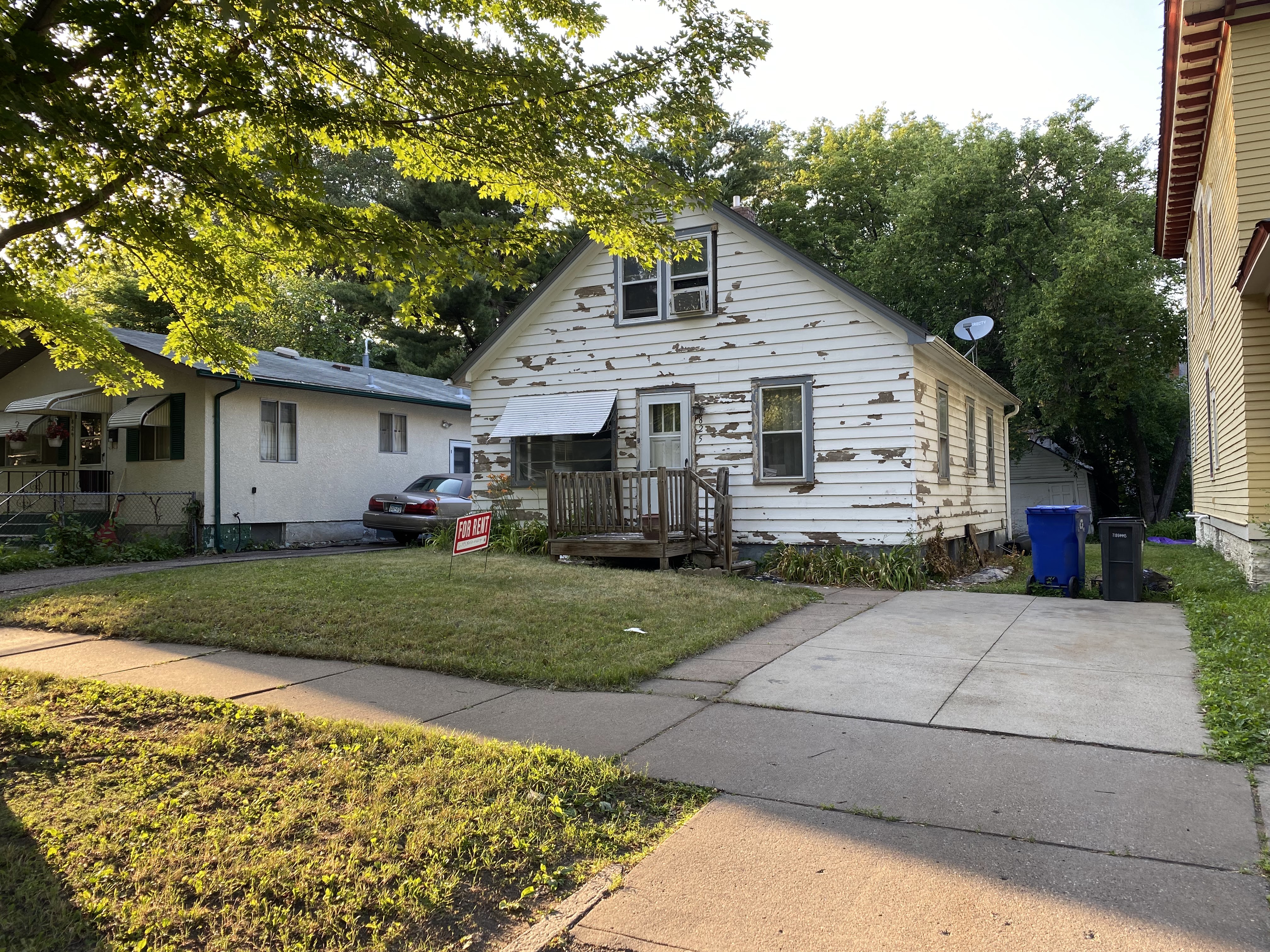
| [A house for rent in the Rondo neighborhood.] |
Well, the Saint Paul Rent Stabilization Stakeholders Group has wrapped up its business, and the 36-page report (with a 250-page appendix!) was submitted to the City by the folks at the the University of Minnesota’s Center for Urban and Regional Affairs (CURA).
There’s good news and bad news. The bad news is that, in my opinion, the Task Force was not a success. (Note that I refuse to use the term "stakeholder," and will refer to it as a "task force" from now on.) We didn’t craft a good rent stabilization policy, and I doubt that the process created political consensus that will bring anyone together who disagreed about rent control. Those were probably the main goals going into April.
But the good news is that the Task Force was not a failure. It did not completely implode, and there is a set of recommendations that can point Saint Paul leaders in the right direction for amending the policy on the books today.
That’s where we’re at. Despite the bumps along the the way, the Task Force creates a starting point for a conversation, showing broad strokes around which Saint Paul can move forward. With a good discussion, and hopefully input from the Mayor’s office implementing the modified policy, I hope city leaders can work out a good long-term rent stabilization policy.
Looking back on the Task Force experience, I’m going to share what I think that policy should be and why.
Thirteen Weeks of Impasse
 |
| [Watch all the meetings here.] |
The main problem was that not everyone agreed there was a problem. Of the 41 members, maybe one-third were people who had worked on the rent control ballot campaign. Having spent a year trying to put their policy in place, most of those members were ecstatic about the status quo. It’s not hard to see why folks were not thrilled about a group whose stated purpose was to undo their work.
That meant that right from the beginning, and almost unwaveringly throughout the proceedings, a large percentage of the Task Force was not on board with its purpose. And I don’t blame them either; I’d have felt the same way.
It didn’t help matters that, during the weeks of policy discussion, moderators never made a case for why change was necessary. I never sensed that the CURA team leading the eight weeks of policy context viewed the existing ordinance as a problem, and throughout the conversation, there wasn’t any any sense of the stakes to policy choices. It was mostly an overview of policies from around the country — “some cities do it this way, other cities do it this way” — without a sense of what the downsides and tradeoffs might be.
That’s not necessarily the CURA folks’ fault, either. I doubt most of the CURA staff viewed the status quo as a problem, and Director Ed Goetz had been clear throughout the election campaign that he supported St. Paul’s rent stabilization ballot initiative.
This is a long way of saying that most of the Task Force proceedings were, in my view, a waste of time. (I bet most members feel the same way.) Almost nothing from the weeks of preparation for the policy negotiation changed anyone’s mind. The Task Force could have skipped those eight two-hour meetings, spent more time on the small group negotiation, and the outcome would probably have been just as good, if not better. At the very least, doing so would have saved 41 volunteer members, and every staffer at CURA, 20 hours of prime Tuesday afternoons during a wonderful Minnesota spring and summer.
(A side note: I've been researching rent control for a while now, and didn’t personally learn much from the various lectures. In fact, I found the four-part ULI/Minneapolis FED rent stabilization discussion to be more informational than the Task Force lectures, and for housing policy nerds, I recommend those discussions. The only thing that surprised me during the Task Force learnings - mentioned in the talk by Ken Barr - was that the the “reasonable rate of return” provision on the books in Saint Paul is not a simply policy idea, but rather a CYA legal requirement based on existing US case law. In other words, if a city or state passes a rent control policy that does not include a “reasonable rate of return”, it will almost certainly be thrown out in court.)
The point is that there was a gap at the center of the Task Force meetings: What was the issue here? What was the problem we were trying to solve? What were the downsides about the existing policy?
Without common ground — the idea that there was a problem that needed a solution — the Task Force was hobbled from the start.
So today, looking back and looking forward, it begs the question: apart from the new construction exemption provision (which I have written about at great length), what are the problems that the Task Force was convened to solve?
Here are the two biggest that I see.
 |
| [Still-vacant duplex on my block; it was like this for over a year.] |
Problem #1: Disinvestment
My wife and I bought a small house in Frogtown about three years ago, the first time I’ve owned any property. Right away, we learned that the shoddy looking duplex next-door had some problems. For one thing, twice when we were home, some sort of police gang task force rolled up and strode across our lawn with rifles to knock on the door of the downstairs tenants. They eventually moved out, but the duplex remained pretty in said shape, with lots of people coming and going. Probably the nadir was when we watched EMTs pull a dead body out of the basement, a woman who had either overdosed or died of old age.
Anyway, that was not great.
Then one day, I walked out the door and found a guy — let’s call him Dave — who was at that very moment thinking about buying the duplex. I encouraged him, and he did.
For the next year, Dave worked on the duplex, and had contractors there most days going in and out doing things like laying concrete, gutting the interior, remodeling the kitchen, building a new set of exterior stairs, adding a doorway, fixing the falling-down porch, pretty much everything except for the exterior painting and aesthetic stuff.
(Speaking of which: It'd be nice, "Dave", if you could get to that one day.)
I’d chat with him every once in a while, to see how it was going. According to Dave, he’d spent around $100,000 on it (so far), and he’d maybe make his money back in ten years. But he also added that “it was in terrible shape,“ and that if nobody had come in and rehabbed the building, it would have been condemned. Things had gotten that bad.
 |
| [Newly vacant lot across the street from my house.] |
The point is that much of Saint Paul's housing stock is in rough shape. It's not unusual to see vacant buildings and lots in many Saint Paul neighborhoods. On my one block in Frogtown, there’s a vacant lot across the street that had a house on it as recently as 2015. Two doors down, another house has sat empty for three years, though someone comes by to mow or shovel once in a while. Three doors down the other direction sits one of the city’s 400 registered vacant buildings. (The above photo of the doorway is a photo of that duplex.)
Judging by the photos, woodwork, and rooflines, all of these homes were once nice places for people to live, and should still be homes for someone today. My block in Frogtown is one of the nicer in the neighborhood, and if you go to any of the most disinvested parts of Saint Paul you’ll find a similar landscape of homes sitting empty and falling apart.
 |
| [Map from this excellent MPR article on the topic.] |
Saint Paul already has a disinvestment problem and I worry that the rent control ordinance will make it worse. There’s certainly a fine line to walk when crafting policy that places hard caps on landlord revenue while expenses rise steeply. On one hand, cities don’t want policies that make it easy for flippers or investors, triggering the loss of affordable housing through gentrification. But cities should be cautious about passing policy that makes it far less likely — as is the case with Dave — for people to fix up Saint Paul homes in desperate need of investment. There’s a cost to turning the landlords / renters dynamic into a zero-sum game, and then picking only one side.
There’s no way to be precise about how the existing policy will affect disinvestment and the housing stock, and figuring out where to draw the line is going to be a challenge. At the very least, it would have been helpful to hear learn from the many (I thought) open-minded property owners on the Task Force. My take, having talked to a lot of folks who work locally on housing, is that the existing policy is not balanced, and will worsen disinvestment in Saint Paul.
How much worse? I can't say, but I do think city leaders should have a useful conversation about it.
 |
| [One of the many rent stabilization forms.] |
Problem #2: Opaque Bureaucracy
My second big goal was to minimize opaque city bureaucracy. As much as possible, it’s makes good policy to not have city departments handle things that could otherwise be sorted out through well-crafted regulation. (It's kind of like how you should design streets that make it hard to drive fast, instead of lowering the speed limit on a wide road and relying on enforcement to solve the problem.)
For the record, the policy on the books does not work that way. Even though the city is implementing the November ordinance with about as light a touch as they can, the policy is not flexible and, especially in a period of high inflation, creates a lot of extra overhead and paperwork. For example, check out the 19-pages of legal rules, or the 22-page form that every landlord has to keep on hand if they increase rent over 3%. Both are only written in English.
There are open questions about how the audit system or the approval process works, and I don’t know how that will go, but it will likely involve a lot of staff time at City Hall. Then there’s the issue of how rental advocates and their lawyers will challenge rent changes, and how those will be handled. To me, it seems like a lot of overhead just to allow rents to keep pace with inflation.
Another problem with a bureaucratic system is that it’s opaque. My guess is that the existing rent control ordinance will become a classic “Saint Paul situation” where only insiders or big players know how things work. People who know people in City Hall will easily get their way; meanwhile, anyone new to the the city, for whatever reason, is going to be frustrated. Having sat at public hearings behind the curved table in the City Council chambers and listened to zoning complaints, I know this is the kind of thing that drives folks nuts about Saint Paul. The city should try to avoid unpredictable bureaucratic hoops.
The final problem with an opaque, sort-it-out-with-staff-time approach is that Saint Paul city departments are understaffed across the board. I’ve been close enough to city workers over the years to know that, especially with an ongoing labor shortage, most people are doing the jobs that two or three folks should be doing. The situation leads to turnover, creating a downward spiral where experience evaporates and services get worse.
The point here is that, given a choice between an inflexible policy that relies on challenges and audits, or a flexible policy that adapts to changing circumstances, less is more. If Saint Paul can figure out a way to create the same positive outcomes for renters without manufacturing a ton of opaque paperwork, it’s probably a good idea.
My Suggestion Coming out of the Task Force
Anyway, to keep a long post slightly shorter, here’s the policy that I think would make for a good starting point for the City Council:
- Rent cap set to some variable rate based on consumer prices or wage growth
- Exemption for new construction (and conversion to residential) of 15-20 years
- Vacancy decontrol with new renter protections (e.g. just cause eviction)
- (Other details are less important to me, but I can see the case for including other policy provisions.)
Here’s a point-by-point case for these policies:
15-20 Year New Construction Exemption
About a year ago, when I first started digging into rent control literature, the lack of a new construction exemption seemed like the biggest problem with the policy proposal on the ballot. Almost no other US city applies rent control to new construction because, so the housing folks tell us, it will reduce investment and construction.
A year after signatures for the ballot measure were first submitted to city hall, and seven months after the election, the impact is clearer. My ballpark guess is that the rent control ballot measure has delayed / prevented something like 3,000 new apartments in St. Paul, with that number likely to grow. Unfortunately, the ballot measure coincided with a housing construction boom across the US and the metro.
 |
| [I made this chart based on HUD data; I know it's not the best chart.] |
This is why, when the Task Force started, Mayor Carter asked us not to deliberate about a new construction exemption. Mayor Carter said that his mind was already made up, and that we’d be wasting our time discussing that provision. (For the record, we talked about it anyway.)
The only open question is how long the rolling exemption window should be, and I certainly don’t know the answer. Something around 15-20 years seems right (what they are doing in Oregon and California), but the real answer is whatever the number is that gets market-rate construction happening in Saint Paul again at a good pace.
Variable Rate / Inflation Adjustment
Another item about which there was early consensus was that a variable rate was preferable to a fixed one. Again, this seems like an obvious change to me. When inflation is over 7%, a 3% rental cap seems like folly.
This is why it’s a strange thing that, during the deliberations, even when inflation was at a 40-year high, the topic of high inflation barely came up. Nobody really talked about the pros and cons of indexing in this kind of environment. Personally, I see lots of reasons why indexing is a good idea, and few reasons for keeping a fixed cap.
(Note that a variable rate is not necessarily more permissive: there are lots of situations where CPI would be lower than 3%.)
Anyway, that should be an easy change for the City Council and Mayor’s Office.
Vacancy Decontrol with Strong Tenant Protections
 |
| [Saint Paul could try again.] |
The argument for vacancy decontrol is that, according to David Garcia of the UC Berkeley Terner Center, it's the most effective way to avoid disinvestment. And because it ties rents to individual tenants, rather than the unit, it’s a straightforward way for landlords to understand the policy. This is especially true when compared to its alternatives, which almost always involve a complex series of write-offs and pass-throughs where small details easily become loopholes.
(This is not to mention an other issue that Matthew Desmond recently mentioned this in his recent Saint Paul talk on housing: dicriminatory screening and “key money” style corruption. According to Desmond, this is an issue in cities like New York and states like California, where there’s a big gap between rent controlled housing and the rest of the housing market.)
With vacancy decontrol, as long as you can solve the harassment/forced removal problem, vacancy decontrol seamlessly combines renter stability with avoiding disinvestment…
… which is why I think a tenant protection provision is the key to the puzzle. If you have legal protection for tenants like just cause evictions, worrying about coastal-city shenanigans becomes less of a problem in Saint Paul.
Amending the rent control ordinance seems like a golden opportunity to revisit the tenant protection push that met an ignominious end in Federal court. Vacancy decontrol would work well if it was tied to tenant protections, and would focus the city policy on the achievable goal of renter stability rather than the unachievable one of keeping city rents below the regional market-rate.
 |
| [From this article on rental trends in Saint Paul and Minneapolis.] |
Other Things and Next Steps
There are some other policy tweaks that could be good ideas, depending on the kind of fine-grained details into which a 41-member group should never delve. There’s a case to be made for an exception for owner-occupied rental properties, e.g. someone who owns and lives in a duplex. Any policy we have should continue to incentivize the creation of ADUs. I think there's a case for different rules for folks who rent rooms to family members.
It’ll be interesting to hear what ideas Council Members have about crafting a long-term ordinance that works for the diverse parts of Saint Paul. I think there are likely to be a bunch of ideas that have pros and cons, tradeoffs between ensuring stability and avoiding disinvestment, between opaque detailed regulation and a more flexible policy.
Wherever Saint Paul moves on this, the sooner the better. Back in the early days of the rent control campaign, CURA head Ed Goetz said in a Sahan Journal interview that “Saint Paul will act as a sort of test for policymakers in Minneapolis.”
The early test results are not great. There’s a huge lack of new housing being built which (because housing projects and lawsuits take a long time from start to finish) is likely to drag on for years, even if the policy changes in November. Meanwhile, for the first time in living memory, Saint Paul rents are now higher than those advertised in neighboring Minneapolis. (See above chart.) It would be ironic if the biggest beneficiaries of the Saint Paul rent control proposal were renters living in Minneapolis, but so far, that’s what’s happened.
The ball is in the City Council’s court. The good news/bad news Rent Stabilization Task Force outcome opens the door to change, but I doubt that the proceedings changed anyone’s mind. It’s likely that, whatever amendments the Mayor and a City Council majority want to make to the existing rent control ordinance, it will be a tooth-and-nail fight.
It’s too bad, because there are good policy solutions that will solve some big problems for Saint Paul while ensuring renter stability and better quality, more abundant housing. I hope Saint Paul leaders can figure it out.