Showing posts with label closings. Show all posts

2023-06-14

St. Paul Loses a Link to its Past as Alary's Rebrands


One of the weirdest dive bars in downtown St. Paul (sadly a too-short list) is closing down. Alary's Bar on 7th Street announced it was closing, and possibly rebranding. It wasn't my favorite place, but it was unique! Their odd parking-lot patio alone made it a must-see stop on any downtown St. Paul bar crawl.

Alary's grand entrance.

Alary's has a great, sordid, St. Paul history, and is the last real link to the city's burlesque past, when downtown was seedy and catered to the debauched, as it did since its days as Pig's Eye. 

Along with the Har-Mar Mall, Alary's has the best amalgamated moniker in the East Metro. It's a mashup of Al Baisi and his partner Larry [something]. Baisi was born in West Virginia and became a lineman for the Chicago Bears int he 1940s, playing in '41, '41, and '46. Alary's has been a local Bears bar ever since. 

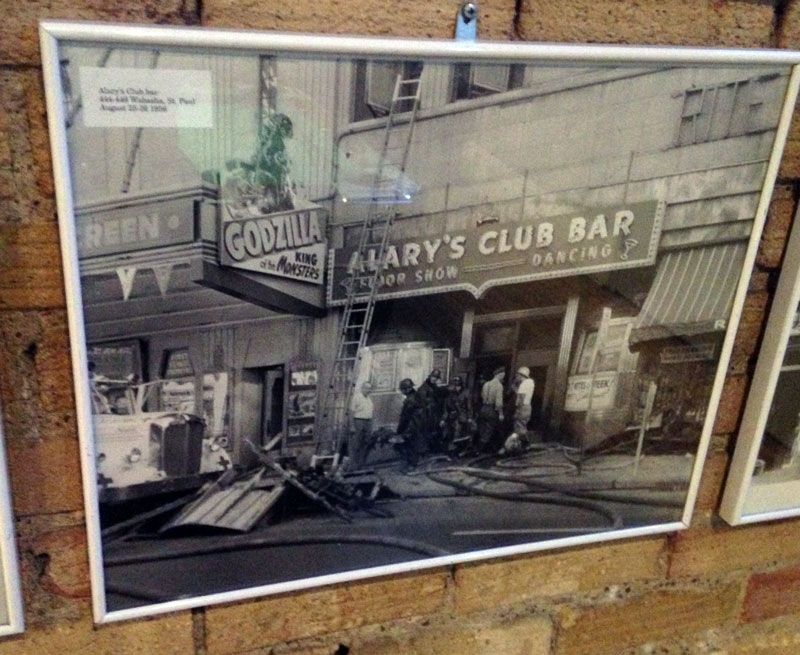
[The original Wabasha location. after a fire.]

Alary's c. 1956.

It all started with Larry and Al took over a Wasbasha club called the Drum Bar in 1949 and rebranded it, adding a burlesque strip show. This was back in the day when such things were commonplace in both downtowns, and St. Paul needed something to compete with the likes of the Persian Palms in Minneapolis' Gateway. It was located about where the Children's Museum is today.

Here's a review of the place from 1979, penned by now-legendary food critic Jeremy Iggers, then writing for the Minneapolis Star:

“The only strip joint that hasn’t lost its charm… a dark and dingy, almost seamy looking place. The two-story white walls are bare except for few vintage photographs of 40s football teams. Many Alary’s customers look like survivors from another era, middle aged men with slicked-back hair and weather faces. Drifters with week-old beards who walk with a limp. Dozens of single men all slip in to watch severely overweight women jiggle their flesh. There are no glass-enclosed cages at Alary’s, but then the dancers never take it all off, a real burlesque. One stripper wears a towering red bouffant and the kind of feathers and fans that make Gypsy Rose Lee famous. Her legs are wrinkled. You can count the rolls in her stomach, but boy, she sure knows how to twirl her tassles one at a time and strut her stuff with class.”

(See also the press clipping below of a brief political run by a former Alary's stripper.) 

The great irony of the strip shows was that, by the end of his life, Baisi was blind. He lost his sight in an East Side shotgun attack (!) in 1970, but he had a special stool at the back of the bar where he held court and listened to the strip tease. 

An Elvgren.

Urban Renewal marked the end of the old Wabasha bars. Mayor Latimer wanted to take down the old buildings and replace them with the new World Trade Center that still stands at Wabasha and (new) 7th. Like any good lineman, Baisi stood his ground, and simply moved the place up the street to an old paint shop that also has an interesting history. The current Alary's which moved in 1998, is in an old paint supply shop that was run by the parents of Gil Elvgren. You've probably seen Elvgren's work, because he was one of the most famous pinup artists in US history. A MIA art graduate, he painted scantily clad women throughout World War II for Brown and Bigelow, the local calendar company. 

Perhaps channeling Elvgren's lewd spirit, Alary's moved into the old downtown paint shop, and used the high ceilings. Al Baisi's kid took over the place, and retained the sexploitation vibe. Not too long ago, the evening bartenders were all scantily clad women, and there was a live video feed. Then there was the infamous Vulcan groping incident of '05, which is horrible. 

It was also a cop bar, and there was a nightstick proudly displayed on the wall, along with other cop paraphernalia. Not my politics, that's for sure! It makes it all the more ironic that, in 2015, a drunk Forest Lake hockey dad jumped into the Alary's hockey game shuttle and drove it a mile without realizing someone was inside the whole time.

Farewell Alary's! It was a real link to St. Paul's less upstanding history.

Cool, something to beat people up with.


Elvgren's Art Deco paint shop.

The dreaded Alary's shuttles.


Cop and Vulcan stuff.


The Royal Defillibrator certificate.


How it felt to go to Alary's.

I loved the history wall: lost St. Paul.


It's hard out there for an arthritic stripper.


2021-10-07

Saint Paul's Last Real Drive-in Peels Out

The Star Tribune reported some sad news this week, that the city's last real proper order-at-a stand and eat-in-your-car drive-in on the East Side.
"It's exciting but it's sad," [said] third-generation owner Angela Fida. "It's exciting because I'm going to start a new chapter in my life, and it's sad because I've been here for so long."
I've been going to the Dari-ette off and on over the last few years for their coney dogs, and I usually got the sense that the place was on its last legs. The vibe was subdued, no flocks of kids with ice cream cones, mostly people driving in and out 

You'd think that an eat-in-your-car outdoor-seating joint could thrive during COVID, but maybe the Dari-ette was different. Well, it was certainly different! As far as I know, there is only one other proper old-school drive-in in the Twin Cities: the Minnetonka Drive-in off Highway 7 (and the great bike trail). 

The closing of the Dari-ette is certainly a loss for Saint Paul history, and another vanishing landmark of the old days on the East Side. It's not that people stopped going to drive-thrus or even food trucks, but it stopped being a social thing in this particular way. We're too bubbled up now to appreciate the spectacle of high school kids bringing out your tray and gawking, or else most people just don't appreciate red sauce Italian fare like they used to. 

The coney dog was fine, by the way. The review is appended below. Mostly, it was the atmosphere that was the treat at Dari-ette, even if it was just a parking lot with some vintage kiosks illuminated by a cool neon sign. I'll miss knowing it was there.

[Coney guide continues:]

The unique Dari-ette lies deep in the East Side, and is the last pure “drive- in” in Saint Paul. In fact, it’s almost the last in the Twin Cities, with usually-functioning car-window menu/speakers/tray-holders. What an amazing slice of mid-century car culture!

The operation was founded in 1951 by Italian entrepreneurs who have passed down through the generations, nobody changing a thing. It’s open from spring to fall and thrives on the labor of teenagers, and if you find yourself up on the East Side, is surely worth a visit.

The menu is old-school Italian fare with ice cream, classic sandwich and burger staples. And lo and behold - the Dari-ette’s extensive menu even includes a coney dog: it’s below-average, with a solid wiener and sauce but not much else to speak of. Anyway, that’s not the point. You’re eating a coney at a drive-in! 

So long, Dari-ette! May you drive off into the sunset. 

[A coney dog and an egg salad sandwich.]


[The Dari-ette at dusk.]


[The Dari-ette in the old days.]


[The menu; most of them were still functional.]


2021-03-09

Another Dive Down as the Hexagon Burns Up, Goes by the Wayside


The Hexagon Bar was unique, a small weird oasis on the concrete streets of the Seward neighborhood. Its loss marks another minor absence for the city’s music scene, and the disappearance of small weird venues like the nearby Triple Rock and the 400 Bar. 

For music, the Hexagon Bar was always cover-free. It was the kind of place you could just pop your head into as you were passing through South Minneapolis, to see who was playing, with little commitment, and whether it sucked or not. There was often a flock of hipsters, crusty punks, U students, and/or random South Minneapolis bozos hanging around outside the door. Late at night, the fenced-in patio was like a petting zoo where people fed each other American Spirit cigarettes. 


At other times, the Hexagon Bar was a classic dive, if there wasn’t a show, you’d find a maybe a dozen regulars drinking out of plastic cups, staring blankly at the claw machine, passing time in a place that slowly changed around them.

I wrote of the place's mercurial nature, back in the 2nd Guide Booklet:

The gritty wedding of dives and music is perfectly suited to another dive characteristic, the daily pattern of regulars, drunks, workers, and the late-night young. Any good dive in an urban area will have a distinct rhythm to the day, a stride and pace of alcoholic progression that mirrors its social reach and the neighborhood around it. In a way, this is like how Jane Jacobs described the “urban ballet,” the passage of a New York sidewalk through the hours, of streets through the day and night. Some dives begin their days in old age, with the retired or hopeless, weary men escaping loneliness, reading the paper, complaining. As the night wears on, years fall off the faces, a time-lapse in reverse. The old man in the olive jacket is replaced by a 30-something in plaid, then again by a black shirted groupie straight out of college. Midnight is for the young and restless and the music takes over the bar, pouring out of the adjacent room like a spilled Grain Belt, impossible to ignore. If you’re here, why would you want to?

It's also wroth pointing out that the Hexagon Bar was the last real remnant of the hub of hell, along with the Schooner Bar a few blocks away. …

The Hub of Hell, also known as Hell’s Half-Acre, was its own special place, where the Puffer-Hubbard gang (from the nearby foundry) was just as likely to police social norms as the actual Minneapolis police.

…


The Hexagon Bar sat on the seam that separated the factories and warehouses of Seward from the working-class homes to the north and east. In those days, there were a lot of industrial facilities in the area, like the Milwaukee Road rail yards, which employed hundreds of working stiffs; Minneapolis-Moline, a farm implement factory; or Flour City Ornamental Iron Works Company, a foundry that crafted large, decorative railings, gates, and doorways. The railroad tracks through the neighborhood were lined with smokestacks and the streets full of men roving around and looking for work and fun.


Heck I’ve been writing odes to the Hexagon Bar for almost ten years now. I think the second ever dive bar bike tour wound up there, back in 2013. Since then, I wrote about the Hexagon Bar in my South Minneapolis Dive guide booklet, researched it as part of work I did on the history of the Seward Neighborhood, and then again included it in my book Closing Time.

I didn’t know it when I was going to shows, but music at the Hexagon Bar was part of a long tradition. Researching the bar book, I dug into an audio history archive from the 1990s that included a colorful interview with the bar’s long-time owner, Aurelea Hupp. Her story is fascinating, but includes this description of the bar in mid-century: 


It was mostly truck drivers. . . . There would be fights in the bar, because we had a hexagon-shaped bar and there only was the one room. We had the oom-pa band there in the corner, three fellas playing, and they’d be four deep at the bar on a Friday or Saturday. The fellas would be arguing, you know, and my husband, who was a friendly guy, he and Jack Reilly would have to stop these fights.


Hupp’s husband inherited the place from his stepdad, who had opened it up after prohibition in 1935. She passed it along to her kids, and apart from losing the original hexagonal shaped bar, it didn’t change all that much. (I put an extended rough transcription of the Hupp interview below.)

The bar was torched during the unrest this summer. The demolition of the ruins this week mark the end of the real Hub of Hell bars that once defined the Seward neighborhood.. Most of them were demolished intentionally through city-led projects, aimed at changing the area, reducing crime, and getting rid of the old bars. While the bowling alley and the Eagles club remain, and though I love them both, neither is really a traditional bar. It’s a bit sad to see the Hex go this way, because I think it had made it through the hardest years of the 1990s and early 2000s.

RIP Hexagon Bar. You had a good run.


[Rough Exerpts from an interview with Aurelia Ann Marie Hupp, long-time proprietor of the Hexagon from the 1950s-1990s.]

I started singing at the Tempo Bar, owned by Roy [???] at the time. Charles Mathews was one of our regular customers, [???] Eckberg was the owner, he was a very regular customer. He was in the Tempo every day in the 1940s, I started singing at the age of 2. 

Somebody had coxed me to enter a contest at the Café Exceptionale. I didn’t take the [waitressing] job be a singer, so I was scared. 

One night we stopped in the Tempo they got me up to sing, Roy Eckberg was there and said, I want you to come and work for me. 

I was a singing waitress. All popular songs of the 40s, and everything that was popular semi-classics. There was a piano player and a violin player and my brothers made a little stage for the waitresses, and they used to be packed every night [with people] from the university. Just packed.

Night and Day, Paper Moon, Summertime, Chattanooga Choo Choo. Bernie Bane Hanson was the piano player. 

The band would be on 20 minutes and the girl would be on 20 minutes, and the girl only lasted two weeks. 

So he sez, You want to come down and try it? 

I don’t mind, I sez. I might not last very long. What was she getting? I asked. 

I was getting 40 dollars a week at the Tempo, so we went down to start it, and the fellow asked me what I expected to get. 

I expect to get 60 dollars a week, I sez.  

If you last more than two weeks, I’ll see that ya get it, he sez. 

The third week came, I got 40 dollars. I said to him, remember me? 

You got it, he sez. 

I worked there about two years. It was after the Tempo, that was like in ’45, [owned by] Gus Nelson. Roy Eckberg had sold it to Gus Nelson and then there was another bar, the Minnesota Bar, I’m pretty sure it was called the Minnesota bar on Franklin. It was a beer parlor. Beer parlor, liquor and beer, 3.2 and liquor, as opposed to hard liquor. 

Then I got the job downtown at the Casablanca, when it was owned by White/ Mitch from Mendota was one of the owners, [???] went to jail because of the murder that was there.  And Tommy Banks. Shetsky took the rap for Tommy Banks, who was the guy that killed him at the time I was singing downtown. 

I was also Rosie the riveter at the St Paul airport because I was working on a specials crew. And when the new B24s came into the St. Paul airport you had to go all over them to see where the rivets were missing.

My husband’s stepdad started the Hexagon at the end of prohibition. It was a beer bar, where you make beer, a Schlitz brewery was there, in the building. That was the building and my husband’s stepdad stared a bar right there and that was in about ’36, 

It had been Schlitz before prohibition. After, it was a natural place for a bar. It had the right smell. So we started a bar there, and when he decided to retire, he gave the bar to his own son and my husband who was his stepson, he was married to my husband’s mother, turned the place over to the two boys in 1945. And they worked there. They were partners, and they added on, and they were partners until his son died. That was Riley, our name was Riley. Our telephone is still listed as William Riley he’s been dead since…

Riley married Hupp, and that was where the two boys came from. One boy in each family, that was the extent of the family. 

He died when he was about 59 years old, my husband had along in about 77, my husband got Alzheimer's and he had Alzheimer's until he passed away. And my son will help him run it and when he died, I stepped in and did it. And now the boys are running it, the one boy is the manager now, and we’re on the corner.

When we were first in here it was The Magic. The bar where emerge is, and meet to us there, where you the city bought it you, it had been formally Duffys. It was Genes, and then Pearsons was always there, and Pearson Bustard his name was, he and his wife both had Cadillacs and beanies and he had a ring on his finger that was a big diamond. 

And he was held up, they said give me that diamond. 

I can’t, he sez. I haven’t had that off my hand in 20 years.

And [the robber] says, cut it off or I’ll cut the damn finger off.

And so it came right off. Heck, you don’t want to get too scared because that what can happen, your fingers shrink.

There are just as many [bars] now, in fact, they gave all ways was the ones that’s owned by the what’s the one a block down from Pearson’s well anyway it's Franky… name of the bar down there that… 

The Eagles', I know it well, they do sell liquor there. One they gave a license to. The FOI / VFW. They gave a liquor license to the Stardust, then Henna’s became Differs, then Duffy’s became an insurance man, Foster. Then Foster became Norma Jeans, then the city took it back. Mr Nib’s was after the Magic Bar, Magic Bar then Mr. Nibs, then it was go right to Mirage called it … now its not any more. 

Gone by the wayside, and Norma Jeans has gone by the wayside and Pearson’s has gone by the wayside. 

[Transcript ends.]

2019-08-26

After 58 Years, J.W. Hulme Disappears from West 7th and St. Clair

[The old West 7th factory.]
Last year, I was happy to finally lead a bike tour of "factories" along St. Clair Avenue, which I'd been thinking about for quite a while. It's a street that boasts a surprising number of manufacturing institutions, both large and small, and it was fun to visit a bunch of these places in an evening.

Well as sometimes happens with my tours, they can be a bit of a "kiss of death." Businesses, bars, or institutions occasionally disappear right after I bring a group to visit them. In the case of the St. Clair tour, it was J. W. Hulme, a leather bag manufacturer that had been on the corner of West 7th and St. Clair since 1960. They announced they'd be closing their factory last October, right after the tour. They stayed open for a few more months, but the building has been in mothballs for the last half a year.

Here is some info about J.W. Hulme that I'd found out in my research:

  • The company was named after John Willis Hulme, who started his first business in 1905 in downtown Saint Paul making a bunch of different canvas items. The company specialized in canvas awnings and tents. 
  • The building on West 7th was built in 1960 when J.W. Hulme expanded. As a publicity stunt to celebrate the new factory the to camp out on the roof of the building for a weekend using Hulme material whenever possible. 
  • In 1988 a bookkeeper “swindled”  $33K from the company. 
  • In the 1990s through the early 2010s, Hulme specialized in high-end canvas and hunting gear that was made specifically for Orvis, the fly-fishing brand.
  • J.W. Hulme was bought by an awning and canvas company guy named Gary Buermann in 2002. In 2005, a new CEO named Jen Guarino a former brand manager turned around the company. They received a boost when a couple of very influential people promoted the bags, and they were sold at places like Barneys Department Store in New York. With lots of debt, a private equity firm bailed them out in ’09.
  • As recently as last year, they employed dozens of highly-skilled sewers making their leather goods.


Sad to see a Saint Paul business close! It was a good run for J. W. Hulme, though. You can still visit their retail location on Grand Avenue, though their bags are now made elsewhere.

[Historic clippings follow.]

[Want ad, 1954.]
[c. 1960.]


[Want ad, 1978.]


[Want ad, 1998.]


[Ad for Orvis equipment, c. 1990s.]
[Current Grand Avenue shop.]

2019-06-20

A Rare Southeast Dive Slated for So-Called Improvement

[Image from MN Daily.]
It is with a leaden heart that I report that another Minneapolis dive is slated to be improved.

Sporty's (formerly the Sportsmen's Inn) is one of the only dives in Southeast Minneapolis, an otherwise relatively quiet working-class and student-oriented slice of the city. Along with Manning's across the street, Sporty's displays a lived in patina and a idiosyncratic veneer that made it seem like someone's 1980s basement. I first came across it during a Stupor Bowl ride, and have returned there often.

The article in the Minnesota Daily reads:
The bar's last day of operation will be June 30, said owner Chris Chistopherson. A new restaurant, Como Tap, is expected to open at the location of 22nd Avenue Southeast and Como Avenue Southeast in late August. 
Christopherson’s lease for the bar, nicknamed Sporty’s for decades, will end in July after unsuccessful renewal negotiations. Renewing the lease would have included a substantial rent increase that Christopherson found unsustainable, he said.
During negotiations, Christopherson said he received a letter informing him the lease would not be renewed. 
“This is not my intent, it breaks my heart. Because I feel like we're allowing an institution to die,” Christopherson said. “But I understand it, I understand business. I understand maximizing profits and I don't know that I'd have done anything different if I was in Joe's spot, because he owns the building. He operated Sporty’s for 14 years.”
It seems like the place will remain a bar, so that's good. Less good is the certitude that it'll be a fancier and "cleaned up". I assume  all the cool kitschy idiosyncratic "your uncle's basement" stuff will be gone.

Here are some fun facts about Sporty's, from last year's Noteworthy Dive Bars of the Southeast Borderlands tour:

  • It's an old mixed-use building with apartments over the bar. Lots of people have lived here over the century, families and kids growing up above the place. Back in 1936, for example, a woman named Margaret Reimers lived upstairs and, in a classic "eyes on the street" moment, witnessed a group of men commit a burglary of company across the street. The place was called United Chemical Co., and the burglars spent two hours breaking into a "strongbox" to steal a grand total of $42. (The safe had had over $1,600 inside earlier in the day, so they were working with bad information. That's $30,000 in today's dollars.) Margaret did not call the police because she did not have a phone.  
  • In 1937, the city granted a license for a restaurant in this location. At that time it was not a bar, and only served soft drinks and sold cigarettes.
  • In 1962, the place was called the Como Inn. Being outside the Minneapolis' 1880s "liquor patrol limits", there's always been a struggle to allow alcohol here. For decades, concerned neighbors have pushed back against having bars on this part of Como. In 1963, organizations in Southeast sent 17 letters to the city to protest the (re)opening of a bar here. The Alderman at the time, a man named Robert McGregor, led the charge to stop the opening of the bar. (He failed, obviously.)
  • By 1969, the bar got a new owner and the name changed to the Sportsmen's Inn.
  • It became Sporty's more recently, and was remodeled about five years ago to add large windows. Maybe that was the beginning of the end? Fenestrating a dive bar is never a good sign. 

Go check out Sporty's before it changes. Be sure to make a pilgrimage to the Kramer painting.

[One of my favorite movie posters, because she is destroying a freeway.]

[The patron saint of Sporty's.]

[An excellent dive bar bathroom, one of the diveyist in Minneapolis.]

2019-04-24

Another Dive Down as Timeless Lee's Liquor Lounge Relinquishes


This one is particularly sad, because Lee's was one of the least likely stories of dive bar survival. It lasted in the last place one would think a bar would linger, centered in a vortex of freeway on-ramps, municipal parking lots, homeless shelters, garbage burners, bus garages, and over-built roads on the far west edge of the downtown.

Lee's Liquor Lounge features prominently in the upcoming book that Andy Sturdevant and I are writing about the history of bars and saloons in Minneapolis and Saint Paul, and I was dearly hoping that we could host a reading on the stage at Lee's this fall, when the book is scheduled for publication, accompanied of course by some honkytonk country. It's a damn shame that won't happen.

Lee's also featured prominently in my Taxidermy Tour of Minneapolis bike ride, which I daresay might be resurrected soon before the place disappears. Lee's has the metro area's absolutely finest collection of mid-century bar kitsch, including a fine case of Elvii, and amongst the throng is some fifty-year-stuffed animals, including a black bear in a shriner's fez and a perched cougar.

[Highlights from the 2015 taxidermy tour.]

The story of Lee's cannot be told without mentioning Louie Siriam, and nobody will ever tell that story better than Brad Zellar did in his 1997 feature piece for the City Pages [see below]. I'm excerpting it here because it's not online, and please read it. Zellar chronicles one of the most amazing bar stories in Twin Cities history. Siriam started his working life as a kid sweeping up the floor at a South Saint Paul slaughterhouse (imagine the yuck!), and would end up in his later years meticulously cleaning Lee's each and every night until the formica gleamed in the limelight.

The bar's owner claims that parking is the culprit for the closure, but I am chalking this up to the absence of Louie. Never take a great dive for granted, folks. They rarely last.

[Louie's office and mop rack from the basement of Lee's.]


[Excerpts from and photos of Brad's 1997 column below.]

Louie’s foot is not an attractive sight. Horribly stunted with splayed, twisted toes and squashed arch, it is the casualty of years of foot-binding labor--20-hour days, seven days a week, including many long hours behind a floor scrubber in the dead of night. Clean floors are an obsession with Louie, the man who has owned Lee’s since 1976, Seriously clean floors. Waxed gleaming floors. They mean something; represent an ethic, a correct way of doing things.


As Louie likes to say,” the horse that shits the fastest don’t shit for long.”


For more than 20 years Lee’s has been Louie’s bar.


No matter how many hours he worked, nothing he did was going to stop the flight of blue-collar jobs that was taking his best customers and their paychecks out to the suburbs or wherever the hell it was taking them. Street bars like his all over the city were being eradicated. … with 394 wrapped around it like a moat that cut him off from downtown.


For a time Vikings’ great Carl Eller ran a liquor store out of the place that was now Lee’s dance floor. There was a short-lived attempt at a game room as well.


The band Trailer Trash… evolved into a regular weekday Wednesday night gig. “You know, where it’s no big deal to play 200 minutes a night. Where people don’t go to see a band but to dance, to have fun. The band’s job was simply to rock the place…. .. the revamped Trailer Trash … kept right on ripping through their catalog of more than 300 roadhouse and honkytonk staples.

Louie once said, “Nate [the Trailer Trash musician] is very impressive and he puts himself across very well. He’s a real gifted salesman. The whole group is just a bunch of fine young fellows, so clean-cut and likable. … The young folks have such clean good fun, and often they will say thank you as they leave."

...

[Another quote from a regular]: “You know, just neighborhood drinking. Friday nights we’d get all gussied up and come to Lee’s. In the old days there was a jukebox with a bunch of country oldies, and maybe twice a year this band would come in and play. I think that first Wednesday with Trailer Trash there was just Ed the bartender, me, and a handful of other people. And then all of a sudden it was the place to see and be seen.”


...


The marriage of band and bar was successful beyond anyone’s imagination, and led to a couple of major renovations designed to open up the room and improve sight lines.


“Because, essentially, Lee’s is a roadhouse. It’s a bona fide honkytonk right in the middle of a city.”


...

Louie has a favorite word: schmaltzy. He’ll say something’s “almost schmaltzy, “ and that’s the spot-on description of the appeal of Lee’s, with the careful emphasis on almost. There’s certainly an element of nostalgia in the bar’s appeal; the place seems to touch a familiar chord even in people who didn’t grow up in the world of servicemen’s clubs and small-town Saturday night dances… There’s something int he bar’s smoky, paneled 1950s roadhouse authenticity -- with its beer signs, stuffed fish, … that resonates in young urban types who’ve received their notions of Americana from, say, David lynch.

...

Lee and Sally Triemert had run Lee’s since 1962 and when Lee passed away Sally started looking for a buyer.

“I looked at the place a couple times and I had my second thoughts…" [says Louie] "But Mrs. Triemert gave me a real nice deal and I went ahead and bought the bar. … I found out quick that this is a very tough racket that requires a lot of hard work… Every night I was in here, doing everything. I was janitor, bartender, bouncer, and bookkeeper. Seven days a week I was working 21 hours just to pay the bills…"


The bar was once surrounded by industry: Kemps, Munsingwear, McGarvey coffee, Shopmaster, the Boyer Ford dealership -- and Louie depended on the business of the working men and women who sopped in after work to drink and cash their paychecks. Freeway construction just outside his front door cut him off form downtown and the neighborhoods to the north and disrupted business for years… It was the first of “many isolations… right from the get go this area started going through enormous transitions. The neighborhood’s pretty much been wiped out a couple different times.


“The last time I took a vacation, I got drafted," said Louie


Louie is out on the sidewalk in front of his bar with a brush and a pail, cleaning windows.

...


2019-03-21

Another Dive Down as Kelly's Depot Bar Departs the Station


I have a little ode to Kelly's today at City Pages. RIP Kelly's. I will miss you and your coney dogs. Get there before the end of April and soak in the atmosphere one last time.

The other shoe finally dropped. The rumors came true. 
Anyway, downtown St. Paul doesn't have a lot of dive bar credibility in the the first place. Most of the old haunts and blue-collar joints have been skyscraper'd, paved, or gentrified, a trend that's been going on well over 70 years. (Of course, downtown Minneapolis is worse; Google "Gateway District" if you don't believe me.)


Check out the story here.

2017-11-29

Another Dive Goes Down as Tracks Bar Hits the End of the Line

Tracks Bar on University Avenue has long been one of the weirder ones. Probably most people think that it’s called “Tracks” because it's near the railroad tracks. This is absolutely not the case! The true story is weirder, and you can read it below.

I liked Tracks, and would often meet people there to give them the flavor of the Midway neighborhood. Tracks was the bar and restaurant of the Midway Days Inn, and hanging out at Tracks was always food for thought. During the day, the place would be a mix of old alkies and bored budget travelers, the perfect place to wallow in vague depression. It was connected to the hotel hallway, and to get the the bathroom you had to go past both the bar fish tank and the hotel swimming pool, each of which had its own distinct aroma.

I remember drinking beer with a friend and watching a messed-up man fall asleep on the bus stop out the window. He leaned way over, drooling on himself before gradually succumb to gravity and slipping into the sidewalk. After a half-hour or so, a cop came and told him to move along.

Over the years, Tracks has tried to change, adopting a classic University Avenue Asian-American menu, for example, or rearranging their darts machine. Off in the corner sat the last remnants of the old “supper club”, a previous incarnation (described below). It was a great place for pull tabs, darts, odd encounters, frozen pizza, and long beer-fueled silences. It was also a comfy well-fenestrated hangout for people in Saint Paul uninterested in $10+ burgers (as punk poet and Tracks fan Paul D. would tell you).

Tracks was a stop on my 2015 Midway Dive Bar tour, and Dickinson was there to greet us. I think he was grading creative writing assignments, and looking out the window. Midway is a part of town that is rapidly changing, but I thought that Tracks would stand the test of time.

I guess I was wrong.

Get there while you can, because tomorrow is the last day. So long, Tracks.


[My excerpt on Tracks from my Dive Bars of the Midway guide booklet follows. Buy the entire guide online!]


Tracks

Dives come in all shapes, sizes, and temporalities. Tracks, about a half-mile West of Snelling Avenue,
offers a most curious story. 

Far back in time this was a “surf-and-turf” white tablecloth joint named Mr. Joe’s. “It was hopping,” one old patron once reminisced, which is difficult to imagine today because, somehow, Tracks transformed from a swank steakhouse into a drab motel bar the color of an expired nectarine.

Today, Tracks is the bar connected to the Midway Day’s Inn, one of the only hotels around, and here small worlds collide. Midway regulars, railroad drunks, cheapskate travelers, and innocent tourists mix to an unmatched social flavor. Where else can you spend an hour playing pull tabs with tourists in town from Iowa for the Hawkeye game while watching people cross University Avenue.

Adding to the human cocktail is the hotel pool, whose chlorine scent sometimes wafts through the door past the fishtank, occupied by two or three goldfish and an inky bottom feeder, and whose sounds echo through the hallway on your way to the bathroom. I’ve a recurring fantasy of renting a room at the Tracks Day’s Inn over a birthday weekend (or out of impromptu despair) and maintaining an assembly/conga line between the bar, the hotel room, and the hot tub waiting between them. Tracks combines the curt familiarity of the dive bar with the uneasy liberation of the hotel bar, a magical and overlooked fiasco, especially in the middle of the city. 

The hotel dive: likely a creature of circumstance, most often found in the suburbs. But here it encroaches into the Midway.

Should you achieve intimacy with Tracks, you’ll notice the strange gold protuberances punctuating the rail along the bar in the shape of huge horse heads. Funny story. Back in the 80s, when Tracks was weathering its nadir, there was a fire, and the club went through a deep identity crisis. Meanwhile a fantastical development was taking place at the very edges of the Southwest suburbs: speculators were building a racetrack named Canterbury Downs. It was to be the first ever Twin Cities’ horse track, and the imaginations of the risk-prone filled with visions of easy money. It was around this time that Tracks was re-named and re-modeled to capitalize on the soon- to-be-burgeoning culture of pony players. Tracks was to be the city’s first off-track betting (OTB) establishment, conveniently located in the Midway, right between the two downtowns. Everything was going to come together, like a great 80s metal cover. 


Alas t’was not to be. The State of Minnesota never legalized off-track betting, and Tracks became just another Midway hotel / dive bar / former surf-and-turf restaurant with gold horse heads guarding its island of alcohol. 

A common pastime at Tracks is to sit at one of the window-side tables and watch the bus stop on the corner. For some reason, this particular shelter attracts vagrancy, and I’ve wasted many a pleasant hour ignoring my problems with beer, watching a man with more problems struggle to stay upright, people drag large bags across the street, or the transit police appear to deal with the addled over-exuberance emerging from the #16 bus.

It would be remiss to point out that this building is hideously ugly, a monochromatic pale orange with vague late-80s cartoon modernist flair. Tracks and the attached motel form a “U” of bad architecture that belies the fact that, inside, you’ll find some of the city’s finest bartenders, sarcastic and firm. 

Appearances can be deceiving. Highly recommended.

[Get your own copy of Noteworthy Dive Bars of the Midway or any other of my dive booklets today!]