Showing posts with label Minnesota. Show all posts

2021-09-07

Walking Tour to Explore Minneapolis Porches on Saturday September 18th


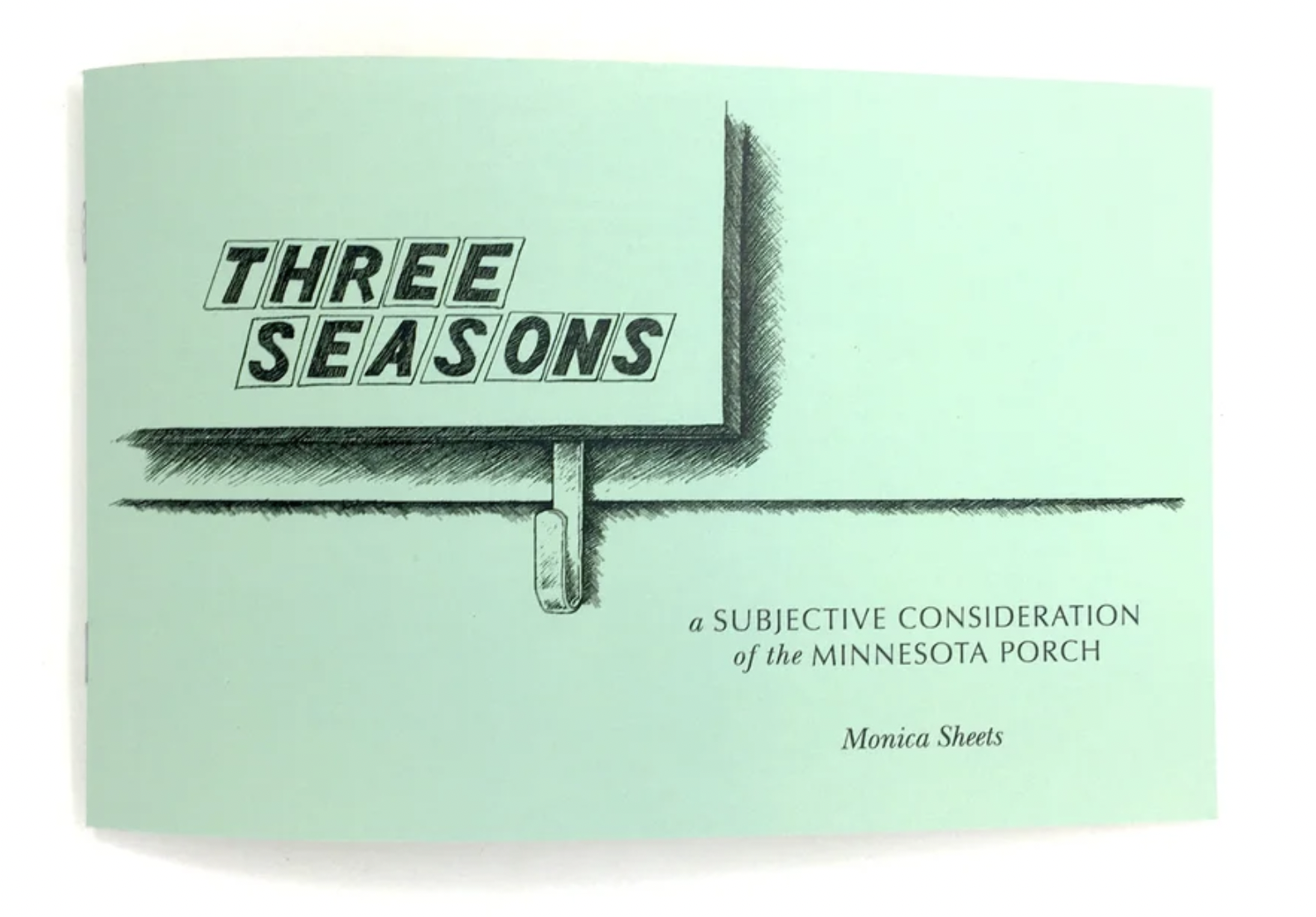
Ever since I read Three Seasons: a Subjective Consideration of the Minnesota Porch, the wonderful new booklet by Monica Sheets, I've felt uncomfortable sitting on my lovely three-season porch. According to the booklet, these kinds of porches are, like the skyway system, an architectural reflection of Minnesotan anti-cosmopolitanism. 

Monica makes quite an argument and, since I've been sitting on my porch and experiencing it anew, it's hard to argue with her. I almost never have conversations from a three-season porch, and  rarely used it with anything other than semi-opaque privacy.

Here's my favorite bit, a taste of the booklet's first section:

I was asked to expand upon what was for me had become a sort of one-liner joke: that the emotional distance off Minnesotans toward other people was reflected in the prevalence of three-season porches. My idea is that the three-season porch turns the interstitial public-private space into a highly ambitious and often highly private space that effectively creates a higher threshold to overcome when communication. This higher architectural threshold mirrors the higher emotional threshold one must overcome in interpersonal interactions with Minnesotans.

If you'd like more details, you are also welcome to read the excerpt just published on streets.mn! Or buy the entire booklet, which I highly recommend. It's available at the online store of East Lake Street's finest imprint, Birchwood Palace Industries


The point is that I'm co-hosting a walking tour (!) with Monica Sheets and Andy Sturdevant (publisher at Birchwood Palace Industries) on Saturday the 18th. I hope you can make it! If' you're like me, you'll never look at porches the same way again.

[Facebook invite is here.]

2020-09-08

The Case Against Henry Sibley

Sign the Petition to change the name here: https://bit.ly/2FlFsjR

[Trigger Warning: detailed account of a massacre.]

I am a proud graduate of Henry Sibley High School in northern Dakota County, or at least I thought I was. Growing up in Mendota Heights, you are surrounded by Henry Sibley’s name. Highway 13, or Sibley Memorial Highway, goes through the town of Mendota, where Sibley lived for most of his life in Minnesota. In high school, “Onward Sibley” was the school song, and “Go Warriors” was the incessant chant. 

To be fair, nobody really knew anything about him, other than that he lived a long time ago and was a governor or something. When I was attending Sibley High in the 1990s, we even had an Indian head as our mascot, ironed onto the fronts of the red leather letter jackets. (Not an athlete myself, I never had one.) Sibley’s name and the Indian head were on most signs and omnipresent at pep rallies. We were the “Sibley Warriors.”

It wasn’t until junior year, AP Economics class, that one of my favorite teachers, Mr. Reed, mentioned the 1862 Dakota Conflict for the first time. Honestly, I’d never heard of it. Mr. Reed said something about Dakota Indians and an infamous execution and used his excellent chalkboard skills to make the point — completely off-topic for Economics — that maybe an Indian head shouldn’t be the school’s mascot. 

Thankfully, as awareness of Sibley’s role the 1862 conflict grew during the 2000s, Sibley High finally changed its mascot  in 1999 to a more Greek-style warrior, though according to one report, “students still wore war paint and feathers during football games.” 

Since then, I’ve learned a lot about Minnesota’s early history and the Dakota people who lived on this land for thousands of years before white settler colonialism arrived. Researching my current project, a history of Saint Paul, I’ve been reading and re-reading a lot of that early history, wonderful books like mni sota makoce, North Country, and the biographies of Henry Sibley and Little Crow. More importantly, I’ve read through a pair of indigenous Dakota books, What Does Justice Look Like and Our History is the Future, both of which deal with the horrific history of white settlers in Minnesota.

I am aware that these books do not make me an expert on Dakota history, and there is still so much to learn about the Dakota people and the Dakota homeland where I live. I think white Minnesotans and people who live in the Twin Cities have a lot of work to do to learn about our past, and how to make a better future that respects the Dakota people and the genocide that occurred here.

But even with my basic research, it’s easy to question Sibley’s role in Minnesota history and whether or not Minnesota, Dakota County, State Highway 13, or School District 197 should be naming things after him. To me at least, the case is pretty clear that white Minnesotans need to re-think our Sibley memorials. 

[The Sibley house in Mendota.]

Henry Sibley’s Early Years

The short biography: Sibley moved to Minnesota from Michigan in 1834, at the age of 23 to take a job with the American Fur Company. From the tiny trading post at Mendota, Sibley worked intimately with the Dakota tribes for about two decades,  trading goods and relying the Dakota for furs. Fur traders relied / exploiting Indian labor to make profits in the fur trade, but certainly by the 1840s, it was a declining industry. Nevertheless, Sibley cultivated close ties with the Dakota who had been living in the Minnesota and Mississippi and River valleys for millennia. At one point, during the winter of 1839, Sibley even went on a months-long hunting expedition with his Dakota allies, making relationships he was able to use to benefit his trade. During this time, he fathered a child with a Dakota woman; he later placed her with a family in Saint Paul and took care of her education. As Minnesota rapidly changed and American and European settlers arrived, Sibley would go on to be a key figure in catalyzing the white colonization of Minnesota/Dakota homeland, negotiating territorial status and becoming its first state governor. 

If you are honest about Minnesota’s dark 19th century history, there are lot of villains. In fact, it’s almost impossible to find white Minnesotans who behaved with any moral decency during this time. Even someone like Bishop Henry Whipple, often lauded as one of the “good” white settlers, does not come off very well in his dealing with the Dakota people (as Mary Lethert Wingerd points out in her epic history). This is to say that it can be tempting to treat Henry Sibley with kid gloves, especially if you went to a high school named after him. And to be honest, I entered my research feeling somewhat charitable towards him. 

[Middle aged Sibley.]

After all, he was better than a lot of his peers! He was better to the Dakota and Winnebago people than Alexander Ramsey, for example, who was worse in just about every way. Reading through his biography and letters, that’s my sense of how Sibley viewed himself too, occupying a supposed middle ground between genocide and so-called “savagery”. 

But at the same time, Sibley’s betrayal of the Dakota people might have been worse. Sure he was not explicitly genocidal  from the beginning, but he knew far more about what he was doing and personally carried out the destructive plans of others. The fact that Sibley had been close with many Dakota for years does not make his betrayal much better; in fact, it might even make it worse.

At best, Sibley's intimacy and kinship with Dakota people gave him a “conscience” of a sort, and for a while Sibley pushed politically for solutions to western settler colonialism that might have been mutually beneficial to both the Dakota and his fur company. For example, he advocated briefly in 1841 to create a Dakota-only Indian territory that would have theoretically made all land west of the Mississippi permanently off limits to white settlement. The plan failed largely due to an election that saw Sibley’s fur trade allies in Washington lose position there. 

Years later, in 1850, after negotiating an agreement that made Minnesota and the Dakota homeland into a territory, Sibley had what I see as his best, most defensible historical moment. He gave a prescient speech to Congress where he correctly called out US Government’s failure to treat Dakota and Indian people with respect and fairness, and predicted a bloody future.

As described in Rhoda Gilman’s biography, here’s what Sibley said to Congress about “the choice facing the country”:  he declaring that the choice was “civilization of the remaining Indian people or their utter extermination.” Sibley stated that “[history would in time] do justice to the heroic bands, who have struggled so fiercely to preserve their lands and the graves of their fathers from the grasping hand of the white man…” 

He continued: “If the act of making a treaty is not to be looked upon as a mere mockery or a farce, every stipulation and every pledge made… should be scrupulously fulfilled … On the contrary,… the commissioners, by making promises which they know will never be performed, plume themselves upon having made a favorable treaty, leaving the poor victims to find out in due time that they have been betrayed and deceived…. I will venture the assertion that not one in ten of the treaties will be found to be have been carried out in good faith.”

Finally, he warned Congress: “If anything is to be done, it must be done now…. Your pioneers are encircling the last home of the red man as with a wall of fire. Their encroachments are perceptible in the restlessness… of the powerful band who inhabit your remote western plains. You must approach these with terms of conciliation and of real friendship or you must very soon suffer the consequences of a bloody and remorseless Indian war… What is to become of [them]… when the buffalo and other game on which they now depend for sustenance are exhausted? Think you they will lie down and die without a struggle?”  (all from Gilman, 119).

But talk is cheap. Sibley’s speech was Cassandra-like, yes, but it was also little more than hot air expelled into the halls of Congress, worthless without action. It mostly had the effect of alleviating Sibley’s conscience. In the end, no matter how conciliatory or close Sibley was with Dakota people in his early years, his speech would up foretelling his own fate. His later actions make him a clear key player in all of the events that would prove fatal to the Dakota. 

Here’s what happened next, and in my opinion, the four biggest reasons Henry Sibley should not be commemorated in Minnesota, Dakota County, or School District 197.


1. Bribery and Manipulation around the Treaties of 1851

It wasn’t long after he gave his speech to congress that Sibley was back in Minnesota, trying to bribe and  manipulate the Dakota tribes out of their ancestral homeland. Sibley played key roles in the notorious treaties of Traverse des Sioux and Mendota, both of which were dishonest manipulations of the relationship between Dakota people, new white settler Minnesotans, and the US government. In particular, Sibley used his influence as a trader and supplier of goods to cajole Dakota leaders by creating massive debts. He then ensured that he and his white partners got huge shares of the future annuity payments.

Here’s a description of Sibley’s actions leading up to 1851, meant to build up pressure to force the Dakota to cede their lands:

While Sibley had been pushing austerity in the [Indian] trade for years, urging his traders to end the practice of handing out presents end even credits, he now reversed these orders… [Sibley’s fur trade partner, Martin] McLeod began dispensing goods on a liberal scale near Lake Traverse… Most attention was given to the lower Indians, or the Mdewakantons and Wahpekutes. Sibley opened his store near St. Paul to them, handing out credits and presents on a large scale… These tactics succeeded, as Henry Sibley’s brother Fred reported that Cheifs Wakute, Grey Iron, and Shakopee were considered to be safe on the treaty issue.(Anderson 55)

For Sibley, the point was to build up enough good will and consequent debt that it would force the Dakota to sign away their homelands.

The other big point was that Sibley personally made bank, and his financial fortunes transformed from insolvency to riches. According to Waziyatawin, Dakota professor and activist, Sibley got a huge portion of the eventual treaty payments:

Henry Hasting Sibley was paid $66,459 in one lump sum. This was in addition to the 10 percent he deducted from the Wahpekute fund for acting as “attorney” in the treaty of Mendota… In addition Sibley’s company took in $105,618,54, split between Sibley, Dousman, McLeod, and Ramsey Crooks. (Waziyatawin 34; Anderson cited, 67.)

The treaty annuities got his company out of debt, allowed him to invest in the territory’s rampant speculation and transportation schemes, and made him a wealthy man.


2. Led the military effort to wipe out Dakota people

[Sibley liked to be remembered as a military general.]

Years later, after never receiving payments or promised shipments of food from the U.S. government, and unable to hunt, fish, or gather food on their former homelands while confined to a tiny reservation —cut in half again in 1858 --  the Dakota people were starving. Some began to fight for food and land and killed many settlers in the Minnesota River valley. Most of the other white settlers fled in terror while calling for revenge against the Dakota. In response, Sibley agreed to lead a state militia against the Dakota under the condition that he have full control over the military mission.

Heading west with some untrained troops and facing continual calls for genocide from hysterical white Minnesotans, Sibley bought into the fervor, writing his wife, of the Dakota: 

Oh, the fiends, the devils in human shape! My heart is hardened against them beyond any touch of mercy. 

He later wrote to Governor Alexander Ramsey that “he would fire upon a flag of truce: 'the day for compromise of any kind has passed.'” (Anderson 174). Leading 1,200 troops west, Sibley vowed that “if any [Dakota] shall escape extinction, the wretched remnant must be driven beyond our borders.” 

He later turned down peace negotiations with Taoyateduta (or Little Crow), his long-time interlocutor, and the leader of the closest Dakota tribe to Saint Paul, after Taoyateduta sued for peace, writing to Sibley: “I want to know from you as a friend what way that I can make peace for my people…” However, according to Anderson, Sibley “had no intention of negotiating in good faith with Little Crow and admitted as much in reports sent east.” (Anderson 156)

In the end, Taoyateduta was smarter than to trust Sibley with a truce, but after being badly outnumbered, fled from the conflict.


3. Oversaw kangaroo court military trials

[The hanging at Mankato.]

After the surrender of the bulk of the Dakota people, thousands of men women and children, Sibley held and oversaw an illegal military trial. As one historian described, the technical nature of the death sentences was highly dubious:

While the state military command had some reservations about the legality of trying Indians, or civilians, by a military tribunal and there was even a basic question of whether Sibley, as the commander in the field, had the right to organize the court, Sibley felt sure that he had acted properly and intended to execute the guilty en masse. (Anderson 164)

In theory, from Sibley’s perspective, any attempt at “justice” would have been worse if Sibley had brought the Dakota people back to Saint Paul. But Sibley's trials were also a farce: 

On some days, several dozen men appeared in court. Although the Dakotas did not realize it at the time, their simple admission to being at one of the battles and firing a gun constituted evidence of guilt. The vast majority of Indians so judged received the death penalty. (Anderson 164)

What's more, Sibley personally exaggerated the claims of terror and even rape, insisting for years afterward that “then and later Sibley stated his belief that most of the [white] women had been repeatedly raped." The charges proved to be largely false, and Sibley knew it. As Gilman again describes: “he admitted to Sarah, however, that not every one of them had suffered. Several reported that they had been treated kindly, and one had preferred her Indian captor to her white husband…” (Gilman 183)

Sibley personally approved the death sentences of over 300 Dakota men who were captured in the mix of Dakota people in Western Minnesota, and Sibley had initially wanted to hang the Dakota on the spot. Thankfully someone persuaded him not to, as the US Government later decided that the military tribunals had been a sham. 

By one account:

Washington officials, however, demanded to see the trial transcripts and soon discovered major flaws. Minnesota politicians had claimed on the floors of Congress that Dakota men had raped every white captive woman; the evidence, on the other hand, showed that only two had been assaulted. In addition, many Indians argued that they had been compelled to go to the various battles by the soldiers’ lodge and that they fought unwillingly, hurting no one. When it came to determining which Indians had actually killed civilians, only in a few cases could eyewitnesses be produced to verify such charges. (Anderson 165)

Though President Lincoln changed most of the sentences, 38 Dakota were hanged and killed by the US government at Mankato that December. From the beginning, Sibley was right in the middle of it.


4. Participated in the Punitive Expeditions, a second military effort to wipe out the Dakota people

[The concentration camp at Fort Snelling.]

It did not end there. After the mass execution, and the deadly removal of the Dakota survivors from their concentration camp at Fort Snelling, Henry Sibley re-upped with the Minnesota military for what has become known as “the punitive expeditions.” Sibley himself led half of the force of thousands into Dakota territory (today’s North and South Dakota) to hunt down Dakota tribes. Sibley’s force marched for months, destroying the food and shelter of the fleeing Dakota people, and driving them west over the Missouri River. 

The other force was led by Alfred Sully, a military officer who took the another large group of soldiers through Dakota territory. Sully’s force also hunted down Dakota people and families that had fled west, burning food and supplies, and killing Dakota when they found them. The worst of it all was the massacre at Whitestone Hill, when Sully’s force came upon a group of 4,000 Dakota and Lakota families. Here’s a horrific description of what happened next, as told to professor and activist Nick Estes, by LaDonna Bravebull Allard:

As my great-great-grandmother Mary Big Moccasin told the story, the attack came the day after the big hunt, when spirits were high. The sun was setting and everyone was sharing an evening meal when Sully’s soldiers surrounded the camp on Whitestone Hill. In the chaos that ensued, people tied their children to the horses and dogs and fled. Mary was 9 years old. As she ran, she was shot in the hip and went down. She laid there until morning, when a soldier found her. As he loaded her into the wagon, she heard her relatives moaning and crying on the battlefield. (Estes 104)

400 Dakota and Lakota were killed, and according to Estes, “the dogs returned to camp with babies still tied to them, where they were shot by the soldiers.” Sully’s men also “destroyed half a million pounds of dried buffalo meat and razed more than 300 lodges,” which was a death sentence of its own for Dakota people with nothing to eat.

While Sully’s and not Sibley’s forces committed the massacre, by some accounts Sibley regretted the lost opportunity. As Gilman writes, “without a massacre to his credit, the General [Sibley] again faced abuse from his political foes”  (Anderson 201). It seems to me that, even if he oversaw the first march after the outbreak of violence, Sibley did not have to participate in this second, far worse humanitarian travesty. 


In short: not good

Henry Sibley spoke Dakota, called some Dakota people his kin for a while, and, compared to most territorial Minnesotans, understood a lot about their culture. So did he have a guilty conscience? Did he know what he was doing? 

To me, these questions become irrelevant. Sibley’s actions speak louder than any of his words.

I am still learning about this story and have a long way to go. These sources reflect just a tiny fraction of the perspectives on what happened in Minnesota and the Dakotas in the 19th century. White people who inherited this history, myself very much included, have a lot of work to do to understand and reconcile ourselves with our past. 

But as a Henry Sibley Warrior, class of ’97, I am certain it’s time to stop naming things after leaders with blood on their hands. To this day, the kids who are attending Henry Sibley High School, walking the hallways, call themselves “warriors”, chanting Sibley’s name, and I would bet that almost all of them are ignorant of the real meaning of those words. Our kids deserve a better legacy and, as a first step, changing the name of our high school seems like the very least we can do. 

Sign the Petition to change the name here: https://bit.ly/2FlFsjR
2019-07-29

Writer Lewis Hyde on the History of Little Crow's Burial

[Dakota chief Taoyateduta, or Little Crow.]

There's a local angle in Chistopher Lydon's wonderful Open Source podcast this week, a thoughtful discussion by the writer Lewis Hyde about .

I first discovered Christopher Lydon's work when he guest hosted the MPR flagship talk show program over ten years ago, in the brief interim between Katherine Lampher and Kerri Miller. I've been a fan ever since. He's an amazing interviewer and his discussion with Lewis Hyde is a good example of that. Hyde was a sociology major at the University of Minnesota, and his new book is called "A Primer for Forgetting," and includes some info about Minnesota's traumatic 1862 Dakota Wars and their aftermath.

Here's the excerpt about Little Crow and Minnesota history, from about 12 minutes into the conversation. Hyde describes the story of Little Crow and his burial:

Little Crow… Yeah so the 1860s in Minnesota, he was a Dakota Sioux a leader of what was called the Sioux rebellion. The Sioux had entered into a treaty with the US government in which the Sioux would settle along the river and they would be given annuity and certain goods and then what happened was that the US government reneged on this treaty, so the Sioux were mad. They rebelled. The rebellion was put down. Many were killed. 
Little Crow escaped, but then there was a bounty on his head. There was a bounty on a head of any Sioux to be captured and killed, and there was a double bounty on Little Crow’s body. And he was shot while foraging for berries in Hutchinson, Minnesota by a farmer. And they took him into town, took the body and they dragged it through the streets with dogs picking at his head. And they scalped him. 
And when I was in college in the late 1960s the scalp of little crow was owned by the Minnesota Historical Society. I knew this because I was friends with the poet Robert Bly, and the Vietnam war had one of its almost hidden motivations a kind of ancient American racism. It was easier for us to kill people of color in a foreign land, because we had been killing people of color in our own land 100 years ago. 
So it’s almost like cases like this require the proper burial, the remains of the Indians who were killed the Indian Wars in the 19th century. I have aphorisms in this book and one is to be steeped in history, but not in the past. And to be steeped in history is to be steeped in many of these stories and to know what our past contains. 
And in this case, I would say that the proper burial of Little Crow’s scalp would be an act of foreign policy, in that it would lay to rest a kind of local impulse that has been exported into our foreign wars. 


Check out the whole conversation at the Radio Open Source website.

2019-07-16

The Mendacity of "Ope"

If there’s one thing Minnesotans can’t stand, it’s not being special. We hate the idea that we’re just like people anywhere else. For this reason, Minnesotans want so desperately to feel unique that we'll create idiosyncrasies out of whole cloth.

[From the Strib piece.]
Take for example "ope." According to local lore and trend pieces, "ope" is a thing Minnesotans say all the time. Alongside "grey duck", "uff da" and "hot dish", it's one of the rare cultural shibboleths. You can now buy special “ope” stickers on Minnesota-themed merchandise sites, etc.

Only I have never said "ope" and don't recall anyone else ever doing so either...

There was a great Star Tribune piece recently looking into this newfangled Minnesota saying, and the author discovers that "ope" originated in a schtick from a Kalamazoo radio station two years ago, so just like the coney dog, the whole “ope” thing is really from Michigan.

Anyway, the piece scratched the surface, but I dug more deeply into the internet archives. Here's your...

Great Minnesota "Ope" Timeline


1858 - 2009: Nobody in Minnesota is documented as saying "ope".


2009: First documented use of a Minnesotan using the word "ope" on the internet, on a message board about ice fishing.


2012: KDWB Dave Ryan viral Youtube video, “Shit Minnesotans Say”,  is chock full of Minnesotan sayings, but does not include “ope”.

(It later appears, however, in the comments.)


2014: City Pages article "20 things you say that make you a Minnesotan" does not include "ope".

Again, more recent comments take umbrage about the omission.


March 2017: A Buzzfeed article (based on the Kalamazoo thing) makes the bold claim that people in Michigan say “ope".


May 2017: A Buzzfeed article detailing Minnesotan sayings appears, but does not mention “ope”.


August 2017: The Give me The Mike blog makes a list of Minnesotan sayings, and DOES include “ope”.

“Ope!” = excuse me; as in, “Ope! Sorry, I just need to sneak past ya there.”


November 2017: A Minnesota sayings article from the Gustavus Adolphus newspaper does not mention “ope”


November 2017: A Huffington Post article on “ope” appears, but but does not mention Minnesota.


January 2018: City Pages has a story on Minnesotans saying "ope".
It's not something Minnesotans say so much as something they emit. 
Two people are in close quarters. One wants to get to a location that is beyond or next to the other. It does not matter if these people are complete strangers, close relatives, or frequent sex partners.  
"Ope!" says Minnesotan No. 1. "Just gonna' sneak right past ya here..." 
"Ope!" says Minnesotan No. 2, ostensibly to confess that he or she is actually the rude one, and is apologetic for having so inconsiderately occupied a volume of space on the Earth at the same time as Minnesotan No. 1.  
In this spirit, we at City Pages say: "Ope! Just gonna sneak right past ya and into the regional consciousness here..."  

Rest of 2018 - Present: The dam breaks completely. Believing it makes them unique, Minnesotans start saying “ope” and usage spikes. Folks then begin marketing the fact that they say "ope", and everyone chimes in as if we'd been saying "ope" the whole time.

War is peace. Freedom is slavery. Ignorance is strength. And "ope" is Minnesotan.

[Get yer Minnesota "ope" merch today.]


2019-04-17

Funeral for Saint Paul's Central Park Tomorrow

[Central Park, 1960.]
I'm attached to Saint Paul's Central Park, a late Victorian downtown bourgeois park (like Irvine Park and Lafayette Park) that has been in a vegetative coma since around 1970, trapped atop a parking ramp behind the Centennial Office Building next to the State Capitol.

The park has a storied history that actually connects to a distant ancestor of mine, one of the branch of Lindekes that made it rich working for James J. Hill during the rapid growth of the railroads in the northwest. The park was started as an attempt to create a wealthy enclave at the edge of the walkable downtown core of Saint Paul, but was quickly eclipsed once the streetcar system catalyzed growth and expansion of the city in the 1880s.

[Central Park in its later years.]
The last tiny scrap of the park reminds me of nothing more than the last wedge of bifurcated donut in a box of shared by Minnesotans, continually cut in half again and again until there's nothing left but a gesture. So, too, the old Central Park was gradually eliminated throughout the mid-years of the 20th century, until there's but a scrap of green surrounded by parked cars in all directions, a tiny concrete-encased bit of geometric grass topped by a single tree [chef's kiss!] next to which a dirty pebbled ashtray bears the rusty plaque, "CENTRAL PARK" like a jester's sneer.

[The only commemoration.]
The park is slated for final elimination later this year, like pulling the plug on a elderly lost cause with no hope. Perhaps it's for the best, and the attempt to save a scrap of parkland (part of the original lease agreement for the parking ramp in the first place) was always a bit of a joke. But it still makes me sad, particularly as a connoisseur of parking lot parks.

That's why I'm throwing a "funeral" for the park, based on the funeral vigil for the Uptown Arby's. Compared to the Arby's, hardly anyone noticed or appreciated the last scrap of Central Park. It's basically a postage stamp of grass surrounded by modernist brutalism...

But still. Someone should commemorate the park, which was began in the early 1880s and hosted the first ever Saint Paul Ice Palace, as well as countless kids playing, promenades, high school student hangout sessions, and who knows what else throughout its 130 year life. It was eventually eclipsed by State Government, and fell victim to the unstoppable bulldozer of progress, but I appreciated it and its connection to a forgotten past, when Capitol Heights was a wealthy enclave looking down on the gritty, diverse, and booming city of Saint Paul.

See you there!

[Bike tag.]

What: Funeral service for Central Park
When: 5:45 pm, for about a half hour
Why: Because it's almost not there
Where: Go to the stairs by the parking ramp off MLK Boulevard, between Cedar Street and Central Park East (!)
Who: Anyone

[More Central Park photos below.]


[Central park at lower right, c. 1955.]


2018-03-19

Introducing Sprinter (spring + winter), the Season You’ve Been Waiting For

[Sunshine + snowpack.]
People in Minnesota always say that "spring is so short here."

They also always say, with a resigned air, "Oh woe is me! We have six months of winter."

Many people wear these seasonal affectations like paper bags on their heads. In the grips of the seemingly endless winter, they wilt and feign helplessness. They insist they cannot do anything like ride bicycles, sit on patios, play football out of doors, or leave the banal containment of the downtown skyway system from November through May.

Of course that’s not true, but one of the problems I think we face as a northern (albeit rapidly warming) society is that we assume that because it *might/probably-will* snow at some point in April or November, that therefore winter lasts that long also. This kind of attitude subsumes all seasonal variation within a six-month period into once overarching and oppressive seasonal concept — “winter" — that to the untrained eye looks homogeneous and bleak and therefore sends otherwise reasonable people into a cycle of place-based self-loathing that leads invariably to seasonal affective disorders, anti-social architectural escapism, and misguided flights to Florida.

It's sad. But it doesn't have to be this way...

Listen friend, have I got a concept for you! It’s a brand new season that has already existed your whole life,  but you didn’t have a name for it yet.

It’s called Sprinter!

[Sprinter is when all these lines get tangled up at once.]
Sprinter is spring + winter, and it's the season that begins with the first 50º day and lasts until the final bit of snow or sleet-type precipitation.

Like an actual fast-moving runner, sprinter comes at you fast and can be fleeting. But it’s a meaningful, distinct season that exists in Minnesota and helps us understand the fine-grained stuff happening in between actual winter (defined as mostly below-freezing temps) and actual spring (defined as when leaves and flowers appear out of the trees and ground).

Here are some hallmarks of sprinter season.
  • Mud! Lots of mud. In some communities, sprinter is also known as “mud season.” The earthy sickly-sweet smell of mud surrounds you in sprintertime, and you grow to love it in the way that a farmer loves the smell of manure or an old man loves the smell of his farts. It’s a sign that things are alive and working properly.
  • Heavy snow. I mean this literally, in the quality vs. quantity sense, where any snow that falls has a lot of moisture content and is heavy. Thundersnow might also be a thing that happens here.
  • Melting snow. The drips and drops of snow are all around you, forming into sidewalk ice flows and piles of snirt (snow + dirt). The constant dripping and evaporation fills the air with a crisp kind of cold humidity that’s sort of exciting, especially in contrast with…
  • Warm sunshine. Unlike in actual winter, the sprintertime sun warms your skin and you can legit get a sunburn in sprinter like I did at the Minnesota United home opener this weekend. The contrast between the still-existing snow and the warm sun is the hallmark of sprinter weather. 
  • Uneven landscapes. The “warm side” of streets that get all the south-facing sun are dry but the “cold side” of streets that face northward are full of ice. It’s weird!
  • Teens wearing shorts. Oh those teens!
  • Other things? Feel free to leave them in the comments.

Sprinter is what we need. They have more than four seasons in other places (e.g. Japan’s “rainy season” and India’s “monsoon season” and the Shire’s “second breakfast”). Why not here?

Sprinter is spring + winter and it’s a season for those who feel trapped in the eternal slog of wintertime and calendars and whatnot. Embrace sprinter, for it has already embraced you. Get out and ride your bike, bask in the warmth of the midday sun, and go on walks on the sunny sides of streets.

Sprinter moves fast, so enjoy it while it lasts!

[This kid gets it!]

2017-08-24

Re-blog: The Sidewalks of Dan Patch Avenue

[I love the smell of Dan Patch Avenue in the morning.]

So much has been written about the state fair. Every year, everyone goes down there to experience whatever it is that makes the event special. Every year, journalists and storytellers and everyone around the water cooler comes up with their own explanations of why they go, what draws them there, trying to put their finger on that je ne sais quois something.

Everyone has their own reason: "Tradition"... The food... The rides... The bandstand shows... Seed art... Butterhead sculptures... Half-ton pigs... Crazy looking chickens... The horse show... The fireworks... The sock monkey dress... Ye Olde Mill... The butterfly tent... Seeing "faces for radio" at the booths...

[Princess Kay of the Milky Way freezes in her buttery chamber as a dairy artist toils.]

[Reminds me of Han Solo in Empire Strikes Back.]

[The joy of the Pronto Pup, the original food on a stick.]

[Sittin' and watchin' the marchin'.]


All of those reasons are wrong. What really makes the state fair special is the sidewalks. Its one of the only truly car-free (carefree) experiences you'll really have in Minnesota. When you get to the State Fair, however you get there, however much of a pain in the ass it is to drive and park and walk for a mile, take the complicated bus, or bike through the density and chaos, once you walk through the gate and find your way to Dan Patch Avenue, you're free from worrying about cars. You've reached a pedestrian paradise, where you and 100,000 of your closest friends can wander around a truly fascinating urban scene on foot. And that's why people go to the the fair.


There are all ages and varieties of walkers. Somehow, fanny packs begin to make sense. Walking sticks and canes and motor scooters are everywhere. Old people, young people, parents pushing strollers, kids and teenagers fill the fairgrounds and wander down interesting lively street after interesting lively street.

You have so many choices for walking! You can walk on the sidewalk, down the middle of the car-frees street, wander into the many beautiful plazas surrounded by benches and ledges and tables and bandstands.

You can wander into and out of the many open buildings. In some ways, there's no difference between inside and outside. Meandering into the Ag building or the Dairy Barn is just like being outside. Those are sidewalks too, bazaars and booths and things to see and do around every corner. And every street is lined with booths and stands and vendors selling you terribly unhealthy pleasures, every permutation of street food imaginable (except for the world of Asian seafood, somehow... no squid on a stick?).


[An elderly gent contemplates whether or not to quit smoking while wheeling a motorized chair past be-shorted petooties.]


[Old folks and young whippersnappers over by the 4-H building.]


[The Thinker shares space with a well-dressed wooden bear.]

And I haven't even mentioned the people watching. This ancient art is probably the most interesting and rewarding pastime in the history of the human race. Watching other people, looking at them, seeing the great wide variety of types of clothes, hair, hats, and habits that Minnesota has to offer. Seeing farm folks and families and all the kinds of people you don't generally find in your neighborhood, and seeing all these people out and about on the street, walking past all around you, sitting and eating and playing and talking on the phone and yelling at their kids and the two ladies who spent the whole day looking for the “Gin Sue knives” and couldn't find them, and the guy who grew up in South Saint Paul and really wants to tell you about it, and everyone (for once) kind of willing to talk to strangers about the weather and the music and the crazy contraptions and concoctions and cuisine.


[Young Republican pursued by parents with strollers down Judson Avenue.]


[Sidewalk scene outside the Dairy Building.]


People watching is the currency of sidewalk life, and the State Fair is an annual gold mine. The State Fair makes Nicollet Mall during lunch hour look like a cold day in downtown Mandan.

You'll not find sidewalks of this caliber this side of Manhattan. For most people, the State Fair is the absolute epitome of urban life (if bad for your cholesterol). You get home and your feet are sore and your brain is overloaded and you just saw 100,000 people stroll past you in a blur and you feel like you are part of something.

You're part of a state that has community, a state with some sort of common identity, a state with a common place and common sidewalks that we all share, once a year, that we all turn to to walk past with each other, one big, fat, exhausted, overwhelmed, and finally quasi-vaguely-happy family (of sorts). Even when we don't agree (e.g. the liberalism is a mental disorder pig guy, anything having anything to do with Tom Emmer, or any of the old truck-driving farmers that I talked to about biking in the city while I worked at the Kick Gas booth that wouldn't touch Minneapolis with a 100 mile pole), at least we have the State Fair in common.

At least we walk down the same street once a year and enjoy being together. At least we have the sidewalks of Dan Patch Avenue.


[But where is Waldo?]

2016-08-15

Introducing the Twin Cities Original Chains Map

[In memoriam.]
I still remember the time I saw the original Hooters. It was down in Tampa, Florida visiting a friend. We were driving to the beach on day.

Suddenly she said, “Hey that’s the original Hooters” and pointed to a mundane building by the side of the road.

“Huh,” I replied.

I’ll never forget that day. The original Hooters. (Since torn down, because progress.)

But you don’t have to go to Florida to be wowed. There are so many urchains right here in the Twin Cities.

Like did you know that Target stores are “local”? Yes, they are based here. The first Target is in Roseville. It’s gone now, but the site is still a Target store and I suppose that is has some sort of holy shrine-like quality for big-box aficionados.

[The original bean counter.]
So too with the original Dunn Brothers on Grand and Snelling in Saint Paul. Unlike the original Target, the original Dunn's is pretty much unchanged. They still serve dozens of kinds of coffee beans from their bean counter, offer day-old pastries at steep discounts, and even their “for here” prices seem are lower than you’ll find at other Dunn Brothers. It’s like the original store is trapped in a late-90s time warp. Very cool!

So here’s a map of original chain locations from around the Twin Cities. (A store needed to have 4 or more locations to be considered a local chain, and I skipped grocery stores or gyms, because they’re quite boring.)

The general trend seems to be that pizza places migrate from the core city outward into the suburbs, while chain retail places travel in the opposite direction. Together they form a "cycle of chains" like the water cycle, whereby authenticity travels outward in exchange for cheap globalized commodities. It's like the food chain, except it's the chain chain.

Enjoy!


Dunn Brothers - Grand Avenue, Saint Paul

Still the best.


Punch Pizza - Highland, Saint Paul

The unassuming location that started all the Napoli margherita craze.


Best Buy - Roseville

Then and now, a crappy strip mall. (See also: this story on the Best Buy origins.)


Target - Roseville

Since torn down and replaced with a SuperTarget


Caribou - Edina

Looks quaint, but probably isn't.


Pizza Luce - Downtown, Minneapolis

Warehouse District, baby! Still the best Lucé. (See also: an incomplete Lucé rankings.)


Leann Chin - Minnetonka

Where Minnesota's most greatest contribution to cuisine, the cream cheese wonton, was born. Probably didn't look like this back in the 80s.


Famous Dave's - Somewhere in Wisconsin

Somewhere in the woods there, burned down a while back.


Key's Café - South Saint Anthony, Saint Paul

Very wholesome! Full of schlock. (See also: Sidewalk of the Week.)


Red's Savoy Pizza - East 7th Street, Saint Paul

Nothing compares. (See also: Red's Savoy as the rock of Gibraltar.)


Carbone's - Dayton's Bluff, Saint Paul

Very unassuming, and only a few blocks from Red's Savoy!


Zorbaz Mexican Pizza - Detroit Lakes

Not sure this sounds like a good idea.  


Radisson - Downtown, Minneapolis

Since become a "Radisson Blu", which is the color blue with the 'e' removed.


Bibelot - Saint Anthony Park, Saint Paul

The alpha of Christmas kitsch. (See also: Sidewalk of the Week.)


Buca di Beppo - Downtown, Minneapolis

Hard to believe anything so overwhelmingly cloying ever even had a shred of authenticity.


Super America - Lowertown, Saint Paul

Everything has to start somewhere, I suppose.


Creative Kidstuff - Linden Hills, Minneapolis

Because of course over-the-top bourgeois parenting comes from Linden Hills.


Granite City - St. Cloud

Just how you'd imagine it.


Herberger's - Onakis

Because of course "Herberger's" comes from a tiny town.


Crave - Edina

I don't know what this is but apparently it's a thing. They're even coming to the Union Depot for some reason.