Showing posts with label semiotics. Show all posts

2021-04-23

Other Cities of Lakes

Around these parts, everyone says "Minneapolis: City of Lakes” like it's no big deal. After all, we have a few lakes and they are pretty nice. We even put the motto on our stationery.

But did you know there are many claimants to this honorific title? In fact, Minneapolis might not even be one of the top five Cities of Lakes, globally. Let’s look at some of the other contenders.


Place: Pokhara, Nepal - City of Lakes

Population: over 500,000

Number of lakes: At least four good ones

Other distinguishing features: The second largest city in Nepal and the center of its tourism industry, this city has a lot of lakes, including Phewa Lake and Begnas Lake, which both seem awesome. As a bonus feature, they are surrounded by the tallest mountains in the world (!), which seem like a rather striking amenity. People flock to these lakes from all over the world to enjoy them in fancy lakeside hotels before trekking into the mountains.

Not bad for a city of lakes if you ask me! Literally hard to top.


Place: Hyderabad, India  - City of Lakes


Population: at least 8,000,000, and probably many more

Number of lakes: Thousands of lakes (!), but fewer every year

Other distinguishing features: This city is super duper old, over a millennium at minimum. It’s on something of a plateau, and civic leaders went on a tremendous lake-building spree hundreds of years ago where a river or rivers got dammed up and lakes were created willy nilly. Back then, if you threw a rock in the air at random, chances were pretty good it would fall into a lake! 

People seem quite fond of the many many lakes, and some are notable indeed, like Hussein Sagar. But the people of Hyderabad have so many lakes that they seem to have started taking them for granted. The city is growing so fast and unpredictably that the lakes are drying up and all the fish are disappearing. Fewer and fewer lakes each year.


Place: Sudbury, Canada  - City of Lakes (or Ville de lacs)

Population: 160,000

Number of lakes: More than 300

Other distinguishing features: Home of North America’s largest nickel mine and the second-tallest smokestack in the world (which is NOT something you really want to have, by the way), this city has a crap-ton of fine lakes, especially measured on a per capita basis. Lake Wanapetei by itself really puts it on the map: it’s a freakin’ meteorite crater and is ten miles across at one point. Ramsey Lake is almost as big, but like many of the lakes in Sudbury, had the problem of being polluted AF due to the fact that the city itself is predicated on super-toxic mining. In other words, you probably don’t want to swim in it.


Place: Dartmouth, Canada  - City of Lakes


Population: 65,000 

Number of lakes: two dozen

Other distinguishing features: Some excellent lakes in a nice, scenic spot. Dartmouth seems like a nice place. The only catch — it’s not a city any more. Canadians are quite fond of amalgamating things, and cities are no exception. Dartmouth became part of greater Halifax about twenty years ago, at which point it lost any claim to proper municipal status. 

In sum, Dartmouth, Nova Scotia - we’re all good on the lakes front; not so much with the whole city thing any more. 


Place: Hanoi, Vietnam  - City of Lakes


Population: at least 8 million

Number of lakes: at least four or five good ones

Other distinguishing features: This city is kind of a big deal! Not only is Hanoi the capital of a pretty cool country, it has a wild history that involves defeating the United States in a very long and horrible war you might recall. 

Its most popular lake, Hoàn Kiếm Lake, is just wild. It’s surrounded by temples and parks and amazing spots to hang out, and is the site of a 600-year-old national legend where a king found a magic sword there that turned him into a giant that could defeat the Chinese army. There are also other lakes that seem quite nice, with lotus ponds and patios where you can enjoy a beverage and sunset.


Place: Bhopal, India - City of Lakes


Population: almost 2 million

Number of lakes: between two and twelve

Other distinguishing features: This is a cool city that — fun fact! — was home to one of the worst chemical disasters in human history courtesy of Union Carbide corporation. 

Lesser known facts: an ancient king made a bunch of lakes here a thousand years ago and people in Bhopal really like them. While lacking in great names for their lakes (e.g. Upper Lake and Lower Lake) they seem quite nice in other respects. People hang out by the lakes in the daytime and nighttime and there are lots of boats. There are lake festivals, fishing and lots of wildlife. Not bad!

2020-07-15

Ten Things "Highland Bridge" Could Be But Isn't


The new name for the Ford Site was revealed this week and it is "Highland Bridge."  As always, I became inspired by Chris Steller's subsequent tweet.


Here is a list for you of things Highland Bridge could be but is not.
  1. dance troupe at Irish Fest
  2. ride at Como Town
  3. tedious card game
  4. most played track on an Enya album
  5. fundraising website for impoverished bagpipers
  6. grass-fed beef ranch 
  7. wing of an assisted living facility 
  8. kinky sex position
  9. long-running New Zealand soap opera
  10. actual bridge
Feel free to add more in the comments!

2020-05-12

Minneapolis Neighborhoods Ranked by Scrabble Score


By popular demand, here are the highest scoring Minneapolis Neighborhoods according to Scrabble score.

Notes: Ranking includes one-word neighborhood names only.

1. McKinley 19
2. [tied] Hawthorne 18
2. [tied] Kingfield 18
4. Longfellow 17
5. [tied] Bancroft 15
5. [tied] Cleveland 15
5. [tied] Kenwood 15
5. [tied] Lynnhurst 15
5. [tied] Victory 15
10. [tied] Jordan 14
10. [tied] Tangletown 14
10. [tied] Whittier 14
13. Folwell 13
14. [tied] Beltrami 12
14. [tied] Corcoran 12
14. [tied] Kenny 12
14. [tied] Sheridan 12
14. [tied] Windom 12
19. [tied] Armatage 11
19. [tied] Bottineau 11
19. [tied] Bryant 11
19. [tied] Harrison 11
19. [tied] Holland 11
19. [tied] Lyndale 11
25. Seward 10
26. [tied] Central 9
26. [tied] Fulton 9

[See also, Metro Area Cities Ranked by Scrabble Score.]

2020-05-11

Metro Area Cities Ranked by Scrabble Score


By popular request, here are the highest scoring Metro Area Cities according to Scrabble score.

Notes: Ranking only includes 16-point names and higher. This includes one-word city names only.


1. Wayzata  22
2. [tied] Chanhassen 18
2. [tied] Deephaven 18
2. [tied] Excelsior 18
2. [tied] Independence 18
2. [tied] Richfield 18
7. [tied] Mahtomedi 17
7. [tied] Shakopee 17
7. [tied] Woodbury 17
10. [tied] Bloomington 16
10. [tied] Hopkins 16
10. [tied] Robbinsdale 16
10. [tied] Shorewood 16

2019-12-13

Editorials Transformed #1

[In which an editorial is run through a GPT-2 machine-learning AI to generate new text. Lines from the actual editorial are marked in red; everything else is written by the computer program. This one is from the Highland Villager.]


Density of Ford Project demands more realistic plan for traffic

Recent comments by elected and appointed officials about how the transportation for the redeveloped Ford site encourages walking, biking and transit are informative in what they reveal: the extent to which that plan is based largely on a preferred policy outcome that is disconnected from facts and objective analysis.

The decisions here are predicated on the type of transportation designed for the renovated Ford site. As noted in the original brief, there is no usable transportation to connect transit to neighborhoods in the existing downtown and Northern Manhattan, so it is unlikely that a return to a more highly-used Ford site would promote more transit.

Moreover, some community groups have questioned Ford's role in the industrial park and urged that one of the properties be used for market rate housing. Not only does the new streetcar have to be paid for by the city, but the land must be developed under a 15-year lease. Until such time as a new streetcar line connects (and stops) to the existing trackage, the city has no recourse but to contract out its maintenance and planning for when the new streetcar line connects. 

It should be noted that this is different from contracting out the bus routes. In this case, city crews work out plans for a new line for the city with the bus agency, but if that doesn't work out, the city would have no results in front of council and some others may be responsible for ending the contract with the bus agency.

The same study also estimates that for mid-rise mutifamily housing units, there will be only one daily commuter trip for every four dwellings, a 7.2 percent reduction, compared with the downtown area. In contrast, car commuters will travel approximately 300 times a day in a downtown area, versus just 57 trips in a mid-rise.

Following my commute from the 9 to 33 bus for three hours a day, I typically use a backpack to pick up my bus fare. I'm an avid fan of using things like The Med & Commute and The Daily Pioneer to routinely and reliably track my miles. While their web site is nice, I'm more comfortable with their apps for Android and iOS. The apps are well-designed and feature a grid of live display colors. There is a variation to the apps that allows users to manage real-time updates for their trip.

Tolbert's and Gallatin's assumptions ignore the elephant in the room. We are about to break ground on an urban development project that is 10 times the scale of the surrounding neighborhood. In the past month, residents, local elected officials, and the neighborhood's other civic stakeholders have had a chance to know it firsthand.

Happily, we have gotten the first, crucial glimpse into the future of City Hall. The American Planning Association has adopted a resolution that seeks to transform the organization's approach to planning and to its mission by stressing the need to encourage innovative community involvement in planning and by encouraging the sharing of information among planning agencies, policy makers, private sector stakeholders and the public."

We can do better. The Ford site development presents a remarkable opportunity for our community. By bringing these projects forward, we can create the homes, schools and other infrastructure we so desperately need to sustain our students and communities."

The city began developing its 5.4-acre site in 2004. In September, the New Westminster Chamber of Commerce's planning committee was asked to give the public a chance to comment on the city's plans. The forum was open to the public but limited to five candidates for mayor and council, meaning the 5.4-acre site was either kept or turned into a headquarters for the campaign, along with offices for their current and former staffs. There were 37 staffers total – and outside observers who expected that a neutral mediator or adjudicator would be hired to keep the two sides apart.

One witness at the council meeting told the Star: "In a city of our size, not having a 50:50 democracy, with 70 per cent of the public being left out and people being pissed off, people were just wanting a return to the days of the 50:50. When you look at the political model here, it looks like anyone who's not with him is a threat. He's leaving the most powerful position to anybody." 

Other councillors also criticized the move. Wrote one: "This does not contribute to our city.”

It is possible to balance the city of St. Paul's environmental and housing goals with a transportation plan that prioritizes bicycles in the city. That is, the numbers can be stacked against each other, and not get so overboard in infrastructure, while adopting pedestrian-only streets and sidewalks.

In a process called design oversight, an ownership group draws up a neighborhood vision for a development project. Then, after 15 years, any changes are subject to an open housing ordinance.

Mayor Chris Coleman and Plan Commission Chairman David Mitchell have declined to offer any kind of plan.


2019-12-05

Cindi Katz on the History of Household and Families from a Marxist Perspective

[Photo by Chris Arnade.]
The idea of the nuclear family is not only part of our culture, it's embedded in the zoning code. In Minneapolis and Saint Paul, for example, the definition of family forms one of the key concepts in zoning and enforcement, For example, in Saint Paul zoning code, "family" is defined as:

Sec. 60.207. - F.
Family. One (1) or two (2) persons or parents, with their direct lineal descendants and adopted or legally cared for children (and including the domestic employees thereof) together with not more than two (2) persons not so related, living together in the whole or part of a dwelling comprising a single housekeeping unit. Every additional group of four (4) or fewer persons living in such housekeeping unit shall be considered a separate family for the purpose of this code.

Basically more than four adults who are not "direct lineal" cannot be a "family" under this definition.

I was listening to the David Harvey Anti-Capitalist Chronicles podcast, much of which is quite good,  digestable commentary on current political or economic affairs, or Harvey explaining basic Marxist concepts. The other day he uploaded a great conversation between Harvey and geographer Cindi Katz about the Marxist concept of "social reproduction." In other words, how we organize everyday life -- community arrangements around food, clothing, shelter, and child-rearing -- to ensure the welfare of future generations.

Along the way, Katz discusses how the concept of "the family" has played a central role in so mu h of our culture and how this occurred. Social reproduction in everyday life is her specialty, and I found her discussion of the concept to be very interesting.

Cindy Katz: Of course its very hard to get into social reproduction very far without getting into question of what is a household, what is family... What do we mean by family? What is communal work, you know processes and can you speak a little bit about all of that? 
CK: First off all the notion of what is a family or a household is itself a question of social reproduction. (You’ll see that for me everything is social reproduction.) [laughs] 
But in many ways, it is. So that how we constitute what is a normal household, what is a family, how do we feed clothe and take care of future generations, [that\ is a heteronormative idea. It's completely classed and radicalized. 
And ways around or under these conditions, might be to share, to have an extended family… 
I was just at this workshop on adolescence in Africa, and the idea of the extended family being able to absorb many of these sorts of [economic] shocks is something that we’ve offloaded onto individual households. And the pressure on the heteronormative nuclear family is huge. 
But there’s also a sense of, where does the labor to sustain it come from? So the more global question of social reproduction is [that] we see so much labor migration, and that’s a radicalized question [about] where inequalities among countries come from. 
We have domestic laborers who come to the Global North and to work in wealthier households, but even upper-middle class households, as relatively cheap labor, because they come as lone migrants for the most part. And their children in their households are being sustained by their extended family, again, in a stressed and disinvested state. 
And by having domestic labor who can help privileged families, the gendered division of labor doesn’t really change. And the kind of exploitation that’s trans-local, and goes across national boundaries, is enormous. 
But there are incredible transfers of wealth in that way, around the [concept off the] household, and [these transfers] stabilize the kind of heteronormative, white household. And that moves to having sets of struggles around redefining the household and domestic labor and how it can get accomplished.
Katz argues that the nuclear family is rooted both in the exploitation of women through a long history of patriarchal inequality, and also rooted in the exploitation of poor people through colonial and post-colonial inequality. After all, who is taking care of children and the elderly, in many cases, throughout American cities?

I would love to see the notion of the family removed from the zoning code altogether. Our cities need to make sure we are allowing a diversity of different kinds of communities and relationships, including intentional communities, extended families, cousins, grandparents, and basically anyone who considers themselves as such.

Check out Part 1 and Part 2 of the conversation if you are into good podcasts.


2019-07-16

The Mendacity of "Ope"

If there’s one thing Minnesotans can’t stand, it’s not being special. We hate the idea that we’re just like people anywhere else. For this reason, Minnesotans want so desperately to feel unique that we'll create idiosyncrasies out of whole cloth.

[From the Strib piece.]
Take for example "ope." According to local lore and trend pieces, "ope" is a thing Minnesotans say all the time. Alongside "grey duck", "uff da" and "hot dish", it's one of the rare cultural shibboleths. You can now buy special “ope” stickers on Minnesota-themed merchandise sites, etc.

Only I have never said "ope" and don't recall anyone else ever doing so either...

There was a great Star Tribune piece recently looking into this newfangled Minnesota saying, and the author discovers that "ope" originated in a schtick from a Kalamazoo radio station two years ago, so just like the coney dog, the whole “ope” thing is really from Michigan.

Anyway, the piece scratched the surface, but I dug more deeply into the internet archives. Here's your...

Great Minnesota "Ope" Timeline


1858 - 2009: Nobody in Minnesota is documented as saying "ope".


2009: First documented use of a Minnesotan using the word "ope" on the internet, on a message board about ice fishing.


2012: KDWB Dave Ryan viral Youtube video, “Shit Minnesotans Say”,  is chock full of Minnesotan sayings, but does not include “ope”.

(It later appears, however, in the comments.)


2014: City Pages article "20 things you say that make you a Minnesotan" does not include "ope".

Again, more recent comments take umbrage about the omission.


March 2017: A Buzzfeed article (based on the Kalamazoo thing) makes the bold claim that people in Michigan say “ope".


May 2017: A Buzzfeed article detailing Minnesotan sayings appears, but does not mention “ope”.


August 2017: The Give me The Mike blog makes a list of Minnesotan sayings, and DOES include “ope”.

“Ope!” = excuse me; as in, “Ope! Sorry, I just need to sneak past ya there.”


November 2017: A Minnesota sayings article from the Gustavus Adolphus newspaper does not mention “ope”


November 2017: A Huffington Post article on “ope” appears, but but does not mention Minnesota.


January 2018: City Pages has a story on Minnesotans saying "ope".
It's not something Minnesotans say so much as something they emit. 
Two people are in close quarters. One wants to get to a location that is beyond or next to the other. It does not matter if these people are complete strangers, close relatives, or frequent sex partners.  
"Ope!" says Minnesotan No. 1. "Just gonna' sneak right past ya here..." 
"Ope!" says Minnesotan No. 2, ostensibly to confess that he or she is actually the rude one, and is apologetic for having so inconsiderately occupied a volume of space on the Earth at the same time as Minnesotan No. 1.  
In this spirit, we at City Pages say: "Ope! Just gonna sneak right past ya and into the regional consciousness here..."  

Rest of 2018 - Present: The dam breaks completely. Believing it makes them unique, Minnesotans start saying “ope” and usage spikes. Folks then begin marketing the fact that they say "ope", and everyone chimes in as if we'd been saying "ope" the whole time.

War is peace. Freedom is slavery. Ignorance is strength. And "ope" is Minnesotan.

[Get yer Minnesota "ope" merch today.]


2018-09-26

Maps of Colloquial Terms for Where You Park Your Car

[WTH is a "parkade"?]
If you leave the bubble of Minnesota, you quickly come to realize that not everyone calls a multi-story building where empty cars are parked by the same name. Sure, these grey concrete buildings are a ubiquitous part of our landscape. And yes, here in Minnesota, these things are called "parking ramps."

But not so elsewhere in these United States. In fact, much like the great "pop / soda / coke" divide or the Minnesotan "duck duck grey duck" exception, one quickly finds that the term "parking ramp" is rather unique to the Upper Midwest and that elsewhere in the United States people will park their cars on second stories in other kinds of buildings!

Let me break it down for you, using Google Trends maps.

The first key point is that the term "parking ramp" is a geographically specific regionalism...


Minnesota is the center of the "parking ramp", and once you leave the state, the term starts to disappear quickly.

Instead, by far the most common term for these buildings is "parking garage"...


All across the country, except in Minnesota, that 's the #1 name for these buildings.

But wait, there's more...

In the south, a multi-story building full of empty cars is often called a "parking deck"...


And in the west, such a building is repeatedly called a "parking structure"...


Meanwhile, our neighbors to the north have a whole different term for such a building full of temporarily-stored empty automobiles, particularly in the western provinces: the odious term "parkade."


So there you have it. Parking decks. Parking ramps. Parking structures. Parking garages. Parkades. Sadly, a multiple-story place for empty cars might be one of the most distinctive parts of the North American linguistic vernacular.
w

2018-02-23

The Saint Paul Shibboleth Test

According to Merriam-Webster, one of the meanings of shibboleth is thus:

a a use of language regarded as distinctive of a particular group
  • accent was … a shibboleth of social class
  •  —Vivian Ducat

b a custom or usage regarded as distinguishing one group from others
  • for most of the well-to-do in the town, dinner was a shibboleth, its hour dividing mankind
  •  —Osbert Sitwell

I think it's an interesting concept in any city, but especially in a parochial place like Saint Paul. In particular, I am interested in the relationship between the pronunciation and name of a place and its relationship with belonging. I still remember the first time I went to New York City and tried to go to "Houston Street," for example.

So what are the local shibboleths? What are the places and names that distinguish us from being an insider or an outsider?

I write a quick little sentence that had as many of them as I could think of, and gave it to a few folks to read out loud.

First, check it out and read it to yourself, in your head or out loud:


Now hear the same cloyingly written sentences as read by some other people, historians, newcomers, long- and short-term Saint Paulites.

[Use the arrows after the 'Play' button to scroll back and forth between the five examples.]


The shibboleths in the text are:

"Ayd"
"Maria"
"Regina's"
"Nina's"
and "Pedro"

Some of these shibboleths are hotly debated, some are widely known, some are quite local, and some are mysterious to this day.

Thanks to Andy, Andy, Rich, Erin, and Barbara for your help with this project.
 

2017-08-30

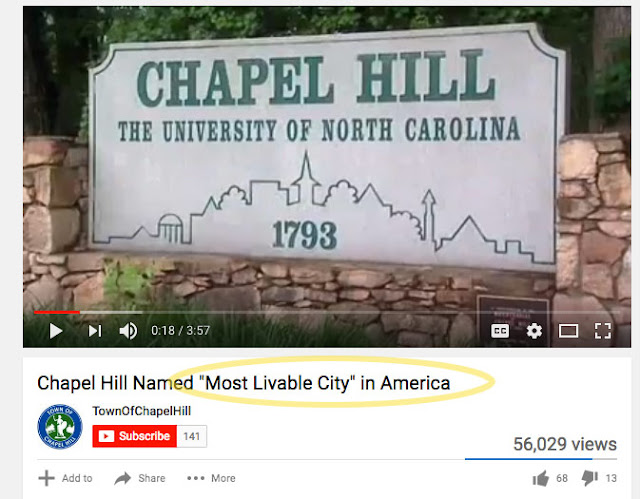
Can We Not with the "Most Livable City" Thing?

When you Google "Saint Paul", the results are clear. Immediately after the name, you see the tagline: "Most livable city in America."

Now, first understand that "official" city mottos are uniquely bad, almost universally so. Minneapolis' "City of Lakes" is about as good as it gets, and things go downhill fast.
  • Bellingham, WA: "Let us Surprise You"
  • Thomasville, NC: "Chair City"

So "Most livable city in America" isn't the worst motto in the world.

But it's still bad. I want to focus specifically here on the word "livable", and what it might mean, deep down inside.

"Livable" is not as bad as some other choices -- e.g. "serene", "Minnesota nice", or anything that having to do with a "village" (!!!) -- but I still don't like it.

Technically "livable" means "fit to live in," but in practice it's more complicated than that.  The Oxford Dictionary lists a few examples of "livable" in context, and you quickly get a sense for how it's used in language.

In practice, the connotations of the word "livable" suggest domesticity, balance, and peace. There is a vague sense of scale, of a rejection of extremes.

Sounds good, but the latent meaning underneath worries me. I read the term "livable" as evolving directly out urban reactionary thinking. Take for example 19th century German social theorist Fredreich's Tönnies' concept of "gemeinschaft", meaning a rural sense of "community." That's a big part of what "livable" means to people, a sense of pastoral social connection that is contrasted against the autonomous anonymous atomization (Tönnies' contrasting concept of "gesellschaft") that comes from modern 19th c. urban life.

From a more contemporary perspective, "livable" is a term that fits right into the anti-urban narratives that were ascendant during post-war America, when so many government policies and cultural touchstones were predicated on a rejection of the old city. Drawing on these kinds of frameworks, suburbanization was tied directly to a latent denouncement of urban life, a turning away from the dirty cities with all their crowds, density and crime.

[A great example of one of these post-war "livability" narratives.]

By contrast, suburbs and small towns were "livable," places "fit" for women and families. Livable places where those where the nuclear family could exist in unthreatened peace, free from immorality in the best and worst senses of the term. (E.g. everything from gambling to booze to miscegenation and racism.)

In that sense, a "livable city" is something of an oxymoron.

(How can a city be livable? Robert Moses shudders at the very idea!)

To be a "livable city" means that you have crafted a balance between urban anonymity and the rural kinship. Again, it sounds good, but this is also the very definition and paradox of suburbia itself! In the end, the term "livable city" is basically a more sophisticated way of capturing the tension between the urban and rural that is synonymous with 20th century suburbia, a theoretical combination of "the best of both worlds" that in practice often has fatal social, economic, and environmental flaws.

This tension is probably one reason why the term "livable" is so confusing. For example, in Saint Paul itself (aka. American's most livable city™), the word "livable" appears in deeply contrasting ways. Witness last night's meeting on the future Ford site, where there were two "livable" groups.

[Everyone pictured here is a "livability" advocate.]
On one hand, you had there the erstwhile transit advocacy organization, Transit for Livable Communities, where "livable" is taken to mean transit-friendly, healthy, and/or environmentally sustainable.

Meanwhile, the grassroots NIMBY organization "Neighbors for Livable Saint Paul" wield the term "livable" to mean just the opposite.

For yet others that I have spoken to, "livable" is literally synonymous with "free parking." For others, it means a living wage and affordable housing. And personally, I would prefer if Saint Paul was the "most walkable city in America." Much of what I consider "livability" begins on the sidewalk.

In one sense, I suppose it's fine to have a city tied to a vague signifier like "livable."  Like the terms "community" or "freedom," it means everything and nothing at the same time, and is thus mostly harmless.

In another sense, however, I'd would prefer if Saint Paul had more meaningful sense of itself, a clearer sense of its values. I worry that the vaguely anti-urban connotations of the term "livable city" is too conservative, in the "looking backward" sense of the term conservative. In the end, "America's Most Livable City™" is too much of a Normal Rockwell Hallmark Card for me.

But that's not even the real problem...

[When people see the slogan on the front page, maybe this is how they read it.]


[I'm telling you, I was livable back in high school!]
No, the main problem with Saint Paul's motto is that it screams of podunk provincialism.

Declaring oneself "most livable city in America" at every opportunity because once someone somewhere named it that on a listicle, is basically admitting that the city of Saint Paul is not a major player in US affairs. It's like saying we're a city in desperate need of validation.

In other words, Saint Paul should follow the first rule of good writing: "show, don't tell." It's great for a think tank or cloying magazine to name you "America's Most Livable City™",  but if you put it in big letters on your homepage for the next ten years, that's a cry for help. It's almost as bad as declaring yourself a "city on the move."

Putting "Most Livable City in America™" on the homepage suggests that Saint Paul is so desperate for attention that it's clinging to a decade-old city ranking like Al Bundy to his high school football career or Minneapolis to its Mary Tyler Moore statue.  In other words, America's most livable city shouldn't have to say so. People should just know about it, feel it, and experience it.
 
In conclusion, here are some other "most livable cities in America." This is an incomplete list.

[Click images for links!]

https://www.youtube.com/watch?v=UaCrMbRidYY

https://jerseydigs.com/jersey-city-most-livable-city-america/

http://www.wweek.com/culture/2017/07/17/portland-is-once-again-the-most-livable-city-in-america-according-to-british-magazine-for-rich-people/

https://www.forbes.com/2010/04/29/cities-livable-pittsburgh-lifestyle-real-estate-top-ten-jobs-crime-income.html


http://blog.al.com/spotnews/2011/06/tuscaloosa_named_most_livable.html


2017-03-07

Parking and Walkability Explainer for Local Businesses

[See the whole thing here.]
There are few things that I find more depressing than when a small, local business in a walkable neighborhood goes to the mat to stop a street safety project. One of the main reasons why I love living in a walkable city is because there are so many small locally-owned businesses. Sharing the joy of walking to local businesses was the main reasons I started this blog in the first place over ten years ago. These great businesses make walking and biking in the Twin Cities worth while.

And yet, it seems like whenever a tough trade-off comes to the fore --  involving bike lanes, bumpouts, bus stops, or parking -- just about every small, local business seems perfectly willing to throw walkers and bikers under the bus and prioritize parking over safe, sustainable streets. It happens time and time again, and it's endlessly frustrating.

The latest example? Mother Earth Gardens, a local garden supply store in Minneapolis' Longfellow neighborhood, is distributing a parking loss alarmism flier trying to stop a bike lane on 38h Street. [Note: This corner was Sidewalk of the Week circa 2010.]  Given the environmentally-friendly name of the store, the irony seems massive to me, sort of like an "Earth First! Gas Station" or a "vegan butcher"... only with actual meat.

What is the reason for this maddening anti-sidewalk tendency?

Part of it is cultural inertia. Part is the conservative nature of small business people who -- especially in a hyper-competitive age of big-box retail -- have to overcome mind-boggling odds to survive. But part of it is that so many customers complain about parking all the time.

Let's face it, the problem is us. We are the parking-addled lizard-brain car-zombies we've been waiting for.

In an era of automobility and easy convenience, nothing brings out our reptilian tendencies like trying to park our cars. Parking can turn even the most ardent environmentalist into a tailpipe-sucking Soucheray. Parking gives birth to our worst selves

That's why I like to imagine a different world. What if businesses tried to teach customers some of the reasons why they should support and embrace more "difficult" parking?

What if each time someone came into a walkable, locally-owned business and said "geepers boy it was so hard to park!" there was an immediate interruption...

*** RECORD SCRATCH ***

... and some sort of "Troy McClure"-type woman popped out of the woodwork and said:

"Oh hello! My name is Anita Walkmore. You might remember me from such films as 'The Life of Pie' and 'Walker: Texans in Nursing Homes'. I'm here to tell you about why walkable, local businesses are different from the suburbs...

[Anita puts her arm around the customer's shoulder]

... permit me to explain," she says, before sweeping her hand in a wide gesture to lead their be-parked customer into a world of sidewalks and small businesses.

I picture small business people having a little flier that they could hand out to parking zombies. The flier would have a "quick and easy parking primer" with a small number of bullet points. It would say "Walkable Businesses Parking 101" on the very top.

It might look something like this:
Walkable Businesses Parking 101
So you parked at a walkalbe, local business...

That's OK! Here are some things you should know.

Did you know? The high cost of free parking
All the big parking lots in the suburbs seem like they're free. But actually they come at a big cost!

Environmentally, big parking lots pollute the earth through runoff pollution and other types of greenhouse gases having to do with construction. Economically, the average parking space in the US costs almost $30,000 per space to produce. That's a lot when you add it up.

By shopping at a walkable store, you're helping to keep prices low, and to stop greenhouse gas and other kinds of pollution.

Did you know? Parking lots destroy walkable neighborhoods


The neighborhood you love dates to the streetcar era, when few people drove cars every day. That's why there are so many old buildings, so close together. That's why this neighborhood is so beautiful.

The walkable urban fabric makes it harder to park. But the more we pave over our urban space to make parking lots, the worse it is to walk around. You can't have it both ways, with easy parking and a walkable neighborhood. The more that we knock down old buildings for parking, the more we erode our city. Let's not even go there!
Did you know? Walkable neighborhoods put vulnerable people first

Many people in our city don't have a car, or are too young or too old to drive everywhere. That's why this local business puts a priority on bike lanes, bus stops, and safe sidewalks... sometimes even more than parking spots.

It's a choice that reflects our values. We believe that everyone should be able to safely, easily get around our city no matter their age, income, or ability.

Did you know? Walking is great exercise

We take good care of our sidewalk. We make sure it's shoveled all winter long and unobstructed throughout the year. We make that choice because we want to thrive in a city full of people walking and connecting with each other, leading healthy lives, enjoying the out-of-doors, and supporting neighborhood businesses.

In short, we really appreciate that you are shopping at our walkable, local business. We might ask you to park farther away -- or even pay a buck or two -- but that's because we believe in a sustainable city that works for everyone.

So thanks! We appreciate your willingness to walk to support a business you believe in.  You are making a difference.

Sincerely,
[your local business]

Would it work?

Not sure, but anything's better than having "Mother Earth Gardens Against Bike Lanes" be a real non-Onion thing that happens in Minneapolis.

[A great walkable corner.]

Update:

From a reader, here is an actual graphically-designed flier version!


2016-12-05

City Signs as a Conversation, the Introduction from my "Signs of the Times" Photo Book


Some years ago I was walking along a street in Saint Paul’s Cathedral Hill neighborhood, when a bit of paint on the asphalt caught my eye.

“POSSIBLE MONUMENT” it read, scrawled as if by an municipal official next to an otherwise mundane street corner. The nearby fire hydrant? I wondered. The curb? The lamp- post? Or the sign referring to itself?

But a monument to what, exactly? What was being remembered?

Signs like this appear all around the city, but most of the time people move too fast to see them. Noticing these small signs, left for the observant and contemplative, is one of the great opportunities of a life spent on the sidewalks, because the speed at which we move changes what we can see.

Moving faster, speeding along in a car or train, the world begins to blur and details disappear. Signs get bigger, elevating themselves to heights far beyond the stroller’s reach. Signs get brighter, flashing and blinking to attract the scattered focus of the digital gaze. Attention becomes a zero sum game, and many small signs fall through the cracks, seen only by slow and steady, a lost language of attention and observation, seeing the city at a pedestrian pace. 


These are not neon, not the storefront marquee, nor the billboard. For the most part, these are hand-written small notes jotted down for a specific purpose, part of a constant interaction between the non-human city -- the walls, doors, poles -- and the constant churn of people. Passers-by, shopkeepers, employees, rabble-rousers, artists, or neighbors putting up small signs for the choice few to notice, many handwritten and hand-placed with care. This unceasing back-and-forth, the remaking and re-writing of the city’s semiotic surface. Signs on signs on poles. Sometimes graffiti (though that’s not included here). Sometimes official signage, sometimes in a lawn, sometimes on a wall. Signs camouflaged or emblazoned like urban insignia on the margins of the sidewalk. Rarely permanent, these signs fade away or fall apart, are taken down or covered up by another. The changing city is the palimpsest that remains.

These days, we live in an era of scant signage. Compared to the pedestrian-paced days, when sidewalks were full of life, the signs inhabiting our cities have become scarce as streets have sped up and blurred. And the more people walking the streets, the more subtle the small signs; New York City and Chicago are full of these. Yet most of the signs in this volume were visible from the sidewalks of Minneapolis and Saint Paul over the last decade, from the period of about 2003 to 2016 (though there are a few notable exceptions from my various wanderings to other cities).

I sometimes dream that a renaissance of small signs is unfolding, as more signs make walking more interesting, and more walking makes signs more worthwhile. In that spirit, I hope you enjoy these signs of the times. On your journey, look for your own signs. Take notice and stock. Signs disappear when ignored. When seen, they acquire meaning and multiply, each, at that moment, a possible monument. 

2016-10-26

My TEDxMinneapolis Sidewalk Talk is On the Air!

This August, I was one of the speakers at TEDxMinneapolis’ annual big show, giving a talk on sidewalks. I’m happy with how it turned out and grateful to the (volunteer) team at TEDxMinneapolis for believing in me and greatly helping shape the talk. I’m also indebted to my friends who gave me crucial feedback. Thank you! 


One of the tricks to putting a talk like this together is making it seem like it’s off the cuff, minimizing the work involved. But in reality, it was a lot of work. I began meeting with my three-person TEDxMinneapolis team back in May, for hour-long sessions where we’d go over ideas, I’d give draft versions, get feedback, and we’d discuss ways to change it. Admittedly, there’s kind of a “formula” for TED talks — personal story, big problem, a-ha moment, pivot to change narrative, maybe some jokes — but it’s a broad formula, kind of like the scientific method meets a thirty-minute sitcom. TED talks can be done well or poorly, and can head in lots of different directions.

When I was researching my talk, and refining the topic, I googled around to find and, to be honest, didn’t find all that much. There’s a good one from Regina, Saskatchewan about kids walking to school, another about having “walking meetings” at work, and there’s a kid from Colorado describing a thousand-mile walking journey. But nothing out there really focuses on the material role that urban design plays in making walking possible, nothing really got at the role of sidewalks and cities in shaping our more personal behavior. 


Delicate Balance

[One of the only two "selfies" I've ever taken.]
One of the ways that the TEDxMinneapolis team really helped me was in reinforcing the idea of balancing a message to make it broadly appealing. For example, the balance between positive stories and negative criticism was an initial focus with this blog, where I wanted to include lots of stories about how great walking can be in the Twin Cities alongside critical analyses of why our streets need improvement. Thus the somewhat-long-lived "sidewalk of the week" feature and all the fun photographs, alongside my usual ranting and sometimes pointed sarcasm.

Getting that balance right is difficult, and it's something the TED people think about carefully. Nobody wants to be lectured about how irresponsible or horrible the world is. People don't respond well to facts and charts lacking personal narratives, or the classic lectures parodied in (the horrible propaganda film) Ferris Bueller.

With lots of help from my consulting team, the talk tries to be carefully balanced between negative and positive tone, personal stories and abstract information, points about the magnitude of the problem balanced with achievable "call to action"-type aims and ends. That's something all of us should think about, and this was a great experience in creating an effective narrative.


Thinking About Audience

The other big thing you realize when doing a TED-type talk is the importance of thinking past your usual audiences. When you start becoming obsessed with a subject, no matter what it is, you can easily become swallowed up bye by the depth of your passion, becoming more narrowly focused on finely-honed concepts or language. As you do this, your audience inevitably both contracts and intensifies, and that's part of the fun of both academia and the internet.

But that kind of distillation of conversation can quickly become an echo chamber with less and less political efficacy. Thinking through a TED-type lens forces you to think about new audiences, people who might have never thought much about sidewalks, urban design, or walking in the first place. That's a very useful exercise for anyone who wants to translate ideas into action, and also a great exercise, in general, for getting out of personal or theoretical ruts.

It's also just kinda fun to memorize a twenty-minute speech, prepare in a "green room" and perform before a large audience who laughs at your jokes. So thanks again to my excellent TEDxMinneapolis team, especially Jasmine, Dustin, and Megan, all the people who came to my practice talk and gave me feedback, and my friends and family to attended the big show.


Enjoy!