2006-07-27

Suburban Urbanism in Chaska

Hot on the heels of my last post about increasing homogeneity and class segregation in US metro areas, here’s something that’s bucking the trend...

In that interview with Kerry Miller, urban sociologist George Galster described two things that can counter market forces that work to increase the homogeneity of neighborhoods: metro-area income redistribution like Minnesotas LGA program, and zoning requirements that require a diversity of affordability in new housing developments.

How is the Twin Cities doing on this front? Not very well lately, but there are few promising signs. Check out this recent Strib Op-Ed on improving the exurban park system, or this Strib story from a few weeks ago on townhouses in the suburbs… both pieces point towards a recent phenomenon: suburban (or "new") urbanism.

Well, here’s another piece of the puzzle. Here’s an article from last week detailing an effort in Chaska that seeks to implement "traditional neighbrhood design" housing in a new development there. Chaska is a small, but rapidly growing town just South of Shakopee and Chanhassen, and they’ve been on the cutting edge of city government involvement. (A few years ago they even built a city-owned Wi-Fi network.)
Something like the complex was always planned for the center of Clover Ridge. As in other new urbanist projects, the idea is to create a bustling "town center" at the heart of the neighborhood. The site is next to a recently built four-story condo building, near a park-and-ride bus stop and across the street from a brand-new Clover Ridge Elementary School.

Peter Musty of the Charette Center in Minneapolis, who helped design parts of Clover Ridge, said the Marketplace would be the one "block of real urbanism" in the neighborhood that makes it all work.

As a "technique for getting people out and walking," the shops will give residents a gathering spot and a destination.

Some residents can't wait.

Four years ago, Megan Schaack moved with her family from St. Louis Park to Clover Fields, a sub-neighborhood of Clover Ridge where houses sit close together on narrow lots -- a typical new urbanist design. "We like the look of it and the way it's conducive to meeting the neighbors," she said.

I’ve seen a few of the “urban” developments in the suburbs, like the one in Saint Louis Park, the mixed-use Village of Mendota Heights, or the “downtown” in Maple Grove. While the New Yorker in me cringes at these consumerist displays of newness, and the pedestrian in me tires at walking through the endless parking lots the ring Main Street Maple Grove, I still think these ”downtowns” are a good thing, and sorely needed in the sprawling burbs.

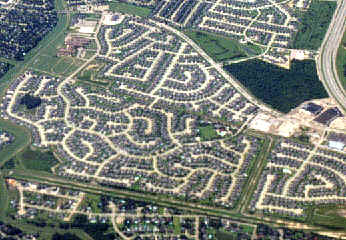
That said, inserting a walkable street into a cul-de-sac-laden sprawl after the fact is pretty darn middling, and it pales in comparison to designing a walkable, sensical city in the first place. That’s why it’s nice to see Chaska thinking of these things in advance.

Here’s an exceprt from a different, more wonky piece on the Chaska development that gets to the heart of why it’s a good idea.

In Chaska, Minn., the first phase of a new traditional neighborhood is making significant strides toward creating residences that start affordable and stay that way. One of four neighborhoods within the Clover Ridge development, Clover Field combines a cost-efficient construction technique and uses a land trust organization to retain affordability while allowing homeowners to benefit and profit from their properties' increasing value. In doing so, Clover Ridge starts to deliver on the city of Chaska's vision of being "the best small town in America" by providing a neighborhood filled with a wide variety of housing styles and types -- and just as many price points.

Over thirty percent of the built-out Clover Ridge homes will be “affordable housing,” which is a very good percentage in a new development in the Twin Cities. Plus, the housing density is almost four times what it is in a “typical” suburb, wherever that is. (Actually, as I’ve pointed out before, suburban townhomes are far more popular than most people think.)

The downside to all this “new urbanism” news is how rare it really is that a new development includes a density and diversity in their housing. Sure the Met Council encourages affordable housing, and has a couple programs aimed an increasing affordability in the suburbs. But compared to a real affordability mandate, like the one they have in Montgomery County, MD, the Met Council can’t create real results.

Without some kind of regulation, real estate market forces are too powerful to resist for most cities – and this leads to inevitable inequalties. As George Galster explains, without revenue sharing or affordability requirements, city governments start competing with each other to attract the wealthiest home-buyers.

The Chaska project demonstrates that it’s not that hard to implement housing diversity if the desire (or requirement) is there.

2006-07-25

MPR on "Apartheid Without Apartments"

A friend of mine cued me in on a great MPR Midmorning show that I somehow missed, on the growing trend of neighborhood class homogenization. Kerry Miller interviews an urban studies professor from Wayne State university in Detriot named George Galster about this trend, and a study he just completed that shows that the Twin Cities is #1 in the nation in terms of percentage of middle-class families.

On the other hand, we're just #21 in terms of middle-class neighborhoods, or (as he defines it) neighborhoods that effectively balance and mix incomes. So, apparently, we're a relatively egalatarian place that manages, somehow, to still segregate people according to class. Please note that I'm not mentioning segregation according to race or ethnicity ...

It's a very good read, and makes a case that the Twin Cities is in a unique position to lead the nation in terms of geographic justice, thanks to the unique governing body that is the Met Council and what's left of our Local Government Aid system. Hopefully, we can get Democrats back in charge of the State Legislature before the GOP further guts both of those important institutions.

Anyway, enough kvetching. I made a very rough transcription of the interview, so you're welcome to listen to the show or browse my hacktastic typing job ...

[rough transcript starting halfway through the show, aka. "the intersting part"]

Kerry Miller: The Twin Cities is number one on your list of places with a middle class population. Why is this area for now bucking this trend?

George Galster: It’s amazing that the Mary Richards stereotype is amazingly true. We were stunned when we found that Minneapolis/Saint Paul had by far the highest percent of middle income (middle class) families with 26%.

However, the Twin Cities is also losing our middle class families. Over the last 30 years we lost our share a little faster than the nation did. We’re losing our head start faster than everyone else…

Kerry Miller: The Twin Cities still has these neighborhoods where the middle class population is living together?

George Galster: Well, actually the Twin Cities wasn’t all that nation leading when it came to middle income neighborhoods. In fact, 50% of Twin Cities neighborhoods we classified as middle income. It doesn’t sound bad, but it was 21st out of the top 100 cities. For some reason, the Twin Cities wasn’t using its #1 ranking of middle-income families in a way that produced middle-income neighborhoods. Why weren’t they distributing themselves across space so that they formed a middle-income neighborhood? Part of the story is that we shouldn’t just focus on middle income families…

Frankly, there are many many middle income neighborhoods that have quite a large share of lower and higher income families. But the median puts them right in that middle range. You may say that the Twin Cities, it may have solid middle class neighborhoods, but it has less than its share of neighborhoods that have both the high and low people living in equal proportions. So that might be an interesting set of discussions for your listeners. The Twin Cities have fewer highly mixed neighborhoods than some of the other cities do.

Caller: Hasn’t this thing with people buying as much house as they can get always been true? Don’t people always want the most house for the money?

George Galster: Well, the variety of housing types seemed to be greater in the past, so that there were a mixture of price points in terms of the houses. And it meant that there was a wider mix of incomes in the same geographic area. That’s what we see differently today. Developers are making large-scale subdivisions of houses at the same price point, people of the same incomes buy into these large suburban areas, and it creates a homogeneous neighborhood. In the past when there were smaller scale developers each developing a parcel here and a parcel there, you ended up with a geographic area with a mixture of house types and house prices. That lead to a mix of people who were simply buying the most house they could afford.

Caller: Developer aren’t the ones at fault. Most planning and zoning decisions set a minimum lot size that is very, very large. So developers, because land is so expensive, because of the large lot size, have to make the houses big and appeal to wealthy buyers.

George Galster: That’s absolutely on target. We have seen that in lots of suburban areas. It is based on the self centered but rational notion that they will be better off if they have a lower density environment with higher income people living there and that means they can force up the price points for the people that live in their community, and that means that they will have a stronger tax base and better public services, and be in a stronger fiscal position and status position. So its not simply developers responding in a free market situation. A lot of communities have put together zoning rules that you could argue are intentionally or implicitly exclusionary of people of more modest means, and developers are just responding to rules that are given to them.

Internet Question: Is this a “keeping up with the Jonses” situation? Where a middle class family is relying on its neighbor for inaccurate lifestyle cues?

George Galster: Actually, what we’re seeing is fewer and fewer examples of people with different incomes rubbing shoulders as neighbors. …

Now, why do communities adopt land use policies that exclude those of modest means? A lot of it is a status thing. If communities attract people of high income, they will become known as a high status community. Fill in the blank with whatever proper name of a suburb that you want to fill in here. And that might be the identity that we’re being pushed right now in a consumer society. If your identity is intimately bound up with where you live, and the name of your community, then I could see that being translated into strong political forces that would want to keep that community as high in income, as high in status as possible. And we’re starting to see the geographic consequences of that. In fact, it’s been very successful. We’re seeing more homogenous communities, where only one income group is living there. Of course it’s only the high-income group that’s doing this by choice, and every other group is doing it out of necessity.

Kerry Miller: What is the clout of wealthy communities in the political process. You’re up there at the state legislature, trying to get your share, and if you have wealth you have more power, right?

George Galster: And there’s a second dimension to that which I view as more worrisome. For what issues are they going to be exerting that power? If we’re talking about a community that less and less has different income groups within it, then the very narrow interests of a higher income group are going to be the message that will be conveyed to those state legislatures. Its not going to be a message of “one for all and all for one,” or “we’re all in this together” because they represent a wide range of income groups… Nope, it’s going to be more of a message of “we’ve got ours, we want to continue to keep ours,” and maybe at the expense of other people in our society. That’s what I’m worried about, that this homogeneity of neighborhoods and political jurisdictions is going to increasingly lead to a politics of selfishness.

Caller: Locally the media and the political process leads to larger houses on smaller lots and increasing costs. Is it affected by the demographics of baby boomers?

George Galster: Good question. I don’t have a good answer to that one. I don’t know whether or not my generation is more willing to live in a diverse circumstance.

KM: There seem to be marketing attempts to bring people of closer income levels into these communities for people who are 60 or 65.

George Galster: I agree that the baby boom generation happened to be the dominant force when all this gated community stuff started happening. I wonder if there is a connection there… that’s a fascination question, I’d like to probe it a bit.

Online question: What about those of us being pushed out because of real estate taxes. We’re not choosing to be segregated by income….

George Galster: The key point to remember is that the kinds of sorting processes that I described earlier as leading to more homogeneous neighborhoods are process that not all households are equally powerful to resist… and are certainly not equally responsible for causing. Sounds like Chad [the caller] is in a situation to react to forces that other people are creating. The upper income folks who can afford the most expensive housing are the most powerful force in the housing market, just like they are in most markets in our capitalist system. And developers and politicians are going to respond to that segment of the market more than other segments. We’re talking about the forces that can lead to gentrification in a core community, or suburban subdivision development.

And if those market forces see that the most profit can be made by catering to development aimed at this higher income segment, that can boost housing prices in the area, but it can also change the quality of the retail environment and all sorts of other things, which can create a much more expensive community which the old time residents can no longer afford to live in. So they’re forced to leave the community, thereby creating a more homogenous situation.

The rest is in comments...

2006-07-24

The Univeristy United Zoning Proposal

Take a careful read of this story in that appeared in the Pioneer Press this weekend, about a neighborhood group’s zoning proposal along University Avenue. It’s an interesting article, and it’ll probably be the kind of debate we’re going to see on university Avenue in the next couple of (pre-LRT) years. I came to a number of conclusions, which I’ll go over one by one.

The PiPress doesn’t’ like activists, loves the Chamber of Commerce (duh!)

I am an admirer of Brian McMahon and University United (the University Avenue transit and walkability community group and lobbying outfit) though they might be a tad too idealistic for their own good. The article is a report on their new initiative, a short-term zoning ordinance aimed at limiting auto-centric development along University Avenue until the city of Saint Paul completes its new zoning overlay.

Unfortunately, the Pioneer Press article explaining the proposal kind of booted the story. And, on top of that, they quoted Saint Paul City Council reactionary Debbie Montgomery, who shows herself to be pretty out of touch.
Emboldened by a new limit on development on the eastern end of Grand Avenue, neighborhood activists are now hoping to redraw land-use rules for St. Paul's less trendy commercial corridor […] planning group University United is asking district councils and city leaders to back a plan that would at least temporarily ban new drive-through facilities and auto-related businesses — hallmarks of the thoroughfare that still typify it today.

Neither use, say community activists, belongs on the future route of the Central Corridor light-rail line between downtown St. Paul and Minneapolis.


First of all, the University Avenue has little in common with the Grand Avenue proposal apart from timing. They have different purposes, time-limits, and targets.

Second, the Pioneer Press story doesn’t really explain much about why McMahon and University United want the ordinance, instead giving lots of column space to Chamber of Commerce VP Ellen Walters and Commerce (and ex-mayor Kelly) supporter CouncilMember Debbie Montgomery. The paper doesn't stop and weigh the economic impact of a used-car lot or a big box store. The paper doesn’t take the time to explain that Saint Paul is working on a new zoning overlay that would guide development along University Avenue toward its future as a light rail corridor, and that the University United proposal would be a stop-gap measure. That's why the newspaper’s characterization of the plan as being “at least temporary” is dead wrong. What does "at least temporary" even mean? Is that the same as "non-untemporary"?

As the University United press release makes clear, the proposal is temporary.

The Pioneer Press has a deserved reputation for being in the pocket of the Chamber of Commerce, which is maybe why the keep losing city circulation to their river-side neighbor. Not to mention the fact that the Chamber of Commerce is responsible for the vacant office space in a dead downtown...

CouncilMember Montgomery loves The Man, big boxes
"The people who live here, they need to be the ones working on a plan," said 1st Ward City Council Member Debbie Montgomery.

New design standards are important, Montgomery added, but they can stand in the way of business.

She alluded to last year's negotiations to bring Best Buy and Lowe's to a long-vacant Metro Transit bus-garage site at Snelling Avenue and Interstate 94. The companies were willing to construct the stores with sustainable building principles and give the locations a "two-story look," Montgomery said, but community activists weren't satisfied because the companies wouldn't build a costly multi-level parking ramp or offer union-paying jobs.

The project, which would have required a complicated land swap involving the Metropolitan Council, lost momentum in part because of neighborhood concerns.

"Nothing seems to be enough," Montgomery said.

Somebody needs to tell Montgomery that there’s a difference between a “two-story look” and two stories (e.g. the "two-story" CVS pharmacy on Snelling and University).

That Montgomery would be defending last year’s ill-fated Best Buy/Lowe’s development tells you a lot about where she’s coming from. I still don’t know what’s going to happen to the Snelling bus barn site, but the city dodged a bullet when that they didn’t turn it into another suburban big box.

Montgomery also confuses University United with labor unions that are pissed off because the City of Saint Paul hasn’t followed through on their promised living wage ordinance.

Admittedly, Montgomery is old … but she seems really out of touch to me. I attended last year’s meeting about with the new Super Target development near University and Hamline, (and here’s my write-up of the meeting). At the meeting I saw Montgomery coddling the two Target P.R. men (both of whom were named Bob), and badmouthing the District Council people who like the University United plan. She said things like “they don’t understand that there’s no money,” which is true, but she clearly didn’t like neighborhood groups opposing new business development.

The Central Corridor project is fraught with racial tension

In the article, Montgomery also makes the comment that “the people who live here, they need to be the one’s deciding on a plan.” It seems like she’s playing the race card with that comment, as if Brian McMahon or University United board member Randy Schubring don’t live close enough to University Avenue to have a say in what happens there. Is she suggesting that we put Lucky Rosenboom in charge of zoning?

But, really, Montgomery is just re-fighting the old Rondo Avenue battle all over again. (Here is Peter Bell’s defense of the LRT corridor vs. what happened to Rondo when I-94 went in.) The Central Corridor isn’t another Rondo, it’s the anti-Rondo. No buildings are going to be leveled because of the train, but people in the poor neighborhoods along the corridor will get much better transit service and see their neighborhoods improve economically, aesthetically, and it’ll be safe to walk down the street at night again.

But, even though Montgomery is out of touch, her logic meshes with a lot of things I’ve heard from African-American and Asian-American people who live in the neighborhood. This is just another gentrification battle, andfFrankly, even if gentrification was a real phenomenon, University Avenue is probably fifty years from being gentrified. The only thing minority business owners need to fear is the year-long construction period.

How much influence do District Councils have in Saint Paul?

While Mayor Chris Coleman doesn’t really owe anybody for his huge victory over Randy Kelly, he’s been quite friendly to the District Councils since he’s taken office. Just like in Minneapolis, it seemed that neighborhood groups were starting to have some influence down at city hall, at least when it came to development issues. Coleman has held a number of successful community meetings, involved the public, and been a strong supporter of the popular smoking ban.

But the recent middling decision on a Grand Avenue zoning ordinance, and Coleman’s (and the City Council’s) waffling on a living wage ordinance, has made it seem like Saint Paul’s grassroots momentum is slowing down.

I’m not sure yet if all parts of the University United plan are a good idea (more on this later), or whether (once again) the group is advocating for pies in the sky. But in this debate we can see the power dynamics of the capital city at work.

2006-07-14

*** News Flash *** #2

The top story is the Saint Paul City Council's recent decision not to go ahead with restrictions against chain stores along Grand Avenue. Instead, they adopted much weaker size restrictions on new buildings.
But whether rents and taxes would be affected by capping building sizes is debatable.

"I don't think that a size cap is going to make the problem worse; I just don't know that it's going to make it better, either," said Stacy Mitchell, a land-use consultant with the Minneapolis-based Institute for Local Self-Reliance.

She also said a 25,000-square-foot cap is hardly limiting — many well-known chain stores could fit in that size building.

"In San Francisco, where they're doing this in a number of neighborhoods, a lot of the limits are 4,000 feet or 6,000 feet," Mitchell said.

[PiPress]

Last year the City Council, along with the Summit Hill Association had discussed a much more stringent limitation of "formula businesses" or chain stores along the Eastern portion of the street. While it might make some corporations unhappy, such a move would have been very popular among residents and small business owners along Grand Avenue. It's only speculation, but a chain store restriction might have had the additional benefit of actually doing something to limit property tax increases while also maintaining some of Saint Paul's retail divserity and localism for the forseeable future.

But apparently the City Council didn't have the votes or willpower to again strong-arm the Chamber of Commerce (who would have been against such a plan). Instead, we get a zoning restriction that's largely meaningless.

********************************************

A similar kind of zoning issue is taking place up in Maple Grove, as their City Council is debating whether or not to limit new construction of townhouses.
The proposed rule would limit townhouses to just 10 percent of any housing development.

It would affect much of the city -- areas zoned for lower density housing of 1 to 3.5 units per acre -- but not those zoned for medium- and high-density.

Thousands of townhouses have been built in Maple Grove in recent years. Over the last 10 years, when 7,200 housing units were built in city, 46 percent were detached, single-family homes, while 54 percent were attached townhouses. But in the past four years, 68 percent of new housing has been townhouses.

[Strib]

I don't often talk about the suburbs (because I usually hate them), but one of the few nice things to have happened out in the burbs in recent years is townhouse construction. People seem to like them, and they make a lot of sense given that most people don't live in nuclear families any more.

So seeing some sort of reactionary move like this gain such traction is kind of disappointing.

********************************************

On the other hand, the Strib reported on this far-seeing move by the city planners in New Brighton and Arden Hills . . . they're planning ahead for transit.

It’s still early in the process, but the cities are trying to preserve about a mile of rail line with 24 acres of surrounding right-of-way for a future transportation corridor.

"Now's the time to incorporate planning before the areas get totally developed," said Matt Fulton, the former New Brighton city manager who recently became the Coon Rapids city manager.

[Strib]

I haven't heard the New Brighton/Arden Hills/Roseville area mentioned in regard to a possible LRT line, so this is thinking pretty far into the future.

********************************************

Meanwhile, out in the wide world, oil is at an all-time high, according to this story on the Bloomberg wire.

I just filled up the car I'm borrowing and it cost me $44. If I were to do that regularly, I might have to get a real job . . .

********************************************

The Bunge grain elevator, the Dinkytown landmark where my firefighter friend had to drag away the body of a fallen teenager last year, was sold for housing a few weeks ago.
The Cabrini Partnership and Project for Pride in Living will build affordable housing on the site at 13th Ave. SE, reports Elizabeth Cook in The Minnesota Daily. The development will feature rental apartments as well as five Habitat for Humanity homes and other single-family housing.

Construction is scheduled to begin in September or October and should be completed by the end of the year.

[MplsObserver]

Combining affordable housing, historic preservation, and getting a notoriously dangerous spot off the radar is a lot of birds with one stone. I wonder if there was any city money involved in this?

********************************************

The Hiawatha LRT is having some maintenance done this weekend, and will be closed on Saturday night until Sunday morning, according to this story in the Strib.

I don't understand why whoever plans the LRT hours doesn't take into account the fact the people at bars might want to ride it to their houses (or parked cars) after the bars close. Why do the work on Saturday night instead of Sunday night, when many fewer people would be using it?

For that matter, why does the LRT stop running right before the bars close, instead of right after? Aren't they aware that the Warehouse District is a popular late night spot?

********************************************

Finally, the recent problems with the Big Dig in Boston point to the difficulty inherent in large engineering projects. Admittedly, the Big Dig is the largest urban engineering project in history, but doing anything at the street/building/freeway scale is difficult. It would be no small task to cover up I-94 at Nicollet Avenue, to connect Eat Street with downtown . . .

2006-07-13

The Strib [Hearts] The Burbs

In their attempts to appeal to suburban readers the Star Tribune does a lot of things which, from my point of view, seem stupid. But their recent article in defense of cul-de-sacs really takes the cake.

Here’s a representative sample:
Like many suburban families, the Aasens prize how quiet and child-friendly their lollipop-shaped street is. But not everyone shares that affection. In Minnesota and across the nation, concerns about traffic congestion and increased road maintenance costs are causing a growing backlash against these icons of suburban life.

Local governments across the country, including some in Minnesota, have passed zoning ordinances to limit cul-de-sacs. In Oregon, which embraced "smart growth" land-use concepts decades ago to combat sprawl, 90 percent of the state's cities have ordinances limiting new cul-de-sacs.

Minnesota cities are more permissive, but some are also taking steps to limit new ones. City councils in St. Cloud and Northfield, for example, prefer to routinely deny new cul-de-sacs unless there is a physical necessity for them.

The problem with this quote is that it really soft-pedals the criticisms of the cul-de-sac. The Strib claims that “Smart Growth” advocates don’t like the dead end streets because it’s hard to plow them.
An oft-cited concern with cul-de-sacs is that they often result in overly congested connecting streets. All those cars from neighborhoods of dead-end streets have to go somewhere, critics say.

But traffic isn't the only concern. When Josh Tenney, a 27-year-old truck salesman, moved into his "sweet little" cul-de-sac in the northern suburb of Hugo two springs ago, he never once thought about winter.

"Where does all the snow go? Spread across all the yards," he said. "Where does the sand and salt go? Spread across the yards. Where do all the rocks, gravel, and winter trash go? You guessed it, spread across the yards."

While I appreciate the particularly Minnesotan cul de sac criticism, being hard to plow is just the tip of the snowdrift when it comes to culs-de-sac and their problems.

Here’s three big reasons:

  1. They’re a pedestrian wasteland. Culs-de-sac, and the sprawling, disordered, difficult to navigate neighborhoods that follow them, are too non-linear to easily have sidewalks. Even if they had them, it would be too difficult to walk anywhere, and the lack of any commercial streets mean there’s nowhere to walk anyway. For a country facing an oil-induced energy crisis, this is a problem.
  2. They can increase traffic congestion. Because culs-de-sac aren’t through streets, they force all the cars onto one or two main drags. Increased traffic levels often mean congestion, and without any alternative routes, there’s nothing PO’d drivers can do about it.
  3. Culs-de-sac aren’t safer. At least one study has shown that the “quiet and child-friendly” cul-de-sac is statistically more dangerous. Parents, constantly forced to back out of their driveways, are very likely to back over one of their own (or their neighbor’s) children. In addition, the lack of regular traffic (or neighbor’s windows) on the street makes it more likely for a burglary to occur.
Next time the Star Tribune weighs in on sensitive urban planning issues in the Twin Cities, they should have a fewer quotes from the Toll Bros. marketing department, and more real information about why traditional neighborhood design makes sense.

For a much better article on the cul de sac, see this NPR story.