Showing posts with label old people. Show all posts

2020-04-13

Quick Thoughts about Industries That Worry Me, or Don't

[From the Star Tribune video of empty streets.]

Mulling around in my mind are the medium-term impacts of COVID-19 and the changes of people's behavior that will stick with us, even if COVID-19 fatality tapers off.

I am thinking here not of the next month or two, but of the next year or two, i.e. until there is a widespread, effective vaccine.

What am I missing?

(In no particular order)

Tourism/Hospitality - Probably the worst hit industry, especially for international travel.

Airlines - See above.

Retail - So much shopping is moving online, how will that affect retail in general? Probably quite a lot. Hopefully, smaller local shops can remain afloat.

Transit - It's so important that people take transit again, but how will people feel comfortable sitting a foot from a stranger? It should be possible, but I don't see it happening easily. I'm very worried.

Theater/Music - For live performance, it sort of depends. Theater might be OK, but many theaters or concert venues rely on older audiences. OTOH, places like First Avenue or any venue that is not seated is going to create a ton of anxiety for people, packed onto a dance floor for example.

Restaurants/Bars - Short-term, these are hurt a lot. But I actually think restaurants and bars can come back fairly quickly with some changes put in place. OTOH the business is so marginal already...

Food Trucks - They are events-driven. Without events, many can't survive.

Universities - Enrollment will be down a lot, especially for international students. This was already happening to some degree, but expect hiring freezes and for schools that were already struggling to get be worse off.

Catering/Events/Weddings/Funerals - I don't see how big events continue, especially multi-generational events with lots of folks traveling. They'll have to get smaller and change.

Festivals/Fairs - See above.

Night Clubs/Dancing - Seems bad, but at least young people are relatively invulnerable, I guess. Say goodbye to square dancing at the Eagles Club or Tapestry Folk Dance center, especially since their patrons are often older. When will it feel OK again to hold hands with dozens of strangers?

Seniors in Groups - Places that have moved past the epidemic stage seem to be maintaining restrictions and extreme caution for older people, who are by far the most vulnerable. Any kind of group activity for older people is going to be severely impacted.

Museums - If older people stop going to events, that would be bad for museums. So many museums rely on seniors, and seem to have doubled-down on events as a key part of their business model.

Sports: Spectator and Participation - I think it won't be too long before TV-only spectator sports return. They'll figure this out. That said, some sports are better than others. Crowds at stadiums, though? When will that happen again? Years from now?

Political Organizing - How do you door knock or hold rallies? Yet, people want to talk on the phone and have plenty of time to write emails to elected officials.

Churches - Mostly older people in close proximity, hugging and maybe even putting their hands near each others' faces? Seems bad.

Cruise Ships - Good riddance.

2017-11-09

Even Four Years Later, Minneapolis City Council Still Getting Younger

[CM Gordon is now the oldest elected person at City Hall.]
Four years ago, after the Minneapolis City Election dust had settled, I did a quick analysis of the results and pointed out how there had been a big generational shift at City Hall. With a big influx of under-40 Council Members taking over for older folks, the "average age" of the fourteen elected officials went down that year from 54 to 42, a drop of twelve years. That's about as big a "generational shift" as you can get, especially if you are keeping half the incumbents around.

Here's what I wrote at the time:
Age isn't everything, of course, any many of the incumbents are "young at heart." But sometimes age is important. As everyone who has ever had parents knows, there are big generational differences about the importance of computers, cars, "quality of life", etc. It'll be interesting to see how and if Minneapolis starts to "act younger" with its decision-making as the new council takes the reins.

Well, despite everyone being four years older than they were four years ago, this year's results only continued that trend. Two new council members are under 30, the new mayor is under 40, and here's the updated chart:


(Note: I do not have Jeremy Schoeder's age in here yet. I have reached out to him and will add it when I can.)

For the record, the median age in Minneapolis is 33.7.

That's only part of the picture. The other, much bigger deal, is that the City Council has become more diverse. On one hand, the city's gender parity is gone, and that's disappointing.

On the other hand, there is a big increase in people of color and non-cisgender representation. That is huge.

Here's David Brauer's summary:

https://twitter.com/dbrauer/status/928381811511541761


Especially when compared to eight years ago, there's been a visible change in the political and power dynamics in Minneapolis City Hall. In an era when cities are under attack on all sides from other levels of government, engaging younger people and historically disenfranchised groups in local politics is a great sign.

2017-09-26

8-80 Cities versus 16-80 Drivers

[7-yr-old and 91-yr-old, hit by cars on the same day this month.]
I have been driving more often lately, borrowing my girlfriends' car to run errands. As I’ve described on this blog before, whenever I'm driving in a city, I try to actually drive at-or-below the speed limit.

(Yes, you read that right.  That means, that I drive 30-35 miles per hour on Cretin Avenue or West 7th Street, for example. Or below 30 on my own George Street.)

As you can imagine, thanks to our too-wide and too-forgiving city streets, I almost always find someone riding my bumper.

The other day, driving around the West 7th Street area it happened again.  I’ve gotten kind of used to tailgating at this point, and I ignore the social pressure of the car behind me. (Or "the flow", as LarsChristiensen once called it.) It’s rather a mild annoyance, less annoying than when you’re bicycling down Rice Street and someone throws their garbage at you, but about equally annoying as the construction signsplaced in the middle of the bike lane on the Wabasha Bridge.

At any rate, I was surprised the other day on West 7th Street when I caught a glimpse of the tailgating driver: it was a the proverbial little old lady, peeking over the steering wheel, hair as pure white as an audience at a Trump rally.

I shouldn’t have been surprised, I suppose, but I found the sight depressing. In Saint Paul, even the little old ladies are speeding as fast as possible through the neighborhoods.

8-80 Cities and Driving Culture

One of the best bandwagons that Saint Paul ever jumped upon was the Gil Peñalosa “8-80 movement”, a call-to-action for cities to take street design seriously, and to focus attention on people at the youngest and oldest parts of the aging and mobility spectrum. Peñalosa’s key argument is that, if we design streets where 8-year-olds and 80-year-olds can safely walk, bike, and get around, then we have a city that will work for everyone.

That’s why it’s frustrating to see the proverbial octogenarian speeding, driving dangerously, and riding my ass. We’ve created roads and an entire urban landscape that revolves around driving, all throughout one's life from 16 up to age 80. But I worry about a future that combines aging, diminished perception, and our drive-everywhere culture with attempts to promote active living.

Designing streets that allow people with a wide range of capacities to drive everywhere comes at a cost.  If we make it easy for a distracted teenager or mostly-deaf grandfather to speed around, it makes it impossible for your 10-year-old kid or your great aunt to walk to the store. The same wide streets, big parking lots, and turn lanes designed for tailgating make it all-but-impossible to cross the street. In short, streets that are forgiving for “16-to-80 drivers” come at the expense of “8-80 cities.”


To make matters worse, often during street design debates, the proverbial “little old lady” is raised up as an excuse for not building safer crosswalks or keeping parking spots. This happened during the Ramsey County debate around a 4-3 road diet on Dale Street, for example. From what I heard about the conversation, the "little old ladies" going to church needed once-a-week parking, so the county didn’t improve a deadly 4-lane death road through a walkable neighborhood. Instead of a safer road that would have had slower speeds and fewer conflict points, we kept the one without safer intersections and without shorter crossing distances.

Especially given how important staying active is to staying healthy, particularly as we get older, can’t there be another solution?

I am really interested in hearing from older Saint Paul folk about whether they see this as a problem, and what the solution might be. In Saint Paul’s ongoing comprehensive planning process, there are a bunch of ideas for how to adapt the city over the next decade to be a better fit for older people.

Note: I learned that “aging in place” is no longer the best way to phrase this; “aging in community” is better, because it gets at a more active, social, and vital sense of what it means to be aging.

Here are a few slides from a recent presentation to the Planning Commission with some of the idea from the draft chapters of the upcoming Comprehensive Plan. (See also, a recent Saint Paul study entitled "Reframing Aging: Opportunities for Aging in Community" that covers all of this!)

To me, the transportation components are particularly important. Can Saint Paul figure out a way to create streets that allow people to walk safely, no matter their age? Can we change our assumptions about driving at the same time? Or is there no way to reconcile “8-80 cities” with “16-80 drivers”?


Update:

All hope is lost.

2017-09-14

An Open Letter to Charles Hathaway

[This is in response to a letter to the editor in the most recent Villager, pictured at right.]

Dear Charles:

We've never met, but I read with a mix of interest and anxiety your recent letter in the Highland Villager. In it, you castigate a "small group" of younger people who "jeered" at "what these old people built" during a recent meeting on the Ford site.

As a obsessive student of Saint Paul history, I was initially put off by your condescending tone. As I have done many times during the Ford site debate, I rolled my eyes and looked away.

Yet later I realized we might have something in common. Despite the fact that we disagree on the merit of the city's plans for the Ford Site  -- I have called them "the best thing I've ever seen Saint Paul propose, anywhere" -- I see common ground.

In your letter, you describe the rich social connections that people have built over the years. You list things like PTA meetings, coaching baseball, gardening, attending funerals, and donating used clothing to frame what you see as a lack respect for older folks living in Saint Paul.

I, too, value of these kinds of social connections. When I think of the word "community", it is precisely these sorts of relationships that spring to mind. I love the weak ties of recognition that come from knowing one's neighbor, and I value the strong ties of kinship that come from sharing institutions like schools, churches, libraries, or even the neighborhood bar. (There are too few of these in Highland, by the way, but that's another story!)

However, I think there's something important that you might not yet recognize. I'm guessing you're in my parents' generation, born sometime in the mid-1950s, give or take a few years. That was right in the midst of the post-war baby boom generation when Saint Paul, and indeed all US cities, experienced rapid change.

Memories are a fickle thing, but in my research over the years, I am always amazed when I'm reminded how much denser and more populated Saint Paul used to be. In the 50s and 60s, our city was much more full of people. Streets were narrower. Higher percentages of folks took transit every day. People walked a lot more! And on average, every house in Highland -- and all through the city -- housed more people than they do today. Instead of 1, 2, or 3 people living in a single-family home, when you were born, there might have been 2, 4, or 6 people sharing the same space.

Just like you, I look back on those times (weirdly, before I was born) and think fond thoughts. I like to imagine Cleveland Avenue, Saint Clair Avenue, or a dozen other streets when there were a hundred local shops, foot traffic all day, and a rich world of street life. That seems wonderful to me!

The problem is that, since the 60s, public space in our cities has eroded. Instead of homes and shops, we have parking lots. Instead of big families, we have houses with only one or two people (and their pets, of course). Much of the time, instead of connecting, people watch TV, or stare at their phones. (See? I sound like an old crank!) The point is that the social propinquity that we both value has been changing for a long time.

What do we do?

On this we likely won't agree, but for me, a big culprit of this change is urban design.

I've talked about this before, but when we're swallowed up by private homes or driving around in our private cars, stuck in traffic or speeding past, we become the least common denominator of our social selves. In our cars, we have little way of communicating apart from a honking horn, a revved engine, or a turn signal. In our disconnected homes, with their quiet front yards, we have little way to engage apart from lawn signs. (Witness Highland these days!)

Instead, we spend our time inside private bubbles, driving or holed up in dens. We listen to private soundtracks or (worse) some idiot ranting about "garage logic." Meanwhile, Saint Paul's sidewalks, shops, and public spaces are frayed by vast parking lots, speeding cars, and the march of privatization. Meanwhile, Saint Paul continues to lose the density and social connection that made it a vital place.

If you don't believe me on this last point, I'd urge you to check out the sociologist Robert Putnam's book "Bowling Alone", about the what he calls "the decline of social capital."  Putnam's social capital is precisely the kinds of relationships you describe in your letter. He shows that, since the World War Two generation (your parents), it's been disappearing. And one of the main culprits is our driving habit.

Putnam summarizes the causes for the decline like this [emphasis mine]:
First, pressures of time and money, including the special pressures on two-career families, contributed measurably to the diminution of our social and community involvement... Second, suburbanization, commuting, and sprawl also played a supporting role... Third, the effect of electronic entertainment - above all, television - in privatizing our leisure time has been substantial... Fourth and most important, generational change - the slow steady, and ineluctable replacement of the long civic generation by their less involved children and grandchildren - has been a very powerful factor.
I encourage you to read the whole thing, or at least skim through the charts about picnics and Shriners' clubs. And by the way, it might surprise you to read some of the data on the Millennial generation. They are more interested in civic engagement and social connection than anyone has been in a long time.

The point is that I believe the city's plan for the Ford site matches our future needs and will strengthen the social fabric in Saint Paul. If Putnam is right, we need less "privatized space" and more everyday public space in which people can connect. If we want to keep the kinds of social ties and connections that you and I both value, we need less orientation toward cars and more social forms of transit and transportation. We need opportunities to walk around and encounter the diversity that Saint Paul has to offer. And most importantly, we need better housing accommodation for smaller households. Only then will we welcome the people who will become the next generation of PTO members, community gardeners, soccer coaches, and urban stewards.

In short, Saint Paul needs density. Building a neighborhood for the future can help Highland return to to the rich and dynamic social fabric that it had back when you were growing up.

Given how poisonous the debate has been over the Ford site plans so far -- I had to walk out of the recent church meeting because I could not tolerate the hostility coming from many of the "Say No" people -- I don't expect you to agree. I only hope others might read this with open minds and hearts. I hope Saint Paul might see a possible future for people of all backgrounds. I hope we can value what walkable streets, fewer cars, and more diverse kinds of homes might offer for our community.

I want to see our cities change, but I'm not trying to erase the past. On the contrary, in many ways, I want to return to it. I want those relationships we both value to thrive. I want a city where gardening, volunteerism, civic involvement, and small businesses flourish. I want a city where traditions are both honored and created anew, transformed for a future that includes the full diversity of Saint Paul's children. In the city to come, they will accomplish things greater than either of us can imagine.

Sincerely,

2016-02-08

Why I Love the Green Line: an Open Letter to my Fort Road Neighbors

[A car-choked street.]
Hello neighbor.

I live across the High Bridge from you, and spend a lot of time in your neighborhood. Plus, I take the bus and train an awful lot. Just wanted to drop a line.

Look, I get it. Many of you vividly remember the debate over Riverview transit back in the 90s. And you were right! Widening the street by 4' would have been a bad move back then, and would be a bad idea today.

But this is the year that Saint Paul's leaders, and that includes many of you, are going to make a huge decision about a transit line along the Riverview Corridor. It’s the kind of thing that, once made, is almost impossible to change.*

[A poll from a neighborhood Facebook page.]
There’s a lot of debate in the neighborhood along West 7th Street, or "old Fort Road." Many people have been very vocal about not wanting to see any rail on West 7th. And some people I’ve spoken to have said that the opposition from business leaders and community groups is so strong that planners are considering bypassing the 7th Street neighborhood in favor of a route along the river.

Alternately, some people would prefer a bus rapid transit investment that would minimize impacts to  today’s car-centric street designs (parking, higher speed travel lanes, difficult pedestrian crossings).

Personally, I think either of those two options would be a huge mistake. Bypassing West 7th Street would leave thousands of people out in the cold, and waste Saint Paul’s best chance to build a great transit city.

[Riverview doesn't have to look like this Green Line station, but the idea should be the same; give people secure, pleasant places to take transit.]


For me, a lot depends on how you feel about the Green Line. Reading through the neighborhood comments over the past month or two, I've noticed that many people seem to think that the Green Line is a failure. Or that it's too slow. Or that it's ruined University Avenue.

My experience is just the opposite. I take the Green Line (from end-to-end) all the time, once or twice a week for over a year now. When you spend time actually riding on the train, it changes your mind.

[Putting a bike on the bus rack.]
See, when compared to riding the bus, the Green Line is amazing. When you sit and watch the people around you, you see relaxed, comfortable folks. They might look bored, yes, but they're allowed to move, sit, and travel through the city without a car, but with respect.

Rolling up in a wheelchair, or with a stroller, or with a bunch of shopping bags, or with a cane, or with two kids, or with whatever burden you carry, the train is just so much better.  You can see a measure of relief in the faces of the thousands of people from the diverse Frogtown, Hamline-Midway, Downtown, and University-area neighborhoods trying to get around.

Even though we have a decent transit system, riding the bus around the city can sometimes be a disheartening experience. Stepping up over snowbanks, huddling in a shelter, scooching through cramped aisles, struggling to put your bike on the front rack...

Don’t get me wrong, taking the bus is a perfectly fine way to get around, and I often do it myself, but a predictable smooth-running train with level boarding and plenty of space is a huge step up in the quality of life for everyone on board. It's a sign that our city is treating the transit-dependent, the elderly, the young, the poor, and anyone else who wants to shed some car trips with some much deserved dignity.

[A pretty full Green Line car.]
That's important because Saint Paul is a diverse city with many of areas of concentrated poverty. Over 40% of our 280,000 people are people of color. Over half of the people living in the West 7th neighborhood rent their home. 35% of neighborhood households make less than $35K a year. Yet all through Saint Paul, and all though this planning process, almost all the people making decisions around the table are white owners of homes or businesses. This isn't to cast blame, but just to point out that lots of people are being left out. What about them?

Don't get me wrong. I have questions too. There tons of details about exact routes, modes, and design decisions still on the table. (Check out my suggestion for one possible route that would serve huge parts of the West 7th and Highland neighborhoods without having major impacts on parking or car travel on 7th Street).

[Wheelchair, guy in the companion seat, bike rack on the Green Line.]
By all means, people in the community should be debating how best to design and build rail transit in this corridor. Can a streetcar-style vehicle work? Should we use the Ford Spur? How do we get across the river? What are the trade-offs between stops and transit speeds?

But bypassing all the people whose lives would be meaningfully improved by a major transit investment would be a disaster. That’s what they’re doing with the two Minneapolis rail lines, skipping the heart of the city. And it’s a shame. Saint Paul should do better.

Try the Green Line. Take the bus. Think about who lives here, all your neighbors, not just the ones who show up to meetings.

The future of the Fort Road neighborhood depends on what choices we make this year. Let’s give our transit riders a great future.

See you on the sidewalk.

Yours truly,
Bill


[A man with a cane and an unleashed dog crossing West 7th Street.]


[Guy on the Green Line with an elaborate wheelchair setup.]

[Riding the Green Line on Halloween.]

[Two wheelchairs / scooters on the Green Line at the same time.]

 
[Guy hauling U-Haul boxes, bike (not his) on the Green Line.]


[Folks looking out Green Blue Line windows.]

[Riding the Green Line on a December evening.]

[Riding the Green Line on a December evening.]

[It's time to "level up" the bus.]

* In 2010, Hennepin County SWLRT planners decided for the 3C alignment down the Kenilworth Corridor instead of going through uptown. It was the wrong decision, but there’s nothing anyone can do about it now.

2015-12-21

Old Joe Soucheray Reads "How to Repair Your 10-Speed Bike" by Young Joe Soucheray

[This is a real book.]
I spend as little time as possible thinking about Joe Soucheray, for the same reason that I dislike cleaning my toilet. But when someone told me that the famously-automobile-centric anti-everything grouch had written a book about bike repair, I was floored. It turns out, Soucheray's first career, before becoming Saint Paul's version of Jabba the Hut, was to write pre-teen books about sports and bikes.

So I ordered myself a copy of the 1979 Creative Education Soucheray classic, and here it is, as I imagine it being read by the current ridiculously ornery version of its author.


Young Joe Soucheray: You must frequently use tools or your father wouldn't always be asking you where they are. And you have to admit you did leave the pliers and wrench down at Dave's house where you were trying to fix HIS bike.

Old Joe Soucheray: Kids today! They steal stuff all the time. If any kid gets near my garage, they know which end of the shotgun I'll be holding.

And these bicyclists are the worst of all. You see these bicycle gangs running around Saint Paul, stealing things from garages, terrorizing the minivan-driving moms just trying to bring their bike-free kids to school. Not on my watch. Next time I see a biker gang stealing things from innocent garage owners, my SUV bumper is going to have a thing or two to say about that.


Young Joe Soucheray: Actually, 10-speeds are perfect examples of form following function. They combine the economy of lightweight and selective gear ratios to give the rider the most efficient use of his pedaling power regardless of terrain -- from city streets to dirt country lanes.

Old Joe Soucheray: The bicycle is a menace to the innocent taxpaying driver. If bicycles are so great, why do these spandex hypocrites with their Italian leotards that look like the labels on olive jars keep breaking the law, taking over the road, and preventing innocent minivan moms from bringing their disabled nephews to the hospital? Bicycles are a relic of history, like elevator operators. Just the other day a mom that I know had to hit the brakes because a bicyclist who looked like a tangerine tried to turn. When will the city listen?


Young Joe Soucheray: And the derailleur! Derailleur is French word that means "Don't you dare come near me with a tool." The derailleur, of course, is all that gobbledy-gook at the rear wheel hub, where the small sprocket connects to the big sprocket and the big sprocket connects to the chain.

Old Joe Soucheray: Speaking of gobbledy-gook! What have the French ever done for anybody? They're a bunch of lazy snobs living off the government, they don't even have a word for "entrepreneur." Anything French needs to be voted off the island, beginning with these fancy Italian bicycles with their clown hypocrite riders, who are all lawyers with two cars waiting for them in the garage. If I had to describe this weenie little bike part, I'd called it a "Freedom gear," because the last thing you'll find coming out of my mouth is French.


Young Joe Soucheray: Now that you have your tools, don't get excited. Always remember never to fix anything unless it barks, screeches or goes clank in the night.

Old Joe Soucheray: If you want to hear some barking and screeching, just stop for a second and listen to the roar of the people when the big government at City Hall proposes another "traffic calming" bike lane!

Traffic calming? More like traffic enraging. Destroying small businesses and minivan-moms with six kids just trying to survive while City Hall is taking their taxes, and ruining the streets with more bikes. If you hear something going clank in the night, it'll be me hitting the next Italian jersey wearing hypocrite bicyclist I see with my car.


Young Joe Soucheray: However, it still goes flat. Don't worry, though; you can fix it. Start by looking for a nail or a sword or a tree trunk which might be causing the flat.

Old Joe Soucheray: A sword? Why didn't I think of that. I've been slashing bike tires with my trusty pocket knife, but a sword would be a lot quicker.


Young Joe Soucheray: Once you have changed and repaired a flat tire properly tell your father you want to go to college at M.I.T. He'll know what you mean.

Old Joe Soucheray: M.I.T.? Liberal elites. Over my dead body.


Young Joe Soucheray: Now for the understatement of the year, or at least the understatement of this book. Brakes are important. They are so important that you must check them carefully and often -- before every major ride.

Old Joe Soucheray: If bicycles have brakes, it's news to me. I've never seen any of those Italian racing suit tax-dodging hypocrites with two cars back home in the garage use them. It's the poor minivan-moms with seven kids who have to brake for these biker gangs destroying small businesses one bike lane waste of money at a time. Next time you have a biker in your sights, if you forget to hit the brakes, I forgive you.


Young Joe Soucheray: Cycling is a unique sport. Every time you cycle you are getting the same benefits that walkers and joggers receive, but you are traveling at your own pace, seeing more and hearing more. Any machine that can provide that for you is worth taking care of.

Old Joe Soucheray: These hypocrite bicycle people believe in nothing but their own egos, and in wasting your precious tax money by destroying everything we love about Saint Paul. Don't get me started on these joggers. Get the hell out of my way. How loudly do we have to yell?

Who wrote this socialist propaganda anyway?

2015-10-19

Reading the Highland Villager #140

[Highland Villager: Special Boomer Edition, comes with free parking protest flier.]
[Basically the problem is that the best source of Saint Paul streets & sidewalks news is the Highland Villager, a very fine and historical newspaper. This wouldn't be a problem, except that its not available online. You basically have to live in or frequent Saint Paul to read it. Until this newspaper goes online, sidewalk information must be set free. See also: Three Reasons Why I Re-Blog the Highland Villager.] 


Headline: Opposition grows over city's plan for parking meters on Grand Avenue
Author: Jane McClure

Short short version: Article begins "time may be running out for those who are opposed to installing parking meters..." [which is kind of witty; if only they had a way to "buy" more time somehow, in small flexible increments]. There might be a vote on the 21st. There are signs and there was a meeting where "city officials were booed and hissed at times." [I like how in Minneapolis, they're having a big public push and debate over whether to have "fair scheduling," a $15/hour minimum wage, and paid sick leave for low-wage workers; and in Saint Paul, we have people hissing at parking meters.] Neighborhood groups are concerned about a lack of process. "A petition in support of the meters had 37 signatures." Quote from city official saying, "for 35 years we've looked at parking issues on Grand," and "there is no free parking; everyone who benefits from parking should pay for it." [I imagine myself going to tonight's public meeting with a sign saying, "THIS WHOLE CONVERSATION IS IDIOTIC," and to have folks come up to me thinking I'm agreeing them, only I'm not. Actually my sign would simply say: "PARKING METERS MAKE CENTS".] Most bizarre quote: "Others say they sometimes make multiple trips to Grand to shop in a single day and having to plug meter after meter would be a hassle." [There's an app for that. No, I'm serious; there is.] Mentioned in the very last paragraph: the city is extending hours and raising "event" prices for meters downtown. [The only silver lining of the Grand situation is that nobody is paying attention to the meters downtown, which are much more important. Also, the one talking point that I'm surprised I've never seen: the high cost of enforcement of existing parking rules on Grand. Parking meters were initially invented to make enforcement of time restrictions easier for cops. That's exactly what they'd be doing here.]


Headline: Other merchants also oppose parking meters
Author: Jane McClure

Short short version: [I can't even read this one. I'm telling my eyes to look at the page, commanding them with my brain to identify the letters and form them into words, but nothing seems to be working. I can't do it. They will not respond. I think I've reached some critical limit case of automobile intransigence. They just look like shapes, little black specks on the white page, the vague word BANK floating in a speckled sea of newsprint.]


Headline: Glut of recent street projects drives St. Paul to rethink process
Author: Jane McClure

Short short version: A lot of streets were and are under construction. Road construction planning might be rolled into the existing CIB process. Last year the mayor's office approved an emergency reconstruction plan for 20 arterial streets.  [That money came from the residential street fund, so neighborhoods are upset about that, IIRC.] Best quote: "The city has switched from using pea gravel and bituminous material to granite chips, which hold up longer." Time keeps on passing. Temporary repairs are time consuming and don't solve the problem. [Things fall apart. People are upset when roads aren't fixed; people are upset when roads are fixed; the earth spins ever on its axis; sic transit gloria.]


Headline: Property taxes on the rise in St. Paul; West End, downtown may see steepest increases
Author: Jane McClure

Short short version: Taxes will rise for some people, particularly those with money: schools, county, and city.


Headline: Randolph road work resumes in 2016; $7M project moves east of Syndicate St.
Author: Jane McClure

Short short version: Even before construction on Randolph is done this year, the county is "already planning" construction on Randolph for next year. [The gall!] Some property owners are replacing their sewer pipes. There will be safer pedestrian ramps. The intersection at Lexington won't be widened, but a bus stop will be moved farther away [from the corner, where people want to go] and a turn lane will be added. Best quote: "long-buried remnants of the Randoph Avenue streetcar line will be unearthed along with the old brick pavers." Neighbors are concerned about traffic. Everything costs money.


Headline: Variance allows reuse of historic stone house
Author: Jane McClure

Short short version: And old building made of limestone from the 1850s will be preserved, protected, and turned into a place serving beer.


Headline: Street sweeping begins, which means plowing is close behind
Author: Jane McClure

Short short version: Time keeps on ticking, ticking, ticking, into the future.


Headline: St. Paul police gear up for trial run of body cameras
Author: Jane McClure

Short short version: Some cops will wear tiny cameras on their shirts.


Headline: Cleveland Ave. still in running for a north-south bike route
Author: Jane McClure

Short short version: [A task force, which I am on, which was formed to determine where the ideal route for a North-South bike route in the city's Southwestern quadrant should be, has been meeting.] There will be an "open house." Neighbors are concerned about traffic and parking.


Headline: Council approves funding to repair Irvine Avenue wall
Author: Jane McClure

Short short version: The city wil spend $800K to fix a retaining wall on Ramsey Hill.


Headline: St. Paul Public Schools prepares next Facilities Master Plan; District's most pressing space need appears to be middle schools
Author: Jane McClure

Short short version: Saint Paul schools need more money for their buildings. They are at 95% capacity.


Headline: City may lift limits on on-sale liquor licenses
Author: Jane McClure

Short short version: There has long been a limit on the number of restaurants in the "western third of Saint Paul" that could serve booze. Ward 4 only has 16; there will be a lottery. Because Champp's closed in Ward 3, which only has 7 licenses, lots of other businesses are clamoring to get their hands on it. CMs Tolbert and Stark would like to see restrictions eased. Apparently nobody is really upset about the idea.There's also a 60/40 rule on the books that some restaurants would like to see changed. [As long as Tommies are banned from all of these places, everything should be fine.]


Headline: St. Thomas drafting new master plan
Author: Jane McClure

Short short version: The University of St. Thomas is going to plan "every square foot of space on both campuses." Neighbors are concerned about traffic and parking.

2015-08-12

Crap Public Process Irresponsibly Inciting Bikelash

[A David Glass for City Council volunteer handing out fliers.]
Yesterday while working on a totally unrelated column, I stopped inside the Half Time Rec, one of my favorite Saint Paul dive bars to grab a beer. (I was trying to get a picture for a story I was writing.)

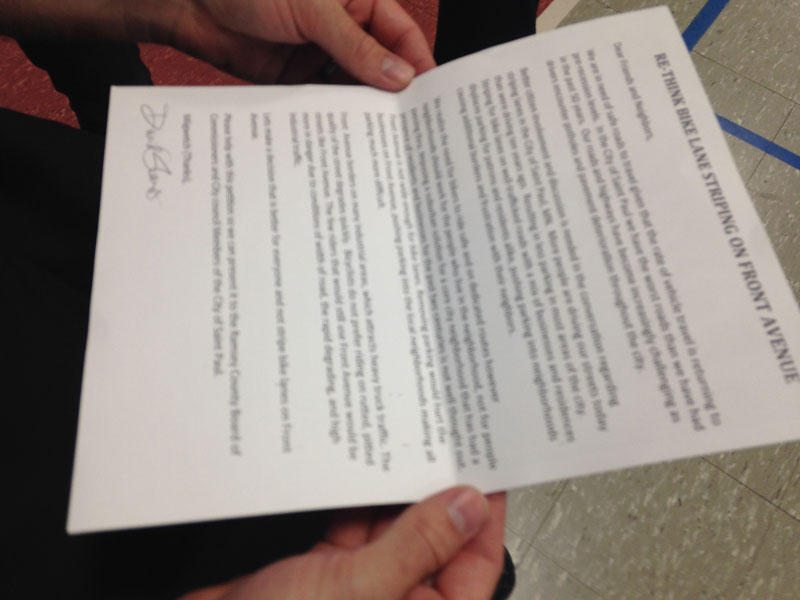
It turned out to be a highly unpleasant experience because I'd biked there. As it happened, I walked in just as anti-bicycling City Council Candidate (and failed restauranteur) David Glass's organizer had just gone through the place handing out  misleading fliers about the proposed bike lane for Front.

[You can see the full text at the bottom.]

I ended up having to sit there drinking my Summit while five or six old guys ranted at me about bikes. Other than muttering, "I'm just trying to get around," I didn't really argue with them.

Here are some verbatim quotes:

No more bikes! No more bikes! [Chanted]

The problem is they don't pay taxes on the road, they think they own the road...

Not on a busy street, they get enough trails.

You know how we got around in the 60s 70s? We didn't even wear the fucking faggot ass bike helmets.

I hear you, I love that, it's great and it's so green, but there's so many trails now. They mess up traffic. We pay enough city taxes. Are you guys paying taxes? Get a license and pay taxes on it, but they don't. Get a bike license, if you're on my trail and have a license, get tagged.

Saint Paul's trying to go biking-cars-no street parking. That's bullshit. you can't mess up people's parking.

That's crazy. I'm not totally against it, if they do do it that way, then you got to get a bike license on it

The problem is this road, people use this damn near like a highway.

We used to be able to play baseball down here in the middle of the street, but now there are so many people it's just overpopulated.

This is a throughway now. Maybe tear the sidewalks out and make it wider.

A lot of trucks, this is a throughway.

[Front of the Glass flier.]
I have thick skin, and I don't necessarily disagree everything these guys were muttering. Cars and trucks drive too fast, which is a good reason for bike lanes. I don't wear a helmet most of time, because I think bicycling should be safe for anyone. I'd love to see equity in taxing and spending, though they've got it totally backwards.

And I've been through a lot of public testimony during public meetings at The Planning Commission about all kinds of things, from St Thomas student malfeasance to traffic to taxes. I once listened to five-minute rant by a twelve-year-old about traffic and the war on cars, and I did it with a straight face.

Not only that, but I love dive bars and often get into conversations with grumpy old men about bicycles. They usually think I'm crazy. I've even joked with the guy who owns The Gopher Bar about parking my bike, and if he's not a raging asshole, than I don't know who is.

Ramsey County's last minute half-assed public process (which I wrote about today on streets.mn) seems designed to inflame disputes. It amounts to a kangaroo court, and that's irresponsiblity on an almost Lake Elmo scale.

Misinformation that turns bike lanes or other safety improvements into divisive politics has poor consequences. And there are a lot of facts and examples that can provide actual data to help with shape conversations. For example, the city actually counted the parked cars on Front Avenue before recommending putting in the bike lane.


[Dead people not parking on Front Avenue.]

Inciting Violence against Bicyclists

[Strib story.]
In just the last week or so, there have been at least two attacks against bicyclists that have crossed over my desk. In the first, a guy driving a White Ford Bronco threw concrete at a few random bicyclists in South Minneapolis, seriously injuring at least one of them:
About 5:30 p.m. Friday, he said, two people were struck with cement-type material “within seconds of each other” near W. 41st Street and Bryant Avenue S. One person had minor injuries, but the second, identified on a GoFundMe page as Mackenzie Jensen, was struck in the face and suffered multiple facial fractures that will require two surgeries.
His jaw has been wired shut and he is expected to lose multiple weeks of work, the web page states.

Via Facebook, here's another story from a woman who was biking on Saint Paul's East Side:
August 10 at 9:04pm

Another heads up. Last week on my commute home some punks tried to knock me off my bike on Edgerton at 6:30 pm. I couldn't get their plates. they were going too fast. Be safe ladies. Focus and have your eyes and ears on guard. 🚴💚... some boys came up behind me on Edgerton, going really fast and close. The boy on the passenger side was out of the window to his waste and he swung@ me but missed. I tried to catch them and came within a block 6 blocks later. Never got plates. Punks.

Those are just two stories from this week. It's dangerous enough riding bikes around the Twin Cities, having to worry about cars accidentally running you over. Having to worry that drivers might intentionally try to hurt you is something I thought we'd left behind us.

The way that Ramsey County is handling this situation does nothing but inflames animosity to people riding bicycles, and makes what should be a simple safety improvement into a culture war. I'd expect this kind of thing from someone like Joe Soucheray. But for elected officials like Janice Rettman, I have higher standards.


[Commissioner Rettman pacing around in front of the Western Avenue bike lane meeting for some reason.]

[David Glass flier below.]

Re-Think Bike Lane Striping on Front Avenue
[A dumbfounded bicyclist reading the flier.]
Dear Friends and Neighbors,

We are in need of safe roads to travel given that the rate of vehicle travel is returning to pre-recession levels. In the city of Saint Paul we have the worst roads that we have had in the past 50 years. [sic] Our roads and highways have become increasingly challenging as drivers encounter potholes and pavement deterioration throughout the city.

Better citizen involved and discussion is needed in the conversation regarding striping lanes in the City of Saint Paul, MN. More people are driving our streets today than were driving ten years ago. Resulting in less parking in most areas of the city. Striping for bike lanes on well-trafficked roads with a mix of businesses and residences displaces parking for patrons and residents alike pushing parking into neighborhoods causing additional burdens and frustration with their neighbors.

We realize the need for bikers to ride safe and on dedicated routes however neighborhoods should work for the people who live in the neighborhood, not for people passing thru. Imposing a suburban solution for a core city neighborhood that has had a presence of residents and businesses for the past two centuries is not well thought out. Front Avenue is not wide enough for bike lanes. Removing parking would hurt the businesses on Front Avenue, pushing parking int o the local neighborhoods making all parking much more difficult.

Front Avenue borders on many industrial areas, which attracts heavy truck traffic. The quality of the street degrades quickly. Bicyclists do not prefer riding on rutted, pitted streets like Front Avenue. The few riders that would still use Front Avenue would be more in danger due to conditions of width of road, the rapid degrading, and high industrial traffic.

Lets make a decision that is better for everyone and not stripe bike lanes on Front Avenue.

Miigwetch (Thanks),
David Glass

2013-11-06

Minneapolis City Hall Becoming Much Younger

[Here I offer the unusual caveats about Ranked Choice Voting and how we don't really know who is going to win the close races in Wards 5, 9, and 13. Consider it stated.]

That said, it's worth pointing out the average age of City Hall has gone down quite a bit this week. We've replaced older people with far younger people, moving the average age of our city officials down over a decade, from 53 54 to 42.

That might not seem like much, but given the window of opportunity for public service, this is quite a big deal. (To elect someone under the age of Andrew Johnson, for example, is very rare.)

FYI, the average age in Minneapolis is 33.7.

Age isn't everything, of course, any many of the incumbents are "young at heart." But sometimes age is important. As everyone who has ever had parents knows, there are big generational differences about the importance of computers, cars, "quality of life", etc. It'll be interesting to see how and if Minneapolis starts to "act younger" with its decision-making as the new council takes the reins.

[h/t Ben Olson for the pic.]

Correction: R.T. ("ReTweet") Rybak's true age is 57, not 48.

2013-05-13

Sidewalk Poetry #36

Hunt Walking


If you could be there
with the rest, coming out

of Vernondale's store
carrying bags

in late spring, and if,
looking far down the road

where the white houses waver
in heat, you could see

for the first time
since winter, old Hunt,

the crippled man, walking
by not quite falling

down first on one side,
then on the other

holding aloft the bony
wing of his cane,

you would understand why
they have stopped

on the porch by the sign
that says Yes We Are Open,

without knowing
where they are

going, or what it is
they hold in their hands.


[Sidewalk in Portsmouth, NH.]

2012-11-12

TCS Interviews George and Betty, Members of the Saint Paul Hiking Club, as they Re-dedicate a Plaque in Honor of a Veteran


 [The plaque in question.]


INTERVIEW V

[Late afternoon. Late Spring. TWIN CITY SIDEWALKS (TCS) calmly, cooly, walks toward a large glass greenhouse in a large city park in the warm sunshine. He approaches a group of mostly older people, slowly gathering together, singly and in groups of two. They are the SAINT PAUL HIKING CLUB, and as each member arrives, they are greeted with the smallest hugs. They gather together to talk in quiet voices.

After a few minutes, the group walks through a pair of glass doors and into the low brown building. They walk, with purpose, through another pair of doors and back outside, into a small zoo. Monkeys sit in a tree nearby.


The group approaches a tree and stops to stare at the ground. Next to the tree, by the guardrailing, is a white marble plaque that reads:

    In memory of
    PFC CHARLES MARVIN HUHLMAN
    Born September 11, 1918
Killed in Action, Czechoslovakia, April 25, 1945
Erected in Saint Paul Municipal Hiking Club, 1948.

An older man, in his mid 80s, GEORGE HUNKINS, holds a clip board. He turns to the plaque, places his shoe up on the railing, and begins to talk. The group gathers around, squinting in the sunshine.]

George Hunkins: [Quickly, in reedy clipped voice.] He was marine, graduated Johnson High School in 1937. HE wasn’t sent overseas until early 1945. You can see he was a PFC. The only thing lower is a buck private, you know.  He was kind of a medic attending to the thing, and I imagine that the German that shot him, I imagine he must have known that the war was going down, that the Nazis and them Germans didn’t have much left. But anyway, he was gunned down by this sniper.

And perhaps about when the word got back form his parents two or three weeks later, they probably contacted the Saint Paul Hiking Club. I think the club probably had twice as many members at that time, and I would guess they were much younger. I would guess that probably two-thirds of the men were in the military. And they decided then about the 1st Sunday in June of ‘48, they had a remembrance and they dedicated this bench. His parents came out, and the bench originally was in Mounds Park. I don’t know how long but they do know that some people that didn’t care about it, and did some damage to it.

The city decided then, you see, the Saint Paul Hiking Club. The Hiking Club was started then in 1921 and the reason it got started… Minneapolis had a club. Back in those days, there was great rivalry between Minneapolis and Saint Paul. So the Saint Paul people said, Minneapolis has a club? We gotta have a club.

So that’s how it started. Those of you that know, the presidents of this club. They know at my post because it got passed down from president to president. They don’t know much more than that, because they never had a historian. In fact, Harold Hawkinson kind of declared himself the historian.
My thing, being one of the youngest in world war two. And people say, thank you for serving, and I saw, I was no doggone hero. I was in the great lakes about six weeks when I heard a superbomb was dropped. So.

Then of course I have been active in there, and decided to wear this. I spent eighteen nineteen years out at Fort Snelling on the Thursday squad remembering all the veterans who served and got buried there.

It’s just my feeling that we should remember.

[GEORGE explains something about the united church of Christ on Saint Paul's Summit Avenue.]

George Hunkins: I went there. They have a lot of information about him. They give it you know, most of you probably know up until about thirty forty years ago, belonging to a church or a religious organization was pretty important. The last thirty years, it isn’t. I’ve noticed out at Fort Snelling, I’d say maybe thirty-five forty-five percent come out there, no clergy. That tells you they don’t belong to a religious organization. And sometimes you know, they don’t even hardly have a prayer in memory of their deceased one.

So that’s the background, and like I said, I could say a few other things but they’re not in my craw right now. We’ve had about 2 remembrances here, and we’ve had a couple out at Fort Snelling. He’s interred there and his parents elected to bring his remains back. I’m sure that day was January 6th, 1949. In fact, just the memory if you read the sports section this morning, you notice that the athletic director, Normam Taig, he made mention, said he was with his father. We just visited Normandy. Omaha beach. I cannot imagine what happened that day. Everybody remembers it. June 6th,1944. Plenty of blood and people there and of course, in fact, one of our members incidentally, two of our members are Gold Star. My wife. Gold Star sisters. and Pat Tiller, she’s a Gold Star sister.
We had another lady who was active in the club. She hasn’t hiked for probably 10 years. Her name was Lenore.

[A WOMAN WITH A FAMILY approaches the group, and begins to push its way through the assembled cluster.]

Woman with a family: [Pushing a stroller, annoyed.] Excuse us. Excuse us. 

George Hunkins: [Unflapped.] Her parents, she was raised in Winona, I know, but she visited her brother who was buried there in France. And she got paid by the government because the government had a program that next of kin could visit there. And her parents didn’t care to go, but she was happy to go. So that’s another thing. Lenore’s brother, she was a gold star sister.

[A pause. Members of the SAINT PAUL HIKING CLUB look at the roots of the tree.]

George Hunkins: [Semi-wistfully.] I’m soon 85 and who knows you know, who knows about the rest of my life. I’d bet come 2021, we’ll have a big celebration. But it’d be nice to carry on this honor and keep this club going from time to time. You know how the people coming back from Afghanistan and Iraq, how they make it. GI’s in the Second World War, they were coming back by droves. I just saw the other day, sixteen million people served in the Second World War. Our country, about 290,000 sacrificed in the  Second World War. They used to say that a couple years ago about a thousand, mostly men, were dying every day. I just saw in the paper a few weeks ago. this year they envision that 250, 000 World War Two people will depart this life.

Just a moment of silence here.

[A brief second passes. Nearby, a LOUDSPEAKER mounted on a pole makes a beeping noise and begins to bray.]

Loudspeaker: Attention Como Visitors, your attention please. The time is now 5:56. At precisely 6:00, the Como Park Zoo and the Margorie McNeely Conservatory will close for the day. This includes all buildings, grounds, the café, and gardens. Please make your way to the exits now. Thank you for joining us at the Como Park Zoo and Conservatory today.

George Hunkins: [Continuing despite the LOUDSPEAKER] We gather here for Charles Marvin, he laid down his life. For all those that sacrificed their life, may they be in eternal rest. Amen.

[Silently, the SAINT PAUL HIKING CLUB turns toward the exit, walks through the building, and leaves the zoo.]


ACT ONE SCENE TWO

[Outside. In the Parking lot. The groups huddles together at the edge of the sidewalk, chatting excitedly. BETTY CONNELLY, an older woman, gets out a box filled with sugar cookies. She looks around at the others, unsure where to go.]

TCS: I’m doing a story about the hiking club for my website. Do you have time for a few questions?

Betty Connelly: As long as we can do it while walking.

TCS: Of course. It’s a hiking club. Just tell me your name then.

Betty Connelly: Betty Connelly.

TCS: What kind of stuff do you guys do?

Betty Connelly:  It depends on where we walk, depends on who leads the hike. There are people who have been here longer. Maybe about five years that I’ve been a member. Whoever leads the hike decides where we’re going to hike. Oftentimes it’s in the East Metro, but not always. It can be occasionally in Minneapolis or that area. I remember the furthest away that I went was Hastings. Somebody had… that was a neat one because of the views there, and I’m a reluctant leader. I’ve led one each of the last two years. [She laughs.] But it’s on Sundays, it’s roughly about 5 miles, though I think last time it was about 6 miles. And on Tuesdays it’s supposed to be about 3 miles and about an hour hike. And every so often usually they designate a place to meet to eat afterwards.

This is kind of unusual to do the eating before we hike. And so, pot luck. Lot of times it’s a restaurant afterwards. And I would say, at least on the Sunday hikes, there’s some people who show up virtually for every hike. A good Sunday there will be about 25 people, sometimes more. Sometimes less. And I don’t know the exact membership, I know its way beyond that. It might not be a hundred people, but it’s approaching that.

[GEORGE approaches BETTY and gives her directions to the picnic table. He offers her a ride in his car, and she accepts. Nearby, the SAINT PAUL HIKING CLUB gathers around the picnic table, laden with Tupperware, and eats delicious sandwiches made from white bread.]