2014-06-26

Signs of the Times #88

POST
N[access]
BIL[box]S

[Wall. Downtown, Minneapolis.]


7-4-14
til
da
WORLD
BLOW

[Sidewalk. Downtown, Saint Paul.]


This newsbox is no longer owned
by the ONION.

[Crappy plastic newsbox. Milwaukee, WI.]


NO
SKATEBOARDING
AND
ROLLERBLADING

[Pole. Milwaukee, WI.]

DANGER
Pedestrians
<------ p="">

[Orange plastic thing. Milwaukee, WI.]


F
R
O
N
T

[Window. Milwaukee, WI.]

Northwestern Mutual,
as owner of these premises,
prohibits carrying
firearms or other weapons 
beyond this point.

[Wall. Milwaukee, WI.]

"TO THIS GAME YOU STAY A SLAVE"

[Truck. Milwaukee, WI.]

TCSidewalks Live!: Bowling Alley Bike Tour Tonight

Your friendly reminder to bike along to five (5) bowling alleys of the Twin Cities this evening, and learn all about the state of the lanes today.

NOTE: We will NOT be bowling.

Today looks like a lovely day for a bike ride.

[Facebook invite here.]
Bike trip to five (5) bowling alleys in Minneapolis and Saint Paul. We won't be bowling at any of them, just looking at them all and learning about their history.

When: starts at 6:30.
Total distance: less than twenty (20) miles.
Cost: free, donation optional.
Ending: Leave at any time, but the final alley is in Northeast Minneapolis.

PS. You can take the Green Line to Midway Pro Bowl!

[The best bowling story wins this TCSidewalks commissioned Bowling Tour trophy!] 


Reading the Highland Villager Op-Ed Extra #6

Our newest sport: Pothole slaloming
By Tom Goldstein

No matter where you travel in St. Paul, there’s no escaping the potholes. The official tart of summer is just around the corner, and the deplorable road conditions that plagued us thorough the winter and spring show scant signs of improvement.

As might be expected, the condition of St. Paul’s streets has generated lots of angry calls to the Mayor’s Office and City Council. Most taxpayers have little patience for tired excuses about the harsh winter we just endured when they know the real culprit is years of failing to maintain the streets while the mayor focused on flashy downtown projects like the new Saints ballpark and the Penfield.

What many St. Paulites fail to appreciate is that the apparent neglect of our streets is really part of a wickedly brilliant plan concocted by the mayor over the past six years that is only now beginning to bear fruit. Think about it: Did anybody every describe St. Paul as the “most livable city in America” before the mayor diverted $350,000 from the Parks and Recreation Department’s budget to build the city’s firsts refrigerated outdoor ice rinks back in 2007? Heck no! And who can deny the energy and excitement generated by the Crashed Ice event that sends skaters hurtling down death defying ramps every winter while the rest of us look on?

Well, thanks to the mayor’s genius, we’re no longer relegated to the status of mere spectators. After a glorious winter in which every trip to the store involved a thrilling slide along iced-over streets, who among us wants to return to the days when getting in your car meant just one more boring trip where nothing exciting every happened? Not me. I’d go crazy [too late] if I had to endure another Minnesota winter where I couldn’t take my life into my hands every time I slid behind the wheel.

Even better, with pothole slaloming – St. Paul’s unofficial new sport – no longer just a spring pastime, anybody with the courage to put the pedal to the metal on our city streets can enjoy a jaw-rattling adventure year around. Even bike enthusiast can get in on the action.

But addition recreational opportunities such as these are only part of Coleman’s plan. In the same way that competitive youth sports have proven to be a boon for orthopedic surgeons, pothole slaloming is generating a surge in business for auto and bike repair shops for new shock absorbers, wheel alignments, and tire replacements. These repair services are sure to jump-start the local economy. Job growth in St. Paul during the mayor’s time in office may have been stagnant, but just wait. But next winter all of that is bound to change.

And this is just the start of what’s to come. Last month, Gil Penalosa, executive director of the Tronto-based 8-80 Cities program, was in town to discuss “placemaking” – the art of transforming cities in to urban oases by promoting amenities such as transit, parks, biking and walkable streets that benefit everyone from kids to seniors. As part of his presentation, Penalsaoa talked about how the public’s fixation on potholes underscores the excessive resources we devoted to roadways rather than the urban amenities most city-dwellers prefer.

To no one’s surprise, the mayor championed Penalosa’s work. [He did?] And while Coleman didn’t explicitly reveal how the city’s disinvestment in city streets perfectly aligned with the goals Penalosa outlined, the proof is in the pudding: As city streets continue to deteriorate, driving as a means of transportation will all but disappear, and pothole-slalom devotees will flock to St. Paul, transforming our culture the same way that snowboarding created an entire new industry. And before we know it, the Green Line – as well as the many streetcar routes that are sure to follow – will be transporting so many riders that road maintenance can be abandoned.

Unfortunately, by the time all of this comes to pass, the only occasion we’ll have to see our former mayor is when he comes to town aboard Air Force One. After all, who better to lead the country than a visionary like Chris Coleman, who discovered, long before any of us, that the only way forward in America is by neglecting basic needs in favor of more important things?

Tom Goldstein is a lawyer and former St. Paul School Board member. He lives in the Hamline-Midway neighborhood.

2014-06-25

Why 'Sidewalk Closed' Signs?

["Pay Attention to this Sign!"]
Since I started this blog in 2005, I've taken pictures of a great many things: detritus, idiosyncratic signage, shop windows, doorways, lampposts, temporarily abandoned dogs...

There are also lots of sidewalk pictures that don't make it: interesting buildings, random sunsets, etc. For a photos to graduate to an actual blog category, there are two basic requirements.

First, the object, infrastructure, or situation has to grab the eye. The truly mundane -- think of doorknobs or gutters -- is not visually interesting enough to merit photographic documentation.

Second, that visual thing has to reveal something about how infrastructure affects our daily lives. Our built environment typically sits in the background. All around us things are silently "doing work" from the corners of our eyes. What happens when we look?

Oddly enough, once I acquired a dgitibal camera, one of the first things I began taking pictures of were 'sidewalk closed' signs. Why 'sidewalk closed' signs?

It all began with this photo, taken in 2006 near Hamline University in Saint Paul:

[The original 'sidewalk closed' sign.]

I remember like it was only yesterday when I happened on this scene. It seemed to sum up so much about our city streets and daily life.

There was one simple reason...

Everyone Ignores These Signs

[They also tend to ironically block the sidewalk even when not used.]
There is little on this earth more functionally useless than a 'sidewalk closed' sign. A fence? Now that's useful. Concrete barriers are semi-useful.

These signs? They make a mockery of signs.

If "freedom" is the degree to which people are able to overcome their environmental obstacles, pedestrians are by far the most liberated mode of travel. In a car, one little orange barrel can keep you from your destination. On a bike, a well-placed set of stairs might force you to dismount.

On foot, it takes one hell of a fence to stop you from walking where you want to walk. Hence desire paths, razor wire, parkour.

Almost everywhere that 'sidewalk closed' signs exist, people ignore them. They walk around. They walk in the street. They push the sign to the side.

For the most part, people walk where they want to walk. People walk where they feel safe, and along the most direct path they can find. Unless you're German, no amount of signage will stop you if you think it's the best way.


[The only conceivable purpose of these signs is to provide liability relief.]

Abstract v. Lived Space

The difference between expected theoretical behavior of people and actual real world behavior of people is akin to what urban theorists call "abstract vs. lived space." The concept comes loosely from French sociologist Henri Lefebvre (also quoted in my recent Minnpost column).

Basically, abstract space describes the theoretical spatial relations between people, buildings, technology, etc. Abstract space is how we think of things operating in maps, models, and stories we tell about ourselves. Typically these stories are relatively simple, "rational", efficient, hierarchical. Think of the rules the rules of a highway: keep right unless passing, zipper merge, don't speed, etc. That is abstract space.

Lived space on the other hand is what actually happens in the real world. Lived space encompasses the everyday resistances of actual behavior, the various ways that buildings or people or technologies escape their stated intentions. In lived space, people speed. Buildings fall apart. Pavement cracks. Machines stop working. The world fills with conversations and daydreams.

In this example, the 'sidewalk closed' sign perfectly illustrates the difference between these two conceptions of space. In theory, all pedestrians obey all signs. If the "sidewalk is closed" for whatever reason, people cross the street and continue on their way using the adjacent sidewalk.

In the lived space of the real world, people are tired when they walk, can see the sidewalk right in front of them, don't want to cross the street, and can easily step around the meaningless sign.

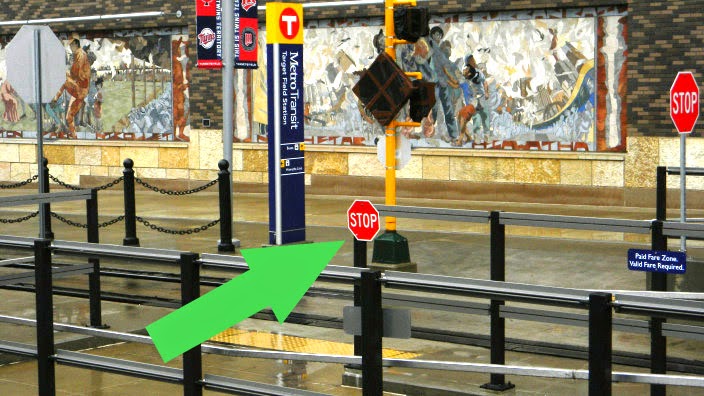
[A stop sign on the transitway that most people will ignore.]

[A "pedestrian stop sign" that most people will ignore.]

And This is Why We Must Walk

As designers, we ignore lived space at our peril. I often see design approaches that seem to dwell completely in abstract space, where the actual behavior of people seems irrelevant to the stated goals of an urban situation. This might be bike racks, architecture, street design, or whatever.

Almost always in these cases, "desire paths" form around the poor design. People vote with their feet. If you design a space or situation contrary to the actual behavior of most people, you'll find yourself ignored.

And this is why engineers, architects, decision makers, and planners must actually use the things they are building. If you don't take the bus on a regular basis, you probably have no idea how the bus is used. You don't see how people sit, interact with each other, use the payment devices, or negotiate the bus shelters. You can't do a good job designing or planning a bus system unless you actually use it.

The same is true for sidewalks, crosswalks, bumpouts, and pedestrian signals. Unless you actually walk around regularly (not just once), you won't understand how people walk and use streets in workaday lived space. And you'll end up designing things that are completely ignored... like 'sidewalk closed' signs.


http://tcsidewalks.blogspot.com/2013/05/donate-to-this-sidewalk-blogger.html

Sidewalk Closed Signs #6

 [Lowertown, Saint Paul.]

[Downtown, Minneapolis.]


[Milwaukee, WI.]

[Milwaukee, WI.]


 [Milwaukee, WI.]

[Milwaukee, WI.]


[Milwaukee, WI.]


[Milwaukee, WI.]